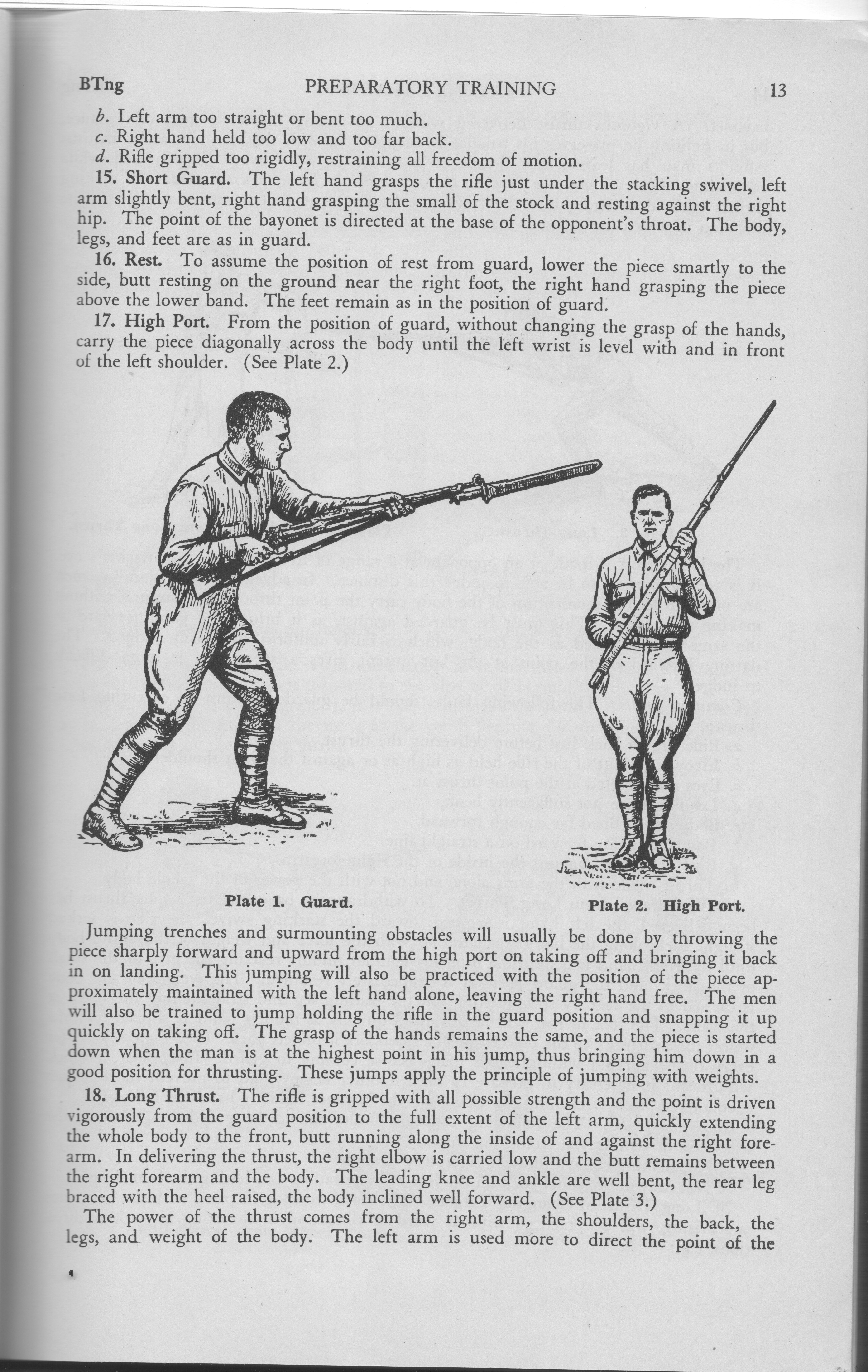
An illustration from Carl’s WW II infantry textbook.
Carl R. Bonde, Jr.’s high school sophomore year. November 2, 1940.
His parents had recently moved for the third time, this time to five acres on the southern edge of town. For the first time, they were buying the property. On a hill.
Carl turned over in bed after peering at his alarm clock. Eleven-fourteen. Bull! He had forgotten to wind it. Again. Carl had a pretty good idea of the time. He had heard his older sister Carol clumping downstairs in her fashionable shoes. Jesus it was cold! The weather was freezing and their bedrooms was upstairs, unheated except for whatever came up the long straight stairs. The house had a homemade wood furnace in the basement that heated the air that came up the register in the living room. Smelled like pine smoke.
He pulled his head further under the covers. He could see his breath in the dim light of dawn. The windows were translucent with frost. Carol will take at least half an hour in the bathroom, he thought. He had to pee. Other mornings he would go downstairs, run out the kitchen door and take a leak against one of the trees. It was too damn cold. He used the “can o’ pee” option.
Carl pulled the coffee can from under the bed, got up, did his business, jumped back under the covers. Just a little piss on his underwear. Didn’t matter what he did after he peed, some urine always dribbled out.
Anyhow, he got almost warm again after thrashing his legs back and forth a couple of times. He didn’t get quite as warm as he wanted, so he got up, pulling on a couple of layers of clothes. Long handles, then denim pants lined with flannel. Socks.
His parents were up and his mom had fixed oatmeal. He wanted a cigarette, so he hunkered over the heat close to where his dad sat in his overstuffed chair and lit up. He loved talking about hunting with his dad. They would certainly go out next weekend. The light snow made stalking deer easy.
Carl’s sexual preference was ambiguous. One of those who signed his year book was a boy who wrote, “Dearest Carl.” Another advised him to “Leave the wimmin alone.” For the sake of more fun, we can suppose he was gay. I asked Carl’s friend, Bill Moomey, if Carl had a sweetheart somewhere but apparently he didn’t. Bill just said, nope. Bill told me about a gay sailor he encountered on the USS George Washington in November, 1944. Bill said at that time, it was his first exposure to an openly homosexual man. That tends to rule out that Bud, who he had known intimately through nearly a year of rigorous outdoor infantry training, was gay.
Carl had a propensity for clowning, disrupting, the usual stuff of high school boys. Carl was also very bright. He would later score near genius on an Army aptitude test.
Carl walked to high school down to the dirt road, then four blocks more. He was on time, as usual, but he wasn’t much concerned. He knew that his sisters had been high achievers in high school. Band, orchestra, excellent grades, after school jobs. Buddy had no time for that. He liked to hunt and fish. He was applying to work as a fire lookout in Glacier Park.

November 1, 2015
Words are the pie crust of story. They must be spare, delicious, and flaky. Almost not there, yet it holds the fruit in its arms. Thanks to the writers in Russell Rowland’s writers workshop. We meet tomorrow.
I am chronically depressed, so I am anxious. About things in general, and about particulars. My anxiety gives me more opportunities for courage than most. I have halitosis. My brother used to tell me how ugly I was until I believed him. My teeth and ears are damned large.
That is the good news. Now, the bad news. I am in trouble. I feel love. I am not at liberty to say with whom. Please let me digress here. I have to express something grammatical.
Today I learned about the use of the word “whom.” It follows a preposition. A fellow choir singer said that a preposition is any word that can describe a cat in relation to a fence. My fellow choir member’s name is Tahani. She is a beautiful soprano. Now I know when to use the word “whom.” It follows a preposition.
Please let me digress a second time. Let’s see. Love. Trouble. Liberty. Digress. Cat. Fence. Soprano.
Pie crust. The trouble is one must mix it, just enough. Then roll it out thin. Once. Just one strike. Then you are out! OUT!
I love my writers workshop. Each of us has a compelling tale to tell. One in particular, named Rhonda, thoughtfully edited my offering and improved it. I think I am in love. I am thinking of paying her to edit more of my work so that it may see print at last.
My breath stinks. No. Really. I am tired of people telling me that self-deprecation is boring. No. It is true. We are getting old, actually getting more the same as we ever were. I think as we grow wiser, older, we become gentler and kinder and more patient with other people. However, our bodies betray us. Our bodies smell, leak, sag, flop, fart, droop and ache. But hey! We are still alive!
How depressing. I am anxious about being able to tell my story. I am in trouble. Will I be forgiven? What if I feel love? What if I never confess? What if I do confess? Will people hate me for it? Anxiety gives me more opportunities for courage than most.
Now. Do you know when to use the word “whom?”

Watching Donald Duck.
October 29, 2015
I’m about to make a pair of pumpkin pies. First, pour myself a glass of wine. I chose a pinot noir to pair with me, sitting around thinking about making a pie. Actually I’m on my second, no third glass. This wine has been exquisite, considering it was just $5.99 at Good Earth Market, our local co-op. My critics have a list of chores for me this evening. Things like “make popcorn” and “play Donald Duck on the computer.” The one critic is Jackson Bruner, age four. He did a good job of eating his supper: his favorite these days, beans and rice. I think some cheese helped the palate.
I have to sign off. Pies beckon. Jackson beckons. My dear spouse treads on my feet. I’ve gotta go.

Tom Struckman, about 1964, with nephews Chris and Chuck Angel in Dillon, Montana.
October 25, 2015
In 1952 my brother Tom had a batman costume, that is, a headgear/mask made of blue material with pointed ears, along with a cape and blue pants. I don’t know where he got these, but they were upstairs in his (forbidden) room. Of course, I tried them on. I could only imagine the play he had with his friends, probably the Browders. Little Tommy Browder was about the same age as Tom. Tom was “Big Tommy.” Little Tommy in the 1970s changed his name to Sebastian and married Dolly. Dolly Browder was the midwife who delivered my grandson, Roland, just 6 years ago.
Jimmy Browder was a bit younger than I. When he was maybe 6 years old, he had to go about on crutches because something was wrong with his knees. I saw him walking, running, on his bad leg, knee and all. A snap for him, even with the crutches.
Jimmy eventually became a Missoula County Sheriff Deputy and in 1981 I saw his picture in the Missoulian as he carried off the body of my school classmate, Bruce Stoverud, after he crashed his hang-glider in the Hellgate Canyon in June after a sudden thunderstorm caused him to wing-over and die. I heard that Bruce’s mother was devastated, lost her mind, was hopelessly grief-stricken, and died a miserable person. Like that.
My brother Tom had a batman costume, but he helped me fix up an Indian breech cloth. He took a pillowcase that we colored with crayons and looped it through my underpants so that it hung outside front and back. Then we took up bows and arrows. I don’t know where it went after that. Can’t remember. I imagine we dashed in and out of the house, then around the yard a few times, whooping, shrieking.
The world I inherited was one of decay and echoing of good times just past. The ice skates were worn out. The seams down the back of the shoe were separated, the threads torn. The toy cap gun was broken, and my parents were not buying any replacements. In good shape, though, were the miniature figures: the soldiers, the knights. The army men came in just a few models. The grenade throwers had this plastic look of terror. Actually we had some pretty good army men, made of flexible stuff, like rubber. Some of the shooters were prone, some firing from the off hand position.
Later I learned that the standing position of firing was called “off hand” when I went through Marine Corps basic training. I was not happy when I learned that. My will to live was pretty much gone by then. Back to the shooting: such a position is notoriously unreliable. We learned that our bodies’ heartbeats would make the front sight weave a figure eight, so our strategy was to time the weaving so that when we squeezed the trigger the sight would pass the bulls eye. It worked part of the time and I qualified as a Marine marksman.
I think the batman costume, the skates, the cap gun and a bunch of other costume-stuff was in a drawer in the hallway opposite our kitchen where I grew up, at 334 North Avenue West, Missoula. Oh yes. Mittens, too. Socks, hats, plastic belts. None of these things could impress my friends who had better cowboy gear than I had. However, none of them had any batman accouterments, either, because they didn’t have a brother who was a genius like I did. I always had that ace card. That was my brother Tom. And his things.
I boasted about his things, but if he caught me with any of them he would beat me up. Getting beat up wasn’t the worst thing. It generally meant that he would knock me down onto the ground and punch me in the arms. And curse at me. It really didn’t hurt. It was always worth while to steal my brother’s things. His cool things.
He had elaborate model airplanes, some of them made with tissue and balsa. A phonograph with many classical records. Mozart, Bach, Brahms, Haydn. A Persian rug. A model train set. A book he made about his family’s travels around the southwestern United States. Cub Scout stuff, especially rubber molds for plaster of paris. A pirate plaque he made of copper. No end of cool stuff. A couple of rifles. One of them was my grandfather’s 30-30, the other a Winchester .22 single shot. Of course I played with both of these for hours. Tom had a yellow desk with a cigar box in the drawer with many “I Like Ike” buttons and 12 deeds, each for a square inch of land in the Yukon. Tom said someone could mail the deeds in and receive the land in a burlap bag that someone would shovel in. There was a slip of paper that he wagered with someone that the “Dean Machine” would ultimately be found to be a fake. I think he won that bet.

Fine old dog we rode horses with last summer.
Annabelle is an old gray dog. I was down in the basement a couple days ago, looking out a window, and I saw her nosing around on our side of that ridiculous little fence her owner built. I waited for her to squat and squeeze one out, but she didn’t perform then. Not then. She did sniff around my window and I was livid. No. I was hopeful. I wanted to catch this miscreant in the act. Mustn’t overstate my feelings.
The fence. For some reason our neighbor wanted to erect a fence between our properties. I was good with that. I found a surveyor’s stake. A pipe, really, about a foot in from the sidewalk. I measured, sure enough. Fifty feet from the other side of our driveway. Houses in Billings are mostly built on two 25-foot lots. Ours is on lots 7 & 8. A long time ago I watched my old neighbor, Don, digging around the edge of his yard with a shovel. He showed me the pipe that marked the edge of his property. That’s how I knew to look for the pipe. I found it by measuring 50 feet with a tape, then probing around with the big screwdriver. Yes, “clink,” I found it. Then I dug and put a spike into the pipe’s orifice. My neighbor used the spike to start her ridiculous little metal fence. Looks like a lacy metal fence, only kind of small. Perhaps two feet tall. It would keep Annabelle in, only the fence peters out after about 30 feet in each direction. That allows the little bugger to come and relieve herself. If indeed, she does. I have no proof, only deep, dark suspicions.
In the back we have a wooden fence I built perhaps 25 years ago, that has stood the test of many inhabitants of the house next door. My wife, God bless her, said we’ve had about five different neighbors over the years. The first one to rebel against the established order was the woman who owns “Annabelle,” the sausage dog.
To be clear, I have no interest in the woman next door, although she did put a hot tub behind her garage, next to our fence. On our side of the fence we have a tree house that I built many years ago for our grandchildren. About a week after she put in the hot tub, I happened to be up in the tree house inspecting the floor boards. I heard her say, “hello, neighbor!” How mortified I was! I didn’t look at her, but I suspect she was partially nude!

A mourning dove, symbol of peace.
A woman wanted to do something about the annoying doves that cooed behind her house. She bought a wrist rocket slingshot and some malted milk balls, then went to her backyard to hit the birds that were making her miserable. Oh, she was wrong, of course. She would always be miserable. And angry. But still she tried to hit them. Hard. with the malted milk balls.
But try as she might, she couldn’t. The balls were too light, perhaps, and they always curved one way or the other when she shot them. The birds, on the other hand, did not fly away, but sat on the wires making their distinctive sounds.
She gave up at last. The wires were too far above the alley. Even when she pulled the wrist rocket rubbers back as far as she could, she had to shoot the balls in a high trajectory that always veered one way or the other. She ended up pelting her neighbor’s house on the other side of the block.
Perplexed, she went indoors to fix herself a sandwich and to search the internet. She settled on a dual attack. She would scatter sunflower seeds on the ground so that her cat could catch the doves. She would also put bobble-head owl figures on her garage to scare them away.
Her neighbor across the alley who had endured the rain of candy on his roof watched her as she climbed on her garage. He decided that she was spying on him with tiny cameras within the owl figures. After all, why else would this angry old woman be climbing upon her garage where she could look down on his back yard?
Soon our angry person got a visit from a police officer to investigate a complaint about the candy that she had been firing with her sling shot and whether she put secret cameras on her garage to invade her neighbor’s privacy.
The policeman was skeptical when she told him she had been trying to scare away doves. He wondered about her mental health. He asked her if she believed she was a threat to others or herself.
Angrily, she blurted out her fury at the “damned doves.” She said she meant to “kill them.” The policeman misunderstood her. He thought she meant she wanted to kill those opposed to war, sometimes called “doves,” as opposed to “hawks.”
She managed to explain herself to the policeman. Even so, he left her with a citation and a notice to appear in court because she was accused of being a nuisance to her neighbors. Turns out firing a wrist rocket within the city is a misdemeanor.
But the policeman had given her an idea. Back in her house on the internet, she was investigating purchasing a hawk.

Squirrel. Something like the ones at the beginning of this fable.
Two amorous gray squirrels lived behind an angry woman who considered them “vermin.”
No. She considered rabbits vermin. She didn’t speak ill of the squirrels at all. Instead she marveled at their ability to walk on the phone wire in the alley. She pretty much left the squirrels alone.
She would have left the rabbits alone too, except she found one hiding in her rose garden, right by the driveway where she was about to get into the car. The angry woman cursed the rabbit. “Get outta here, you asshole,” she said. The rabbit only crouched lower among the rose bushes.
Looking about her to see if any neighbors were outdoors and perhaps had heard her curses, she smiled cruelly.
No neighbors were outdoors, but a really old — more than 90 years — lady across the street had been peering through her front window. She was always doing that because she believed that her neighbors plotted against her. She just knew they stalked her.
When the old lady saw the angry woman with her cruel smile glaring at the rabbit she was frightened. The old lady couldn’t see the rabbit, of course. Nor could she hear the angry words. She could see only the woman with the cruel smile, so she telephoned the police.
The police were greatly amused, of course, when they heard about the old lady’s neighbor with a “cruel smile.” They even joked about it and told their families when they got home.
However, they had to investigate, so they took the allegation of stalking seriously and drove by the house where the rabbit had crouched in the rose bush garden.
By then the angry woman had driven off and the rabbit had hopped into someone else’s yard. The police promised to keep an eye on the house where the angry woman lived.
Moral: an aggressive attitude against a rabbit can have untoward consequences to the emotional well-being of an elderly neighbor.

Stephen King has me ready to write, but I am still terribly confused about writing. I published some shit the other day and the person I most respect said it was well-written and worthy of publication. I thanked him, of course, and I believe him. But how can I tell if something is good? I am not really looking for accolades. (Well, I don’t mind getting them, shucks! I would just be grateful if I didn’t have to pay someone to read what I’ve written!)
The thing about the muse. Mr. King said the muse is not reliable, is not necessary. I can’t remember if he called his muse an asshole, really, but I sure don’t feel like writing most days. That’s why my famous diary, “Can’t Leave It Alone,” has so many days missing from it.
I checked my own feelings when I came across someone else’s blog. My impulse was to be jealous. How can that loser have so many devoted readers, I thought. Then I drew a breath. A breath of resignation. My own blog has only 10s of readers on its best day! I clicked on his blog, thus adding my number to his already hundreds. Say! It was pretty good! I said so in a comment at the end of his narrative. No, I don’t remember where it was or what it was called.
Now I am off to my writing group. I paid dearly for others to read what I’ve written.

My Uncle’s friend, Bill Moomey, was delighted to see this photo of his platoon sergeant, Irvin Weaver, of the weapons platoon, Company E, 262nd Infantry Regiment, and his friend Carl Bonde.
Daniel Struckman
In Search of Bud
Writing Workshop
10/19/2015
Chapter 1
Bud and me
Private First Class Carl Ralph Bonde Jr, died Christmas Eve, 1944, along with 763 of his fellow American soldiers when a U-boat torpedo sunk the Belgian troop ship, the SS Leopoldville in the English Channel. Bonde, or “Bud,” as his mother and sisters called him, had turned 21 a couple months earlier.
How many times have I tried to say that in order to tell about Bud, my only maternal uncle?
I never even met Bud. It’s hard to say when I first became aware that he ever existed. Could have been something I overheard at my grandparents’ house when they played bridge with my mother and her sisters. In those days the grownups (but not grandma) smoked heavily and drank whiskey when they played bridge. All of these adults, with the possible exception of my grandpa, were college educated and none was overly sentimental. That is, as long as you don’t count being bitterly angry and chronically depressed as being sentimental. They were Norwegians and they did not use euphemisms for death. People died. They did not pass away. Bud’s photograph probably hung on a wall somewhere at our grandparents’ house in Kalispell, but no one told about him unless we young kids asked. Bud’s presence was inextricably part of his parents’ Victorian house. Are you ready for this? It and a garage stood alone on top of a hill on the outskirts of Kalispell, Montana. Like the vampire castle in Transylvania. This is so corny I am ashamed to say it. I have to say that I don’t think the place was considered to be valuable real estate when they bought it. The house was probably 50 years old in the 1940s and the indoor plumbing consisted of one short water line. Now that I think about it, I’m not sure where their water came from. Probably a well. I do remember that the water heater was electric and stood in grandma’s rectangular kitchen on the side near the clothes washer. Once we heard the cat yowling and grandpa stopped the washing machine, opened the door, and gingerly pulled some sopping clothes from the tub. No cat. Somehow, the cat had gotten into the machine enclosure where the motor was. I don’t know why the cat was in there, perhaps grandpa had pulled off a panel and replaced it.
Our grandparents’ attracted all my aunts and cousins each summer. Grandma baked the usual pies and rolls until they were nearly black. Grandpa smoked and spit and puffed through pursed lips. He kept his bottle of whiskey down at the barn. He gave us money. However, the house itself sucked us in because of its rundown majesty and, at the bottom of the hill, its creek—Ashley Creek—and the woods across the bridge. Grandpa had five acres with outbuildings: a root cellar, chicken coop, storage shed (that none of us ever entered), barn and a long skinny garage. I’ll get back to the storage shed and chicken coop later.
The pig wire fence around their acreage had huge fat spiders that would give you the willies whenever you tried to climb over or through. There were places, like near the chicken coop, where the fence had a hole to crawl through and meet a spider. Grandpa and grandma had garter snakes, sometimes hundreds of them dripping off a rock retaining wall. Their place had apple trees that grandpa painted the trunks with whitewash to keep the ants off. Grandpa said the lime was one of the powders he and I would need to make our own wet cement. Otherwise we would need some cement and sand. And water, too. We never made cement.
We cousins played outdoors and indoors and we often found evidence that uncle Bud had been there. There were fishing poles, and lures with treble hooks on shelves above the workbench in the garage. The garage always smelled of gas and oil. It was long and skinny with four windows at the back end, all on the south side, none on the end. The door on the west end was hard to open, so it generally stayed open. (I don’t have to remember the garage so carefully because I found a photograph of it, taken from the vicinity of the barn at the bottom of the hill.)
We cousins figured the adults were hiding something. Of course we were right. Adults are always hiding something. Should I start in telling how I took a tape measure to the interior walls of the Kalispell house to locate the hidden rooms where they kept the corpse?
Otherwise, what happened to Bud? The ceilings were so high, perhaps 10 feet. In the hallway were built in closets and cabinets up close to the ceiling. This house was no bungalow, but a big, square wooden frame house that seemed to center around the wood furnace with gravity flow air heating. When grandpa had the fire going good in the winter the house smelled of pine wood smoke and I could huddle over one of the silent grates with warmth drifting up and play with my toys and grandma’s cat. She named it “Ting Ting,” or some such nonsense. Everyone, even she, called her “Kitty.” Kitty was a great companion for me. We would chat until I took my hands off her. Then she escaped with a thump and ran away.
My mother told me about her little brother Buddy whenever we sat on our couch in Missoula to turn the stiff black pages through her photo album. I was not old enough to read, but she showed me pictures of Bud as a five-year-old dressed in some sort of two-piece bathing suit with stripes that made him look silly like a little convict. He was outdoors in glaring sunlight and had an umbrella and a sly grin. The picture was taken at one of the houses his folks rented in town before they got the big place on the hill. Kalispell gets especially hot in the summer and Bud was being squirted with a hose. He looked bright and cheerful, almost maniacal! My mother’s reaction to seeing her little brother’s photograph added to my impression of profound loss because I could see my mother’s grief through her stoicism. My mother dearly loved Bud and she was my best source of information about his early years.
The striking thing about the photographs of Bud was their paucity. All were on just the one page. There was the picture of the happy five-year-old next to a teenager smoking a cigarette; then he was pictured in an Army uniform in several more. At last one showed him with a hunting rifle. It was snowy. After that, no other pictures. My mother made no secret that he was a soldier who died in the war.
My own childhood calamity had come in 1953 when I was four when my father died of brain cancer. I remember many times crying in my bed nights the way children do. My mother had me say ritual prayers and we talked about my father’s death (he died, but his spirit lives on). This segued to talking about Bud’s death (a dead soldier who was such a good private that he was private first class). My grandma often referred to empty bottles as “dead soldiers” with no irony at all.
I think just about every child in the early 1950s played “army.” My friends and I played army in our back yards and alleys and basements often. Even the older kids let us play army because we could be the Germans. Many neighbors had dads and uncles in the war. That distinction gave them authority to direct play. For my part I told them about uncle Bud, and even though I didn’t have much information about him, I got to join in the play with the character “uncle Bud.” He was a tough army man, or something. It was okay to just make up the rest of the heroic story, as long as the good guys beat the Germans. The neighbor boys had dads who survived the war and even if the dads didn’t have much to say about their experiences, they invariably had guns or other gear—souvenirs tucked away in cabinets or drawers somewhere. We boys sometimes made the rounds on the weekdays when the adult men were at work. I only had photographs of Bud. (“See? He is marching with a hunting rifle!”) My dead Dad (yes, that’s how I referred to him in elementary school when speaking with friends) had not been a soldier, nor had his father. His grandfather, George Struckman, had been a soldier for the North in the Civil War. My mother kept the civil war pistol hidden during my army-playing years. It turned out to be excellent for playing cowboy once I had found out where she kept it hidden up in the closet. My brother Tom made a tooled leather holster. Ultimately Tom sold the pistol to a pawn shop to pay his rent.
Bud’s absence made a sort of hole in the fabric of reality, especially when we cousins stayed at our grandparents’ in Kalispell. We kept finding stuff of his that we couldn’t explain. In the garage we found boxes of large bullets that did not appear to fit our grandpa’s rifle, a 30-30. We had a ritual of two steps: declare them our property (done) and take them apart by closing the projectile end into the vise and simply breaking it free of the brass casing. Done. Oh, I almost forgot the third and best step of all: lay the casing with gunpowder onto the oil-soaked wood of the garage floorboard, make the powder spill out perhaps an inch out, and light the powder with a match! The powder would burn with a white-hot flare, hesitate a moment while it burned into the brass, then … POP! The primer within the brass would explode.
At first just my cousin Mike and I did this. Many times. Then we invited Mike’s brother Carl, two years older than we. He liked burning the bullet too, although he was chicken to try it until we showed him how. Then we invited David, the next oldest. He also liked it. Then we invited the four oldest: Tom, Dick, Blaine, and Carol. By this time the adults found out what we were doing and we got a stern warning to stay the hell away from the bullets. Grandpa was too wheezy to get after us, so the duty usually fell to Corinne, our eldest and most authoritative aunt. The consequence of doing dangerous “dumb stunts” was never a spanking, just a few words of warning followed by a declaration of how we frightened them.
All this while Bud’s presence was … not there. And yet he seemed to have recently been there the way my mother could tell that I had been recently watching television when I was supposed to be home from school sick in bed, pretending to be asleep. “Still warm,” she said, placing her hand on the set. I was not only pretending to sleep, but the civil war pistol was under the covers with me. In pieces, of course.
Our basement in Missoula smelled strongly of gasoline because of the motor scooter I took apart. The scooter came from Kalispell, from Ted, the kid who lived across the road from my grandparents.’ Ted’s dad had been a soldier in WW II and Ted’s dad was so frightening that none of us dared to speak to him. Ted did all the talking (out of his dad’s hearing, of course). According to Ted, all motors worked because of mysterious things called “coils.” This seemed patently false to me. I never repeated this nonsense to anyone else, especially not to my grandpa.
Grandpa spent much of his days in his reclining chair because he had a hard time catching his breath from emphysema. This made him ideal for any sort of game that didn’t require him to move. He also had a tobacco can about three-fourths full of pennies. I was not aware of WW II until I found steel/zinc pennies in amongst the copper. The 1943 pennies were minted from steel because the government needed the copper for ammunition for World War II, grandpa told me. I also found a book about the army. The wall in the sitting room had a floor to ceiling built-in bookcase that ran clear across the wall from room corner to doorway. The ceiling was really high, all lath and plaster, so the uppermost shelves were nearly inaccessible. Well, inaccessible when an adult was in the room. When I was alone I could climb up there like a monkey, of course, and I often did. That’s how I found the book about “Infantry Tactics and Training.” Not only did the book once belong to Buddy, but also Buddy built the bookshelves before he went away to the army.
My grandfather had unknowingly increased my knowledge several times over about Bud. And there was a photograph in a desk drawer in the parlor, over by the piano. It had been folded, but an aunt, probably, told us that Bud was a member of whatever Army unit that was. “Where is he?” we asked. We searched the faces until we found one that someone had circled with a pencil. That was him! The pencil made a sort of dent in the glossy surface of the photograph, so you had to sort of hold it to see how the light reflected. “That’s Buddy,” went the word as it spread through all of us cousins
I am tempted to declare that Bud’s bedroom upstairs was kept intact, exactly the way it had been the day he left for war. But no. Unfortunately, my grandparents had a chimney fire and the room was damaged by smoke and water. In fact, one winter I helped a mason clean up mortar he dropped on the floor when he was making chimney repairs. Perhaps that’s why I hounded my grandpa to help me mix up a batch of wet cement. I overheard my grandparents talk about how grandpa’s Norwegian friend noticed the fire when he was coming to visit them. For some reason, grandma seemed to resent the friend who saved their home. Was the problem that he and grandpa spoke Norwegian and she did not? Did she really want her house to burn down? I doubt if she did. In fact, she and grandpa remodeled a sunroom on the southwest corner of their house. Now I wonder if they used the US government insurance money from Bud’s death?
Nothing about this story is simple or easy. Bud’s absence, like his presence, was ethereal, hard to grasp. We did have pictures of him. We did have the things he owned as a boy. Why couldn’t we meet him? Why couldn’t we go hunting and fishing with him?
I got involved with Bud more recently in 2005. I didn’t even realize how much this person meant to me until I found myself on the front porch of a house that had been built on the site of Bud’s childhood home on the hill trying to explain to a freckled frightened looking 12-year-old why I wanted to get some dirt from his driveway.
I tried to tell him in as few words as I could that my uncle grew up where he lived and he died on Christmas in 1944 in the English Channel and I wanted to get some dirt and put it in the water there. For him. I started to cry. I hadn’t rehearsed my speech for the lad, or even thought how I was going to ask. The boy, who had been practicing his cello, looked sort of shocked. He looked up at me.
“Sure, mister, go ahead and help yourself,” he said. I noticed a woman, perhaps his mother back in the kitchen, smiling.
Chapter 2
Searching…
I felt like I had gone backward in time as I searched for Carl R. Bonde Jr.’s name on the Internet. I had done this every month or so with no success once the Internet became available in 1998. I had hope and, finally, a plan for systematically searching for Bud.
My scheme was to find the name of any US ship that sank on Christmas 1944 and then follow any leads. I found a website that listed ships lost in WW II along with date lost and disposition. I got perhaps 30 pages with 40 ships per page. I looked and looked for several hours. Most of the ships were small, more like boats. There were thousands!
Then on a hunch I typed Uncle Bud’s name in the search engine box and lo! A History Channel website came up that featured the SS Leopoldville. My first reaction was disappointment! I wanted to search systematically! Then I felt skepticism. This was simply too easy. I was convinced when I found Carl Ralph Bonde Jr.’s name among those lost.
I ordered the History Channel videotape that featured the Leopoldville for $49.95 and then returned to the HC website and followed a link to a sort of blog that had been dormant for many months in which callous strangers questioned why anyone would care about a ship that was sunk 60 years ago. They wrote really ugly words and cynical, but at least they agreed that a ship sunk in 1944 had no relevance to them. Of course I felt hurt. For a while I thought my search had come to an end. Unkind people wrote that the SS Leopoldville no longer mattered. I felt discouraged. Obviously, what I searched for had no relevance or value.
So I was too late. The research had been done, the ceremonies to remember the soldiers had already been held. I saw photographs of soldiers attending reunions. Discouraged, I quit.
I couldn’t leave it alone, though. I didn’t know Bud’s fate. Had he drowned? Were any of his Army buddies still living? Does anyone know?
I found other various websites where I searched for Bud, his Army outfit, or his ship and I printed reams. I ordered a book called The Leopoldville Trilogy, a collection of first hand accounts compiled by Ray Roberts, a WW II veteran who had not been anywhere near the ship when it sank. I searched the index of each. No mention of Bonde. I ordered a set of books for each of my cousins too, and my sister. Also History Channel tapes to go around.
My hopes were up. I wanted to read the stories of survivors. I was hoping to read some from guys who knew Buddy, or perhaps had been close by. I made charts. I kept lists of who was where. Parts of two regiments of the 66th Army Panther Division had been on the ship: the 262nd and 264th. Each had numerous companies. These had platoons, squads and sections. The sections had soldiers.
The books and video, I soon found, were collections of survivor stories, in no particular sequence. Often the stories conflicted or seemed incredible. The ship had been sunk about 60 years previously. None of the books I bought contained Carl R. Bonde, Jr.’s name, although the trilogy book had an image of a monument with his name. Now that I know where to look I can almost make it out.
I don’t remember which website, or when I saw it, but I recall that someone posted Carl’s name with a note that nobody in his family had been located and would someone try? Right then I felt the burden of duty to step up. I felt like a surrogate for my grandma. I could envision my grandma stepping forward to claim her son, to represent his interests before strangers. Or was I remembering a sight I had seen in a courtroom in Kalispell when I was in the 5th grade? My grandpa had died and my grandma went to court, stood before a bailiff, swore on a Bible, then testified. I can’t remember what. What I do remember is that a man who appeared before the judge just before her had been asked if he had ever been arrested. He said “Yes, for vagrancy.” I didn’t know what that meant, but it made my hair stand up. My sister once told me she met a man who had been in jail. (“Wasn’t that scary?” she asked.)
A few times when I found promising email addresses, I wrote. I got replies from other relatives of the lost who inquired about their soldier and then wished me well in my search.
In 2005 most of the active work on the story of the SS Leopoldville seemed to have already been done years before. The books had been written, the films made, the blogs had gone up, comments posted, years had gone by. Seems the most recent blog entries were always 2-3 years old.
I emailed author Allan Andrade who had a web page devoted to the SS Leopoldville. Mr. Andrade had also written one of the most definitive books about the disaster. I had about lost hope of finding anyone who still cared, or who could answer my questions. Andrade’s website had an invitation to write to him, so I told him about my Uncle and me. He answered me the same day. He said he would make some calls to see if he could get permission to help me reach some survivors. A day or so later I got another email.
Andrade wrote, “Call Bill Moomey in Kearney, Nebraska. He remembers your uncle.” I remember feeling glad I was alone in the house, because I yelled! I would like to say I screamed, but I only hollered. I half dreaded calling for some reason, but I was unable to wait.
Chapter 3
Bud’s buddy Bill Moomey
I phoned Bill as quick as that. His wife Doris answered and she called him to the phone. His voice sounded like that of an old farmer, mild and kindly. He told me he had hoped most of his life for the chance to speak with someone from Carl Bonde’s family.
Yes, he remembered Carl quite well because they trained together in a machine gun section for the better part of a year in Alabama before being shipped to England, then to France aboard the Leopoldville. We talked on and on. Bill chuckled. He particularly remembered that Carl would answer the question, “Where are you from?” with a long flowery recitation about the Flathead Valley in Montana that sounded like it had been written by the chamber of commerce.
Since then I have looked up the Kalispell, Montana, chamber of commerce to find one of their descriptions of the Flathead Valley where Carl was born and raised. It is actually very beautiful, verdant, fertile, and like the Garden of Eden. Carl spent his summers in a lookout tower watching for fires over Glacier Park on Huckleberry Mountain, situated near the North Fork of the Flathead River. This interest may have influenced him to choose forestry for his major subject when he attended the University of Montana in Missoula in 1942.
We know that Carl did not stay long in Missoula. I got his college transcript. He started out fine, but got poor grades his second year. In less than two years he was back in Kalispell, volunteering for the draft. Importantly, during WW II one could not enlist in the Navy if one wanted to avoid becoming a soldier. Instead, one would volunteer for the draft. Then a kid would get a letter that started, “Greetings….” and would finish with directions to report to Butte to the Armed Forces Entrance Examination Stations (AFEES). I learned this from a WWII veteran in Billings when I attended an event at my nephew Jon’s daughter Kathleen’s school at Will James Junior High a couple of years ago for Veteran’s Day.
Chapter 4
I talked with Bud’s Buddies in Sarasota, Florida
About the events leading to his death
In 2006 my uncle Carl’s army friends Bill Moomey and Maurice O’Donnell went to great lengths to assure me that he had died quickly from the torpedo blast. But they could not have been certain. Even so, the scenario may have looked like this:
In the dark early morning hours the soldiers lay on the ground at Southampton Harbor dressed in their wool overcoats. Some lay on the brick surface of the dock. Maybe the surface was concrete. Some sources said the area was within a huge building lit by incandescent lights. Other soldiers lay on the piles of duffel bags. Most were weary from hours of walking the previous evening, then riding a packed train from Wilmouth to Southampton. The men didn’t mind the bright overheads because they could sleep at last. This was the morning of Christmas Eve, 1944.
My uncle Bud was one such soldier. Perhaps he and the others of Company E, 262nd Infantry Regiment, lined up single file to board the ships to France. A bored looking sailor stood at the gangway, directing first one way, then the other. “You up there,” he said to Bud. The ones before and after went on to the next gangway. They went to the HMS Cheshire. Bud boarded the SS Leopoldville. He was in good company. Hank Anderson and Bill Moomey and others in his weapons platoon also boarded. They were to sail with the tide on the English Channel.
The Channel is shallow and the ships cannot cross to France except when the tide permits. No doubt the gangways to the ship were short and the inclines gentle. The ships sat low because the tide would remain out for hours.
On the SS Leo, sailors routed the tired men to various ladders and stairs below decks. Bud’s company went to the number 4 hold about 5 levels down, to 4-E. Light bulbs hung from the ceiling of the room that spanned the width, so the room was perhaps 60 by 15 feet with a wooden stairway that landed sidewise in the center. Ten picnic style tables were arranged down the room and hammocks and life jackets stacked on the sides. The exhausted soldiers dropped their duffel bags on the deck, dragged them to one side, and lay down to get some more rest. The ambitious men fixed hammocks. Toilet facilities were accessible, but distant from quarters and insufficient. They were aboard a troopship meant to shuttle thousands from England to France in less than a day. By the time she left port most of the men were still sleeping. Soon after they departed Southampton the soldiers from each berthing area fetched pots of food and dinnerware.
In 2006 I attended a reunion of men who had partaken of the midday meal that December 24. Bill Moomey called it “inedible slop.” Several books have been written about the SS Leopoldville on its final trip across the Channel and the meal has been described many ways, but few of the narratives agree on exactly what it was. Possibilities: bread pudding, stew, cornbread, greasy mutton, and a few descriptions containing bathroom curse words. Some men were certain the pot contained fish.
Bill Moomey said he didn’t eat any of the meal, but others did. Bill said with pride that he never got seasick. Once onto the Channel the ship began to roll with the waves and Bill said some of the men vomited. Seasickness added to the vomit and the odor of the food. Bill left the quarters below for the upper deck and fresh air. The air was fresh, but cold. All the while Bud stayed behind, perhaps seasick. No one knows for sure. Perhaps he too went above deck but gathered with a different group. Bill was fairly sure Bud remained below when the torpedo struck the ship at 5:55 pm.
The men of the 262nd Infantry Regiment had been training together for at least a year in Arkansas and Alabama before their month in England. They knew how to behave if they were on a sinking ship. Various witnesses said that a loudspeaker voice assured them the ship would not sink and that help was on the way. The men could see the lights of Cherbourg, France, from their vantage on the upper deck of the SS Leo. Shore was closer than 6 miles.
Those who could find life preservers helped each other tie the ribbons. The preservers looked like 2 large teabags fastened in 2 places along one side. Your head went between the ribbons and the bags hung front and back. Along the edges were several ribbons and these needed to be tied.
Bill Moomey jumped 20 long feet to the steel deck of the HMS Brilliant. So did survivor Hank Anderson. Both of them said the leap was the bravest thing they ever did. Imagine! Twenty feet! Hank and Bill both were squad or section leaders and felt they had to set a brave example for the others. It was terrifying, though. Others witnessed their bravery. Neither received any formal awards or decorations for their bravery on that cold, lonely place. That cold lonely time.
Al Salata was able to climb down a net to the SS Brilliant. He said simply that he was in the right place at the right time. I heard this from Al in the first 30 seconds that I met him and his fellows in Sarasota Florida in 2006. What a moment that was! Suddenly I was shaking hands with people whom I had read about in several books. People who remembered the sinking of the SS Leopoldville. People who could tell what happened. Two of them remembered Carl R. Bonde! I told them how I was related and they embraced me as one of their own!
###

Me and Gary.
October 14, 2015
Reading Stephen King’s book about writing. Wow, I am encouraged by such a kindly mentor. I vow to mentor others in like manner. He makes writing sound like it is — spontaneous, in a way! My dad taught a high school class in Great Falls in the mid-1940s in which he sponsored a contest called, extemporaneous writing. I think he was onto something there. You know, I didn’t used to think so. I sort of squinted my eyes and tried to make believe I hadn’t seen that when I looked into the 1942, say, “Bison” Great Falls High School Annual. I couldn’t see the use of such a thing, but now it is starting to make sense. Daddy (as we knew him) wrote short stories and sold them. Or tried to sell them. Mostly they didn’t sell, except to Nelson Antrum Crawford at “The Household Magazine.” Mr. Crawford edited the magazine and bought the first story our dad ever sold, a short one titled, “The Hunter.” It was about a child who killed a rabbit with a sling shot and suffered predictable remorse when he saw his prey up close.
We are reading each others’ work in Russell Rowland’s writing workshop group. I am amazed at the variety of writing styles and purposes. And we have just two to critique. Of course, I hesitate to say anything against another’s writing! What if they did that to me? On the other hand, wouldn’t I like to have constructive criticism? Sure I would. Even though I’m not trying to sell any of my work. I’m retired and I don’t need the money!


 insearchofbud