July 2, 2016
Had two weeks of getting lost in Rochester, Minnesota, getting lost in Saint Paul, Minnesota, and lastly, getting lost near Medora, North Dakota. Yes. That’s my main impression of our vacation. And much, much more. Yes. I got on a horse without help. Well, help from the wrangler getting my feet into the stirrups. Well, she held the horse while I got on. And explained how to operate the horse. To stop, go, steer.
Our grandchildren did not get lost. Also, they were not inconvenienced getting on a horse. In fact, some of them performed in an actual circus.
Circus Juventas in Saint Paul is an actual circus camp for pre-adolescents. The way the kids dressed, I just now figured out why they take only younger kids. At the completion of the camp week they put on a show. The kids juggle, swing from ropes, climb ropes, balance. All to the constant applause of their families. I applauded, alone sometimes.
We played with our grandchildren. Cards with Beatrice and George. I never did get the drift of the card game, seven-card “grandpa always loses.” Gunther chased the others back and forth across the back yard. Some of them begged to walk G. on his daily poop bombing runs. On his sorties. Did you know that “sortie” means exit in French? It means “atorvastatin” in English. That is, one of the trade names for generic atorvastatin is Sortie, a prescription cholesterol pill.
Todd’s boys have an abnorm al ability to run, bicycle, play soccer. We played some four-card “spoons” with them. Loser had to perform five reps of an exercise of his choice. I lost only once. I performed high knee lifts that the boys said were almost like an exercise. The boys did push-ups with their feet on a picnic bench.
Then “Lightning” and “Thunderbolt,” rode their bikes around the circuit of campsites as I hollered out a commentary, like at a horse race. You get the picture.
Gunther and the boys picked up deer ticks that we later picked off.
Yes, and I have it all on digital photographs that I have been forbidden to publish, mostly
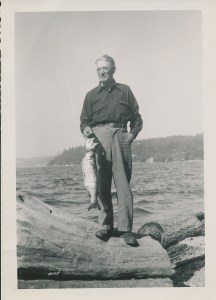
Our grandpa Carl Bonde was easy-going. In fact, that’s the advice he often gave to me. “Easy does it, Danny.” I guess because I was so eager to do things with his stuff. Grandpa had at least six buildings, all of them with stuff. Well, maybe seven buildings, if you count the pump house down by the creek.
The pump house had no floor, just a few boards to brace the walls to give the house its shape. About as large as an outhouse, the pump house had a gas motor. Or maybe it was electric, I don’t remember. If it had been gas, I’d have liked it better. Gas motors in those days had to be wound with a starter rope by hand to get it spinning. You engaged a knot at the end of the starter rope in a sort of notch on the pulley at the end of the crank shaft opposite the working end, then you wound it the only direction you could because of the direction of the notch, its open end opening opposite the way you wound it, then you wound a couple feet of cord around the pulley. The cord seemed to always have some sort of handle at one end. You set the ignition and the choke, then you pulled the rope hard and steady until the engine started. Then you closed the choke and the motor was running. A kid was seldom strong enough to start a motor like that. Unless he was a teenager.
I was fascinated by motors.
The pump house sat right over the creek, its water intake pointing straight down into the water. Aunt Corinne said she caught me tottering around on one of the boards that braced the walls when I was small. The pump house had no floor, for some reason. It smelled of oil and gasoline. Grandpa kept gasoline in a great orange five-gal. gas can. I’m pretty sure the motor wasn’t electric, not at first. Later he might have replaced it.

My grandparents lived atop a hill on the outskirts of Kalispell. They had the longest, skinniest garage I have ever seen.
Grandpa pumped water up the hill to irrigate his fruit trees. He used a couple pieces of aluminum irrigation pipes, plus some surplus fire hose to put the water right at the trees. Sometimes he took me to the fire station when he visited his fire fighter friends.
The chicken coop was unused as far back as I can remember. It had windows that faced the creek. When I tried to clean out the filthy chicken coop once I found some girls panties that looked like they had chocolate stains in the crotch. Someone had put the panties up in the rafters, perhaps to hide them. I never did find out who hid them or why they had chocolate.
Grandpa only got one chicken all the while I was growing up. The chicken was way too lively to put into the chicken coop with its wide open windows.
I’ve told about the extraordinarily long garage before. My cousin David found a .22 lever action rifle in the rafters. I think he still has it. Grandpa said it had belonged to Buddy, his son killed in WW II. The rifle looked like it was caked with horse manure, but David cleaned it up.
Grandpa built his own small barn. Once a kid from across the road told me the barn was a house. He thought he really knew and argued with me. There were always lots of tools and liquor in the barn. The barn smelled of dead flies and dirt.
The other buildings were: 5) root cellar, 6) storage building that nobody ever got to enter, and 7) main house, the old victorian house on the hill.


June 21, 2016
About an hour ago I had to pee, so I got up, did my business. Gunther whined in his crate. Well, there are uh, let’s see, Penny, Henry, Bea, George, and me all sleeping together in the basement of Clara’s and Brian’s house. I sure don’t want a whining dog waking up the whole family.
I open the crate, let Gunther out and we trot upstairs to the family room. I get on the computer while Gunther humps a stuffed toy the size and shape of a basketball. Why? How? He has been castrated! Why would he hump the stuffed toy? I stare in disbelief. He doesn’t stop!
He won’t be still. I finally figure out that he is thirsty. The kids gave him so many salty “Puperoni” treats yesterday that he had to drink all his water. I fill his bowl and he drinks almost all of it. I fill it again.
Gunther and I sit for a while before I carry him back to his crate and lock him in. Now I can’t sleep and it’s two a.m.
Now I’m back upstairs on the computer, drinking a beer, writing, waiting for a sleepy feeling to return. Man! Rochester Minnesota is a warm, humid place. My thighs stick together with perspiration.
For this reason and that, I think about a time almost 60 years ago when I had a chance to sell the Seattle Post-Intelligencer door-to-door in Missoula.
I used to like doing door-to-door commerce when I was a kid. All my best friends did. One time we got a stack of old magazines and went door-to-door. We wanted a dime each. Of course nobody wanted to buy our old used magazines.
We tried selling at this old lady’s hose on the corner of Kensington and —I don’t know — maybe Thames street in Missoula, and she brought out her hearing aid. What a contraption. She had an amplifier and a long wire that went to an earpiece. She asked us to speak into the amplifier. We did, shouting that we were selling magazines. I think she misunderstood. She pulled out ten dollars, which we refused.
Anyhow, years later I somehow got signed up to sell the Seattle Post-Intelligencer. I hated the name. I wanted it to be Post-Intelligence. The final “r” grated on me. I settled on “Seattle P-I,” but that didn’t go over well, either.
A frantic acting, sweaty, man dropped off a bundle of maybe ten issues of the Sunday Seattle Post-Intelligencer at my house. He told me to sell them and I could keep five cents each and I was to give him the other twenty. I think now, that he was having as much trouble as I selling it. I was dubious, but I agreed to try.
I remember that my mother wouldn’t allow me to sell it on Sunday, the day it came out. In those days stores and just about everything in Missoula except Olson’s Grocery was closed Sundays. Day of rest. Therefore, I had to try and sell them on school nights and Saturday. Nobody wanted to buy until I got to Bob McConnell’s house. Bob lived with a relative there. He was a high school kid, probably a freshman. The next week I went to Bob’s to sell him another issue, but he wouldn’t buy. The Seattle P.I. had no world news, he said. Plus, who wants yesterday’s paper?
I wasn’t really tuned in to the high school kids like Bob McConnell until they started at the University of Montana. I vaguely remember that Norman Boyce, one of my brother Tom’s friends, had a distinctive face that most of his peers described as ugly. I didn’t think he was ugly, and I think they thought he was ugly in the best sense of the word. As one who had a lot of character, sort of like Abraham Lincoln.
Norm Boyce died when Mike Fiedler’s brother Eric crashed a car on the road to Drummond. I remember there was some sort of inquest, or investigation and Eric was not found culpable. Nonetheless, there was this cloud of innocence lost on Tom and his friends after that. Evil had entered the world.
In 1967, when I was a freshman at the University of Montana, I was walking past the philosophy department library and I noticed that it had been named in honor of Norman Boyce. I remember now that I was on my way to interview Henry Bugbee, Chairman of the Philosophy Department. I wanted his views for a newspaper article I hoped to write about the administration’s desire to downsize the liberal arts.
How destiny works: In 1978, when our family was preparing to move to Brazil to work on drug research for treatment for falciparum malaria, I needed to take a crash course in Portuguese. Jim Flightner taught the course and we met in the Norman Boyce memorial philosophy library, a small room with a table at the end of a hall in the Liberal Arts building.
“Tell us a story, grandpa,” Beatrice asked.
Mother used to get chemistry set stuff for me. You know, test tubes, chemicals. Even poisonous chemicals that you could order special, such as mercuric chloride and lead sulfide. I had gotten sodium dichromate from a professor at the university.
Well, I used to put all of my chemistry set into a box and take it to school for show-and-tell that we had every day. I was always getting new stuff. I got a metal ring stand and a tripod. Best of all, for my birthday, I got an all-glass distillation set which had a 19-inch tube with a second, larger tube that contained the first one to act as a cooling water jacket. The glass water jacket fit over the glass tube and had a screw cap at each end with a hole and a rubber seal. The water jacket also had a glass nipple at each end to attach a piece of rubber hose. I fastened all of this stuff to the ring stand, somehow, with rubber bands.
I got the hoses for this setup from the university chemistry department. I went there almost every day and asked the students and teachers for old equipment they weren’t using. If they weren’t there after hours to give it to me, sometimes I’d go in and take it, if nobody was using it.
You have to understand that my father died when I was a small boy. I really had only mother, my books, and my imagination to use to set up my chemistry experiments.
The distillation apparatu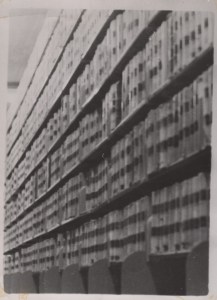 s allowed me to distill water. In fact, that was my science fair experiment: “The distillation of water.” I wanted to give my project some appeal, so I added a whole bunch of chemicals to the water I wanted to distill. I put a sample of each chemical into the water, and wrote the chemical formula of each in a long row.
I copied the formulas from the bottles the chemicals came in. Such as sodium bisulfate: NaHSO4, and calcium carbonate: CaCO3, and sodium dichromate: NaCrO3. I’m guessing at the chemical formulas here. Point is, I listed them all on a piece of paper to impress my teacher, who didn’t know much about chemistry: NaHSO4CaCO3NaCrO3, like that.
Once I got all of this stuff into the water, my water looked a lot like orange mud. I thought this will be all the more interesting to distill. I had a florence flask with a rubber stopper and a glass tube coming out. I used a short piece of rubber hose to attach the flask to the distillation apparatus.
So that was my science fair project that I put in the back of our fifth grade classroom. Only when I lit my alcohol burner under the flask to distill the orange mud it heated up and squirted through the distillation apparatus all over the place, making a big mess. I eventually cleaned the long tube of the orange crud with a stick. A sprout, really, from the lilac hedge in our backyard.
Gold toning a printed-out photograph: How I did it.
I had bought a package of 10 sheets of 11 x 14 inch old fashioned photographic paper that came light-fogged, and therefore worthless for printing with an enlarger and photochemicals. I was dismayed. Yes, I called the seller, and then the manufacturer, but they wouldn’t replace it. Best I could get was a $5 gift card from B&H Photo.
However, I remembered that photo paper tends to darken in the light, even without development. Well, I have a few large negatives left over from other projects, so I got two — one with high contrast — that I put in an 11 x 14 inch contact printing frame. Sure enough, the high contrast negative produced a pretty good-looking print. I had a normal contrast negative too, but that made for a muddy-low contrast print.
To make the image permanent I put the printed-out image in fixer. Well “printed-out” refers to putting the contact frame with negative and paper to print “out” into bright sunlight for perhaps 10 minutes to darken.
Anyway, imagine my disappointment when the fixer essentially bleached out the image. I mean I could make out the image, it was just light yellowish brown against a white background.
I looked up remedies for that and I got an article about toning with gold. Well, I just happened to have 60 ml of gold chloride solution in my laboratory, so I made a pint of solution consisting of distilled water, sodium metaborate, and gold chloride.
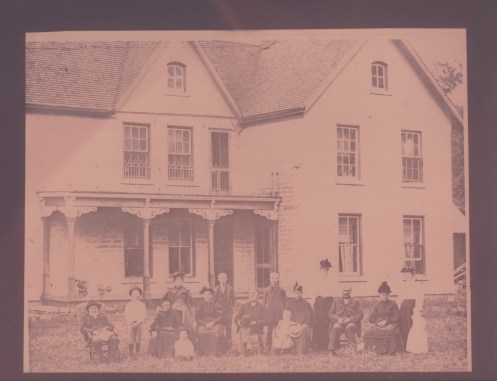
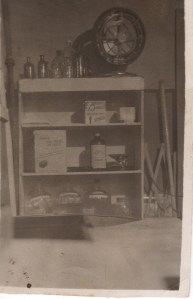
I exposed another sheet, then fixed the image in a dilute solution of sodium hypo sulfite fixer (so’s not to bleach out the image too much) and then soaked in the gold toning bath for three minutes before washing. Here is the result:
I have been keeping this journal, almost daily, since 2010. Just now I glanced through it. It is all on this computer, backed up on those memory sticks or what my nephew Jon calls “thumb drives.”
When it comes to the old days, I’ve told most of my stories. Sometimes I did my best work when I was a little drunk. Always my mantra has been to be as honest as possible. No exaggerations, no omissions. Well, not quite true. I’ve had to omit names because I feel I mustn’t kiss and tell. You get the idea. There are times, for honorable reasons, to keep things private. If you’ve read much of what I’ve written, you may find it hard to believe that I’ve kept much private. Well you’re right. I haven’t spared myself at all. Well, maybe a little bit. But I try to tell the truth mostly.
Sometimes I can sink into a feeling, a longing, perhaps a curiosity about chemistry or biology or sexuality. Those are rare times when the words can flow freely and I know I’m contributing something of value to you, the reader. In those rare times I’m talking about what I was really doing during those years when in school we studied how to diagram a sentence. You know, I still don’t know how to diagram a goddamn sentence. Well, I’ve thought about sentence structure enough that maybe I could. I’d rather learn to speak Spanish than diagram a sentence.
I did well in Spanish. My friend and former sister-in-law, Dana Graham, taught me what to do: memorize the vocabulary words. Then go to class and learn how to conjugate the verbs. Then practice, practice. I can’t speak much Spanish at all, these days. I got A’s in Spanish from Jim Flightner, a wonderful man and professor of Spanish and Portuguese. In fact, I took a semester of Portuguese, a beautiful language, from him. Most of the students were headed for Brazil, so the Portuguese class was businesslike and intense.
I recall, when I was in the 6th grade, copying images of conjugated benzene rings out of a chemistry textbook. I had no idea of what I was copying then, but now I’d recognize them as images of aniline dyes, or at least the chemical structures of organic dyes.
I felt a certain futility then, because I didn’t know why I was copying them, but I’d copy them now in a heartbeat. In fact, I’ve since learned that’s what gives organic dyes their vivid colors: conjugated aromatic molecules. These terms, like “aromatic” have precise meanings in chemistry. In literature, aromatic might simply mean having an aroma. In chemistry, aromatic compounds have characteristic six-sided carbon structures with alternating single and double bonds.
Aromatic compounds may also serve as receptors for electrons, or “free radicals.” Those who frequent so-called “natural supplement” stores may remember seeing compounds that serve as anti-oxidants. They are simply conjugated aromatic compounds in pill form.
Oxidation refers to removing electrons or adding oxygen. Reduction refers to adding electrons or removing oxygen. For example, a metal, such as iron, tin, lead, is said to be “reduced” when it is in its metallic state. It is oxidized when it is in its ionized or rusted state.
Some of that may seem like a foreign language, but I have loved it
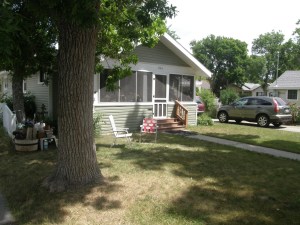
Don and Gert Christiansen’s house.
While walking Gunther, I met old Don Christiansen coming out of his house, and he invited me to sit and talk. I unleashed G., who dashed about, finally settling down with a Burger King fountain drink cup to chew to pieces in front of us.
We moved the lawn chairs a couple of times until we got them satisfactorily into the shade, but also with the right amount of warmth from the sun.
Don and I talked about many things: dogs, fish, pictures, chainsaws, tools, and rattlesnakes. He knew a guy who got bit on the leg while irrigating near Joliet. Made him sick for a few days.
Finally we talked about sports. Don played sports in his youth.
Recently, he said, when he was at a nursing home, he saw some kids out across the highway playing baseball. He could watch them through his window, but when a member of the staff took him outdoors and left him to be closer to the game, the kids were not visible from the nursing home grounds. You had to be up higher, like where he had been when he saw them out his window, he said. He never did see them play after first seeing them out his window.
Then we talked about basketball. He said his wife Gert is a “basketball nut.”
Don said that when he was back from the the Korean war, in college, that the coach at Eastern Montana College invited him to practice with the team.
Don had played basketball in high school.
However, although Don had to decline the invitation, he felt honored to be asked. He said he was deeply touched by the coach’s thoughtfulness and willingness to foster talent. We had spoken of other teachers we knew who helped students develop their strengths.
That was Coach Alterowitz, after whom the gymnasium at MSU-Billings was named. Then, Don said with a grin, “that so impressed me that I’m still affected by it.”
June 14 @1411
“Tell me a story!”
I fought the urge to shout ‘fuck you.’ Instead, I unrolled my life in my mind. I catch fleeting glimpses of my sunny childhood with its hours of playing upstairs in my brother’s room, a room I was forbidden from entering. Of course I entered it every chance I got.

Gunther
What did Tom’s room look like? It was long and low with slant roof and kneewalls. The floor was pine, painted brown. The walls were some sort of fiberboard. I have a couple pictures of it I took when I was in the fifth or sixth grade. The blue curtains on the windows at the end of the room looked like they had sliced bananas. I suppose they were really flowers. It’d be fun to see what the place looks like now. Perhaps I’ll knock on the door next time I’m in Missoula.

Then there were the endless days of trying to build a clubhouse for my friends and me. Trouble is, we couldn’t saw or hammer nails accurately so we always ended up with some sort of garbage that looked like a bunch of boards precariously leaning against each other. How do you get a play house to stand up so you can nail boards? I had an inspiration. What if we pounded four long stakes into the ground, then nailed the walls to the stakes? I suggested that to my friend from across the alley. “Naw,” he said. “That kind of thing doesn’t work.” And that was the end of that. I had invented the pole barn and I had let my little friend talk me out of even trying to do it.
I unroll my mind further, and I remember chasing my friend around in his basement. We spent many hours playing in his basement, mostly playing cowboys and Indians. I was always the Indian because my friend had some nice toy pistols. We were racists. My brother wanted to grow up to be an Indian, so I had that secret that allowed me to play the part of the Indian. If my brother wanted to grow up to be one, one must be good, I reasoned. We had a good system of checks and balances. If my friend got too bossy, I’d simply tell him that I quit and I was going home. He would invariably wheedle and beg me to stay, promising not to be such an asshole. Worked every time.
We—my friend and I— spent hours in my back yard digging holes in a garden area in the corner. We wanted to dig a well. Or we wanted to dig all the way to China. Or we wanted to find the body of Smokey, our cat. I figured he was about two feet underground, but we could never find the spot to dig. We dug all around without success.
As murky as the past has grown, the present is not murky at all. Right now I can hear my dog, Gunther, barking at the back fence. He can see through the cracks between the cedar boards back there. I don’t know if someone is lurking in the alley or if he is barking at the two labradors on the other side. Also, a couple of men are rebuilding the house over there. I think they want to flip that house. The fan in the ceiling is roaring away. Becky lives up in the attic and it’s hotter than Hell up there, usually. I really don’t want to go check it out.

The past. The past I can experience goes before I was born, back about 150 years, when my great grandpa was in the Civil War. Now I don’t feel so good about war. Not like I did when I was a kid. I didn’t question the need for wars then. Now I do. Violence only gets more violence, obviously.

$15 Hiawatha theft-proof bike.
June 14, 2016
Eventful day. Yes, the morning routine with coffee, clothing, medicines, Gunther, walking, pooping. Addicted to Facebook, I opened the laptop. Was invited to attend a bell-ringing at church.
So I mounted the old bicycle, my theft-proof Hiawatha girl’s bike, to attend the LGBT solidarity ringing of bell at the UCC Church of the Fervently Religious. A homosexual couple from our church and their child were also there.
I knew they had been Catholic because they recited a Hail Mary after the tolling was finished. One of them told me how grateful she felt that they had found a church that accepted them. I echoed that sentiment.
Then it was off to the credit union for a new debit card and home to dog and writing.
The anti-theft $15 bicycle.
The bike originally cost $15 at the Salvation Army Thrift Store. My nephew greased up the wheel bearings and crank bearings so that I could pedal it. I bought a seat post clamp with nut and bolt for $2 because the bike didn’t have one when I bought it. I replaced the tires and tubes: $30, maybe. Then I paid a guy to add goop and other stuff to the wheels to make the tires essentially flat-proof. $50. Comes to almost $100. I found the rear carrying rack in our garage and bought a good bike helmet. Oh yes, I bought a tail light for about $10.
So I haven’t been locking my bike because I want to get another junker if the Hiawatha is stolen.
Once, someone did take it a short distance, but dumped it on the ground, maybe 100 feet from where I had left it. The front fender was loose, so I added a screw to hold it.
Yesterday afternoon, Penny and I, in setting out for the Y to work out, let Gunther out of the house to lock him in the back yard. You know. The little fellow has to walk about 20 feet from the back steps to the back yard gate. Well, he ran away.
“Penny,” Gunther ran away,” I mumbled glumly.
Back outdoors, I saw G. trotting a couple houses away, head high, confident. I cried, “Gunther!” [Whistle] “Here Gunther!”
Real teamwork.
Gunther seemed to pay no heed. I entered the house where Penny advised me to get a treat and a leash and coax him. I got a treat from the bag.
Over at the Christiansen’s house, Don and Gert’s daughter Carol was speaking with her husband, who was sitting in a car with the door open.
“Have you seen a small brown dog come trotting by?”
“How small a dog?” asked Carol.
 Mexican hairless
“Oh, about yay tall by yay long,” I answered with appropriate gesturing.
“Not that large, but I saw a much smaller dog. One with an underbite,” said Carol, imitating an underbite with her mouth. I thought she looked adorable.
“That would be Gunther!” I exclaimed.
“Oh, there he is,” she said, pointing.
Sure enough, Gunther was chasing a tiny brown dog. A chihuahua, or perhaps a Mexican hairless, who flopped onto its tiny back in submission. I held out my treat: “Here, Gunther. Gotcha!” I scooped up G. and carried him home, locked him in the back yard.
Then Penny and I walked the three blocks to the Y.
This morning G. and I had the usual walk at 6. Surprised to see a couple pairs of people out walking. G’s poop was firm and cohesive. Perfectly formed.
He sees rabbits in abundance, but doesn’t compulsively chase anymore. I wonder if he thinks they are illusions. Sometimes we walk rather close to them before they go hopping away, white tails bobbing. Oh, G. turns his head to look, but is almost indifferent to their presence. We walked past the place with the chihuahua, or Mexican hairless. I don’t know my dog breeds. Anyhow, a stuffed toy lay on the sidewalk.


 insearchofbud