
Dan Struckman, September, 1997.
September 11, 2015
Just got home from our show’s opening. Yeah, there were some forgotten lines, but we still got them in, sometimes not in the order that they were written by the playwright, whose name is Tom Jones (not the singer). I feel good about the show, although I wish it clipped along at a slightly faster pace. I feel sorry for the people in the audience who have to sit on the relatively crappy seats for two hours. We could probably cut 10 minutes if we just moved it along. Maybe not.
Gerry Roe is a fantastic director. When he started in theater in the 50s the actors wore grease paint. I wish you could get to know him. He is short, bald, sort of chubby, and brilliant. He is so smart he is scary. You never know what he is going to say, but it is always right on target. Sometimes you think, oh, that old guy? Then he tells you what you’ve been thinking! Or what you should have been thinking.
The first time that happened was during my audition. He had me read part of the script. I told Gerry that I wouldn’t talk like “El Gallo” in a million years!
I was thinking of my first real love affair, back in 1968. I was thinking of how we had been smoking weed in Missoula and walking along the Clark Fork River in the summer. Gerry picked up on that immediately! He told me what was in my mind! He told me that if he could pick up where he left off with his first wife, he would do so in a blink of an eye. He seemed to understand me to an extreme degree. I was totally blown away.
Since then, Gerry and I have had a chance to talk about our childhoods, and our influences from the television programs of the 1950s, especially the situation comedies, like “The Life of Riley,” starring William Bendix. Also, comedians like Lily Tomlin and Art Carney and, of course, Jackie Gleason.
Gerry freely shared with me about his early life. He was raised by an abusive step-father. Had to be painful. Perhaps great art springs from such pain. I can’t pretend to have had such trauma.
In our show, I like our piano player-in-chief, a woman who hails from Louisiana named Brenda. She talks like she moved to Montana yesterday, with a real southern drawl. I teased her about her drawl. Then I told her I was once in jail in Memphis. Also I told her why I had been in jail. Also what I did to get there. Then, I told Brenda how I got to California and how I got married afterward.
Then I told how the soldier from my late uncle’s company said I “should have been shot” when I told him what I had done to get put in jail in Memphis.
Then, as I was waiting in the wings for the show’s overture, I told Brenda that I had made the whole thing up. I don’t think she believed any of it.
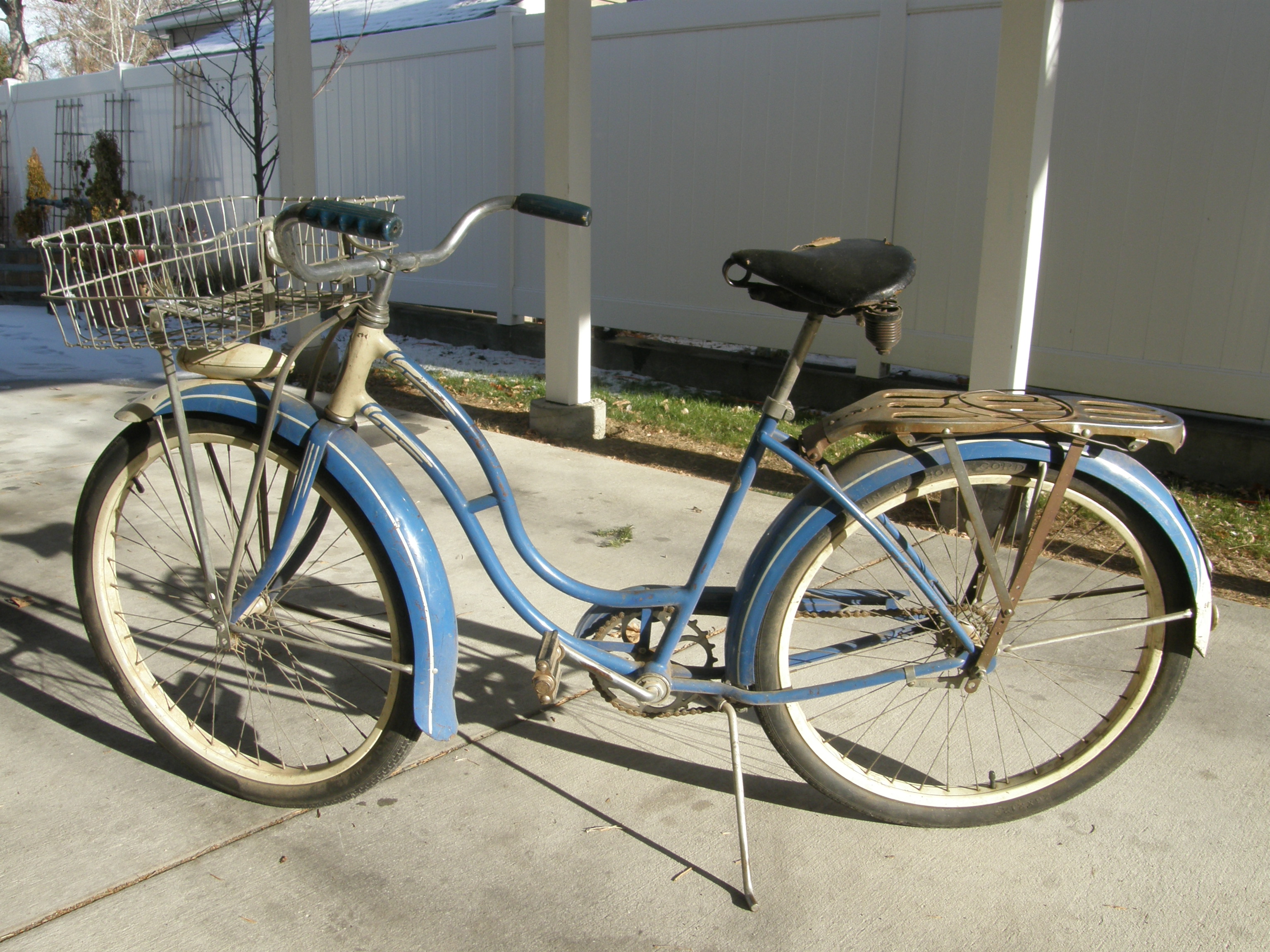
Old Schwinn.
From reading Kurt Vonnegut Jr.,s “Cat’s Cradle,” I considered time travel. I want to meet my uncle, the one who died in 1944, before I was born. You can imagine other advantages. Take as much time as you need.
Anyhow, going back in time interests me. Therefore, I ordered the massive anthology of stories about time travel compiled by Ann and Jeff Van DerMeer. I think the time travel stories have probably all been written.
Using the principle of the “lost cat,” that has served my adult daughter well, and that I firmly believe in, one searches for the answer to a perplexing problem, such as time travel, close to the “front door.” This principle has worked for other things too.
I can’t remember her cat’s name, but when she lived in southern California, her cat bolted. Gone. Out the apartment door. What was the cat’s name? Kevin? Maybe. It’ll come to me later. Kevin was gone and she was heartsick. I think she searched around the apartment building calling. She left food out, nothing. I imagine tears and “lost cat” notices, but I don’t remember. Days passed and no cat.
Then a friend told her that missing cats are often to be found just a few feet from home. I doubted that, but it turned out to be true! She looked within about 10 feet of the door where the cat escaped. Her apartment was on the second floor of a nice airy southern California apartment building, and on a kind of rooftop, perhaps 5 feet lower than her porch. Sure enough, she found her cat. Kevin, I think. Hot, thirsty, hungry.
What does that have to do with time travel?
Remember, according to Einstein’s theory, time and space change when an object approaches the speed of light. Time slows, objects shorten, that kind of thing. Of course, who can accelerate to such a speed? My answer, don’t laugh, is a kid on a bicycle. Here’s how it can work.
Although we seem to be stationary, sitting in our overstuffed chairs, playing with our laptops, we are not really motionless. I remember seeing a post on Facebook that illustrated how the planets of the solar system actually move through space. You know, we’re used to visualizing the sun, there, and the planets orbiting in almost concentric circles. But no.
The reality is that the planets trace a spiral path through interstellar space because the sun is orbiting our own galaxy, the milky way. In turn, the milky way, and its galactic neighbors are also sailing through the inky void. All of this speedy motion adds up.
We’ve got the earth’s rotation, etc. etc. How fast are we zooming along? Well, according to the what I read on the internet, it depends on the “frame,” but perhaps 1000 km/second (rounding up). Well, the speed of light is only about 300,000 km/second. There you have it. We need to go about 300 times faster, is all. We just have to go the right direction.
What is light? Wikipedia has an article outlining the properties of light as electromagnetic radiation. In some ways light behaves like it is made up of photons. Other times, like waves. I like photons because of my chemistry background. A dozen photons can react with a dozen molecules. Both are measurable. Well, the molecules are.
Space-time seems like a kind of webwork, or 3-D fabric that engulfs everything. It gets warped by big items in the cosmos.
Then there is the kid on the bicycle. He just needs to go some arbitrary direction to increase his already great velocity through the cosmos. Then he goes forward or backward in time. That is until someone calls him home for supper. Well, even time travelers have to take a break sometimes.

September 8, 2015
Here’s a quote by H.P. Lovecraft: “I have frequently wondered if the majority of mankind ever pause to reflect upon the occasionally titanic significance of dreams, and of the obscure world to which they belong.”
We think we know something about dreams. Examples: Some of them are bad. All of them are just in our heads. (Thanks to Bob Dylan.) I realize we are getting into the obscure world that H.P. L. mentioned.
My problem with dreams is I cannot find anyone who wants to listen when I have an interesting one to share. I mean some are damned great dreams.
What to do about that? Well, sometimes I can blurt a short synopsis. Not satisfying. Nor does it suit all the dreams. For example, what about the long, feature-length dream? The one in full color with the inevitable house on the hill? (No, it’s not on a hill, really, it’s just that the lot is on a slope that has the alley at the bottom. The big boulders. The vacant rooms.)
In such cases, my listener’s eyes are apt to dart so I have to stop the narrative. I switch tactic. I simply lie and say that I dreamt about the person I’m talking to.
They know I am sort of a liar. And I know they are sort of foolish. Again, there are exceptions.
I start out, “Say…” No. I don’t begin like that.
“You know I dreamed about you,” I begin.
“Shut up!” says the other.
“You are right!” I continue. “I didn’t.
“But I did dream about the long house on the alley.”
In that way I found a way to tell about the long house. The one in my dream that I keep trying to sell. That if I can move it I will get enough money to move off the slope. Probably just a couple of blocks away. Dream blocks. With the inevitable boulders and a slope.

September 7, 2015
I am depressed. As in the diagnosis. For those who don’t know about clinical “major depression,” I will tell about it. The question, “Well, what are you depressed about?” is not germane to this topic.
I have a memory of being a child of 5 who threw a tearful tantrum because my mother found the gifts for her I had stashed in the basement on top of the foundation wall. I remember the feeling of hopelessness. The sorrow. The tears. How I loved my mother! I’ve long wondered if my depression manifested then. Perhaps, but I allow, perhaps not.
Oh, I made excuses for myself throughout my life. When I walked to work in the early 80s I seriously contemplated throwing myself in front of a car. Does everyone do that? Yes. I think they probably do. Do they do that each time they walk to work? Month after month? No. I did.
Where am I going with this? Well, my depression is getting worse. Oh, don’t worry! I’m not suicidal. I have insight into my condition and I love my friends and family way, way to much to hurt them so severely for such a long, long time! It’s just that depression is, well, painful. I know it is treatable with medicine that a doctor can prescribe.
Depression is real. My internist treats my condition as a medical condition and prescribes medicine. I will phone him tomorrow. Well no.
Instead, I will phone his nurse tomorrow, because talking to him directly is impossible. He must have a couple thousand patients! I plan to tell his nurse how the depression has been worsening. It has. Some days it is paralyzing. I have a lot of trouble getting out of bed. When I do get up I want to go back to bed.
One way I am most convinced my depression is worse is that my spouse often tells me that I look sad. I know I do. I can’t help it! Also, my kids are starting to tell me that they are worried. I’ll bet the people I rehearse our play with wouldn’t have thought I am depressed. But I try to sparkle there!
I don’t want to feel “good.” I just don’t want to feel so damned “bad.” I consider feeling slightly bad to be normal.
Again, where am I going with this? Every year my family supports a group that has a fund raiser to fight suicide. It is called “Out of the Darkness.” The annual walk will be this month, so I am thinking about it, even though I will not be able to participate because of my involvement with the musical play, “The Fantasticks.”
Again, I don’t know where I am going with this.

Carl Bonde’s army friends who survived the sinking of the troopship SS Leopoldville, and their spouses. I am the youngster.
Appendix L (to a manuscript I am preparing)
“The 66th in ’06”
WW II Reunion
Company E
262nd Regiment
66th Black Panther
US Army Division
Sarasota, Florida November 2-5, 2006
[I made notes at the reunion; I copied them verbatim with notations and with subsequent corrections by William Moomey, added July 29, 2010.]
Nov. 2, 2006, Sarasota, Florida: I met veteran survivors of Company E, 262nd Regiment, 66th Division (Panthers), US Army. This was Carl R. Bonde, Jr’s [Bud’s company, so these people were his intimates during the last year of his life! Bud was in the machine gun section within the weapons platoon of Company E. [NB: They did not refer to their company as “easy company” (As in Band of Brothers, by Stephen Ambrose.)]
*Hank Anderson was a buck sergeant in the mortar squad, a Leopoldville survivor, and said he remembers Bud. Hank’s wife is Mary Esther.
*Al Salata played baseball for the Army and he was the mortar section sergeant [and the oldest of the group. He died about 2 years later. He was a Leopoldville survivor]. Bill Moomey was there with Doris, his wife. Wally Merza was there with his wife, Martha. They live in Chicago. Bob Carroll and his wife, Colleen, set up the reunion. Portly gentleman [Maurice O’Donnell] drove from Flint, Michigan, to Sarasota. Southern gentleman [Randall Bradham] came from South Carolina. He wrote a book about this unit. He went to army basic training in Missouri. They call him Randy.
The women seem to know the histories verbalized by the soldiers of Company E, 66th Div., every bit as well as the men. Mary Esther, particularly, knows the details of Hank Anderson’s stories as well as or better than he does. I would guess Hank is a minister, retired. He wore his old Army uniform jacket when we went to the Bone Fish restaurant that first evening. He and Mary Esther shared a glass of pink wine. Several of the men were non drinkers, and one or two had a whiskey or similar strong drink. When we returned I went to a nearby grocery, bought a phone card, some cough syrup, and a bottle of Barefoot Merlot. Oh yes, and a cork screw.
Maurice O’Donnell The Great Generation Tom Brokaw. Flags Lt Donald MackWilliams, Lt. Good, from West Point. Allan Andrade – Detective, New York writer.
11/4/2006 6 am, Sarasota, Florida.
Yesterday morning I slept in till 8:40 am. (The night before I had watched TV — Boxing, mostly. I watched a guy named Gonzales from Boise (Caldwell, actually) beat a guy from the Midwest. Both Hispanics. 3 knockdowns. Both very tough fighters. So — Friday at 0900 we gathered at the meeting room. This room was little. The motel is being painted and the big room is closed. Therefore, the gave us a little bitty room with very small tables ~ 24″ across and noisy metal patio chairs that scrape on concrete floor. A guy named Roger, also a military veteran, runs the place. He has a little shrine with war mementos and relics. A letter signed by Colin Powell. Roger is not part of the group, kind of like me, in a way, but still interacts.
The group is very civil and polite, with the mildest of humorous jabs, one with the other. Great conversation. I feel I know these guys better, now.
Briefly, we ate the continental breakfast, although the coffee was gone by 9 and there were just a few pastries.
I ended up speaking with Maurice O’Donnell and Bill Moomey and Randy. Bill had brought a photo album and I got a little acquainted with the story of a member of their company, Cuny, a Sioux from South Dakota, still living, who could not make the reunion. Mary Esther seemed to know Cuny, as she seemed to know many of the absent ones, and fondly.
These guys have been back to France several times. When the war ended each man was assigned duty, mostly involving taking care of POWS, Germans in various parts of France.
Al Salata played 2nd Base in a division baseball team.
Hank Anderson, a tall man (wears size 16 shoe) was in the Elite Constabulary and they were supposed to impress the German civilians. Hank said his uniform was well padded about the upper body to make him look bigger and stronger. The idea was that the Elite C. would convince the Germans that they had lost to a superior army.

Bob Carroll took eight of us to lunch — the 5 women went shopping and to an Es tee Lauder party. This was evidently in preparation for the supper club party hosted by Wally Merza and his wife Martha. I’m better at the men’s names now. They are Henry Anderson, Presbyterian minister, Maurice O’Donnell, fireman, Bill Moomey, farmer; Randy Bradham, cardiovascular surgeon and blueberry farmer and writer, Al Salata occupation? from New York, Walter Merza, wholesale carpet salesman; Bob Carroll, and me. Women: Al’s wife Mary, Bob’s wife Colleen, Mary Esther, Martha, and Doris Moomey. Of the men, three were survivors of the Leopoldville. Bill, Hank, and Al. Al climbed down a net on the side of the sinking ship to safety. [The other two jumped to the deck of a ship that pulled up alongside.] Hank said jumping to the other ship was the single bravest thing he ever did, although not the best thing. Hank was a squad leader for mortars and he felt it was his duty to set the example for his men. Bill Moomey said the distance from the Leopoldville to the deck of the Brilliant was 20 feet. When Hank jumped, he was not even sure it was the right thing to do or if it was possible to jump without serious injury or death. Remember that some of the men had been told by loudspeaker that the ship was in no danger of sinking. In fact it was sinking and would eventually take hundreds of men to their deaths.
All the veteran 66ers have trouble getting into and out of cars.
We spoke of many things from iPods and cell phones to WW II war stories. Lots of war stories. The veterans who shot mortars were deaf and had big serious hearing aids. The machine gunners did not suffer from hearing impairments. Three of the men had to have coronary artery bypass surgeries, although when I asked the group about the surgeries, Hank Anderson raised his hand along with Maurice, Bob and Bill. Turns out Hank was deaf and thought I was asking to find out who wanted some ice cream.
Walter and Martha Merza. Wally and his wife live 6 months in Sarasota, 6 months in Chicago in a condominium both places. He was a sergeant in Company E, 262nd Regiment. Martha is ill with myasthenia gravis, but at the reunion she seemed totally well.
Wally looks fit, maybe a little overweight, or maybe not. Hard to tell. He is certainly not a couch potato. I think I overheard him say that he and Martha visit the Y every day for exercise.
He had been a wholesale carpet salesman, so he had charisma. In other words, you just wanted to hang around with him and listen to him talk, tell him stories, because Wally loved to hear stories too. Naturally I told the guys my experiences of my 7 years in the Marines. They were interested in my military stories about delivering newspapers, getting into trouble with the officers, fixing Volkswagens, having children, going overseas.
Wally bought an antique Lionel electric train set “O” Gauge (stands for “original”) for Martha from a relative of his for $800. He showed me the locomotive, still in its original box. It was beautiful green and black and quite heavy and large. Perhaps 14″ long unless you include the coal tender, and then it would be 24″ long.
He had a squad member in his machine gun unit, Jimmy Roselli, who went on to become a professional singer. Wally said Jimmy sounded like Tony Bennett or Frank Sinatra, only Wally said Jimmy had a greater vocal range than either of the others. Wally had a book about Roselli, Titled He made the Wise Guys Cry. Because his singing could do that to the mobsters. Wally said the book was going to be made into a movie, starring John Travolta, but Travolta wanted to be the singer, and Roselli disagreed with that, so the project never went forward.
Wally had had a computer, but it was bought used, and it froze up the first time he turned it on. He figures he broke it and is still looking for a new replacement when he figures out the best kind to buy.
Wally and Martha (a professional dancer and stage producer) bought us a prime rib supper at a Sarasota night club. Then they took us to their Sarasota condo afterward. What a great pair.
Randy Bradford, the smallest physically of the group, is a retired cardiovascular surgeon. He got his medical degree from the University of Michigan after the war. During the war he was a machine gunner and rifleman. When embarking from Southampton, he was in the part that got separated from the other Company E men and went across the channel on the HMS Cheshire. So did Maurice O’Donnell, Wally Merza, and Bob Carroll. Randy said he heard the explosion on the Leopoldville and even saw the torpedo trail on the water. Maurice said after the explosions the men of the Cheshire went to general quarters and he was stationed on the far side of his ship and could not see the Leo.
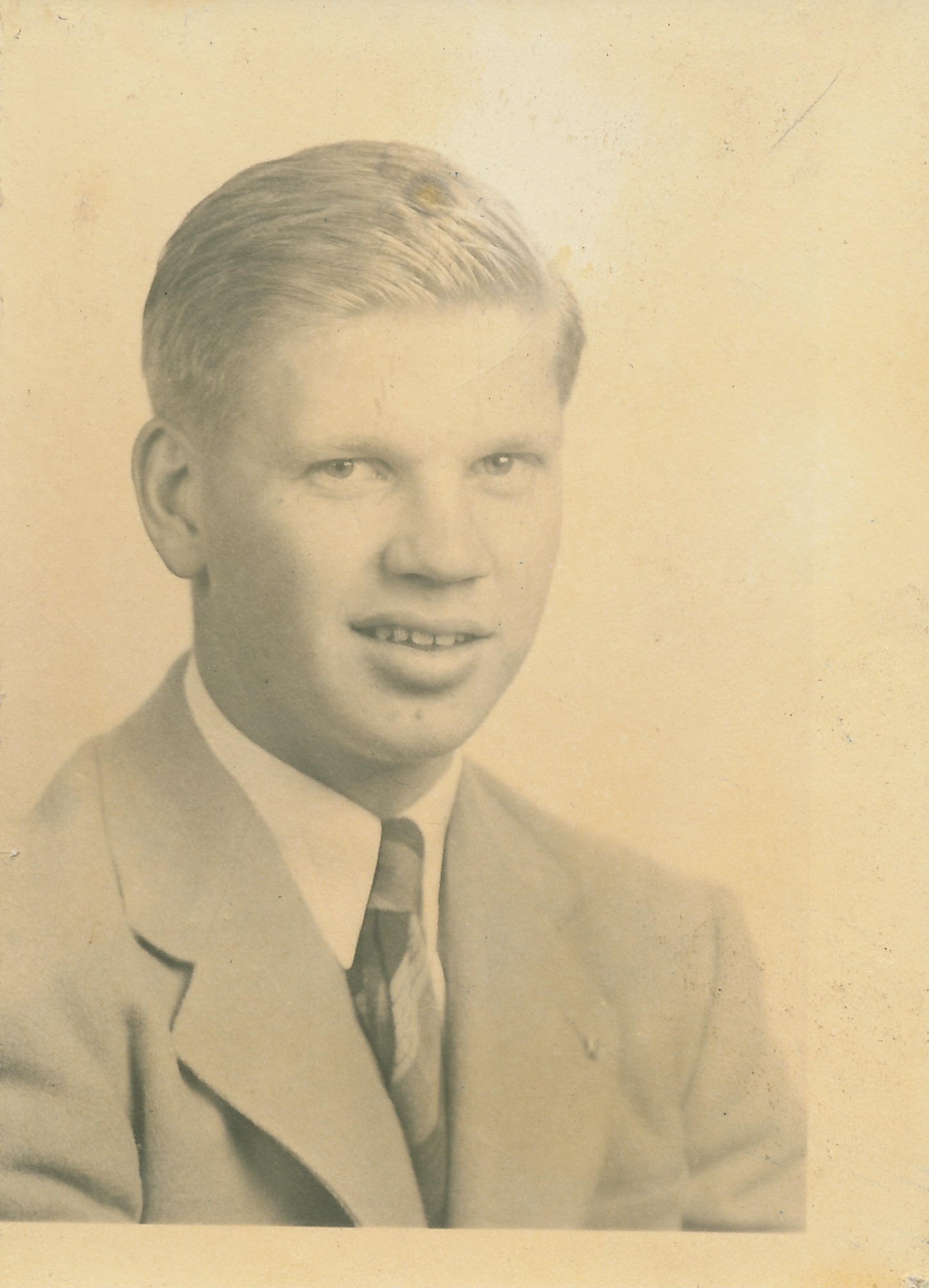
Carl Bonde’s high school graduation picture, 1941.
Chapter two
I felt like I had gone backward in time as I searched for Carl R. Bonde Jr.’s name on the Internet. I had done this every month or so with no success once the Internet became available. I had hope and, finally, a plan for systematically searching for Bud.
My scheme was to find the name of any US ship that sank on Christmas 1944 and then follow any leads. I found a website that listed ships lost in WW II along with date lost and disposition. I got perhaps 30 pages with 40 ships per page. I looked and looked for several hours. Most of the ships were small, more like boats.
Then on a hunch I typed Uncle Bud’s name in the search engine box and lo! A History Channel website came up that featured the SS Leopoldville. My first reaction was disappointment! Then I felt skepticism. This was simply too easy. I was convinced when I found Bud’s name among those lost.
I ordered the History Channel videotape that featured the Leopoldville for $49.95 and then returned to the HC website and followed a link to a sort of blog that had been dormant for many months in which callous strangers questioned why anyone would care about a ship that was sunk 60 years ago. They wrote really ugly words and cynical, but at least they agreed that a ship sunk in 1944 had no relevance to them.
Of course I felt hurt. For a while I thought my search had come to an end. Unkind people wrote that the SS Leopoldville no longer mattered. I felt discouraged. Obviously, what I searched for had no relevance or value.
I was too late. The research had been done, the ceremonies to remember the soldiers had already been held. I saw photographs of soldiers attending reunions.
I couldn’t leave it alone, though. I didn’t know Bud’s fate. Had he drowned? Were any of his Army buddies still living? Does anyone know?
I found other various websites where I searched for Bud, his Army outfit, or his ship and I printed reams. I ordered a book called The Leopoldville Trilogy, a collection of first hand accounts compiled by Ray Roberts, a WW II veteran who had not been anywhere near the ship when it sank. I ordered a set for each of my cousins too, and my sister. Also History Channel tapes to go around.
My hopes were up. I wanted to read the stories of survivors. I was hoping to read some from guys who knew Buddy, or perhaps had been close by. I made charts. I kept lists of who was where. Parts of two regiments of the 66th Army Panther Division had been on the ship: the 262nd and 264th. Each had numerous companies. These had squads and sections. The sections had soldiers.
The books and video, I soon found, were collections of survivor stories, in no particular sequence. Often the stories conflicted or seemed incredible. The ship had been sunk about 60 years previously. None of the books I bought contained Carl R. Bonde, Jr.’s name, although the trilogy book had an image of a monument with his name. Now that I knew where to look I can almost make it out.
I don’t remember which website, or when I saw it, but I recall that someone posted Carl’s name with a note that nobody in his family had been located and would someone try?
Right then I felt the burden of duty to step up. I felt like a surrogate for my grandma. I could envision my grandma stepping forward to claim her son, to represent his interests before strangers. Or was I was remembering a sight I had seen in a courtroom in Kalispell when I was in the 5th grade? My grandpa had died and my grandma went to court, stood before a bailiff, swore on a Bible, then testified. I can’t remember what. What I do remember is that a man who appeared before the judge just before her had been asked if he had ever been arrested. He said “Yes, for vagrancy.” I didn’t know what that meant, but it made my hair stand up.
My sister once told me she met a man who had been in jail. (“Wasn’t that scary?” she asked.)
A few times when I found promising email addresses, I wrote. I got replies from other relatives of the lost who inquired about their soldier and then wished me well in my search.
In 2005 most of the active work on the story of the SS Leopoldville seemed to have already been done years before. The books had been written, the films made, the blogs had gone up, comments posted, years had gone by. Seems the most recent blog entries were always 2-3 years old.
I emailed author Allan Andrade who had a web page devoted to the SS Leopoldville. Mr. Andrade had also written one of the most definitive books about the disaster. I had about lost hope of finding anyone who still cared, or who could answer my questions. Andrade’s website had an invitation to write to him, so I told him about my Uncle and me. He answered quite soon. He said he would make some calls to see if he could get permission to help me reach some survivors. A day or so later I got another email.

Bill Moomey, who died last year, was a close friend of Carl’s. He credited Carl with saving his life because the 66th Division had been devastated by the torpedo that struck the SS Leopoldville Christmas Eve, 1944. The 66th was assigned to the cost of France to contain German submariners in their bunkers.
Andrade wrote, “Call Bill Moomey in Kearney, Nebraska. He remembers your uncle.” I remember feeling glad I was alone in the house, because I yelled! I would like to say I screamed, but I only hollered. I half dreaded calling for some reason, but I was unable to wait.
I phoned Bill as quick as that. His wife Doris answered and she called him to the phone. His voice sounded like that of an old farmer, mild and kindly. He told me he had hoped most of his life for the chance to speak with someone from Carl Bonde’s family.
Yes, he remembered Carl quite well because they trained together in a machine gun section for the better part of a year in Alabama before being shipped to England, then to France aboard the Leopoldville. We talked on and on. Bill Chuckled. He particularly remembered that Carl would answer the question, “Where are you from?” with a long flowery recitation that sounded like it had been written by the chamber of commerce.
Since then I have looked up the Kalispell, Montana, chamber of commerce to find one of their descriptions of the Flathead Valley where Carl was born and raised. It is actually very beautiful, verdant, fertile, and like the Garden of Eden. Carl spent his summers in a lookout tower watching for fires over Glacier Park on Huckleberry Mountain, situated near the North Fork of the Flathead River. This interest may have influenced him to choose forestry for his major subject when he attended the University of Montana in Missoula in 1942.
We know that Carl did not stay long in Missoula. In less than two years he was back in Kalispell, volunteering for the draft. Importantly, during WW II one could not enlist in the Navy if one wanted to avoid becoming a soldier. Instead, one would volunteer for the draft. Then a kid would get a letter that started, “Greetings….” and would finish with directions to report to Butte to the Armed Forces Entrance Examination Stations (AFEES). I learned this from a WWII veteran in Billings when I attended an event at my nephew Jon’s daughter’s (Kathleen Elizabeth Angel) school a couple of years ago for Veteran’s Day.
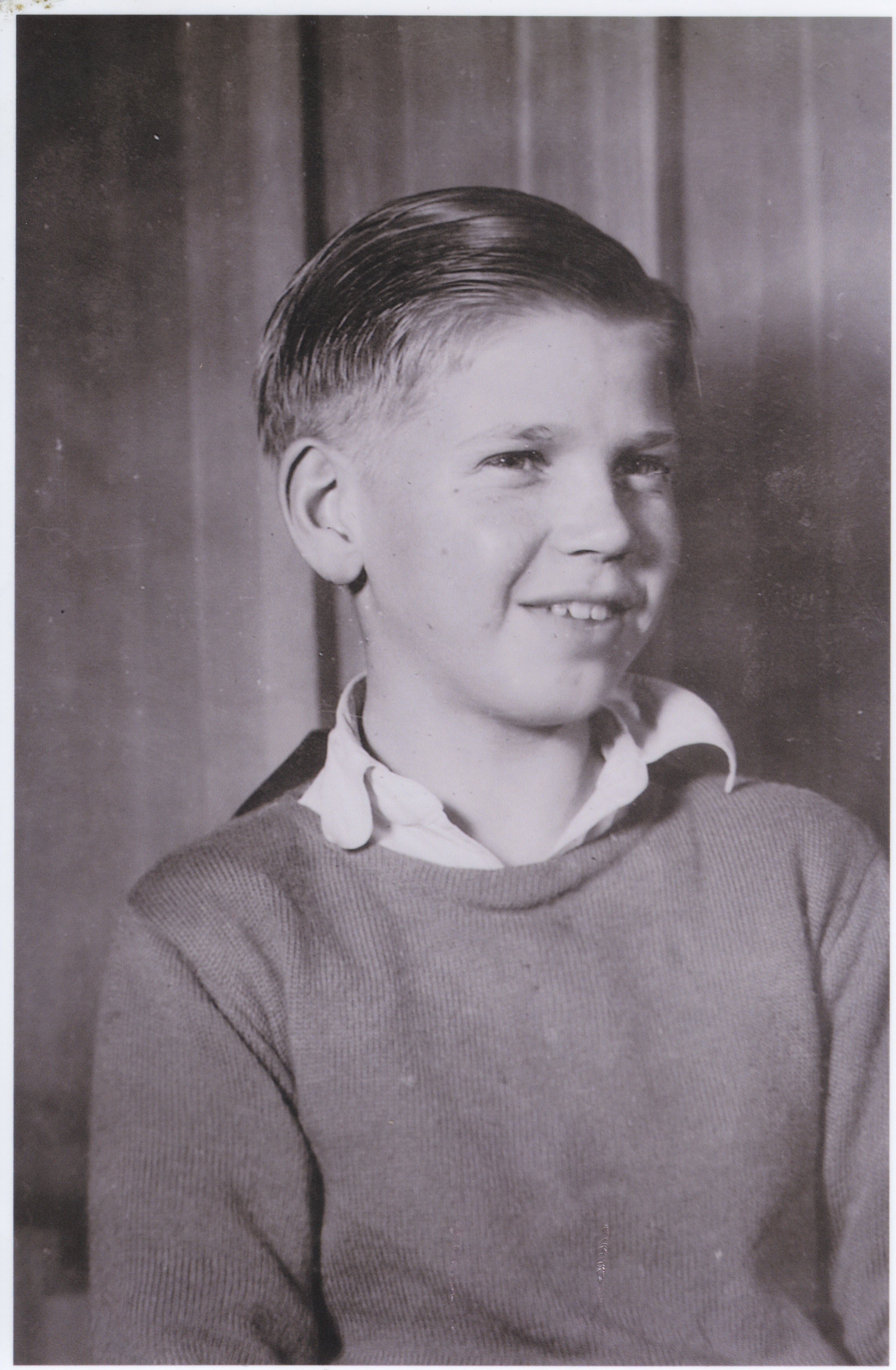
This photograph, taken by an unknown person, shows my uncle Carl –he was born in 1923, so perhaps 1932–in Kalispell.
Private First Class Carl Ralph Bonde Jr, died Christmas Eve, 1944, along with 763 of his fellow Americans when a U-boat torpedo sunk the Belgian troop ship, the SS Leopoldville in the English Channel. Bonde, or “Bud,” as his mother and sisters called him, was just 21.
How many times have I tried to say that in order to tell about Bud, my only maternal uncle?
I never even met Bud. It’s hard to say when I first became aware that he ever existed. Could have been something I overheard at my grandparents’ house when they played bridge with my mother and her sisters. In those days the grownups (but not grandma) smoked heavily and drank whiskey when they played bridge. All of these adults, with the possible exception of my grandpa, were college educated and absolutely none was overly sentimental. That is, as long as you don’t count being bitterly angry and chronically depressed as being sentimental. They were Norwegians and they did not use euphemisms for death. People died. They did not pass away. Bud’s photograph probably hung on a wall somewhere at our grandparents’ house in Kalispell, but no one told about him unless we young kids asked. Bud’s presence was inextricably part of his parents’ Victorian house. Are you ready for this? It and a garage stood alone on top of a hill on the outskirts of Kalispell, Montana. Like the vampire castle in Transylvania. This is so corny I am ashamed to say it. I have to say that I don’t think the place was considered to be valuable real estate when they bought it. The house was probably 50 years old and the indoor plumbing consisted of one short water line. Now that I think about it, I don’t know where their water came from. I do remember that the water heater was electric and stood in grandma’s rectangular kitchen on the side near the clothes washer. Once we heard the cat yowling and grandpa stopped the washing machine, opened the door, and gingerly pulled some sopping clothes from the tub. No cat. Somehow, the cat had gotten into the machine enclosure where the motor was. I don’t know why the cat was there, perhaps grandpa had pulled off a panel and replaced it.
Our grandparents’ attracted all my cousins each summer. Grandma baked the usual pies and rolls until they were nearly black. Grandpa smoked and spit and puffed through pursed lips. He kept his liquor down at the barn. He gave us money. However, the house itself sucked us in because of its rundown majesty and, at the bottom of the hill, its creek—Ashley Creek—and the woods across the bridge. Grandpa had five acres with outbuildings: a root cellar, chicken coop, storage shed (that none of us ever entered), barn and a long skinny garage. I’ll get back to the storage shed and chicken coop later.

My Uncle’s friend, Bill Moomey, was delighted to see this photo of his platoon sergeant, Irvin Weaver, of the weapons platoon, Company E, 262nd Infantry Regiment, and his friend Carl Bonde.
The pig wire fence around their acreage had huge fat spiders that would give you the willies whenever you tried to climb over or through. There were places, like near the chicken coop, where the fence had a hole to crawl through and meet a spider. Grandpa and grandma had garter snakes, sometimes hundreds of them dripping off a rock retaining wall. Their place had apple trees that grandpa painted the trunks with whitewash to keep the ants off. Grandpa said the lime was one of the powders he and I would need to make our own wet cement. Otherwise we would need some cement and sand. And water, too. We never made cement.
We cousins played outdoors and indoors and we often found evidence that Uncle Bud had been there. There were fishing poles, and lures with treble hooks on shelves above the workbench in the garage. The garage always smelled of gas and oil. It was long and skinny with four windows at the back end, all on the south side, none on the end. The door on the west end was hard to open, so it generally stayed open. (I don’t have to remember the garage so carefully because I found a photograph of it, taken from the vicinity of the barn at the bottom of the hill.)
We cousins figured the adults were hiding something. Of course we were right. Adults are always hiding something. Should I start in telling how I took a tape measure to the interior walls of the Kalispell house to locate the hidden rooms where they kept the corpse? Otherwise, what happened to Bud? The ceilings were so high, perhaps 10 feet. In the hallway were built in closets and cabinets up close to the ceiling. This house was no bungalow, but a big, square wooden frame house that seemed to center around the wood furnace with gravity flow air heating. When grandpa had the fire going good in the winter the house smelled of pine wood smoke and I could huddle over one of the silent grates with warmth drifting up and play with my toys and grandma’s cat. She named it “Ting Ting,” or some such nonsense. Everyone, even she, called it “Kitty.” Kitty was a great companion for me.
My mother told me about her little brother Buddy whenever we sat on our couch in Missoula to turn the stiff black pages through her photo album. I was not old enough to read, but she showed me pictures of Bud as a five-year-old dressed in some sort of two-piece bathing suit with stripes that made him look silly like a little convict. He was outdoors in glaring sunlight and had an umbrella and a sly grin. The picture was taken at one of the houses his folks rented in town before they got the big place on the hill. Kalispell gets especially hot in the summer and Bud was being squirted with a hose. He looked bright and cheerful, almost maniacal! My mother’s reaction to seeing her little brother’s photograph added to my impression of profound loss because I could see my mother’s grief through her stoicism. My mother dearly loved Bud and she was my best source of information about him.
The striking thing about the photographs of Bud was their paucity. All were on just the one page. There was the picture of the happy five-year-old next to a teenager smoking a cigarette; then he was pictured in an Army uniform in several more. At last one showed him with a hunting rifle. It was snowy. After that, no other pictures. My mother made no secret that he was soldier who died.

Journalism Associate Professor Robert Powers Struckman was 47 when he died of a brain tumor.
My own childhood calamity had come in 1953 when I was four when my father died of brain cancer. I remember crying in my bed nights the way children do. My mother had me say ritual prayers and we talked about my father’s death (he died, but his spirit lives on). This segued to talking about Bud’s death (a dead soldier who was such a good private that he was private first class). My grandma often referred to empty bottles as “dead soldiers” with no irony at all.

Someone snapped this photograph when Carl was on leave, before entering infantry training in Arkansas.
I think just about every child in the early 1950s played “army.” My friends and I played army in our back yards and alleys and basements often. Even the older kids let us play army because we could be the Germans. Many neighbors had dads and uncles in the war. That distinction gave them authority to direct play. For my part I told them about Uncle Bud, and even though I didn’t have much information about him, I got to join in the play with the character “Uncle Bud.” He was a tough army man, or something. It was okay to just make up the rest of the heroic story, as long as the good guys beat the Germans. The neighbor boys had dads who survived the war and even if the dads didn’t have much to say about their experiences, they invariably had guns or other gear—souvenirs tucked away in cabinets or drawers somewhere. We boys sometimes made the rounds on the weekdays when the adult men were at work. I only had photographs of Bud. (“See? He is marching with a hunting rifle!”) My dead Dad (yes, that’s how I referred to him in elementary school when speaking with friends) had not been a soldier, nor had his father. His grandfather, George Struckman, had been a soldier for the North in the Civil War. My mother kept the civil war pistol hidden during my army-playing years. It turned out to be excellent for playing cowboy once I had found out where she kept it hidden up in the closet.
Bud’s absence made a sort of hole in the fabric of reality, especially when we cousins stayed at our grandparents’ in Kalispell. We kept finding stuff of his that we couldn’t explain. In the garage we found boxes of large bullets that did not appear to fit our grandpa’s rifle. We had a ritual of two steps: declare them our property (done) and take them apart by closing the projectile end into the vise and simply breaking it free of the brass casing. Done. Oh, I almost forgot the third and best step of all: lay the casing with gunpowder onto the oil-soaked wood of the garage floorboard, make the powder spill out perhaps an inch out, and light the powder with a match! The powder would burn with a white-hot flare, hesitate a moment while it burned into the brass, then … POP! The primer within the brass would explode.
At first just my cousin Mike Judd and I did this. Many times. Then we invited Mike’s brother Carl, two years older than we. He liked burning the bullet too, although he was chicken to try it until we showed him how. Then we invited David, the next oldest. He also liked it. Then we invited the four oldest: Tom, Dick, Blaine, and Carol. By this time the adults found out what we were doing and we got a stern warning to stay the hell away from the bullets. Grandpa was too wheezy to get after us, so the duty usually fell to Corinne, our eldest and most authoritative aunt. The consequence of doing dangerous “dumb stunts” was never a spanking, just a few words of warning followed by a declaration of how we frightened them. All this while Bud’s presence was … not there. And yet he seemed to have recently been there the way my mother could tell that I had been recently watching television when I was supposed to be home from school sick in bed, pretending to be asleep. “Still warm,” she said, placing her hand on the set. I was not only pretending to sleep, but the civil war pistol was under the covers with me. In pieces, of course.
Our basement in Missoula smelled strongly of gasoline because of the motor scooter I took apart. The scooter came from Kalispell, from Ted, the kid who lived across the road from my grandparents.’ Ted’s dad had been a soldier in WW II and Ted’s dad was so frightening that none of us dared to speak to him. Ted did all the talking (out of his dad’s hearing, of course). According to Ted, all motors worked because of mysterious things called “coils.” This seemed patently false to me. I never repeated this nonsense to anyone else, especially not my grandpa.
Grandpa spent much of his days in his reclining chair because he had a hard time catching his breath from emphysema. This made him ideal for any sort of game that didn’t require him to move. He also had a tobacco can about three-fourths full of pennies. I was not aware of the second world war until I found steel/zinc pennies in amongst the copper. The 1943 pennies were minted from steel because the government needed the copper for ammunition for World War II, grandpa told me. I also found a book about the army. The wall in the sitting room had a floor to ceiling built-in bookcase that ran clear across the wall from room corner to doorway. The ceiling was really high, all lath and plaster, so the uppermost shelves were nearly inaccessible. Well, inaccessible when an adult was in the room. When I was alone I could climb up there like a monkey, of course, and I often did. That’s how I found the book about “Infantry Tactics and Training.” Not only did the book once belong to Buddy, but also Buddy built the bookshelves. My grandfather had unknowingly increased my knowledge several times over about Bud. And there was a photograph in a desk drawer in the parlor, over by the piano. It had been folded, but an aunt, probably, told us that Bud was a member of whatever Army unit that was. “Where is he?” we asked. We searched the faces until we found one that someone had circled with a pencil. That was him! The pencil made a sort of dent in the glossy surface of the photograph, so you had to sort of hold it to see how the light reflected. “That’s Buddy,” went the word as it spread through all of us cousins
I am tempted to declare that Bud’s bedroom upstairs was kept intact, exactly the way it had been the day he left for war. Unfortunately, my grandparents had a chimney fire and the room was damaged by smoke and water. In fact, one winter I helped a mason clean up mortar he dropped on the floor when he was making chimney repairs. Perhaps that’s why I hounded my grandpa to help me mix up a batch of wet cement. I overheard my grandparents talk about how grandpa’s Norwegian friend noticed the fire when he was coming to visit them. For some reason, grandma seemed to resent the friend who saved their home. Was the problem that he and grandpa spoke Norwegian and she did not? Did she really want her house to burn down? I doubt if she did. In fact, she and grandpa remodeled a sunroom on the southwest corner of their house. Now I wonder if they used the US government insurance money from Bud’s death?
Nothing about this story is simple or easy. Bud’s absence, like his presence, was ethereal, hard to grasp. We did have pictures of him. We did have the things he owned as a boy. Why couldn’t we meet him? Why couldn’t we go hunting and fishing with him? I got involved with Bud more recently during the past 11 years. I didn’t even realize how much his person meant to me until I found myself on the front porch of a house that had been built on the site of Bud’s childhood home trying to explain to a freckled frightened looking 12-year-old why I wanted to get some dirt from his driveway.
I tried to tell him in as few words as I could that my uncle grew up where he lived and he died on Christmas in 1944 in the English Channel and I wanted to get some dirt and put it in the water there. For him. I started to cry. I hadn’t rehearsed my speech for the lad, or even thought how I was going to ask. The boy looked sort of shocked.
“Sure, mister, go ahead and help yourself,” he said.

Once upon a time an old lady decided to kill all of the moths in her house. To do so, she employed her vacuum cleaner, chasing down and sucking up all of the offending insects. She soon learned that there were more moths, always more, and more and more. Her electric machine started to fill with the fluttering millers. The dust from their frantically beating wings clogged the filter of her vacuum.
Soon she gave up that tactic. She got into her car and went to the local hardware. There she found some flypaper strips to hang near her lightbulbs. She tacked them to a wooden partition above the table lamps.
The next morning the sticky strips were festooned with dead and dying moths. She had not been troubled with fluttering all night.
Moral: Sometimes a technically fancy electric appliance is inferior to simple glue. Nerds do not always prevail.

An actual photograph of our front yard, frequented by rabbits.
September 4, 2015
A Billings wild rabbit lived under the neighbor’s porch, subsisting on grass and the tender shoots of flowers and vegetables to be found in the neighbors’ yards nearby.
One day, the rabbit felt menaced by a dachshund, named “Annabelle,” who lived in the gray stucco house.
“Spare me,” begged the rabbit, “and I won’t tell on you for pooping in the Struckmans’ front yard.”
Unfortunately, Annabelle was old and deaf and attacked the rabbit anyway.
Fortunately, Annabelle was also toothless.
Unfortunately, Annabelle then pooped in the Struckmans’ yard.
Also unfortunately, Annabelle’s owner was ill and also neglected to pick up the poop.
Unfortunately, the rabbit couldn’t pick up the poop either, being a—well—a rabbit.
Fortunately, Dan Struckman picked up the poop with a plastic bag. Two, actually, because they were grocery store bags.
Unfortunately, Dan didn’t like doing it.
Fortunately, Dan learned from his grandchild that squishing the poop in the plastic bag is a real kick, and makes the job fun.

I never used to wow the babes in 1968 when Bill Yenne made this photograph.
September 3, 2015
Today I visited Community Day Care and sang to the babies, birth through 12 months. No. I don’t know how old the kids were. Must have been a half-dozen or maybe a couple more than that, toddling about.
They seemed to enjoy blues, so I played guitar and sang “Trouble in Mind,” the way Janis Joplin sang it, only quietly and sweetly (I said to myself). I didn’t know either of the teachers, so I introduced myself and sat near the fence that keeps the kids in the play area. I did a Yiddish folk song, but even babies seem to know when you don’t remember the words correctly. I also tried a couple songs from “The Fantasticks,” that we are performing later this month at NOVA Theater. Neither song pleased the babies. I think the accompanying music and the close harmony and dancing around are required at a minimum. Oh, they responded to “Hey Jude,” though.
Why I went to the child care this morning: I had promised Karen Tooker. Eventually, after stopping to chat with the First Congregational Senior Minister, Mike Mulberry, about huge theological questions of “having enough fun,” I caught up with Karen in her classroom. I was out of time. I did learn from Volunteer Grandpa Bernard that the four- and five-year-olds still sang the song, “Abiyoyo,” while eating lunch. Also the few I spoke with wanted to know why I am so large. One girl told me she wants to be as big as me.
I promised to return, perhaps early next week, when I learn to play some more songs.


 insearchofbud