
Tom Struckman in the early 1960s in Missoula. I had recently learned how to open the camera shutter, fire off a flashbulb, then close the shutter. Worked well at night.
Tom is standing at his version of attention. Feet parallel and touching at all points, left hand stretched toward ground against trouser leg, horn carried like a football.
The bookcase has a set of encyclopedia Britannica that had once belonged to his Grandpa, Emil G. Struckman. Emil’s dad fought for the North in the Civil War.
Tom painted the picture above his left shoulder on the wall. Shows the bookcase with the encyclopedia set and his record player, sitting on a yellow desk.
The couch came from Kalispell. I eventually sawed it up to fit a 1960 Studebaker Lark VI station wagon.

I am guessing Buddy was home on leave from the Army when he took this photograph. I’m guessing he had someone fire a flashbulb and another hold the shutter open using the “bulb” shutter function. Notice that the lamp and his hands cast shadows.
I played with bud’s camera after his death when his sister, my mother, gave it to me in 1958. The camera was a Kodak with bellows that accepted 120 film, 8 exposures (2.25 x 3.25 inches) per roll. It had a quality shutter and lens, also a wire sports finder. I don’t remember what happened to it. I think I broke it.
The camera had an f3.5 Zeiss lens and shutter capable of bulb, and shutter speeds to 1/100, if memory serves me. I played with it enough that I knew it intimately.
I printed the above image from Buddy’s negative when I was in the 5th or 6th grade. I don’t remember any of the furniture in the photograph.
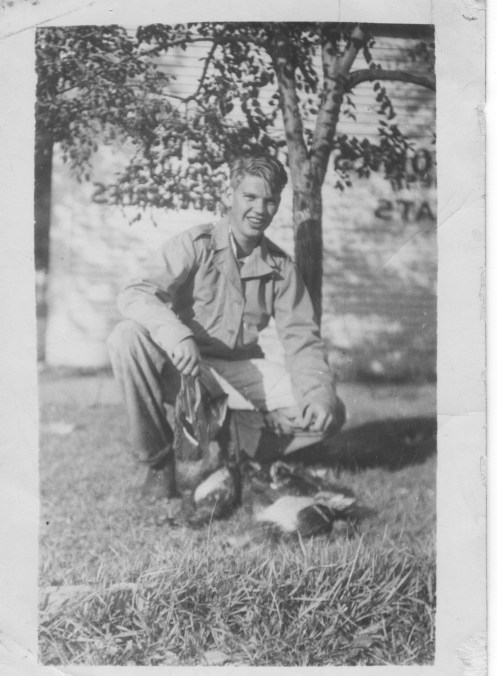
I printed this photograph of Buddy from a negative my mother gave me that he had developed. I always thought that those animals on the lawn were ducks. Again, I suppose he had this photo taken when he was on leave from the Army.
I don’t know that Bud owned a shotgun, just a .22 and a 30-30 Winchester and another rifle with a scope. I did play with his collection of shotgun shells as recently as 1964. I remember that he had an 8 gauge. It was, like, an inch and a quarter in diameter.
At first I thought that Bud was hunkered in front of a fruit tree, presumably one of his father’s. Carl Sr. had numerous apple trees and a few cherries as well. But that was before I noticed the writing on the building behind him. I wonder if you can deduce what it says?
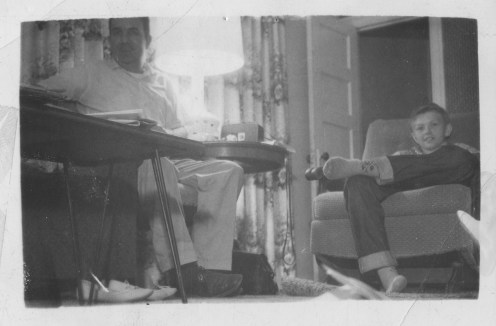
Mike and I were eleven years old in 1960 when the Judd family drove hundreds of miles in their new station wagon to visit us in Missoula. Mike has since told me that he has few pictures of his father, Phil, seen sitting at left above. I have just this one. Mike and I developed and printed this one in my basement.
Mike’s mom and mine were sisters. They were Bonde girls from Kalispell. Their brother, Carl R. Bonde, Jr., was killed in action in WW II, Christmas Eve, 1944. I named this blog after him.
Mike’s father Phil was an aviator, or an expert on radar. Something like that, I don’t know exactly what, but he worked in Alaska, in Anchorage. I’m thinking the family bought the car in Seattle or Portland and were headed to Alaska that summer.
One of those days Phil drove all of us kids out to the U.S. Forest Service Smokejumper Center west of Missoula. We nosed about the big room where they packed chutes. The next thing we knew, Phil chatted amiably with some of the pilots there and we got a guided tour. Phil and the big men all seemed to speak the same language. Mike said his dad, who died a couple years later of heart disease, could engage just about anyone in conversation. It was a gift.
This summer was the first time Mike, Carl, and I told each other sexually explicit jokes at night in the tent in the backyard. We were all within two years of age of each other. Sticks in my mind that I referred to a boy’s penis as a “dink,” but Carl, who was two years older and already an adolescent, called it a “dick.” I don’t think Mike used either term. He was the acknowledged “good kid.” I recall wondering about that then, but not now. How I giggled! We boys knew dozens of jokes. I am guessing eleven-year-olds still tell the same ones. The ones we told mostly had to do with farmer’s daughters and traveling salesmen. You know.
A couple days later, after running out of fourth of July firecrackers, Mike and I planned an early morning attack on a neighbor who had shouted at us for some transgression or other, probably minor. Certainly not as serious as a broken window. We probably popped firecrackers or peed on her shrubs. You know, property crime. Anyway, I thought we were alone when I whispered to Mike, “Let’s get some salt from the kitchen and put it on her lawn early tomorrow.”
A voice like God said, “You aren’t going to salt anybody’s lawn.” Turned out it was Mike’s big brother David who had been listening and monitoring our suspicious behavior.

November 24, 2015
Fan
Even numbered day. I may turn on a fan for white noise in our bedroom on even-numbered days. She hates fans. Says they dry out her nose and she can’t hear the house creak, pop, do the things houses in the night do when they come alive. I love . . . well, you get the idea. Plus, I already know the house is alive, and I don’t care.
I think I already told you, forgetful reader, about my childhood darkroom at 334 North Avenue West, Missoula. Before global warming, winters were colder and our basement, while not cold enough to, say, freeze water, made me shiver. It wasn’t cold enough that I could see my breath, but chilly. And damp. And dark. I put my brother’s good Persian rug over the basement window. The basement was good for a 10-year-old boy developing pictures. And I still have them. The photographs, I mean. I used to buy supplies from a pharmacist downtown.
in 1959 my Grandma moved in with us, bringing treasures like my Grandpa Carl’s gas power lawnmower. Also an electric heater with fan. Or more properly, a fan with heater. The heater coil kept breaking, but I took the heater apart and soon learned how to use a pencil to make the broken ends touch together and spark. Then the coiled metal pieces stuck together and the whole system of coiled wires would glow bright orange. I liked to huddle near the heater. Still do. Ran it while I developed pictures. The heater’s control was on the back of the base, a metal tab that moved up and down in a slot. The glowing coils didn’t seem to bother the developing film.
I found an old photograph of my photography developing equipment. It all fit in a bookcase. Most prominent was the fan. I always felt better with a fan. In 1959 I didn’t have to wait for an even numbered day.
Wheaties (R): Our Religion?
Why fuss about things so long ago? My experience today, like yours, is immediate and true. No memory distortion, except the usual beliefs and notions we have about the world. I’m not talking about religion here, but what we truly believe. Seriously.
I mean, really. How do we know we can eat breakfast? Well, maybe a box of cereal is nearby. That’s what we believe. Faith is believing what we know to be true. Like cereal.
I’m almost through here. Back to the church of Wheaties (R). I used the example of Wheaties (R) on purpose, because my dad, who died in 1953 when I was four years old, told me the story of Goldilocks, only he substituted “Wheaties (R)” for “porridge.” I don’t exactly remember, but he may have changed the “too hot, too cold, just right” with “too soggy.” Like that.
Traveling North
You’ll have to tell me your method, but when I journey through time I try to glide North, past Alaska. This we all did in 1968, in August. A sandaled and beaded hippie chick, tanned, backpack, in Eugene, Oregon, told us that the fires in the Alaskan interior could make you rich fighting them. Hamburgers cost, like, $100, though, so you had to get out without spending much. Okay. Hamburgers really cost $5 then.
Anyway, in 1968, this guy my age I met in Seattle had a VW van he bought new in Germany. Had it shipped to the US. He didn’t let anyone else drive for the first 4 or 5 days of our journey north. Finally, when I drove, the old Alcan highway looked like a road across a ranch. Only wider. Come to think of it, the Alcan was far better than most roads across a ranch, but it wasn’t paved. No, not damned much.
We picked up a couple of hitch hikers near Vancouver, British Columbia. Both boys, maybe eighteen. We drove northeast to pick up the Great North Trail. For some reason you can’t just drive from Seattle up the coast to Nome. For a long list of reasons. “No road goes there” comes in there near the top. Well, it rains a lot. I don’t know. I’d have to go there to really understand. We can go together.
The map said we needed to head toward Edmonton. So we went that direction with our couple of hitch hikers, Canadians, who also helped us find our way. They said Canadians men didn’t worry about being sent to Vietnam, although they had an army. The two went to Winnipeg. We let them out about 4 a.m. somewhere in the fog that was beyond my ability to understand, because I wasn’t driving or studying the map. It started to rain.
We didn’t have anywhere near the cigarettes we needed. We had no marijuana at all. No intoxicant except the thrill of the road to the North. We had no food. We had just one spare tire.
The Compleat Idiot
We had no Good Book. By that, don’t you think I might have meant that guidebook north, “Mileposts,” (although technically that one is a magazine)?
No. More properly I would have been referring to “How to Keep Your Volkswagen Alive, Step-by-step Procedures for the Compleat Idiot.” You know, the Good Book. At only nineteen, I had never heard of the “Idiot” book, by John Muir. Now you and most of us others can still quote passages.
Here are a few of my favorites from “Idiot”:
- Just follow the instructions. Don’t take shortcuts. Don’t take long cuts either.
- Take it easy with the wrench. You don’t want to make the nuts crying tight.
- Trust yourself. It’s the only way.
- We’ll put this engine back together, together.
- You must love. That sounds crazy, doesn’t it? It means if you, say, hurt yourself trying to loosen a stubborn bolt, pick up a tool and rub it like a feelie until your temper and good sense return.
- Keep the inside of the engine crankcase remorselessly clean.
- Don’t diddle with the clevis.
- Buy good tools.
- With bread and Muldoon in mind, you can make it to your destination before it gives up the ghost and says, ‘That’s all, mate.’

Yesterday my internist increased my dosage of fluoxetine to 40mg/daily. So far, I had seen scant improvement in my profound sadness. I have had to basically stay home except to work. I feel better. I am so grateful for the improvement. I realize that depression is not just one person’s malady. The bummer radiates to all of those in the vicinity. It sucks.
Today my mood improved so much that I remarked to my wife that something-or-other “was good.” This stopped me. Wow, I appreciated something as being good. Made me almost smile.
The other thing will be further writing. Oh, the usual fretting about the neurotic things one does fret about, but at least I think I’ll be able to tell you about it. You reader, you. You lazy, good-for-nothing reader. You. Please read. I’ll pay you, if necessary, but read!

Don’t write badly. Just say “no.”
November 20, 2015
I just rescued a piece of fiction about my Uncle Carl’s first day as an Army recruit.
In it he reminisced about his first sexual adventure. I am not sure why I felt so bad, other than I have been weathering a particularly severe spell of depression lately.
I mean, I didn’t use either the words “fuck” or even “sexual intercourse.” Come to think, these words might have improved it.
But no, I wanted to give up. I had used the word “panties.” And “penetrate.” One of my pastors listed both of these as particularly distasteful. Oh, there were other objectionable words on the list. Words like “moist,” “crusty,” and “slacks.” My effort seemed like a lost cause, but in a calm moment I thought how I could remove the icky words, make the save; and at last, I feel better about it. Not great, but at least I’m not hanging my head.
What now? I’ve guess I’ve gotten most of the facts about my Uncle Carl from the public records in Montana: Kalispell, Missoula, Billings; and Nebraska, Florida, and France. The available truth is, well, dwindling. I’m pretty tired. I’ve always admired the concept of “facts.”
Now I’m down to fabricating a story to pin on my hapless Uncle. Well, I don’t want to waste too much sympathy on him. After all, he went to England and wrote home about the “Limeys” over there. I asked Carl’s wartime buddy Bill Moomey about that. “Everyone called them Limeys,” he said. Bill was a retired farmer and didn’t talk much. He did express how glad he was to finally meet some of Carl’s relatives.
Bill had been trying to make connections with us relatives for years. He knew about Carl Bonde having come from Kalispell. Circumstances in 1958 closed the chapter on the Kalispell Bondes. The last one, my grandma, moved in with us in Missoula. That was Carl’s mother, Ellen.
I was glad Ellen moved in with us. She brought along the good power lawnmower. My mother would never have bought a power mower. I immediately started mowing lawns for money. I used the money to buy an enlarger for making photographs.
I guess I could dig into my memory and tell about Carl’s mother. She acted depressed and bitter when she lived with us. I suppose losing her 21-year-old son didn’t do her disposition any good.

March 7, 1943
His anxiety and confusion made standing under electric lights at attention at 3 a.m. easier. Bud had been in Army boot camp a little more than four hours. Of course, his anxious energy was counterbalanced by the sadness, the loss. He had left his girlfriend behind. Gloom took away whatever pleasure he might have found in the dark beauty of the surroundings. The well-ordered parade ground, lit by slants of window light. The cypress trees. He hadn’t seen cypress before, except in pictures. In books. In school. Bud had about 60 companions in the same situation.
Now he was standing at attention, looking straight ahead. He and the others had all just gotten their heads shaved. They wore identical-looking fatigues and boots.
Bud thought about home, about college. He had been living in Montana the two years before he joined the Army. He had hoped enlisting would get him into the Navy, possibly safer during the war against Germany and Japan. It didn’t work. He had offered himself to be drafted. His best choice.
Just last year Bud saw a picture of cypress trees when he took botany as a forestry student. Botany 101. Sounded like an easy subject when he handed his card to the girl sitting at the table in the gym. He was a young man. The university had great looking women just about everywhere he looked. The registration girl found a place for him in Botany 101, section 5. The entire — oh, maybe 200 students or so — class met in Science Hall on the oval for lectures three days a week and then split up by section for labs in the same building. He could barely stand the routine. He hated school, except for the drinking and the women. Well, he liked math. But he hated all the rest of it.
He had really just wanted to find a woman to love, to sleep with. Bud smiled despite the non-com’s order against it. Apparently the sergeant, or whatever the guy’s rank was, wasn’t even paying attention to the company. Maybe nobody was even watching. Bud enjoyed his thoughts. Best of all, Carl remembered that he had found exactly such a woman in Missoula. He remembered how he and his first girl had loved each other and had gone everywhere together for more than a year. When she finally agreed to have sex with him his first impulse was to tell her no! That he had changed his mind. He had never heard of girls saying yes. Well, he had, but he figured the guys who boasted were liars. No women had ever said yes to him.
They had hiked up along the river some distance, perhaps a couple of miles through the trees and foliage of the river bottom. He spread a blanket. He remembered how guilty he felt when he thought of his mother. Up to that moment she had been the primary woman in his life. Not any more.
He blushed as he lifted his girlfriend’s dress and pulled her hose and underwear down and off her bare feet. Then she drew her legs up to her chest as she sat bare-bottomed on the blanket. She looked up at him as she clasped her arms around her legs. She asked him to please be gentle. He blushed again.
He remembered sitting next to her, kissing her, then he had taken off his own shoes and pants. He fumbled with his own underwear. He could hardly control himself. He remembered with chagrin that he couldn’t seem to have sex her. He didn’t know about her hymen. He had been so excited that he ejaculated onto the blanket. He remembered weeping. Combined frustration and shame.
Bud’s mind returned to the Army parade ground. His anxiety was less. Hell, he could stand at attention all night if he had to. The others were starting to look around, same as him. He decided to perform small acts of defiance. Maybe add a wrinkle to his clothes, skip an eyelet on his boots. He would do those things on purpose, to keep his sense of self.
Then the sound of boots interrupted his fantasies.
“Fall out!” a voice commanded. Bud looked uncertainly around but none of the other guys seemed to know what to do. Fall down? he wondered. He grinned at the thought of everyone just collapsing like rag dolls.
“You piece of garbage!” shouted a man in uniform with a broad brim hat and shiny boots. The man ran right up to Bud. He was maybe less than 5 feet tall, had a red face and stood in front of Bud. Inches away from his face. “Did I say give me a goofy smile, turd? You better answer me! Answer me!”
“No sir!” Carl’s voice was high. He stopped smiling. He stood as still as he could, amazed at the man’s appearance and energy. Amazed at how this crazy guy had picked him out of the group. Amazed at the man’s volume and language. Nobody had spoken to him like that before.
Oddly, of this startling experience, he thought only that he probably wouldn’t tell any of his sisters about this.
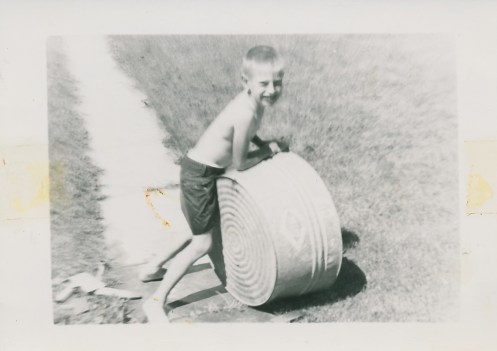
Tonight I tried reading some of what I wrote over the past couple years. The bummer is that I have been repeating the same damn stories to an unacceptable degree. Example: How many times I gotta tell you how I carry my bike in the trunk of the car? How many times I gotta tell you about the library, about the homeless people of Billings? Twice is too many. I need a new slant. When I think of that I think of my illustrious childhood. I was born with a grin on me.
As a kid whose mother had recently gotten a television, I’d say in 1958, give or take a year, I loved to watch the popular sitcom, “The Life of Riley,” starring William Bendix. First off, that particular show was crap. At least I think it is now, when I bring it up on Youtube. However, in those early days I had lost my father to a brain tumor and Mr. Bendix seemed like a damned good substitute. He played Riley, who was good natured, gentle, kind, and altogether a harmless old doofus. My kind of adult male. I needed a safe one.
Monday I told one of my co-workers that I was a happy first grader. At 6 years old, I chirped, smiled, and loved school and all the kids in it, especially the children from my block who were my age. Both Kathy and Mike were in my first grade class. I’ve seen pictures of myself with a wide grin, the happy grin of innocence. This was the large smile and chirping that got me into deep shit with our first grade teacher, Mrs. Clemens. Mrs. Clemens gave no clemency, so her name was misleading. The first day of school she moved my desk into the hall and I didn’t even knew why. I am indignant now. What a … bitch! Nothing for a 6-year-old to chirp about in the hall. She soon found out that I was unrepentant. I had no idea why I was in the hall. I thought everyone should speak whenever they wanted. Mrs. Clemens had it with me and my lack of manners. She told me she had been lenient with me. What the hell did the word “lenient” mean, I wondered.
I wondered about lenient all the way to Mr. Sayer’s office. He was the principal. He looked scary. He smoked all of the time. Of course, he was in his office and he was permitted to smoke. He had been a soldier in the Pacific during WW II and he had fungus infected fingernails that mixed nicely with the nicotine and smoke stains from the cigarettes.
Mr. Sayer looked scary. He had a bald head and funny cupped-shaped yellow fingernails. The other kids were afraid of him, and so was I. I remember going to his office as a 6-year-old, explaining to him that Mrs. Clemens said I should go to him. Only I didn’t know what for. Mr. Sayer didn’t hurt or threaten me. As I recall, I sat in his office and watched him smoke. He may have had post traumatic stress from the horrible battles of the Pacific. I didn’t know anything about that. I probably just grinned at him until he figured I’d been away from Mrs. Clemens long enough so that he could send me back. Where I grinned and chirped.
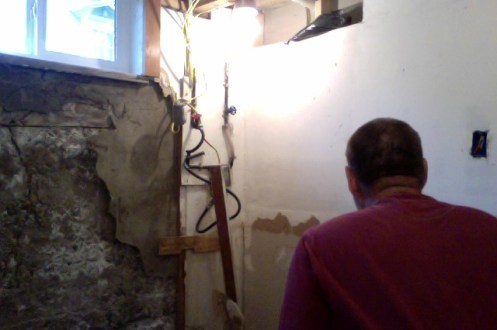
Darkroom at our house. Not dark.
November 18, 2015
Writing. Obsession with me. Sentence fragment. Mundane. Problem: it’s all mundane today.
The car had been in the Metric Wrench, a repair shop a bit more than a mile from home across Billings. Jerry told me it was ready, so I should get it.
The air this morning was cold as hell. I considered driving to get it, but I always end up imagining driving a block, walking back to get the other car, and so on. Oh, I could have walked, but what’s the use having a car?
Instead, I rode my theft-proof Hiawatha to the shop. Theft-proof because I paid $15 for that bike at a thrift store and I don’t need to lock it because nobody else wants it. I wore shorts because I had been in the basement darkroom. I was too lazy to change pants.
All I needed was my jacket, helmet, gloves, wallet. It was breezy and chilly, maybe 40 degrees. My wallet had requisite credit card and drivers license. To pay Jerry because car needed a new rack. A rack, as it turns out, is part of the steering assembly. The rack was leaking and needed to be replaced. No picture came into my mind’s eye. I tried to picture a laundry rack, the wooden kind that you hang clothes on. No mental image of the kind of rack that helps steer a car.
I pedaled downtown. Cold as it was, few were out walking. I crossed against the light and rode on the sidewalk. Yes, against the law. Bicycling is relatively uncommon these days and I’d been getting away with ignoring traffic laws. Oh, I feel an appropriate misgiving, almost guilt. Well, not quite guilt. Billings has way too many big trucks, so I like pedaling on the sidewalk on busy streets like Fourth Avenue.
I notice the usual homeless walking about with back packs, pulling along rolling luggage, and carrying sleeping bags. I wonder if I will seem to fit into their world better when I pedal my old pink girl’s Hiawatha bike? I think it would be nice to fit in.
I meet a guy walking toward me with a pair of athletic shoes hanging, laces tied together, around his neck. He looks like an athlete headed for the Y, I think. An athlete because of the Y, because of the shoes, but also his face. He had a game face. I say “hi” and he lifts a hand in a gesture of greeting. Of the brotherhood of athletes, I thought mentally comforting myself.
A couple of people hurry across Fourth Avenue near the Transwestern Building. I slowed. So did they. I remembered once, years ago, trying to avoid hitting a deer. I sped up and the deer sped up. I slowed down and so did the deer. Ultimately, I hit the deer, though I was going, maybe, 15 miles an hour. The injured deer then lept over a guard rail and died. It was still there the next day.
Anyway, I didn’t want to mix it up with the pair of pedestrians, me on my bike, but as I sped up so did the pair. Experiencing foreboding, I pedaled even harder and managed to get past the place they would have landed at the sidewalk. Well, landed, but only if they been swimming or flying. But they weren’t. One was a Native-looking woman, the other, a man. I didn’t get much of a look at him. I pedaled on.
I pedaled past Lincoln Center. I thought about the public library. I pedaled past the bank and past the Gazette. A man was talking on his cell. Then he waved a card at a box by the “employee only” door and went inside. I glanced to see if my nephew’s wife was in her office. I looked in the wrong window and soon I crossed 27th Street.
Writing. My plan now is to go through what I’ve written and omit needless words. One time I reduced an entire hunting trip to, like, 8 words. Ah! The essence of poetry. Mundane.
After 27th Street plus a couple more blocks, I took a left. Yes, at the tire place. A sign said “Retread Tires.” As I rode past, a semi started to pull out, but I rode faster and managed to beat him to the street. I went hmm: flatbed truck with cubic yards of stuff wrapped in white fabric. Bright white fabric. I wondered if the cubic yards were filled with ground up rubber from tires? This was an unresolved question, like so many of my questions these days. I got my car keys and I let Jerry swipe my credit card, but for some reason it didn’t take. He let me drive away in the car anyway. I had put my bike in the trunk so the front wheel and handlebars hung out so I could mostly close the trunk lid.
I hit Albertson’s on the way home. I picked up a rare vintage wine, next pausing at a meat display. New products! They had lutefisk in white plastic bags with the outline of a happy fish. Next to that amazing sight was a display of wooden boxes, each smaller than a pack of hotdogs. Price, $11.95. “Salt Cod,” read the blue print. The boxes were high-quality wood. Instructions on the side said to soak the cod in changes of water until most of the salt was gone. I took one of the boxes. I headed toward checkout with the wine and the box of cod. Less than two minutes later I paused mid-aisle. I had to admit that of all the impulse buys I’ve made, this was maybe the stupidest. I headed back to the meat display, careful not to make eye contact with one of my favorite butchers who happened to be walking toward. I carefully replaced the wooden box. On the way out I bought some flowers instead.
At home, flowers in vase, Jerry phoned me. My credit card had been declined. And so forth. And so on. Mundane.
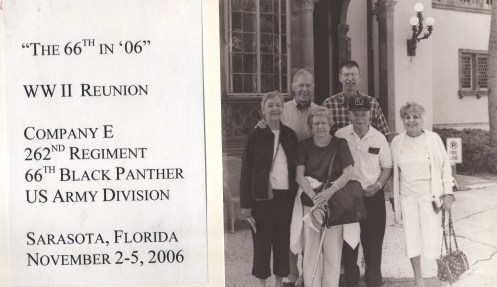
Carl Bonde’s army friends who survived the sinking of the troopship SS Leopoldville, and their spouses. I am the youngster.
I was lucky to meet the people behind the names in the books about the sinking of the SS Leopoldville on Christmas Eve, 1944. I had read their names often enough to recognize them easily: Hank Anderson, for example. And Al Salata. I couldn’t believe that I was actually shaking their hands after all the times I had read and re-read the accounts of the deadly night.
Speechless, almost. I felt like I stuttered. “Hank Anderson? I know all about you,” I gushed. About a dozen of us stood in a tiny tea-room at a motel in Sarasota, Florida. “Man! I am so glad to meet you!”
My friend and Leopoldville survivor, Bill Moomey, introduced me as Carl Bonde’s nephew. I thought Bill went a bit overboard in explaining that I had a legitimate interest in being at the reunion. I had, after all, gone to a bit of expense to fly there from Montana. It’s not like I was crashing a party, but actually, that’s what I was doing. Hank Anderson responded to Bill, saying in his booming voice, “I remember Carl.” I could have kissed him. Those words mean so much to me.
To my pleasure and surprise, Esther Anderson, Hank’s wife, handed me a gift bag with some water, snacks, and a reunion tee shirt. It said, “66th in ’06 Company E Reunion.” I noticed the shirt among the items I have been using for my research into my lost uncle’s life.
The best part of the Company E reunion was time spent with men like Hank Anderson. He told me what he thought was the highlight of his military experience in WW II.
“The military police led me out of a German apartment building in handcuffs and locked me in jail,” Hank said. “That was my proudest moment of the war.” Hank, about 80 years old, and nearly my height, 6 foot 4 inches, had a ready smile, white wavy hair, and booming voice. He told me his tale as we headed to breakfast the second or third day of the reunion.
Some general or other, he said, and I can’t quote him word-for-word because I didn’t take notes, decided that after the Nazi surrender the German civilians needed to be convinced that they had been beaten by a superior kind of people. Hank said that the idea was flawed and a poor one, but it gained some traction with the command. The American Army created what it called the Elite Constabulary. (I did a subsequent web search that turned up nothing.)
The idea, Hank said, was that guys like him, tall, blond, athletic, were dressed in special uniforms with padding that made them look impressive. They were ordered to break down the doors of civilian Germans and intimidate them, so that they would know that yes indeed, they had been defeated by the Americans.
Hank got a padded uniform with weapons, and ordered to work an apartment building. Hank said he knocked on the door of an old German woman who lived alone. Instead of intimidating her, Hank said he took off his jacket, laid his weapons down, and spoke to her as one person to another, with respect.
Hank said this did not go over well with his commander, who discovered him sitting on a couch with the old lady, simply talking. Hank was arrested on the spot and marched out of the building. “That was my proudest moment,” Hank said.
Hank got in trouble again soon after for failing to punish a member of his platoon. In both cases, Hank said he was released from the stockade on Monday morning when his commanding officer found out what had happened. The war was over.
I thought this would be a great time to tell Hank how I had been sentenced to be given a bad conduct discharge from the Marine Corps for hitting my commanding officer, who had dared me to do it. Hank said he was proud of me. Again, I could have kissed him.
I must hastily add that when I told the same story to another in Company E, Randall Bradham, he said I should have been shot.


 insearchofbud