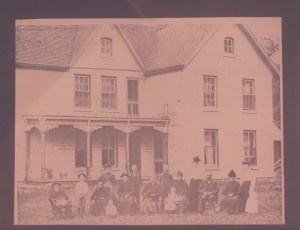
According to materials in the archives at Carleton College and elsewhere, the Bonde family, illustrated here, descended from Norwegian immigrants Tosten (left) and Ingabor (seated some distance to the right). They didn’t do much public display of affection in those days, unless you consider the number of their offspring a public display.
I have mentioned King Harald Harfegre the Fairhair as having given rise to this bunch of people, one of whom is my Grandfather Carl T. Bonde. Here’s some material I lifted about this damned interesting fair-haired dude:
In the Saga of Harald Fairhair in Heimskringla, which is the most elaborate although not the oldest or most reliable source to the life of Harald, it is written that Harald succeeded, on the death of his father Halfdan the Black Gudrödarson, to the sovereignty of several small, and somewhat scattered kingdoms in Vestfold, which had come into his father’s hands through conquest and inheritance. His protector-regent was his mother’s brother Guthorm.
The unification of Norway is something of a love story. It begins with a marriage proposal that resulted in rejection and scorn from Gyda, the daughter of Eirik, king of Hordaland. She said she refused to marry Harald “before he was king over all of Norway”. Harald was therefore induced to take a vow not to cut nor comb his hair until he was sole king of Norway, and when he was justified in trimming it ten years later, he exchanged the epithet “Shockhead” or “Tanglehair” for the one by which he is usually known.
In 866, Harald made the first of a series of conquests over the many petty kingdoms which would compose all of Norway, including Värmland in Sweden, which had sworn allegiance to the Swedish king Erik Eymundsson. In 872, after a great victory at Hafrsfjordnear Stavanger, Harald found himself king over the whole country. His realm was, however, threatened by dangers from without, as large numbers of his opponents had taken refuge, not only in Iceland, then recently discovered; but also in the Orkney Islands, Shetland Islands, Hebrides Islands, Faroe Islands and the northern European mainland. However, his opponents’ leaving was not entirely voluntary. Many Norwegian chieftains who were wealthy and respected posed a threat to Harald; therefore, they were subjected to much harassment from Harald, prompting them to vacate the land. At last, Harald was forced to make an expedition to the West, to clear the islands and the Scottish mainland of some Vikings who tried to hide there.[3]
The earliest narrative source which mentions Harald, the 12th century Íslendingabók notes that Iceland was settled during his lifetime. Harald is thus depicted as the prime cause of the Norse settlement of Iceland and beyond. Iceland was settled by “malcontents” from Norway, who resented Harald’s claim of rights of taxation over lands, which the possessors appear to have previously held in absolute ownership.
If you’ve waded through this Wikipedia quotation, you get the idea of the voraciousness with which Harald ruled Norway, all for the sake of Gyda the Scornful. Also the length of his hair. And that he allowed his hair to become a tangle. Perhaps like the dreadlocks of today.
I don’t know which of Harald’s twenty children of the fair-haired one was my forebear, but it may boil down to either one nick-named “blood-axe” or another with the pet name “the good.” The material I saw doesn’t tell which.

Bungalow in Billings
We bought this big old house in January, 1984, the one where Penny and I still live. A January arctic air mass had settled over Billings and the temperatures were in the teens below zero, possibly colder than that. I rented a U-Haul to move the two blocks down the street from where we had been renting. Our oldest kid was 12 years old. Well, we had a nephew or two live with us. I can’t remember exactly who or when, but they seemed to come and stay for months at a time. It was good.
The house had filthy green carpet. I don’t know where we slept that first night. I remember that our cat, Burton Rustle, disappeared without a trace in the subzero weather. I imagine we slept in our old house for a couple nights until we got moved into the new. Probably we all slept together in the front room after we moved in.
We didn’t have a refrigerator. Problem wasn’t keeping food cold; problem was keeping the food from freezing so we could eat it. We found an ad for an outfit that sold used appliances and we got a fridge delivered to our house. Trouble is the fridge was at least 30 years old and you opened the door with a wire coat hanger. We didn’t learn about this until after we tried to use it in our house. We’d spent $100. The next morning I tried to complain about the fridge and the person simply hung up on me. Penny went to our bank at nine the next morning to stop payment on the check, just in time to see the seller pull out of the bank parking lot. Missed him by just a minute or so.
We needed to fix up the attic so the boys would have space to sleep. Winter of ’84. That’s when I met Tex Jawort at UBC Building Supplies. He helped me load a lot of 2x4s and insulation and sheetrock into our old VW van. I remember that Tex admired the van. My nephew helped fix up the attic. The access to the attic was in our back bedroom, so I cut a hole from the dining room into the stairway. I cut the outline of the new doorway in the lath and plaster, then took a run at it with a cinder block. Just as I was crashing into the wall with the block, Penny walked into the house, home from work.
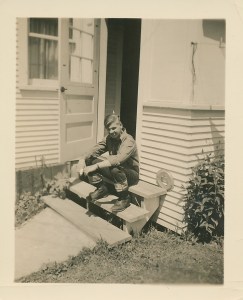 End of Carl’s Junior Year
June 15, 1940
Carl’s dad gave him a ride from Kalispell to the entrance of Glacier National Park in his old black Plymouth. Bud had the packsack with clothes, shoes, extra warm clothes, rain gear and his rifle. Park Service fire lookouts and guards were allowed to bring a rifle in those days to discourage bears. He had what he would need for his first summer as a Park Service fire lookout.
His dad took him past Columbia Falls, past Hungry Horse, and let him off at the West Glacier Ranger Station.
 Bud clumped in through the front screen door into the front office. He noticed that quite a few had walked onto the floor with corked boots because of the black dots–spike holes–in the deck. The place smelled like newly sawn wood.
No one was there. He dropped his pack and leaned his rifle, then, after walking around, thumbed through the display of maps and other amenities offered to the tourists from all over the world who visited Glacier National Park. A wall map captured his attention on the other side of a counter. Bud walked around to study it. He located West Glacier, then followed the North Fork of the Flathead River until he reached a horseshoe bend where he found Huckleberry Mountain. That would be his job this summer: to man the lookout and watch for fires.
“Hey. Anybody home? Hello.”
Still nobody came, so Bud walked through to the office back door and onto a sort of broad gravel yard flanked by warehouses and garages with huge touring cars. Everyone called them jammers, he found out later.
He heard a man’s voice from a nearby warehouse. He poked his head around the edge of the door and saw a young uniformed man he later learned was Ralph Fulp, speaking to a group of mostly youths approximately his age. Bud recognized about half of them: There were the Huck brothers, Garvin and Vernal; Leslie Cornelius, Rob Jystad, Art Anderson and Don Bolton. Also a much older man. In those days the women were hired separately and always got office jobs. Everyone in the group was headed to work on a fire lookout tower. Leslie Cornelius, the only one who lived in the Park year around at the railroad town at Essex, was assigned to Swiftcurrent Mountain. Bolton got Waterton Lake; Anderson, Hornet Peak; Jystad, Hubbart Mountain; the Huck twins: Garvin got Scalplock Mountain and Vernal got Loneman; an old-timer, Scotty Beaton, got Numa Ridge as he had for the previous 17 summers. Carl got Huckleberry Mountain.
By the end of June they would all be itching to get to their towers. They will have slept in the bunkhouse with some of the guys who ran the Jammers and some firefighter reserves. They wouldn’t get to know the Gear Jammers because they were gone all day driving. They got to know a couple firefighters, a guy everyone called “Smiley,” an immense man with a slow wit, and another named Kevin.
They would not be manning their fire lookout towers until after July first, Fulp said. First they had to train how to read maps and use a compass, how to use and maintain the wires for the battery operated telephone systems, basic first aid and safety, and how to locate and put out forest fires. Fulp told them about the pack train of mules to supply them about every two weeks.
The warehouse at West Glacier Park Station had a lot of old excess army gear from the Great War. Europe was again in turmoil with the rise of the Nazis in Germany, but so far, the U.S. had managed to avoid trouble.
One night, the boys in the bunkhouse were playing cribbage in the main room when Smiley came out of the kitchen and asked, “Hey! Does anyone know where I can get a funnel?”
Kevin shouted at him, “Just use your head!”
Smiley gave out a sort of grunt or yell and ran at Kevin, knocking him down from his seat on a bunk. Kevin rolled, howling, then ran out the bunkhouse door, the screen clacking after him. Kevin outran Smiley. After a while Smiley returned, said he didn’t know where Kevin went. Later, Carl and the others found out Kevin had climbed a tree and spent the night there.
Was it the sweaty smell? Something about Smiley offended the others. He was just creepy. He kept a loaded .22 pistol in his footlocker, he said, for protection against the other men. “Uh hope I never have to use it,” Smiley said.
Smiley also kept a stick he stripped the bark from with a nail sticking out of it, another weapon. He kept that one under his bed until one of the other men stole it and threw it out into some bushes.
“Hey Smiley,” the boys could hear Kevin’s voice in the dark after they had all laid down in their bunks. “Hey Smiley!” he repeated.
No answer from Smiley.
“Smiley, I hear you got a girlfriend,” Kevin said.
“Noooooooo,” moaned Smiley. The others could almost feel the heat from Smiley’s embarrassment.
“Yeah, I hear you got a girlfriend, and your peter has a festering sore on it,” continued Kevin.
“No I don’t,” protested Smiley.
“See? You need to go into Columbia Falls and see a doctor,” said Kevin. “He’ll put a bag on your dick, kind of like a Bull Durham tobacco bag, but filled with medicine. Then he’ll tie it on with the strings.”
No answer from Smiley. Things got quiet and stayed that way, except for the snoring.
 The day started at 3 a.m. when they went to open up Huckleberry Mountain Lookout. The rain had turned to a light snowfall and Carl wondered how a fire could ever burn when the woods had snow like this.
His dispatcher’s name was Jackson Miller, an amiable old guy with a hawk nose. And half of one foot missing. You could tell by the way his logging boot looked when he walked. The toe region of his left foot was obviously empty because the boot crease went down to the sole. Jackson was also the outfitter and leader of Bud’s first trip to Huckleberry.
The wranglers, Nathan and Craig, had already brought four mules and six horses to the warehouse area where they were tied to a long line across. Four saddle horses had bridles; the rest of the stock had halters. The pack animals had Decker saddles for packing. The mules, in addition, had straps that reached around their butts and withers to prevent their loads from shifting front or back.
Bud didn’t know about pack animals, so he studied how they were rigged. He was a bit more, but minimally, acquainted with saddle horses.
He watched as the wranglers and Jackson prepared the mules and pack horses. Bud’s gear was divided up and piled in the center of each square of canvas, called a “maynee.” Jackson asked Bud to gather up the corners and heft the loads to get them approximately the same weight so they wouldn’t shift to either side once loaded on an animal. Each animal could carry about 200 lbs of gear: food, clothing, bedding, water in milk cans, a rifle and ammunition, and other supplies for the summer. Especially six volt telephone batteries. The big kind. The size and shape of a can of beer. Dozens and dozens of them in wooden boxes.
Once the loads were about equal, the wranglers folded the maynees like envelopes: left, right, bottom, top, and tied them shut with a diamond hitch using a 15-ft length of rope. After all of the 12 maynees were fixed up, the wranglers hoisted each load up high on the sawbuck, drew a rope beneath it and back up onto the saddle, and secured it with several wraps around the load and then tied it off.
Bud was impressed how quickly the mules and pack horses were loaded. Then the wranglers saddled up their horses and Bud’s. Jackson saddled his own horse and led the way. The wranglers rode on either end of the pack string. A good thing because a couple of times the animals bolted and dodged off the trail.
They made the first five miles of the trip by lunch time because the trail was flat. Bud tried to peer through the fog to see which mountain would be his home as the wet brush swept his legs, soaking his pants and filling his boots with water. The air smelled of wet wood.
Every so often he’d hear one of the wranglers curse at the Park Service pack animals. Each animal had a “GP” brand on its butt. Stood for “Got Piss.” Bud had heard that one before and didn’t think it was funny. Anyway, they rode through intermittent fog all morning and Bud thought if was spooky. He was afraid of grizzlies.
The cook at the bunkhouse had prepared lunches that they each put in a canvas roll behind their saddles. That and an old military surplus canteen in a canvas canteen carrier. Great War canteens looked the same as the ones from the Civil War: circular in shape with a cork stopper.
After lunch they started up the trail to the lookout. An hour of flat trail followed a creek before they headed gradually up the side of a long canyon. After what seemed like an interminably long time, six hours, they climbed above the clouds, reached the head of the canyon, crossed a saddle, and stayed on the left side of a steep hill for another three miles before they got to the ridge with Huckleberry Lookout. Bud felt exhilarated.
And there it was! A log cabin with a cupola atop it. Bud’s home for the duration of the summer.

Glacier National Park Fire Lookout Cabin
What I did last summer
For Sophomore English Composition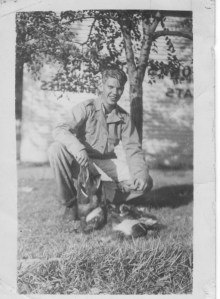
September 20, 1938
by Carl R. Bonde, Jr.
Daddy and Mummy took me and my sisters Crummy and Hummy to Glacier Park on holiday. On our way there we stopped for elephants, to ride them, and to chase a few grizzly bears. I chased a grizzly bear into the lake where the water hung over our heads like an atmosphere.
The sun shined brightly all summer except for when it rained and it rained all the time, every day.
That is what I did last summer. That was the first day. After that we had a picnic, caught a fish, made a camp, slept out a night, picked a vegetable, peeled a squash, bled a beet, fed the dog, fed the chickens.
After that I got back to high school and wrote a 100 word essay about what I did last summer.
The End
Carl R. Bonde, Jr.’s high school junior year
November 2, 1939
Carl turned over in bed after peering at his alarm clock. Eleven-fourteen. Worse luck! He had forgotten to wind it again. Carl had a pretty good idea of the time. He had heard his older sister Carol clumping downstairs in her fashionable shoes. Jeez it was colder than a brass toilet seat on the shady side of an iceberg! Their bedrooms were upstairs, unheated, freezing, except for whatever came up the long straight stairs. In the basement was the oil drum furnace that heated the air for the register in the living room. The house smelled like pine smoke in the winter. Winter in Kalispell seemed to last all year.
He pulled the wool quilt to his chin. He could see his breath in the dim light of morning. The windows were fingernail thick with frost. ‘Carol will take at least half an hour in the bathroom,’ he thought. He had to pee. Other mornings he would go downstairs, run out the kitchen door and take a leak against one of the trees. That day was damn cold.
Carl pulled the coffee can from under the bed, got up, pissed, pushed it back under, jumped back under the covers. Just a little piss on his underwear. Didn’t matter what he did after he peed, some urine always dribbled out. Got a little on the linoleum floor.
Anyhow, he got almost warm again after thrashing his legs back and forth a couple of times. Not as warm as he needed to get, so he got up, pulling on a couple of layers of clothes. Long handles, then denim pants lined with flannel. Socks. Shoes.
His parents were up and his mom had fixed oatmeal. He wanted a cigarette, so he hunkered over the heat close to where his dad sat in his overstuffed chair and lit up. Good thing he was wearing shoes because the grille was apt to cut into his bare feet. He loved talking about hunting with his dad. They would certainly go out next weekend. The light snow made stalking deer easy.
Author’s note: Carl’s sexual preference was ambiguous. One of those who signed his year book was a boy who wrote, “Dearest Carl.” Another advised him to “Leave the wimmin alone.” For the sake of more fun, we can suppose he was gay. In 2010, I asked Carl’s army buddy, Bill Moomey, if Carl had a sweetheart somewhere, but apparently he didn’t. Bill just said, nope. Bill told me about a gay sailor he encountered on the USS George Washington in November, 1944. Bill said at that time, it was his first exposure to an openly homosexual man. That tends to rule out that Bud, who he had known intimately through nearly a year of rigorous outdoor infantry training, was gay.
He had a propensity for clowning, disrupting — the usual stuff of high school boys. Carl later scored near genius on an army intelligence test.
Carl walked through light snow to high school down to the dirt road, then four blocks more. He was on time, as usual, but he didn’t care if he hadn’t been. He knew that his sisters had been high achievers in high school. Band, orchestra, excellent grades, after school jobs. Buddy had no time for that. He liked to hunt and fish. He was applying to work as a fire lookout in Glacier Park.

My dreams were shattered when she dumped me for another. Damn! Longest year of my life extended from the time I went to bed that night listening to Hank Williams and Patsy Cline until the wee hours of the morning when I finally dropped asleep.
Although I understood about Country and Western any joy in discovery was muted by my complete loss of appetite. I tried to eat the Salisbury steak at Almeda Mann’s but my mouth was dry. I was way too embarrassed to tell why.
That’s when my wandering days began.
That’s when my wandering days began.
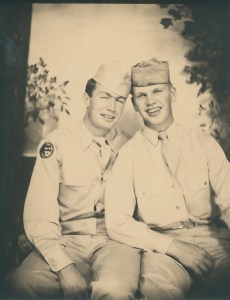
My Uncle’s friend, Bill Moomey, was delighted to see this photo of his platoon sergeant, Irvin Weaver, of the weapons platoon, Company E, 262nd Infantry Regiment, and his friend Carl Bonde.
Curious to see what the French person had written, translated from English to French, then back to English, I copied the website:
http://www.database-memoire.eu/Old/coll/B/bonde_carl.php#anglais
Interesting to see what was included: bits of family history and lore that I had included in some of the 437 posts I’ve written in my blog, insearchofbud.wordpress.com
Also interesting to note things omitted: most importantly the bibliography and other items published about the sinking of the Leopoldville. Granted, none of the five books, notably “A Night Before Christmas” by Joaquin Sanders and “The Leopoldville Disaster,” by Allan Andrade, mentioned Carl’s name, but a book of photographs, published just a few years ago by Allan Andrade, did.
 July 4, 2016
I have nothing to say, I say, saying it. Of course, it’s raining, or starting to. I could look up the National Weather Service to see if we are under any alerts or warnings. My energy is low. Almost too low to write anything.
July 5, 2016 @ 0130
I’ve been awake an hour, finally ate a medium-size dish of vanilla ice cream. I believe this is totally because of medicine I take, an antipsychotic with a side effect of increase in appetite. I feel exhausted. Going back to bed. Proud of myself for having written anything so far.
Later today I face a difficult day of work. Mondays in a pharmacy are apt to be busy, but this is a Tuesday after a three-day weekend at the beginning of the month. My strategy today is to crank out the work steadily and not allow myself to panic.
July 6, 2016 @0211
Feeling much better. Worked about 9 hours yesterday standing at the pharmacy filling prescriptions, mostly. This made my left lower leg and feet ache. Oh yes, and my lower back. Wow. Took some Aleve without very much relief. After supper, which Penny made, I went directly to bath and bed, slept soundly until now. I’m staking everything on writing my book about Bud. I need to work the story into a unified whole and I need an editor. I hope to finish telling about his early life in great detail, his short military career in exquisite detail, his final 48 hours in fine detail.
After that, I want to tell the story of how I came to know a man who died about four years and four months before I was born nearly 70 years ago. Is this time travel? No. Or yes.
If I could go back in time I’d meet my uncle in London in 1944 just to make sure he experienced the thrill of sexual intercourse at least once before he died.
First Grade
Saturday, September 16, 1930
Twinkle twinkle chocolate bar
Your dad drives a rusty car.
Pull the lever, push the choke,
Drive away in a trail of smoke.
Twinkle twinkle chocolate bar
Your dad drives a rusty car.
Buddy’s friend Teddy lived across the road. The two first-graders played soldier whenever they got together. Buddy and he also experimented with light
er fluid and matches, wrestling, and even poking their fingers into each other’s butts during the many hours they were unsupervised.
Life was good for Buddy. Not for Teddy, because unlike Buddy, his dad didn’t own five acres, only a house and yard down the hill and across Fifth Street. But, on the other hand, Teddy had old abandoned rusty cars to play in.
One morning Teddy waited for Buddy at the foot of the hill.
“Hey!” shouted Teddy, spying Buddy and his dog Prince, hiking down toward the bridge. The morning was bright, barely any hint of autumn, save the narrowest brown on the edges of the leaves of the apple trees that dotted the hill. The air was chilly too.
“Hoo,” returned Buddy. “Go to hell!” What a thrill to shout a swear word his mother would likely spank him for. If she had heard him.
“You go to hell!”
“Asshole!”
Buddy had to slip out of the house early on weekends to stay clear of his three sisters who would dominate him if they caught him. Oh, they sometimes took him swimming in the pool at the park, but too often, the teenage girls just ended up downtown at Norm’s News, hanging out with high school boys. Buddy soon learned to get up earlier than his sisters.
As they usually did, Buddy, Prince, and Teddy met at the barn at the foot of the hill. The home made door was almost always open and the air was cool in the shade of the interior. It always smelled sort of like dirt and oily rags. The two sat on a bench that went with a picnic table that served as catch-all for tools. Teddy looked expectantly at Buddy.
“Here they are,” said Buddy, producing a pack of Pall Malls.
“Gimme one,” demanded Teddy. “Gotta light?”
Here, Buddy produced a silvery Zippo. He expertly flicked it open and, after a couple tries, lit it. Teddy held the cigarette to his mouth and leaned in toward the flame. “Ah,” Teddy said, puffing a silver cloud of smoke. “Outstanding! And they are mild.” Of course he was reciting an ad from the radio.
“Go ahead and inhale!” Buddy said.
Teddy did, but began coughing. “I’d rather puff,” he said, once he caught his breath.
Soon the pair were puffing on their cigarettes, leaning against the barn. Just like a couple old soldiers. The smoke made their mouths water and they spit frequently. One cigarette apiece was enough. Carl hid the rest of the pack over the top of the door frame.

Dan Struckman
The French are rightfully proud of their fine language, and I was gratified to find a website that borrowed some of my language, translated from English to French, then back to English again. Here it follows, exactly as duplicated below:
Chapter two
I felt like I Had gone backward in time as I searched for Carl R. Bonde Jr.’s name on the Internet. I Had done this every month or so with no success ounce est devenu the Internet available. I Had hope and, finally, a map for Systematically searching for Bud.
Was my scheme to find the name of Any US That ship sank on Christmas 1944 And Then follow Any leads. I found a website listed That ships lost in WW II along with time lost and disposal. Perhaps I got 30 pages with 40 ships per page. I Looked and Looked for Several hours. Most of the ships Were Small, more like boats.
Then we hunch I typed Uncle Bud’s name in the search engine box and lo! A History Channel website cam Up That featured the SS Leopoldville. My first reaction Was disappointment! Then I felt skepticism. Reviews This was simply too easy. I Was Convinced When I found Bud’s name Among Those lost.
I ordered the History Channel videotape That featured the Leopoldville for $ 49.95 And Then returned to the HC website and Followed a link to a lot of blog That HAD beens dormant For Many months in qui callous strangers Questioned why anyone Would care about a ship That Was sunk 60 years ago. They wrote words really ugly and cynical, at least aim They Agreed That ship was sunk in 1944 HAD no relevance to ’em. Of course I felt hurt. For a while I thought my search HAD come to an end. Unkind people wrote que la SS Leopoldville No. along mattered. I felt discouraged.

How it began: Carl R. Bonde, Jr.
Wednesday, 7:30 p.m., September 16, 1929, Kalispell, Montana.
The bathwater was almost warm this time. Carl got a dog and a scooter yesterday for his sixth birthday. And a wooden boat from Pete Paulson. He laid down in the tub and swam the few inches from where he could push off with his feet on the drain end, to where his head touched on the round end. He did this again and again, pretending to be swimming. He couldn’t swim.
In another part of the house he could hear his mother’s agitated voice: “Well, I’m going to have it annulled,” she shouted. Well, she didn’t really shout or yell, but she was emphatic. Buddy didn’t know what the word “annulled” meant, but he knew it had to do with his oldest sister, Corinne. His mom’s voice dropped and Buddy could make out no more.
Even though he had his birthday the day before and he felt entitled to a long bath, he heard the insistent knock on the door, heralding a sister. It was Helen, two years younger than Corinne. He thought about his dog. His German shepherd puppy. His warm, fat puppy, already named Prince. His dog. His father had also given him a leather collar, too large for the puppy. Buddy could hear his puppy race about the house, down the hall that connected the bathroom with the parlor where his dad liked to sit and smoke his pipe, his cigarettes, his cigars. Everyone in the house smoked except him and his mother.
Buddy wasn’t allowed to have more than two or three inches of water in his bath, nor to spend much time playing with his new wooden boat. His was a Norwegian family and they considered baths a luxury. Just wasn’t decent to have a lot of bathwater. Especially not hot bathwater.
His new boat was solid wood, home made, about five inches long, three inches wide, painted yellow on the hull, green on the cabin. It floated a bit crooked. Probably too much weight up above.
The knocking continued, so Buddy got out of the tub, wrapped a towel, and unlatched the door. His high school-age sister Helen barged in.
Buddy, modest about his nakedness, had stopped letting Helen powder his body, including his private parts, with lavender talc. He put on his pajamas after Helen shut him out of the bathroom.
Buddy crept barefoot up the hall so he could hear his parents.
“I think it’s a crime the way that man just took off with Corinne on that motorcycle,” his mother said. Corinne was at least five or six years younger than Gordon Smith, the man she eloped with.
“It would be a good idea for her to stay away from him,” his dad said mildly.
“If you ask me, he’s a — a little puke!” his mom said. Buddy hadn’t heard his mother swear before.
“That’ll do, m’love. That’ll do.” His father didn’t usually confront his mother in such a direct way. He spoke in a soothing way, with a Norwegian accent.
His dad was seated in the overstuffed chair; his mother was pacing back and forth, clearly upset. She was wearing a house dress. Dad had dark wool suit pants and a white shirt with his loosened tie still around his neck.
Carl’s father sold groceries wholesale to stores. He restocked them using a notebook and wrote up the store’s orders in a flowing, ornate style of penmanship. You see, in business college in North Dakota, he had studied penmanship from the master, himself: Austin Palmer of the Palmer Method.
Thus, Carl Bonde had secured his profession with his beautiful and legible grocery orders, written longhand in pencil, duplicated by means of a heavy purple carbon paper. Carl’s fluency in Norwegian helped. Many of the grocers and other commercial people in Northwestern Montana were Norwegian immigrants or children of immigrants who spoke little or no English.
Even though they still lived in town, Prince still could roam freely. He was protective of Buddy and trotted along most everywhere with the six-year old boy.
Buddy’s birthday was September 15, so he didn’t start first grade until he was seven. One day later and he’d have been a first grader. This gave him a year to explore Kalispell with his dog and any kids who got up as early as he did.
Ashley creek rolled silently through the edge of town, changing to noisy rapids by the time it made a bend and flattened out until it reached the sawmill, out of bounds to the curious child. The boundary was a practical one; it was just damned hard to get to the sawmill, so it was never a place Buddy routinely visited when he made the rounds with his dog.


 insearchofbud