 March 7, 1943
His anxious energy made standing under electric lights at attention at 3 a.m. easier.
Carl had been in Army boot camp a little more than four hours. Of course, his anxious energy was counterbalanced by the sadness, the loss. His reverie soon turned away from sadness. He looked up.
The lightbulbs in the outdoor fixtures far overhead were huge, compared to the ones he had at home in Kalispell. Carl wondered where bulbs like that came from. He wondered if they would have been better for his homemade photo enlarger than the puny bulb he used at home. Do they make a lot of heat? Carl thought that they probably made lots of heat.
Carl’s problem was that the image his enlarger made had a hot spot in the middle, despite the big piece of wax paper Carl fastened between bulb and negative to diffuse the light. Anyway, the bulb had soon melted the wax, spoiling the image even more.
If thinking about his homemade enlarger made no sense, neither did obsessing about the love life he had left behind.
His girlfriend had long strawberry blond hair. How he longed to touch her hair. Gloom soon took away whatever pleasure Carl might have found in the dark beauty of the surroundings. The well-ordered parade ground, lit by the moon and 3 a.m. slants of window light. The cypress trees. He hadn’t seen cypress before, except in pictures. In books. In school. Everything was humid and quiet.
Carl had maybe 60 other army recruit companions in the same situation as him. Someone had ordered them to stand at attention, then whoever it was, left them to wonder what the hell would happen next.
They stood there, looking straight ahead. He and the others had all just gotten their heads shorn. Not quite bald, but close. They wore identical fatigues and boots.
Carl thought about home, about college. He had been living in Missoula, Montana, for most of the two years before he joined the Army. He had hoped enlisting would get him into the Navy, possibly safer during the war. It didn’t work. He had offered himself to be drafted. His best choice.
Just last year Carl saw a picture of cypress trees when he took intro to botany as a forestry student. Botany 101. Sounded like an easy subject when he handed his card to the registration girl sitting at the table in the gym.
Oh that registration girl! Carl could picture her even now. Didn’t the university have great looking women just about everywhere he looked? He rarely saw R.G. again.
Anyway, R.G. found a place for him in Botany 101, section 5. The entire — oh, maybe 200 students or so — botany class met in Science Hall on the oval for lectures three days a week and then split up by section for labs in the same building.
He could barely stand it. He hated the routine, the boredom. Botany 101 consisted of memorizing a couple hundred unfamiliar words and a couple dozen new concepts. That was all. He hated school, except for the drinking and the women. Well, he liked math, because it was more than a new vocab list and a few ideas. But he hated all the rest of it. He liked playing bridge and chess too.
He had really wanted to find a woman to love, to sleep with. Carl smiled despite the order against it. Apparently whoever gave the order to stand there wasn’t even paying attention. Maybe nobody was watching. Carl enjoyed his thoughts. Best of all, Carl recalled how he had found exactly such a woman in Missoula. He remembered how they they had loved each other and went everywhere together for more than a year. Then she finally agreed to have sex with him. His first impulse was to tell her no! that he had changed his mind. Carl was getting aroused by his memory.
They had hiked out along the river some distance. They spread a blanket. He remembered how guilty he felt when he thought of his mother. Up until this moment she had been the principle woman in his life. That was about to change, he thought.
She offered herself to him and he at first sat beside her and kissed her. Then he helped her remove her boots and socks. He unfastened her pants and pulled them off.
He blushed a deep crimson as he pulled her panties down and off her feet. She drew her legs to her chest as she sat on the blanket and clasped her arms around her legs. She was cold. She asked with him to please be gentle. He blushed again.
He remembered sitting beside her, then they laid down together. He sat up to untie and remove his shoes. He took off his pants. He fumbled with his own underwear.
Then he cringed. Carl remembered with chagrin that he failed when he tried to have sex with her. He knew nothing about her hymen. He was so excited that he ejaculated onto the blanket. He felt frustration, shame.
They consummated their relationship later that day at a friend’s brother’s apartment.
Carl’s mind was back in the recruit depot. His anxiety was less. Hell, he could stand at attention all night if he needed to. Carl saw that the others were starting to look around, same as he was.
He decided he would perform small acts of defiance. Maybe add a wrinkle to his clothes, skip an eyelet on his boots. Carl didn’t want to get brainwashed.
Then loud footsteps interrupted his thoughts.
“Fall out!” a voice commanded. Bud looked around but nobody seemed to know what to do. ‘What did it mean? Fall down?.’ He grinned when he thought of all 60 recruits just collapsing. Then came a voice like a thunderbolt.
“You piece of shit!” shouted a man with a broad brim hat and shiny boots. He was maybe less than 5 feet tall, had a red face and stood in front of Carl. Inches away from his face. “Did I say give me a goofy smile, turd? You better answer me! ANSWER ME!”
“No sir!” Carl’s voice was high. He stopped smiling. He stood as still as he could, amazed at the man’s appearance and energy. Amazed at how this crazy guy had picked him out of the group. Amazed at the man’s volume and language. Nobody had spoken to him like that before.
Oddly, he thought how he probably wouldn’t tell any of his sisters about this man’s foul vocabulary.
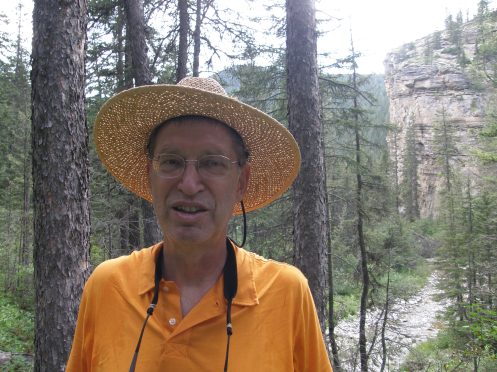
The Beartooth Front
Penny and I had made this hike a couple years ago with a group from the Montana Wilderness Society. Several in the group were expert in identifying wildflowers. One used a phone app.
One could use a phone because the trek was just outside the Beartooth Wilderness, as I said yesterday.
A couple years ago I was two years younger and all the stronger and more vibrant. Even then, seemed to take all my strength to take to the trail, climb up an endless bunch of switchbacks, and come out at this saddle between the Beartooths and well, something else. I think we hiked about 11 miles, half uphill.
Today I figured P. and I wouldn’t be able to hike all the way up the saddle, but we did. I stopped and took a few pictures. Well, I tried to take a few pictures with a new smart phone. Trouble is, I don’t know how. And if I did take some photographs, I haven’t the knowledge of plants to say what the pictures were of, or the knowledge of how to share them. Our niece Becky will come home and help me post the pictures.
P. and I made it all the way to the top! For that we have earned our own pride. We also earned sore toes coming back down. Oh yes. Gunther accompanied us the whole way. P. fixed up some drinking water by pouring some into a plastic bag that she fashioned into a reservoir for the dear dog to lap up. There was a creek near the bottom of the trail just before the switchbacks commenced. I have a picture of Gunther wallowing in the mud of the creek. What a trooper!
Man my toes hurt. My second toe is longer than my great toe, so it bumps into the end of my shoe as I descend a trail. What a trial. What pain. However, the good thing is that I frequently get a black toenail on each foot, the sign and stigma of a real hiker.

June, 1941
Carl reports to the West Glacier Ranger Station Monday for his second summer as a fire lookout on Huckleberry Mountain. First he graduates from high school and says goodbye to his friends from school. We find Carl in bed the next morning.
Carl was sicker than he could remember. He knew it was from last night’s graduation, drinking out on a road toward Conrad Cemetery.
‘His friend Hank had a trunkful of bottles in a box. No, a boxful of bottles in his trunk.’ Carl narrated the scene in his head. Then Carl didn’t care. He wished he could throw up, but he knew he couldn’t because he had the dry heaves hours ago. Carl was glad the shades on his room were drawn because light hurt his eyes and his head.
He didn’t want his mother to know about last night. When did he come home? God! The taste of whiskey was all in his nose and head! Cloying, sweet. Made him feel restless. He drew up his legs and extended them.
Hank had told him he wanted him to have a good time after graduation. He teased him about being a virgin, about not drinking. It was June, 1941, the evening warm. A clandestine party. Carl was only starting to realize he no longer trusted Hank.
“This is like an initiation,” he urged. “Here, drink this. Tastes like creme de cocoa. Drink it right out of the bottle.” Some of his other friends also partook. Like Les and Dave. Duck didn’t come. Duck’s dad was an alcoholic and Duck wouldn’t drink.
The liquor burned, tasted sweet, sort of like cocoa. He gulped a few. Soon Carl was heading ’round into the slant. After running into the ground that rose up to his cheek like a wall of gravel, he crawled over to the side of the road and vomited in the long grass. Things got mixed up after that. He remembered lying on the floor of the car in the backseat. Something about his jacket being left behind. He sort of remembered hollering for someone to get it for him. Then he fell asleep.
At last Hank took Carl home, pointed him toward the porch, and drove away.
Carl made it into the kitchen door, then through into the dining room. After the dark confusing maze inside his house, Carl couldn’t keep from brushing hard against the stairwell as he climbed to his room. He felt a bit proud of his ability to navigate in the dark. Once into his bed he got under the covers without removing his clothes. Didn’t matter, he thought. The room spun, so Carl put one foot out onto the floor.
Soon, morning.
“Yoohoo, Buddy!” sang his mother from downstairs. Carl said nothing. “Want some eggs for breakfast?” The thought of eating eggs made him retch. His body felt suddenly hot and he kicked off his covers with feet that still had on shoes. “Buddy,” she called again, her voice high, musical. She walked up the stairs in her leather heeled shoes. Clump. Clump. Clump. He looked at her face in the doorway.
“I don’t feel so good, ma.”
“Now why would that be?” his mother asked, coyly. “Was it something you — she paused for effect — drank?”
He didn’t answer. He felt shame. His mother clumped back downstairs. Now he felt cold again and wrapped up in his blankets. His head ached. Nobody would help him get some aspirin powder that he knew was in the hallway cabinet near the bathroom.
His sister Carol was in girl scouts, off to a camp at Flathead Lake. He stared at the wall, in his misery. He studied the door to the closet. At his stuff. Books, a knapsack, wool socks. His rifle.
He knew that in a couple of days he would be back, working in Glacier Park. On Huckleberry Mountain. Living in the cabin beneath a fire lookout, thousands of feet above the North Fork of the Flathead River. He wondered if he would feel better by then.
He loved his parents, but right then he was thinking his mother was. . . he didn’t want to finish the thought. He wasn’t superstitious or religious. He had always been the family pet, kind of. The only boy in the family born after three girls.
He loved his mother so much! But she was heartless. She was bad! He wanted to say it aloud, so he whispered, “you bitch!” Somehow, he felt better. He had survived the rite of passage. He removed his clothes and got back in bed to try and sleep.

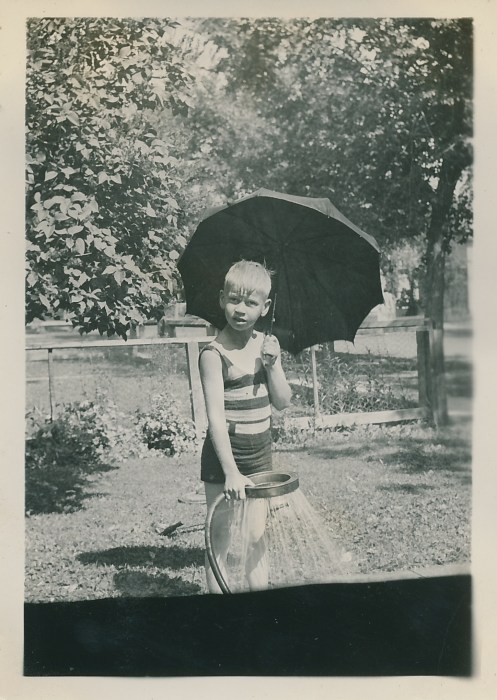
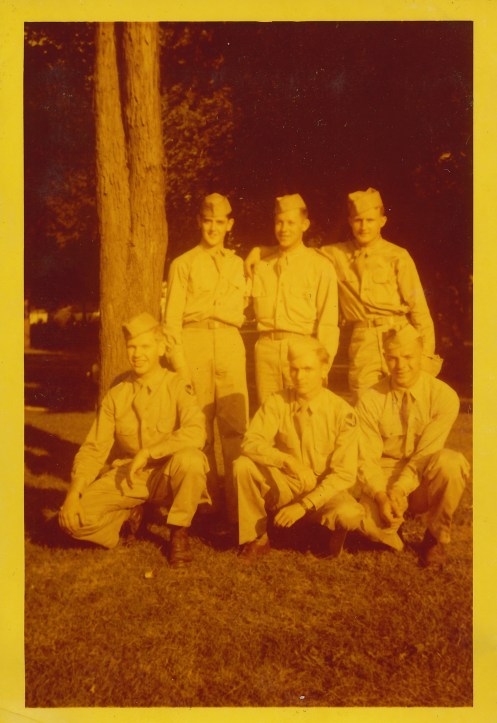
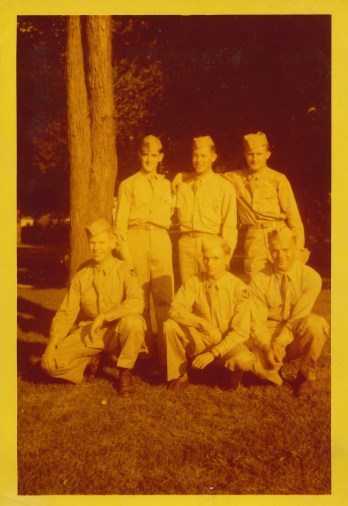
Carl is front left in this toned photograph. Their left shoulder insignia appears to be a pair of wings, possibly from the A.S.T.P. period when Carl attended the University of North Dakota as part of the Army Specialized Training Program. After several months the program was abruptly terminated and all of the students were given the rank of private and sent to infantry units. Carl went to the 66th Panther Infantry Division in the deep south. He and 763 other soldiers were ultimately killed by a Nazi torpedo within a few miles of Cherbourg, France, Christmas Eve, 1944.

Looks like Carl and his friend were getting into being soldiers. Again, this appears to have been taken during the winter of 1942 in Grand Forks, North Dakota at UND.

I don’t know who is standing to Carl’s right in this photograph. I can’t even tell where it was taken, or by whom.

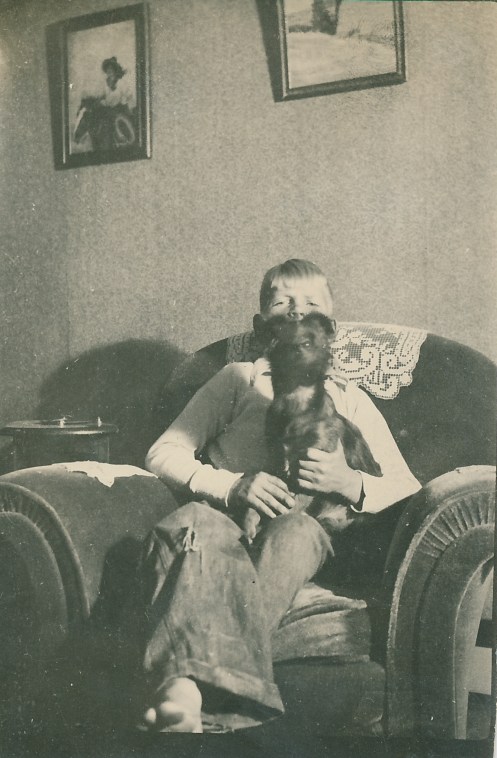
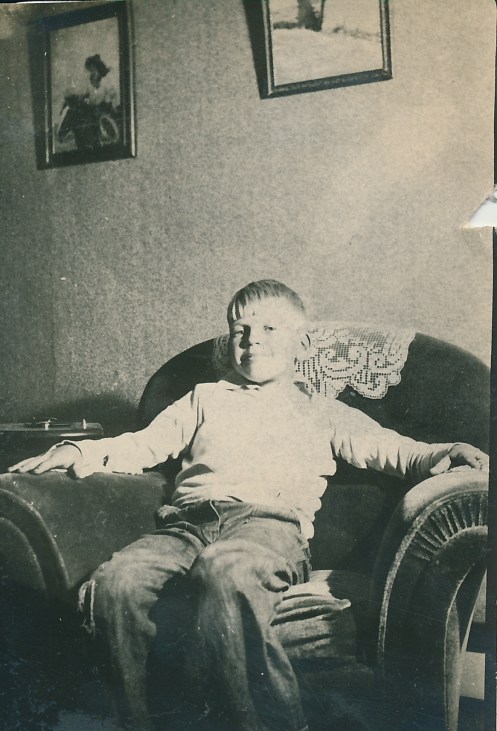
Carl is home on leave in this photograph taken at his home in Kalispell, Montana. His dog Prince was evidently happy to see him. That this photo was well loved is evident by the wear and tear.

Carol
My high school age sister occasionally brought boyfriends over to the house: Loren Durand, Harry Fritz; all of them good guys, fun for a pre-adolescent like me to hang around. I must have been quite young because I remember teasing Loren about his hair. He didn’t like my teasing. And climbing up Harry Fritz like he was a tree. He wasn’t a tree, and, but I think he was only mildly irritated by my physically hanging off him.
Then, some time or other, she brought over an older guy named Chuck. Chuck Angel. My earliest memory is that Carol and Chuck took me and Eric Fiedler along when they went up to Blue Mountain to a shooting range to shoot Chuck’s .270 rifle at targets. I must have been in the fifth or sixth grade because I was old enough to hold the rifle and fire it. Recoil hurt. Chuck let me look through the scope at a soldier, probably in the National Guard, who you could see hundreds of yards away in the hot summer sun. I could only see his helmet. Bothers me when I think I was pointing a rifle at a person.
Chuck was fun for me. Once on the way out to somewhere in the country near Missoula we stopped at Jumbo Hall, a prefabricated post WWII dormitory at the University of Montana. I think the place was still called Montana State University in Missoula. At that time Bozeman had the Montana State College of Agriculture.
Anyway at Jumbo Hall I was amazed to see Chuck climb through a window and return to the car with a brown bag that looked like a purse. Turns out it was a camera bag that he had bought in Germany when he was overseas in the U.S. Army. ‘Wow! A real army man,’ I thought. Chuck answered my questions about the army honestly and respectfully, so I loved Chuck. He and Carol took me swimming at Lolo Hot Springs, at Nimrod Hot Springs. Nimrod was on the old highway between Missoula and Drummond. Chuck was a genuine man. My own father died when I was about four years old.
Chuck was handsome, smart, kind and, best of all, he and Carol liked each other. And both of them liked me a great deal. They played games with me. Games like throwing golf balls into a diaper pail filled with water. Juggling. Card games. Board games.
Carol and Chuck let me babysit their first child, Chuckie, for a generous 25 cents/hour, while they went out on dates that didn’t cost them any more money than to pay me. They were dirt poor because Chuck was in law school and they lived on the G.I. Bill and whatever money Chuck could earn teaching accounting as an adjunct at the university. They lived in the old strip houses near the university golf course. Of course they had no television and perhaps they had a radio, but they certainly didn’t get the newspaper because they couldn’t afford it. What they had was classical white privilege. They knew things would eventually get rosy. They spent their spare time playing with the baby. I played with Chuckie for hours also.
After law school, they moved to Helena where Chuck was a clerk for one of the Supreme Court justices; then Chuck got a job in Bozeman with a law firm.
One day, while I watched the kids for Carol when she was out shopping, I got to looking through Carol’s photo albums and I found a couple of letters, written on yellow legal paper, Chuck had written to Carol before they got married. Of course, I was in high school by then and I had a prurient interest in a juicy love letter to my sister. I had just opened the letter and read the salutation, “Dearest Carol. . . .” when I heard the front door opening. I tried to hide the letters under the couch where I was sitting on the floor, but Carol saw me and she snatched up the letters, telling me they were private and I wasn’t to read her private letters.
Fast forward to about ten years ago when my sister was recovering from a horrendous car wreck. Well, she ran into a moving train with her car. I’ve written about that before. Everyone thought she had tried to commit suicide by crashing at high speed into the train. The coal car she crashed into was damaged enough that the railroad sent my sister a bill for damages. My sister was damaged enough to spend some time in intensive care. Oh, and they had to extract her from the wreck with jaws of life. Carol had been speeding faster than 60 miles/hr when she hit the train. The speedometers stick to the speed the car is going. They make them that way, my niece told me.
The short of it was my sister was forbidden to return to her big victorian style house in Mitchell, Nebraska, when she was discharged from the hospital. From the psychiatric ward.
I had the pleasure of signing my sister out of the ward. Payback for her springing me from a military jail in 1970. But anyway, I helped move my sister to our house in Billings so she could recuperate. I think I’ve written about that before too.
What I didn’t tell about was Carol’s son Jon and I packed up and moved Carol’s stuff into storage. At the last, I moved a bread box of her valuables and I found the yellow letters that started “Dearest Carol. . . .” At last. I scanned the first page. Chuck talked about his wishes for marriage and family. I folded the letter back up and replaced it in the box.
Knowledge about life in a fire lookout comes from our having served three summers at Indian Mountain Lookout in the Kaniksu National Forest in Northeastern Washington. We gleaned information about the old days from the old timers at Priest Lake, and from digging around garbage pits and bushes on the mountain top, where we found boxes and boxes of old telephone batteries, bottles, cans, dinnerware, pots and pans.
Two weeks, three days later
Carl fell into a sort of routine despite his freedom from supervision, his solitude. His duties were simple enough. He was required to make a log book entry about six times a day. Previous entries read mostly like this: “0800 — reported no fires.” He was also required to telephone his dispatcher back at the West Glacier Station periodically. Other than maintaining the premises and keeping watch for forest fires, his time was his own. His daytime routine included plenty of time for napping and reading.
Finally, after weeks of clear skies and cool weather, there was heavy cloud buildup. Carl had long ago connected and tested the field telephone so he could speak with the dispatcher, Jackson Miller. It was about 6:30 p.m. A few drops of rain started to fall and Bud remembered suddenly that the rain gauge hadn’t been emptied since the last sprinkle when he got 0.12inches. Bud raced out of the cabin, down the hill toward the gauge and as he tossed out the water, he heard a deafening, “SNAP — BOOM” “echo echo echo.” A blinding flash came simultaneously.
Without thinking, Buddy flung down the guage and sprinted back up the hill to the safety of the lightning-protected cabin of the lookout. When he got his breath he looked out toward the direction of the strike.
Still shaking with excitement, he saw a misty, broad cloud of blue smoke wafting over the crest of his hillside. He stood on the special stool with glass insulated feet and grabbed the telephone receiver and cranked a handle:
“Fire flash. This is Huckleberry Mountain,” he said, following the script he got in training.
A voice on the other end answered, “Hi Carl,” go ahead and chase the smoke. Wait — it might be just a cloud. Have much moisture?”
“Jackson, just a couple drops of rain. In fact I was….”
“Uh, stay where you are for now, Carl. I’ll call you back in a few.”
‘He doesn’t believe me,’ Buddy thought. He climbed up a ladder into the cupola, feeling glum. He saw a distant flash of lightning. He counted the seconds. It was so far away he never did hear the thunder.
The phone in the cabin downstairs rang, so Buddy stepped onto the footstool and picked up the receiver. “Huckleberry,” he said.
“Uh, go ahead and chase the smoke you saw,” a voice said.
“Okay, Jackson,” Bonde replied, and hung up.
Carl’s fire pack leaned against a log wall by his door. He grabbed his hat and the pickaxe everyone called a pulaski, and headed down the mountain toward the smoke. He was surprised at how close it was, only about 40 yards from the lookout. There he saw a tree that had been split from crown to trunk, still standing, with fire licking outside the split. Bits of burning material were scattered about the base of the tree.
He did as he was trained. He sized up the fire to determine what to do first. Since the embers and twigs were burning in the forest duff, Buddy started digging a line around that area around the tree, including all of the burning embers, before chopping at the embers and cooling them in the dirt until they were out. Then he dug a trench with his pulaski to drop the burning snag. He recalled a training film he saw where they described a snag like that as a “widow maker” should a heavy limb get shook loose by the person chopping at the base.
As wet as the forest was this early in the season, he knew he didn’t need any reinforcement from other fire fighters. He had assessed the overall danger.
Next, he took the precaution of knocking down the smaller trees near the burning snag, dragging them out of range of the snag he was about to fell. After making the area ready, he notched the base of the snag on the side where he had dug the trench. Then he cut out a second wedge opposite to, and higher than the first, in order to make a hinge to steer the tree.
The tree began to tip, but the butt of the snag hopped off its hinge and it fell crookedly into another tree that, in turn, came crashing down so close to Carl he had to run downhill. Even then, he took a hard hit to his foot.
Fortunately, Buddy wasn’t trapped beneath the falling tree, but his foot had been struck with great force by its weight. Hobbling a step, then crawling, he knew he was seriously injured.
Years later, after he joined the army, he found out he had broken his first metatarsal. Because the fracture had never been properly set, he had a deformed foot that almost disqualified him from military service because they thought at first he had flat feet.
Buddy knew enough first aid from what he learned in Boy Scouts to know not to remove his boot. Instead, he re-laced it tighter so that it wouldn’t swell too much. Carl hobbled with a crutch he made from a branch, then he cut a line through the duff down to mineral soil to prevent the fire from getting away, and carefully mopped up. He put the whole thing out one ember at a time. The snag was now lying across the ground, and he cut the fire away with his axe and the hoe end of his Pulaski. Then he chopped up the embers and mixed them with mineral soil until they had cooled enough that he could handle everything with his bare hands. Bud knew not to leave the area until all was extinguished. It was dark when he had finished, and he was getting cold. His foot throbbed and hurt especially when he stood and gravity made his injury swell even more.
He faced a dilemma, but he also knew he needed to phone in to his dispatcher and report the fire extinguished. Fortunately, he had 40 yards to hobble uphill to cabin. After a few steps, though he had to drop to his hands and knees because of pain. Still, it took him only about five minutes because it was close.
Once in the cabin he rang his dispatcher. “It’s out, Jackson,” Carl said. “I put out the fire.”
The next morning, Carl stayed in his lookout cabin, took aspirin, and started looking through the variety of books that others had left him: The Maltese Falcon by Dashiell Hammett; Brood of the Witch-Queen by Sax Rohmer; War of the Worlds by H.G. Wells; The Hobbit, by J.R.R. Tolkien; Zane Grey — lots of Zane Grey. Then, Montana, High, wide and Handsome, by Joseph Kinsey Howard; The Big Rock Candy Mountain and the Great Gatsby. And a series of reports about the Big Burn of 1910. Thoreau’s Walden Pond, Jules Verne’s 10,000 Leagues Under the Sea, and The Outcasts of Poker Flat, by Bret Harte.
The next morning, even for a 17-year-old, Carl realized he was in a huge amount of trouble. His foot was discolored and swollen so that it looked more gray than pink, with small red spots where he had bled beneath the skin. He hadn’t realized that taking aspirin would only permit more bleeding and more swelling.
Took him like, twenty minutes, but he managed to change his underwear and pants and put his sock and boot back on his injured right foot. He found a copy of Colliers magazine on the bookshelf and, using the bandage roll from his first aid kit, tied on a splint to help prevent his foot from flexing. Once this was in place, Carl laid back on his cot and propped his throbbing foot on a pillow. And he worried. And thought. A few minutes later, he remembered that he needed to check in with his dispatcher for his 8 a.m.
Took him a few painful moments to get to the phone, but he rang up the dispatcher. It wasn’t Jackson this time, but another guy named Lloyd. “Huckleberry Mountain,” Carl said.
“Roger,” said the voice on the other end. “How’s the fire?”
“It’s out.” Carl answered.
“That’s not what I heard from Hornet Peak,” said Lloyd.
“That’s my smoky stove,” Carl answered quickly.
“Roger that.” said the voice.
“Bye,” said Carl.
“Bye.”
Carl felt panic. A hot place somewhere must have caught fire again down at the snag. Grabbing his crutch, Carl hobbled back out his door and down the short distance to the wildfire place. Didn’t hurt as much at all, as long as he didn’t hit his foot against any beargrass or stones or deadfall. Sure enough. There was considerable smoke coming from the snag itself, close to the root end where he had felled it.
Worse luck, he had forgotten to bring a tool. Going up was more than twice as hard, he thought, but got back to his cabin. Where was the pulaski? He looked in the usual places, but the damn thing was gone. Then he remembered that he had left it down at the fire after he had gotten hurt.
Another hobble had just the few painful moments when his right foot bumped into something. He found his pulaski close to the far end of the snag, where he had left it to return to his lookout cabin.
Turns out putting out the fire in the snag was a lot tougher than he thought it was going to be. He found it impossible to split the snag open without bucking it into some shorter lengths first. And his foot hurt whenever he stood to work. Took him more than two hours to split up the snag in order to scrape out the burning part, then cool the embers in dirt, chopping them finer and finer until the fire was out. At last Bud could touch all parts of the burnt snag with his bare hands and could find nothing more afire.
This time he left his crutch below, leaning on the ax end of his pulaski as a cane to help him climb back to the lookout. Bud was filthy, stinky, sweaty, tired, and very hungry and thirsty. He took care of his thirst first, then laid down on his cot again. He had to check in four times a day: 8 a.m., then 1, 5 and 8 p.m. He kept track of the time on his government wristwatch, logged his check-ins in the government logbook. He scrambled a half-dozen eggs mixed with an onion for lunch while he waited for time to report to the dispatcher for the 1 p.m. check. He used a bit of his precious water to clean his pan and fork that he used to cook and eat the eggs, then used the same water to wash his filthy sooty hands. He rinsed the pan and fork, then reserved the rinse water for the next washing. Only he used some of it to clean his face. This time the conversation with Lloyd was different. Lloyd asked Carl to take an extra careful look at the countryside to make sure no more smokes had popped up from the previous night’s lightning storm. Carl promised to do so.
Author’s note: Carl finished the season without any medical attention, thereby keeping his job, thereby ensuring his employment the following summer. He reported four more fires that first summer, six the next. Finally, in the winter quarter at the University of Montana in Missoula,
Here’s the premise for a story: suppose a man were to clean out his garage, hauling out box after box, old tricycles, fishing gear, flower pots — in abundance — and tarps, painting supplies, more tricycles. Wait. Didn’t he already haul a bunch of trikes to the Salvation Army store? Turns out the garage is vomiting up trikes from the depths of the earth and the man is trapped in an eternal cycle like Sisyphus.

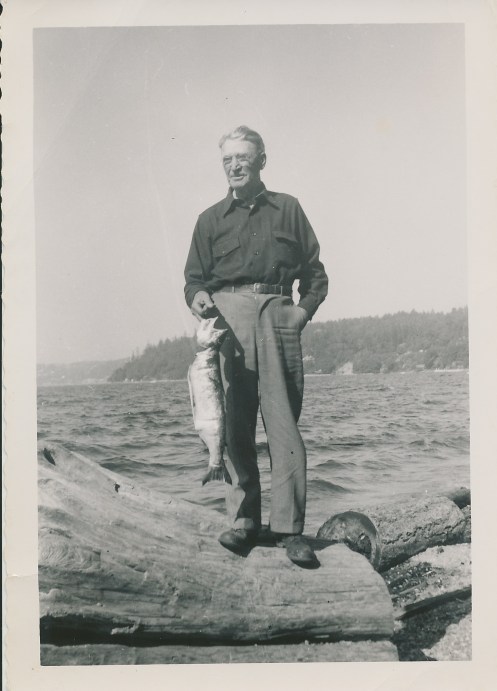
Grandpa Carl Tosten Bonde. By 1957 the fierceness had been bred out.
Reading the genealogy material, I lingered over the names of some of my purported Norwegian ancestors: Erik, king of Hordaland; Halfdan the Black Gudrodarson, King Harald Harfagre the Fair-haired; Eric Bloodaxe and Haakon the Good, who ruled side-by-side after Harald’s death; Paal Eiricksen; Berit Olsdotter Egge; Thorstein Eysteinsson; Einar Halverson Groven; Carl Tosten Bonde; Ellen Wichstrom, Helen Bonde, Dan Struckman.
Should be noted that Harald Harfagre the fair-haired spawned twenty children and an entire dynasty in Norway starting about 900 A.D. In other words, practically the whole country. You can do that if you are a fecund king with a half-dozen wives.
Harald the fair-haired king searched out and killed the last of the Vikings who tried to hide in places like Scotland and the Shetland Islands. I assume he dispatched them himself or gave them to his son Eric Bloodaxe, tyrant-in-training. I don’t know what role Haakon the Good played. Perhaps he was good at killing Vikings.
My own name, Struck Man, seems to almost fit with the rest of my lineage.

The world looks altogether good from the lookout, surrounded by nature.
6,235 feet elevation, Huckleberry Mountain
July 2, 1940
At the lookout the wranglers ran a rope from the lookout building to a bleached, twisty, driftwood-looking log and tied the stock so they could graze on the sparse vegetation. Jackson and Buddy prepared a meal of fresh meat and potatoes on the cookstove inside the building, after first removing a bucket from the chimney that had kept the rain and snow out. Last season’s fire lookout had left a supply of dry, split wood in a box near the stove. Jackson told Buddy to do the same for next year.
While the food was cooking, the wranglers removed the loads and saddles from the stock. Then the wranglers took the mules and horses by turns to a nearby snowbank to feed and water them. They only had to lead one mule and three others followed like children. A wrangler had put a bell on one of the mules to make a racket when it trotted along after the others. They were all jacks. The horses were all stallions. Buddy noticed this, but was too tired to ask why.
The men made a campfire after looking far and wide for some tree roots to burn; all the other wood they could find was too wet. They used three sticks of the dry wood from inside the cabin to start the fire. After talking about how they each came to work at Glacier, the wranglers and Jackson bedded down outdoors, the fire popping as it cooled.
Buddy ended up doing most of the work to open the lookout for the fire season, and after a seemingly endless, chilly, night on a cot inside the cabin, Jackson and his pack string had gone back down the mountain right after breakfast. The bacon they had eaten for breakfast was the last fresh meat Buddy would get for two weeks until the next resupply.
He could hardly believe that the mountain was all his! Nobody would tell him what to do! He could sleep when tired, eat when hungry, do chores whenever he saw fit. He was an official Park Service fire lookout.
That first day Buddy hauled his cot outdoors from the relatively dark, damp cabin atop Huckleberry Mountain. The air inside the cabin had a peculiar sour smell from hundreds of dead house flies.
At 6,235 feet the air was cold, but the sun was warm. Soon insects buzzed around as a cold breeze swept over him. He took a nap for a couple of hours.
Buddy felt exhausted by the long horseback ride of the day before and the poor sleep because he had been cold. At last, outdoors on his cot, the sun beat hot and he laid on his right side, clothes on, except for his boots, two wool blankets covering him. He felt warm. He felt happy. He slept fitfully for a short time.
When he woke, the left side of his face was hot and sunburned, but he didn’t care.
He sat up on his cot that he had dragged out of the cabin and looked around. The cloudless sky was dark blue about an intense sun. Insects buzzed. He couldn’t identify them; not that he was any expert. He had spent a fair amount of time outdoors at his parents’ place in Kalispell and had gone hunting every fall, but these bugs were new.
He looked for the outhouse, perhaps 20 yards away down hill toward the distant bend in the North Fork of the Flathead River. Buddy wiped the sleep from his eyes and carefully padded barefoot toward the outhouse. Then stopped. Then peed on the ground. He felt elated because the mountain was his and he could piss wherever he wanted. Man, he really had to pee bad! He made a dark wet bubbly place in the dirt.
He padded back to his cot, sat down, put his boots on with care, cleaning his feet from the tiny bits of dirt, lacing each boot all the way up. He needed lunch. He needed to get settled in his little cabin. The left side of his nose itched from sunburn.
The interior was considerably darker, though clean, except for the stove where he and Jackson had fried pancakes and bacon. Overhead was a ladder fixed to a couple of wooden brackets.
Buddy took down the ladder and put it up into a hole in the ceiling. In less time than it takes to tell, he was up inside the cupola where he could barely stand erect. In fact, the cupola had seats built in on all sides, an Osborne fire finder in the center, on a metal pedestal.
Bud sat for a few minutes looking out into the blue distance in each direction. Of course to the south all he could see was the green of the ridge where he had come with the pack train. Below, on three sides of the ridge, was the Flathead, where it made a wide bend on the east, the south, then on the west, before it made another bend and headed north again. Buddy thought about grizzlies and wondered where his rifle was.
Author’s note: Carl Bonde worked at least two summers in the Glacier Park Service Fire Lookout atop Huckleberry Mountain on the North Fork of the Flathead River about 1940.
Most of this tale about Huckleberry Mountain is factual. We hiked up the trail six miles to that lookout last summer. Other information came from Ray Kresek’s book, Fire Lookouts of the Northwest, necessary historical data, because the lookout Bonde used has since been replaced at least twice.
Details regarding packing with mules and horses came from our experience with going into the Bob Marshall Wilderness two summers ago with Penny and our grandson, Josiah. We went with a man named Rick who had purchased the outfitting business from Smoke Elser.
Knowledge about life in a fire lookout comes from our having served three summers at Indian Mountain Lookout in the Kaniksu National Forest in Northeastern Washington. We gleaned information about the old days from the old timers at Priest Lake, and from digging around garbage pits and bushes on the mountain top, where we found boxes and boxes of old telephone batteries and other items of interest.
Two weeks, three days later
Heavy cloud buildup. Buddy has connected and tested the field telephone so he can speak with the dispatcher, Jackson Miller. It is about 6:30 p.m. A few drops of rain start to fall and Bud remembers that the rain gauge hadn’t been emptied since the last sprinkle when he got 0.12inches. Bud raced out of the cabin, down the hill toward the gauge and as he tossed out the water, “Crack” “echo echo echo.” A blinding flash came simultaneously.


 insearchofbud