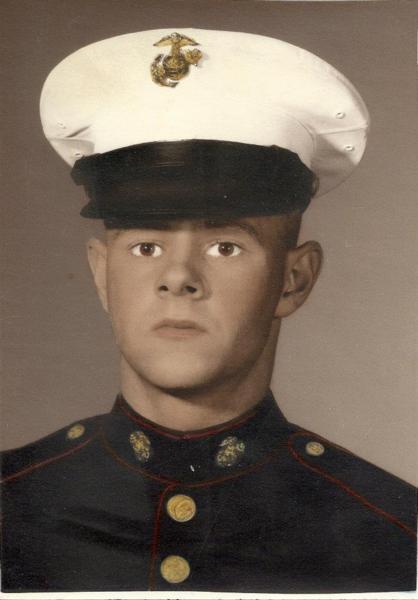
Sanford Kim Archer, PVT USMC
I found Kim’s Marine Corps photograph on a website called “Virtual Wall.” Had some remembrances from some of Kim’s siblings and others who wanted to pay him tribute.
If you lost someone in Vietnam, I recommend simply doing a web search of their name.
Newspaper article:
Melrose Marine badly wounded – Lance Cpl Stanford K. Archer of Melrose is in critical condition in a Da Nang hospital after receiving shrapnel wounds in his kidneys from hostile mortar fire 1 Feb (1968) according to a Marine telegram received Sunday by his parents, Mr. and Mrs. Wilbert Archer, Melrose. The telegram said Cpl. Archer and his unit, the 1st Bn, 5th Regiment, 1st Marine Division, were in defensive positions when the mortar attack came. A later telegram said the youth had developed difficulty in breathing at the station hospital. Cpl Archer, who enlisted with the 1st Montana Platoon in June 1966, was sent to Vietnam last September (1967). He encountered a Viet Cong sniper face-to-face recently. The episode was described in an article in the Montana Standard (Jan 23 1968).
Montana Standard, Butte MT, 6 Feb 1968
I don’t know this man well. I searched on http://www.no-quarter which purports to list all casualties, and was looking for all Marine casualties from Montana, as I joined with the “Montana” platoon of 1966, all of us flying to San Diego on the same day from Helena, after a big send-off by the Governor and a bit of a party the night before, put on by the U.S. Marine Corps for publicity, where a captain began to introduce us to the yelling that was soon to intensify. I know him as the man who “sounded off” early in the role call as he was an “Archer”, and only otherwise that he was a good kid and a nice guy. Somebody probably still misses him. I hope so, I did when I saw his name there. Rest Well, Archer. It isn’t much down here, still the same old stuff, wars, famine and destruction. Semper Fi.
The above message appeared on the “virtual wall” from a friend, gdhowe58@gmail.com

I remember that Kim Archer played football with us when we were on the junior varsity team and that Kim was from Melrose and a large family. Or maybe it was another kid from Melrose whose family was large. Large is six kids or more. Kim also ran in track meets his first two years of high school. He wrestled when he was a senior.
Anyway, a bully hounded me when I was a sophomore. He was older and heavier than I was and he got me to agree to an after school fight. I finally agreed, after being badgered. I remember that Kim Archer urged me to fight, saying “You’ll be the tougher for it.”
I did go out behind the school for the fight, but I ended up sitting on the ground, kicking at the bully. Interestingly, I was friend with the bully’s little brother who was considerably smaller than I was and quite friendly. Ultimately the bully and I quit fighting and I didn’t get hurt and neither did he.
The next time I remember seeing Kim Archer was in an English class. He was a senior and I was a junior. Kim sat in the back of the class and sang, I think, to bother the teacher. Anyway, Mrs. Henningsen asked Kim to stop interrupting, but urged him to join the school choir. Kim finally quit singing and I don’t remember him much after that. He didn’t join the choir. I do remember thinking that Kim, for all of his small stature, was large in toughness.
When I was a freshman at the University of Montana, I always read through my hometown paper, the Dillon Tribune and my high school newspaper, The Beaver. That’s when I learned that Kim had been killed in action in Vietnam while in the Marines.
Years later, in fact about 11 or 12 years ago, I saw a poster listing all of the soldiers who had been killed, by Montana county. Turns out Kim Archer was the only one from our home county of Beaverhead County. This was ironic, considering that Beaverhead County was home of the Montana John Birch Society, and extremely right-wing.
Questions I had: Was Kim Archer’s admonition to me responsible for me joining the Marines in 1969? What exactly happened to Kim in Vietnam?
When visiting my middle child in Washington D.C. I paid my respects to the fallen listed on the Vietnam Memorial Wall. Sure enough, I found Sanford Kim Archer’s name on the wall. I think he was Lance Corporal when he died.
Most recently, I found a tribute to fallen soldiers in Vietnam, and it listed Kim’s unit and a few details about his death. He was badly wounded in an enemy mortar attack.
Now I want to find out more about him to tell his story.
Seems like every Summer morning about 10 a.m., or so, my friend Paul Dennison would show up at the door. “Can Dan Play?” he asked my mother. I was often still in bed asleep, but Paul didn’t mind sitting with me while I ate Wheaties or whatever cereal was available. Although he lived at least a half mile away, he had a bicycle, as did I, and we had the University of Montana as a playground, to travel the sidewalks.
We pedaled hard, the wind whistling in our ears, to the chemistry-pharmacy building. We tested the doors, usually locked. We cruised around the oval and the outlying walkways, probably stopped at the journalism school print shop to watch the printers. I remember watching as freshly colated pamphlets got stapled with a wire stapler on a kind of metal saddle. Always fascinating to see the linotype operator at work. I don’t know when I’ve ever seen a machine as complex as that at the university, except the Montana Kaimin was printed on a flatbed press in those days and the press fed one sheet at a time on a huge roller across the type. Lots of little spindles and things spun to distribute the ink on the type. Sometimes little gas flames dried the ink before the pages got to the stack where the jogger evened up the pile. Best of all was the smell of printers ink that permeated the journalism building.
Upstairs the two teletype machines chattered away. One was marked AP, the other, UPI. They chomped away and occasionally emitted a “Ding” signaling the start or finish of a transmission.
Every building at the university had the potential for fun within, even the somber liberal arts building, four stories connected by both stairs and an elevator. We liked to travel to the basement of the buildings and try to get lost in the maze of pipes and passages. Occasionally one of the doors that was usually locked would yield to our daily testing and allow us to creep into a sanctum that might have immense boilers of red-lead painted hue. Sometimes the floor was simply concrete; other times it was concrete painted gray.
Elevators provided fun, as long as we allowed real use by students to interrupt our play. One game was to get in the elevator on the fourth floor, press the button to make it go to the basement, then run down the stairs floor by floor to try to beat it. We could usually win at this game, even when we tried to beat it from the basement to the fourth floor.
The best game, as always, was to avoid getting caught by university officials. Well, the adults at the university came in a variety of modes: The most dangerous were the uniformed police, then the watchmen, then the custodians and maintenance workers. Any of the foregoing could ruin the game.
You couldn’t always tell them apart. The professors and students were the least menacing, in fact, if you fell in with one of those the chances were pretty good you’d not only get away with being where you didn’t belong, but if you asked some questions you would get answers to real science questions.

The day started slowly enough, the hotel, the long stone pier, the waiting for the boat. The Ceres. Even when the boat had tied up to a jetty handrail and they met Bertrand and his daughter, they still had to wait for her to visit the hotel to pee. Still they waited a half hour more while Bertrand’s friend visited him with a lobster in a bucket of salt water. A Christmas lobster for that night, for Christmas Eve.
He felt in his coat pocket for the bag of dirt and the camera slung on his belt like a six-shooter. The dirt had come a long way. From Kalispell, Montana, in the U.S.A. to Cherbourg, France via Paris and the hassles of the airline and carry on luggage. About a pound of dirt from a driveway on the edge of town. Torn fingernail from trying to scoop it bare-handed.
Bertrand’s daughter lit a cigarette while the man handed over a bundle of five 200-euro notes, no six. Boat fare, plus he had to pay for the huge wreath festooned with red and white flowers. Carnations.
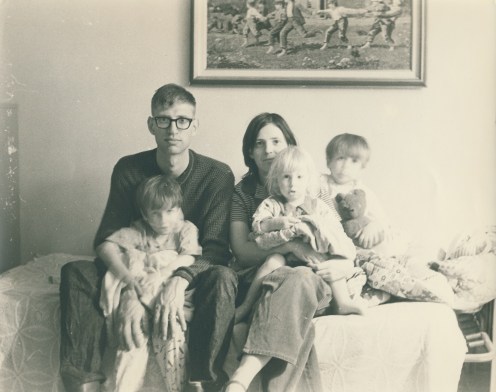
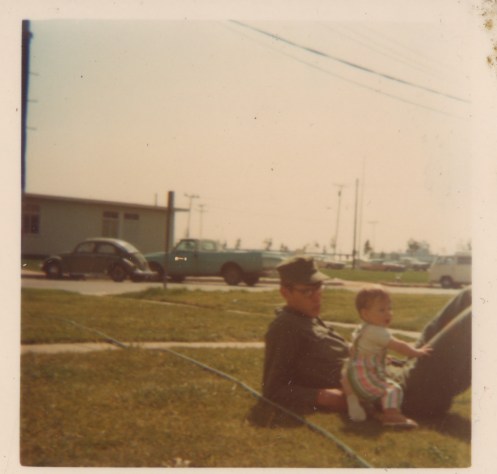
His mother doted on him, called him her pet. Then after he left home a young strawberry blond at college coaxed him into confessing his infatuation with her and he fell madly in love and they professed their love, although neither made promises. They were seldom seen apart until two years later, one cold January evening, when she telephoned him that she no longer loved him. He fell into a depression lasting years.
Then, about a year later, another raven-haired beauty moved in with him and they fell in love with each other, only neither wanted to tell the other.
Both had learned hard lessons and didn’t much believe in romantic love, so they didn’t talk much. They were seldom seen apart from each other, walking the cold streets of town in search of a bowl of soup and a lit cigarette.
Months later, he entered military service without asking her to wait for him to return. He feared that she would inevitably disappoint him. He believed that if he gave her and everything else in life up he would gain her and it all back. He had read that somewhere.
This proved true. He ended up marrying the raven-haired a year later; they raised three children. He fell madly in love with her and soon they have been married nearly 50 years.
This proves something, but I’m not sure what. One kicker is that she had became pregnant with their oldest child while he was away, but the biological father never knew his good fortune.
Things went smoothly ever since, until the dad’s birthday a few years ago when their second child telephoned to ask if his dad was his brother’s biological father, that is.
The dad lied and said he didn’t know. Then he told the truth. This upset the sibs who felt they had been dealt out of the game. Hell, he hadn’t even told the oldest, except that once he explained that his mother was pregnant when he married her and another time he asked him if he wanted two dads or one.
The child had answered, “one.” The good news is that all three children freely express their love for their parents all the more, knowing they are human after all.
Tuesday, September 20 @ 1324
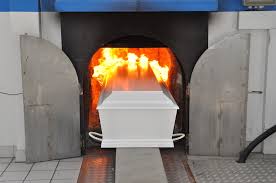
This morning I promised to tell about a restaurant at the corner of Central and Santa Fe in Billings, Montana, that used to have a crematorium. That’s right. I couldn’t help but wonder if the soot in the massive chimney had any, well, fleshy charcoal, from the cremated bodies, mixed with the pork, chicken and beef from Mongolian Barbecue.
For research, I read some from one of my favorite books, Stiff, by Mary Roach. Ms. Roach has written several books in which she has explored popular subjects, such as the digestive tract, but I haven’t read that one yet, just the one about the “Curious Lives of Human Cadavers.”
I’ll paraphrase what she said about how human bodies react to being cremated. I hasten to add that I have never witnessed a cremation, but I did speak to a mortician, a young woman at “Michelotti–Sawyers Cremations and Funerals.”
She showed us her cremation furnace, complete with smoke stack that looks like you could drop a volkswagen down it. Just like the smoke stack in the Chinese grill restaurant that had since become vacant. Makes me wonder what’s next for the corner of Santa Fe and Central. Another crematorium?
My mother had an oil furnace in the house we rented when I was in high school in Dillon, Montana. The M. — S. cremation furnace looked a lot like that. I used to open the door to our oil furnace and watch the roaring flames. I had another couple experiences with incinerators when I was a pharmacist with the U.S. Public Health Service in Lame Deer and again in Pryor. Both of these incinerators burned fuel oil that sprayed out of jets in the side. They made for a hot furnace that roared. We used to throw bottles of liquid injectable medications into the furnace and the glass would explode and the liquid contents would vaporize. Presumably that’s what happens to a cadaver being cremated.
The cadaver must be placed in a lightweight container in order to be pushed into the furnace. Immediately the hair and skin is scorched and burnt off. Next the muscles are burned and they contract with the intense heat. Mary Roach didn’t know if the myth that a body sits up and screams when burnt had any truth at all. Anyway, after a few hours the muscles and collagen all are reduced to ash by the intense heat, I don’t know, more than a thousand degrees Fahrenheit.
Ms. Roach said that the brain is peculiarly resistant to being incinerated. She said that even if the skull is broken by the heat the brain remains a kind of gelatinous mass.
The woman at Michelotti — Sawyers told me that frequently the bones look human once the cremation is complete, so they must be placed in a large metal blender to be crushed and pulverized into unrecognizable fragments, even the teeth, even the coagulated brain. I don’t remember if she mentioned that the bones and the remainders have to cool. She had a kind of fireplace tool-looking hoe she uses to remove the bones and ashes from the cremation chamber that is lined with firebricks.
Of course, I think I’ve said before that the metal hardware that orthopedic surgeons implant into their living patients ends up as fire-darkened artificial hips, knees, and long strips of metal with nails and screws poking out. Of course these aren’t deposited in the container with the ashes, but are saved out, ostensibly to be “recycled.” Whatever that means. I guess eventually when they get enough artificial knees and hips together they make a trip to Pacific Hide and Fur.
I read in Ms. Roach’s book that smoke from a cremation does not have to meet any emission standards, such as the smoke from most other forms of solid waste disposal. She surmised that the EPA doesn’t want to be accused of the impolitic description of human bodies as “solid waste.”
Once when I drove on West Seventh Street near a business called “Cremation and Funeral Gallery” I observed some black smoke issuing from their gigantic smoke stack. I didn’t want to believe they were cremating someone, but now I know they probably were. That’s what it looks like when the cremating is taking place.
What to do with the ashes? Roach suggested that many morticians claim that, in order to sell urns and cemetery crypts, scattering ashes in most places is illegal, such as in Yellowstone National Park, but in fact it is not. It may be illegal — and stupid — to disregard signs at Yellowstone warning one to remain on trails and boardwalks, but scattering ashes is okay as long as no one catches you doing it.
When my brother died in 1997 our younger son Bob took some of Tom’s ashes to San Francisco to a Zen Monastery where Tom had lived during the early 1970s. Bob asked to place some ashes there, but the powers that be declined to give him permission. Bob said he toured the facility — the people were friendly and helpful — and even saw the place Tom stayed and slept. I think it might have resembled some sort of cubicle or cell large enough for one person to sleep on a mat.
Bob said he dumped his portion of Tom’s ashes underneath a bush at the monastery before he left.
Those ashes, by the way, reminded me of fine gravel and gray dirt. Tom’s entire body reduced to less than a cubic foot of ashes. I’d say the cubic box, lined with a plastic bag and tied with what looked like a bread tie with a metal circular tag, was nine inches cubed. I’m good at estimating nine inches because that’s approximately the span from my thumb tip to my little finger tip when I stretch my hand out as far as I can.

I don’t mind taking care of Dan Struckman.

I’m still little old lovable me.

How do I look from the back?
Yesterday, after a day of busting licks at Omnicare, filling scores of little cards with pills, we had an enjoyable evening singing with Steven Hart and the Billings Symphony Chorale. It’s good to be back with the group again. I had little opportunity to spend with Gunther.
I was tired, like a dog, then this morning at 6:30 I had my psychiatrist appointment. The doctor made an adjustment to my antipsychotic medication and, best of all, promised to write me a letter authorizing me to deputize Gunther as my companion dog.
A friend had already given me a vest. I put Gunther in it and lo! He behaves better when in uniform. I took a few photographs. Well, he still wants to horse around when I take off his vest, but look. He never sat still for the camera before.
Gunther is good for me. Next issue of this blog I promise to explore the subject of crematoriums, specifically, one that was converted to a Chinese grill. Today the building, with its tell-tale smokestack, sits idle.
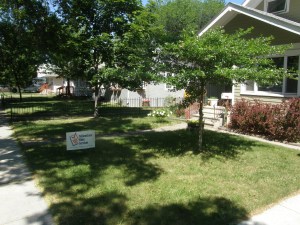
Our house near downtown.
Yest. P. and I walked downtown oh, maybe six blocks or a little farther, to watch a movie at Arthouse Cinema, “Captain Fantastic.” We like Arthouse because the films are eclectic and selected by one with taste for the interesting. But especially because you can drink beer, wine, and/or the usual fare of movies. I had hoped we’d get there so I could drink two beers before the show, but no.
In the case of “Captain,” the film was a Swiss-Family-Robinson-kind of fantasy about a potless hippie living with his large brood in a perpetual kind of July weather in the Pacific Northwest rainforest, only without any rain. The bill said the film was sweet, and it was. Of course, they had an epic adventure in their encounters with straight people.
What did I mean by “potless hippie” above? Well, without pot, the hippie guy and his kids lived the spartan savage life of survivalists who combined a love for Bach’s Goldberg Variations, with novels like Lolita. Hard physical exercise with and without hand weapons with a love for Noam Chomsky. I liked a scene when the dad told one of the kids about sexual intercourse. I kept thinking something was missing. Well, the weather was always fair in the rainforest.
It was good to walk downtown. After the movie we stopped at the “Stacked Grill” for stuffed mushrooms and tacos, then home to walk Gunther. I’d have to give “Stacked” a “just okay” rating. I ordered a glass of their least expensive zin which proved to be an okay choice. The four mushrooms at $2 each were tasty. I could have eaten a couple of dozen. The tacos were okay, but nothing special. I left feeling reasonably satisfied, but the check was $41.

Josiah, as a big child, after one of our “death marches.”
Saturday, September 17, 2016
In five days our oldest grandson, Josiah Corson, will be 18. Normally, this would be cause for despair (you know, teenager-hood and all), but you’d have to know Josiah to appreciate his qualities. For one thing, he took his family members to Paris not once, but twice, helping them through the intricacies of the trains and the plethora of streets that reminded me of a photomicrograph of the human brain. He is also very good at soccer and is a tireless runner. I know he will have a great birthday. It’s just that it would be much greater if he were here with me.


 insearchofbud