
Sigrid Walter Bonnett, youngest child of German engineer Helmuth Walter
I easily found Sigrid and Fred Bonnett’s house just below the rimrocks in Billings, Montana. Sigrid met me on the porch, gracious, friendly. The first thing I noticed entering their house was a bunch of Kodak film on a shelf across the sitting room. I remarked on it and, on closer examination, I saw an old plastic developing tank, a can of Kodak D-ll developer and several cameras, including a Rolleiflex, much like mine, not quite as old. Turns out Fred was a professional photographer, and now an ardent amateur. She said Fred was right upstairs, so I said, “Hi, Fred,” and he came downstairs and we shook hands. Fred nearly derailed my effort to interview his wife because we shared such an interest in photography.
My mother’s little brother died in WWII when his troopship was torpedoed and sunk Christmas Eve, 1944.
Soon Sig had us at their dining room table drinking tea (Constant Comment) and eating cold cuts of meats, cheese and breads. She and her husband were sociable and engaging.
Moments before I explained briefly about how my uncle died in WW II when a U-boat torpedo sunk his troopship, the SS Leopoldville, and how I had been engaged in studying history and writing a book. I was obsessed with his story. German U-boats were important to the story, I explained. Sig said she was happy to speak with someone who cared about the subject of her father, Helmuth Walter. He designed and built submarines.
At one point I mentioned how my grandmother blamed Franklin Roosevelt for her son’s death. Sigrid’s mother hated Roosevelt also, she said. Fred said his father did also.
Here’s a bit more of why Sigrid is important to my story about my Uncle Carl Bonde. Sigrid’s father was an important engineer in Hitler’s navy. In fact, she showed me several documents, adorned with swastikas, signed by Hitler himself, awarding Helmuth Walter an honorary professorship and another award that I forgot to write the name of.
(Sig said she never heard her father mention the Nazi awards he had received. She said she believed he felt they were nothing to be proud of.)
Professor Walter invented a fast U-boat that could run on hydrogen peroxide; also some rockets that used the same fuel and he patented many other inventions. He was friends with the famous Wernher von Braun, rocket scientist.
Sig said Walter sometimes referred to von Braun as a “showboat.”
Walter refined the design of the snorkel on U-boats, that allowed the U-486, the U-boat that killed my uncle, to stay underwater for an extended period.
In fact, U-486 had been built in the port of Keil, Germany, toward the end of WWII. Sig showed me a photograph on her kitchen wall of the house where she had been born, that was about half-mile from her father’s factory. A tunnel connected the house with the factory, she learned the last time she visited. I wasn’t clear whether her father’s factory was the site of submarine assembly.
In 1947, her family was transported to Great Britain when Sig was just 6 weeks old. She was the youngest of five. Her brother Ingol was the oldest. The family was allowed to take furniture and other belongings, she said, including a vase. Sig showed me a massive foot-tall blue vase of cut glass that she said was made by a machine her father had invented.
Sig’s uncle in her mother’s family died on the German side of World War II when he was being airlifted by a hospital plane that got shot down. Her uncle had been in the German navy. I remarked that our histories were oddly symmetrical.
Helmuth had bad teeth, but he didn’t go to the dentist because he said he thought his troubles were trivial, compared to those of his countrymen who were dying in the war. When he finally did visit a dentist he was leaving the building when an allied bomb exploded the dental office and killed his dentist. The port of Keil was bombed frequently.
Helmuth employed about 300 Russian P.O.W.s in his engineering factory, building weapons. During allied bombing attacks they were supposed to head down near the big canal to stay in bomb shelters, but some of them escaped into the woods, instead, where they were killed. Again, the slave labor was something Sig said she was ashamed of. The P.O.W.s sometimes tried to hurt her father, but they never tried to hurt her family, she said.
Sig did have some memories of England where she and her family were held as prisoners of war, along with other families. Her dad was on house arrest, but he could travel within a 10-mile radius of their place at Barrow Inferness. (Sp?)
They lived in a house with six other families. She said her mother had to hurry to get milk or else the other women would arrive first to the supply and take all of the cream. She said her mother had been shocked at the behavior of women when things got rough.
Fred and Sig were friends in the 1960s in high school, although they were from different parts of Montclair, New Jersey. She was from upper Montclair. They both went to college at the University of Colorado in Boulder. She was married at age 18 and they recently celebrated 50 years of marriage in Germany, floating the canal in Keil. Both of them are relatively slim and fit looking. They have lived in their house in Billings since 2005.
Sig said she and her family returned to Germany in 1956 and the kids played in bombed out buildings near her family home.
When she was elementary school age, well, six years old, her family came to the United States on the S.S. America. They arrived on her birthday. She remembered because she got a red, white, and blue ball as a gift.
Her family settled in Montclair, New Jersey, and Helmuth Walter took a job with the Worthington Pump Company. Her parents spoke German at home, but Sigrid learned English. She said she faced only sporadic harassment for being German, particularly in England, soon after the war ended. She said her mother didn’t like the English and they didn’t like her. She said the Irish and Germans got along fine.
Because WWII took a huge toll on her aunts and uncles she grew up with lots of cousins in Germany, and Helmuth had to act as father to many in his family.
Someone asked Helmuth if he would consider working as an engineer for NASA, but he declined, Sig said, saying that he never wanted to work for a government again.

You can see Bertrand Sciboz standing on his boat, the Ceres, as his daughter pilots to pick us up on a pier at Cherbourg, France. I took this picture on our pilgrimage to the Leopoldville.
Saturday, December 24, 2016
On this day in 1944 the S.S. Leopoldville, a Belgian luxury liner that had been refitted as a troopship, left its mooring at Southampton, England, when the tide came in. The English Channel has one of the greatest tidal variances in the world, so Captain Limbor had to wait to sail with the tide.
The Leo was rusty and rundown looking. A long line of soldiers of the U.S. Army 66th Division waited to cross the gangway. One soldier was said to have looked at it and shouted, “I’d rather swim to France than get on this tub.” Another from the Southern U.S. cried out plaintively, “We’ll never get there!” Someone else hollered, “Where are we going?” A chorus answered, “To the bottom!”
This—the story of the S.S. Leopoldville—matters to me because my only maternal uncle was among the several thousand soldiers waiting in line to board the Leo. He spent Christmas Eve day berthed in the depths of the ship, destined to die when a German Uboat torpedo struck the starboard side as Captain Limbor zig-zagged his way toward the French port of Cherbourg. My uncle Carl Ralph Bonde, Jr.’s body was not recovered. In fact, only 12 from weapons platoon, Company E, 286th Regiment, survived to see Christmas Day. I met one of Carl’s close friends, a retired farmer in Nebraska named Bill Moomey, who couldn’t talk about the torpedoing without emotion. Well, he weeped when he told me about his survivor’s guilt.
I’ve been obsessed with my uncle and his fate since I was a child. Thanks to the internet, in 2002 I found out about the fate of the 66th Army Division.
After much planning my wife Penny and I went to Cherbourg France at Christmas on a pilgrimage.
In 2007 on Christmas Eve, we waited on the dock at Cherbourg for my friend, Bertrand Sciboz, to meet Penny and me for a ride to the place about eight kilometers from the port where the wreckage of the S.S. Leopoldville lay under 50 meters of water. Bertrand had dived the wreck and he had an echo locater with which he could visualize the massive ship. Because of the tide Bertrand had a narrow window of opportunity to take us to the wreck at about 6 p.m.
Bertrand and I purchased a wreath to lay on the water exactly over the place where several hundred American soldiers’ bodies were entombed in the steel ship. I had some prayers and letters to read from survivors of the wreck. As Bertrand kept the Ceres steadily over the wreck I placed the wreath, read the letters and prayers aloud, and even put some soil from my uncle’s childhood home in Kalispell, Montana, right into the water where it could drift down to the wreck.
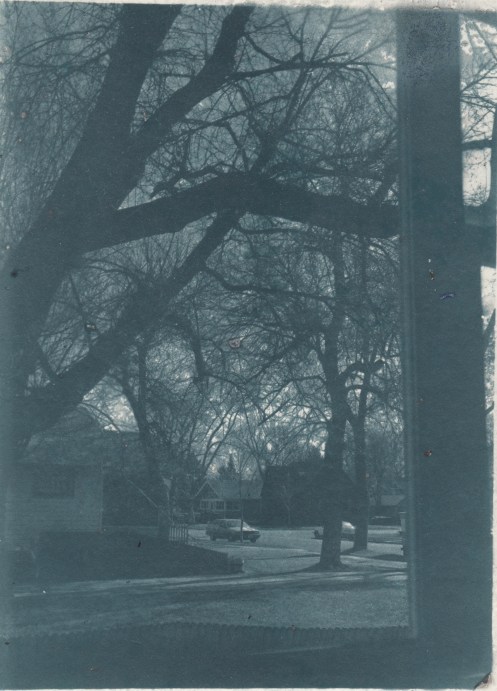
Wednesday, Winter Solstice, 2016
Nothing is happening. My fingers search the keys of the laptop for some pebbly words. Last night I bought two immense bottles of liquor — gin and rum — and some Tom and Jerry batter. I had a couple of Tom and Jerrys then watched an episode of Inspector Morse solve a murder. Several of them, actually. Of course I feel mixed up. E. Alden is coming round so I can take him shopping for new shoes and sweatpants. Socks too, probably.
This evening at the church of the Fervently Religious we will celebrate the “longest night.” Of course, the longest night ever was the one after my girlfriend gave me the boot and I cried. Actually, I didn’t cry. Just felt like it. One whiny country music recording after another on the radio in Dillon, Montana.
Tonight’s celebration will ask us to bring forth photographs of our dead from whom we would like release. Of course, I’ll look for photographs of Tom, Dana, and Hannah and possibly my old girlfriend. I have lots of photos of Hannah. The reason I don’t have many of Dana: I gave them to Hannah when she last visited here. They were both much bigger than life and I am not finding Dana’s death easy to believe. It’s just hard to imagine a world without her on it.

My niece’s son, Jackson Bruner, and I sat and clowned for the camera as we waited for Christmas. That’s a real-looking Spiderman mask in Jack’s hand.

A cover from The Portable Wall. Illustration by Dirk Lee.
Thursday, December 15, 2016
In 1976, after I was discharged from the marines, Dana and Hannah lived a short distance from us at University of Montana family housing in Sisson apartments. I was still working on a journalism degree and I waited until the following summer of 1977 to take the required language. I chose Spanish. Dana taught me how to study a language by memorizing the vocabulary and in understanding how to conjugate the verbs and match them to the gender of nouns and pronouns. She made it seem easy and I got A’s in Spanish. At Penny’s suggestion, I gave Dana a rose. In those days we had everything except much money.
The building where we lived was shaped like a huge “X,” one of two about a quarter mile from the university campus.
That’s about the same time I started the Portable Wall magazine. In fact, I took a class in photography, one in Spanish, and a seminar from Wilbur Wood the summer of 1977. My project in Wilbur’s class, titled “Journalism and Poetry,” was to start a small magazine. Dana contributed $10 toward the first issue and thereby earned the right to name it after a wall at the so-called “Church House” on West Main Street, near other hippie enclaves on Front Street in Missoula. The non-portable Church House wall had a lot of witty graffiti, including “life is what we do while waiting to die.”
I don’t know how many people lived in Church House in the late 1960s, but the building was a two-story duplex with bedrooms and bath upstairs, kitchen and living room down. The place was in pretty rough shape, perfect for any and all of us to sleep anywhere we could find room. I remember that Dana lived there and slept on springs without a mattress. Seriously. Just springs with a sheet and light blanket. I don’t know how she did it.
Years later, when our kids rented a room next door from Church House, I took a roll of film of the venerable old duplex. I looked for the photos just now, a bunch of nondescript pictures showing the south-facing back porch with a beat up old couch. Great for watching the snow melt and Spring arrive. I couldn’t find the photos, but no matter.
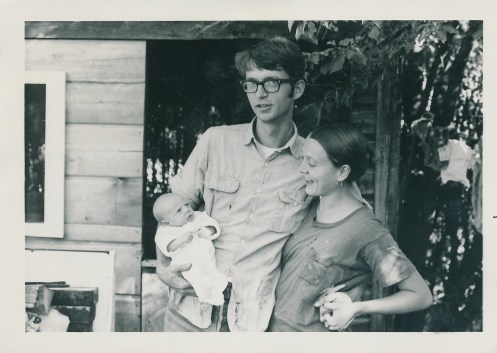
Tom Struckman and Dana Graham with their newborn daughter, Hannah Banana in 1971 probably in NW Montana.
Dana was just another pea-coat clad hippie girl in our universe at the University of Montana back in 1967-68-69. She got my attention once when we guys were hanging around the steps of Brantley Hall. She sang “Danny boy” to me. Hell, she sang to everyone in those days, not just me.
These memories are painful to me now that she is dead. I almost cannot get myself to bring them up.
Because she was a year ahead of us in school, I remember that she once showed my girlfriend and me some work she did when she worked for someone in the botany department. She would look into a microscope and draw what she saw, the color it with watercolors. This impressed my girlfriend so much she mentioned it to me later.
We were all very comfortable hippies in those days. Our parents paid for school and we took classes and smoked a lot of dope and hung out together at the nearby University Congregational Church in the evenings to escape the icy weather.
Funny how a person can insinuate herself into the consciousness over time. Dana was one who gradually came into focus. There was the time she sang. There was the time she showed us the drawings colored meticulously with water colors. There was the time we smuggled her into the dormitory. I remember we smoked pot with her and the rest of our friends in Larry Felton’s dorm room. Larry had bought some moldy pot and had to dry it in his closet. He tried treating it with wine and did other things to it. I don’t remember ever smoking it. I think he took a loss and threw it away.
Larry Felton still smokes pot, last I heard. Recreational pot is legal in California now, where Larry lives.
I was sweet on Dana for a short time in Missoula when I still lived in the back of Peter Koch’s house. Dana and I traveled to Seattle in a volkswagen bug, her on my lap. We fell out of love as quickly as we fell into it. I remember she and I tried to sell acid on the street of the University District in Seattle. Trouble is, nobody bought any. Back in Missoula I tried some of the product we tried to sell. It didn’t do anything but make me sick. I remember Tom gave me a couple aspirin tablets to help my symptoms. P. suggested that we could travel to Canada and homestead. I think I nodded my head.
Dana and my brother married! They lived with my mother and then with my sister, then they moved to northern Montana. Ultimately they had a child, Hannah Banana Graham.
P. and I moved to Southern California where I finished a long stint in the Marine Corps. We had three children and we were very happy. Finally we earned and saved enough money to quit the military and move back to Montana.
By then Tom and Dana had divorced. Dana and we remained close friends, though. We had many adventures with Dana and with Hannah.
All of this makes losing Dana harder and harder.

My friend Walter Blackwolf said Homer froze to death in a car near his brother’s house. Homer had many brothers. About 1995, I visited his mother, who lived between Busby and Lame Deer, Montana, on a little dirt road behind some wrecked cars, a blue bus, and a church. His mother’s name was Agnes Limpy. She lived to be quite old. Her house was neat and clean. I remember seeing a guitar leaning against a corner near the front door.
Homer Limpy was a military veteran, did not drink or use drugs, and was an expert with a sling shot. He enjoyed walking around Lame Deer, but packs of dogs used to harass him, so he made himself a slingshot for self defense.
Homer made many slingshots and I bought them and gave them to family members as gifts.
The slingshots were great quality. He used wood from chokecherry bushes, tied the rubbers with string. The rubbers were always made from red inner tubes, so his slingshots were unmistakable. The pouch for the stone was always leather, rawhide, I think, and tied to the rubbers with string. They withstood a great deal of use.
He made them in many sizes from one inch high to about five or six inches. You could pull the stone back a couple feet and it would come zipping out with a great deal of force, enough to repel a wild dog. I never could get the knack of hitting things I aimed at.
Homer was always kind to me. He spoke softly and we always talked about slingshots.
Dana Graham was a Spur, first time I saw her, Fall of ’67. She and her identically clad sisters of Spur-dom were snaking through Elrod Hall inviting everyone within earshot to sing with them on the steps of Main Hall. I was profoundly lonely so I went as instructed and saw an old classmate, Eddie Hanson, and the guy I got my paper route from, Ron Lebsack. They were dressed in matching gray sweaters with a Grizzly Bear logo, playing guitar, singing folk songs. I felt more lonesome than ever. Eddie graduated a year ahead of me because I was held back. Ron threatened to beat the shit out of for being bad at delivering papers. Singing on the steps sucked.
As the cosmos coalesced and I got acquainted with other would-be hippies and counter-culture types, Dana wound up in our group. I remember we sneaked her into our men-only dorm by disguising her with a bandana over her head and her heavy pea-coat. Lots of hippies wore Army-Navy Surplus pea-coats in those days. They were different from the mass-produced coats you see now days. They were not warm, nor were they made in Indonesia. I’m just guessing about the Indonesia part.
Turns out Dana was a Libra, like several of my closest friends.
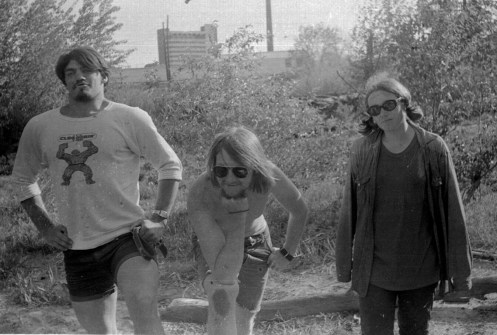
Hippies were not in fashion in 1968. In fact, one had to stick together with others for safety and for having fun! Here’s a photo of Duck, Steve Star and Becky.
You know how it is fashionable these days to talk of hippies with “hippie names” like “Flower Girl” or the like? That’s a lot of bull shit.
I’m here to tell you what the real names were. There was Duck. There was Giant, Little John, John-John, Becky, Virginia, Bin, Larry, Steve Star, Captain Bummer, Peter, Hennessey. I could go on and on.
Today I spent maybe 40 minutes on the phone with my old pal Duck Lenhart, who gave me credit for wearing a big felt hat and for helping him decide to be a conscientious objector during Vietnam. I just remember trying to get him to smoke weed the summer of 1967, but he was resistant to the idea. Duck is an old guy living in Arizona these days.
Duck and I spoke of many things. He once gave our friend Tad $10 to buy a lid of pot and Duck never saw him again. That was 48 years ago!
He said living in a friend’s hotel in Richfield, Idaho, with his rock and roll band in 1969 when he was 20, made a big impression on him. He and the other band members were long-haired hippies before it was fashionable, or even wise, to be so. He remembers being called out by the county sheriff to “defend [his] rights.” Times have changed.
Duck said he drove through Richfield about 10 years ago and saw a guy on a tractor with hair down his back almost to his butt.
Duck worked a career as a roofer, eventually having to give it up because of failing health. Now he lives with his son, daughter-in-law, and his granddaughter. He is retired. Tired and tired again, he said. Most recently he taught guitar in Puyallup, Washington. Says he no longer plays rock and roll, but mellower stuff.
We are getting old, he noted. We are both 67.
I am forgetful, he will find that obvious the way I’ve garbled his story.
Friday, December 2, 2016
This morning at 7 when I took Gunther out to do his business he snatched up something between the back and screen doors: a piece of beef, about the size of a golfball. He gagged so I reached down his throat and grabbed it. I tried to throw it over the back fence but my throw was short and it bounced against the gate. I tried again and pitched it into the alley. Poor Gunther! Where did the meat come from?
Walking, I figured out what had happened. As Gunther got down on his haunches to do his duty, I recalled that our niece Becky came home late last night from a Christmas party and cut her finger on a gift basket she had won. The basket had a bottle of Tanqueray gin and some vermouth and a couple martini glasses. P. got up in the night when she heard Becky crying and talking on her phone. Becky cried because her finger hurt, she said.
No blood. So P. tossed Becky a couple tissues and returned to bed. Wait. First they checked the gift basket and couldn’t figure out how she cut her finger. Possibly a paper cut. That part remains a mystery.
Anyway, I figured out that the meat was a clue. I checked the fridge after I got Gunther back into the house and sure enough. A styrofoam food take home box had just the baked potato.
My mood was good. Agatha Christie has been a good teacher. But then I got a call from Charter Communications, our cable company. A poor soul there noted that we had missed one of our payments and offered to take our payment then and there so we could “avoid a break in service.”
Sweet Jesus! I explained to her that we’ve been customers for the past 11 years and only missed making two payments and NOW they are threatening to pull the cable service! I got after her with my usual tirade about how I wished I could go ahead and stop receiving service now! We mailed our check yesterday! I asked the young lady if she would call me back to apologize today or tomorrow after our check arrives. She said she “can’t.”
Then, realizing the error of my ways, I apologized to her for ripping into her, that she was just doing her job, probably the toughest job in the building.
She said with a hint of resignation that it was “okay, it happens all the time.”
Then the phone rang again and this time it was “Private Caller.” It was my old carpet selling friend from Istanbul, Metin! What an honor to be called by such a carpet selling friend! I got acquainted with him a year or two ago in Turkey because Rick Steves recommended his store.
Metin said he will expect to stay with us in Billings because I owe him a glass of Scotch! What a great conversation we had. Then I called my daughter and my mood soared as I described my interaction with Metin, my sleuthing re: the mystery of the cut finger, then my remorse at getting after the young woman who called me about our cable bill. My mood was low by then.
I attempted to call Charter back to apologize to the woman, but I got a mechanized answering service that offered to take my payment right then and there.


 insearchofbud