As I grew into adulthood as far as I knew the men in my family who went to war died. I learned this from my uncle Buddy whose ship was sunk in the English Channel by a U-Boat. I faced Vietnam. Have you seen the Vietnam Memorial wall? Well, I ran from Vietnam in 1968 at first, but then I relented and headed toward it, joining the military. Intellectually I had faith that things would work out. My gut told me I must die in Vietnam. Buddy’s dark fate was most real to me. I told Penny that we were finished with each other. I was to leave for Butte the following Tuesday. Later, Penny told me she didn’t think I made much sense. I knew death to be the most final. My father was dead. My grandparents. Buddy. I had abandoned hope and I would have cried if I thought it would help. Who wants to be a sad sack? Somehow, when you are dressed in green and are shaved bald and as hard as concrete, you cannot cry if you want to.
Appendix C
Letter from Bill Loughborough to his wife
Finished June 25, 1945
My Darling Jean,
I know you are curious about my eventful trip from England to France. My folks have also asked me to describe it. Walrath wrote about it as soon as censorship was lifted, and his mother called mine to relate the little bit Don had known about it. When censorship was discontinued, we were asked not to write about troop movements until 6 months afterwards. That is the reason I have not talked of it. To save my writing two letters on the subject, will you please send this on to my folks, Honey?
I went to London on the morning of the 21st of December [1944]. Jack Yarbrough, Chuck Gere, Bob Rogers, Bill Moomey, Tony Lemos, Carl Bondy [sic], Dick Vester, and Jim Grunewald were in the same pass group with me. We left the London railroad station about midnight of the 22nd and arrived at our camp in Dorchester about 5 A.M. on the 23rd. After an hour’s sleep, we were awakened along with the rest of the camp and told to pack. All day Saturday the 23rd we worked frantically to get the supply room, kitchen, and orderly room packed and ready to move. There was the usual arguing on rather this proposed move was to be a “dry run” or the “real McCoy”. We were to be ready to leave by 5 P.M. Because of this short notice, we were almost sure this was just a practice move. We were “good to go” at about 4 P.M. so I went over to see Bill Klostermann, whose barracks was just a few yards away from mine.
Bill was not his usual self that day and seemed to be in very low spirits. I don’t know what was bothering him and whether or not he was worried about going to France. There was a crap game in progress in one corner of the barracks and a bull-session in another. I thought it strange that Bill was not in either of these. I believe he was just plain homesick that day. He read me his latest letter from home in which his mother told of the nice gift you had sent her and of how much they liked you. I left him to go eat.
We finally left for the railroad station at about 9 P.M. One group had left approximately two hours earlier; and, when they didn’t return, we figured this must really be it. We carried everything we owned for the mile and a half to the station. I had a pack-board, with blankets, shelter-half, pack, etc. attached, on my back. My carbine was slung on my shoulder, my gas-mask drooped from the other shoulder, my steel helmit pushed my head down into my collar, and my over-crowded dufflel-bag was carried first in my arms, then over one shoulder, then over the other, then on top of my pack and resting on my neck, and finally dragged along the pavement. My rather weak right leg gave out on me about a quarter of the way and I took a tumble. From then on I went along at my own speed and fell further and further back. The entire regiment started out in regular formation, but was really strung out before we reached the station. Bill Bailey of the 3rd platoon joined me in the rear and we helped each other with our bags. We sat down on them about every 100 yeards [sic]. Of course this was all done in the dark and thru the blacked-out town of Dorchester. By the time we reached the train we were all very bitter because trucks could have just as well carried us.
Eight men with all their equipment were squeezed into each compartment on the train. In spite of this sardine-like living, almost all of us slept during the two hour ride.
It was about 1 A.M. when we dismounted at the Southampton Station. Here we loaded our duffle-bags on trucks and then marched across town to the docks. We didn’t see muck of this great port because it was in total blackness, and we were on the low road by the docks: Most of the city is on high ground. The docks were really buzzing with activity even at such an un-Godly hour.
At about the last dock we finally did a column right and passed by the gate of a brilliantly lighted pier. Two grey hulks loomed up at their waiting positions. We were marched into the large frame building on the pier for doughnuts and coffee from the Red Cross. They had two clubmobiles set up and American Girls to hand out the stuff to the long lines of G.I.s. The bunch who had left Dorchester before us had already had their refreshments and were beginning to load on one of the ships. After standing around kidding for about an hour, we marched on to the other ship. As we left the dock we picked up anyone’s duffle-bag, that is, in our own company group. We carried these up the gang plank, along the deck a ways, and then down a narrow, steep stairway to our compartment in the hold of the ship. We were on E dick, which is well below the water level. We dumped the bags in the middle of the floor, and the first men down grabbed the hammocks and began tying them up to hooks on the ceiling. The next ones down laid claim to table tops and benches as their “beds”. This compartment evidently was the ship’s mess hall. Being in the 3rd mortar squad in the 4th platoon, I was always #186 in a company of 187 men on these troop movements. Consequently, when I got below, the only place to establish a “bed” was on the floor beneath a table. Bob Rogers was next to me under the table, and Len Benda was on top of the same table. Dick, “Nick”, Matthews, Jack Yarbrough, and Everett, “Mac”, MacDaniel were hanging in hammocks above the table.
The remainder of our 4th platoon, the entire 3rd plat., part of “F” company, part of “H” company and a small portion of battalion hdqt. company were in this same compartment. We were crowded beyond description.
The rest of our compnay [sic], company hdqt., 1st plat., and 2nd plat., were on the other ship. The remainders of the other companies mentioned above were in other parts of our ship. Some of Klostermann’s “F” company were directly below us in the bottom deck. Bill, himself, was in the same compartment I was.
When we got “settled”, it was after 4A.M., so we all fell asleep in spite of our surroundings. Breakfast was at about 8:30, but I slept right thru until our next meal which came at 3:30 Sunday afternoon.
These meals are the worst I have ever tasted. One big pot of “slop” was passed out to each group of about ten. The individual then ate off of a very dirty plate that was washed by just dipping it in water.
You see, this was not an American manned ship. It was a British controlled Belgian ship, the “Leopoldville”. A large part of her crew were Belgian Congo negroes.
The Channel was extremely rough this Sunday afternoon; and that combined with the lousy food made most of the boys sick. Right after “dinner” Hank Anderson, Jack Yarbrough, George Miller, and Dick Matthews headed for the fresh air of the upper decks. They asked me if I wanted to go up with them. I was all slept out by this time and was collecting my stuff which had been pretty well kicked about in the shuffle, so I told them I would meet them on deck in a few minutes. In the meantime I found my duffle bag in the pile and discovered it had a big hole in the bottom of it from the dragging it suffered the previous night. It also had a “fetching” aroma. A medicine bottle of American whiskey which I had carried from the States to have on Christmas Day had broken on Christmas Eve!
When I left to join the boys on deck, the rest of the gang were either asleep or lying in hammocks looking very green. I stood on Starboard and talked with the boys for about an hour, after which I went up to the bow to stand in the wind. Ole Jensen came along in a little while, and we sat on a hatch on C deck at the head of the stairs leading down to D deck, the last open deck. Bill Klostermann and two of his “F” Co. buddies came up the steps about 5:30, stopped and talked a minute, and then moved aft on C deck. Bill said he was too cold and was going below to get out of the wind. That was the last time I saw Bill.
Shortly, Ole and I went in out of the wind, but we went up on B deck which was partially shielded. We sat on a bench in a little alcove on the Starboard side and watched dusk come on. Bill Moomey soon came by and sat down with us. He had left his hammock when Tom Bowle and Tony Lemos had parted company with their dinners. The resultant oder [sic] was too much for him and he came up for fresh air.
The other troop ship carrying the remainder of the infantrymen of the Division was a little to our rear and slightly to one side of us. Destroyers and corvettes roamed the waters in front of us and way out on our flanks. At about 5:40 we spotted 3 destroyers or corvettes in a little huddle way off to our starboard. We guessed they had a submarine trapped. Beyond them and about 10 miles from us were the lights of the outer breakwater of the Port of Cherbourg. By this time my squad leader, Al Salata, had come along and joined our little group.
Ole suddenly felt his insides rising and hurried to the rail at a point about 15 yards aft of where we were sitting. He returned, and we contemplated procuring a blanket to keep our legs warm. We didn’t consider it very seriously, though, because we were all too lazy to go down after it. Ole hadn’t been back from the rail two minutes, when the ship jarred, a terrific explosion was heard, and a piece of metal hurtled overboard at just about the point where Ole’s dinner had gone over.
Ole, Bill, Al, and I rose simultaneously and began tightening our own and each other’s life preservers. I believe I said, “Looks like we’re hit”, without much feeling. It was really quite an amazing observation, don’t you think? We automatically headed for the bow of the ship, but not in any great haste. We went to the same hatch on C deck where Ole and I were sitting about a half hour before. The open decks were quickly filling up with soldiers. Presently we were joined by Hank, Jack, and George; making 7 of us from the weapons platoon standing there together. Dick Matthews, who had been with these 3 boys, had gone below just about 3 minutes before the explosion.
Soon C and D decks in the bow where [sic] jammed. There had been no announcements over the public address system. No one seemed to know whether we had been torpedoed or had struck a mine. All the lights onboard were turned on or awhile and our ship must have stood out like a sore thumb. This led many to believe it could not have been a submarine because we now would make a wonderful target.
The destroyers came back and hung around us like flies. I didn’t see what the other troop ship did, but learned later she took off like a “great-ass bird” around our port side. She zig-zagged back out into the Channel and returned to the Port of Cherbourg in the wee hours of the morning. The boys on her, including Eich, Walrath, Saxton, and most of the boys we knew at Missouri, disembarked Christmas Morning.
As we “E” Co. men stood together in the bow, we were naturally worried about what was happening aft – especially in compartment F-4. We knew the explosion had come from very near our compartment. Bill Moomey was the only machine-gunner in our little group, and since all his close buddies were down in the hold, he spoke the most often of them [including Carl Bonde]. The rest of us tried to act and talk optimistically to cheer Bill, but there were doubts in all our hearts.
There was never any real thought that the ship would sink. Everyone in the bow was very calm. Some believed we would be put off onto destroyers, tugs, and lifeboats. Others said we would be towed in by the tugs which we were told were on the way. We watched the crew attempt to lower a lifeboat. They got it swung out over the water but couldn’t lower it because it was tied up incorrectly. They left it swinging there and moved onto another one. After much effort they finally got this one half way to the water when one man cut one of the ropes. Of course all this bungled work by the crew brought intermittent cheers, handclaps, and Bronx cheers from the G.I.’s. What would we do without that ever-present American humor?
About 7 a tug passed very close by our port side. She was manned by blue-clad English sailors, and there was the usual exchange of cheers and humorous cracks. There was a girl dressed in red standing before the cabin of the tug. She, of course, received a hearty greeting.
[Omitted is a drawing of the Leopoldville by Bill Loughborough that shows where the torpedo hit.]
Yes, about 7:30 we saw the nose of a destroyer draw up close on our starboard side. It jockeyed back and forth several times and then stayed even with us; only her nose showing to us. She had been lashed to our ship’s side. Someone yelled to those on the starboard half of this part of C deck to file along the railing and to board the destroyer. That order included our little “E” Company group. We were in no hurry to get off our big ship which still stood perfectly erect. No one hurried, in fact. We knew there had been only one explosion, and figured the water-tight doors would keep water out of the other compartments.
Nevertheless, one by one we climbed up on the rail and made the big leap to the destroyer. Big Hank was one of the first to jump from our particular point, and of course fell over his big feet as he hit the destroyer deck. I called down, “Nice one, Hank!” He looked up and grinned at me as I hung overboard on one strand of the rope net which was slung over the side of our ship. There were too many on the net, so I let go and really leaped. The waves were tossing the two ships like kites in a heavy wind. When the waves forced them apart, there was quite a gap between them. Seeing this, I gave such a leap that even had they been away apart I would have been O.K. They were just coming together, though, so I sprawled out on my belly in midship against a ventilater [sic] stack. Old laughed at me from above.
I spoke to a weather-beaten English sailor who was straining to hold one of the huge ropes which lashed the ships together. We were moved quickly around the starboard side of the destroyer and finally down into the hold. I saw Hank a few men ahead of me but was kept from catching him by a sailor who directed me down a ladder leading to the bottom deck. Lo and behold, this was the galley! It soon filled to capacity. Al Salata was across the compartment, about 150 G.I.’s away. The cook passed some cups of hot soup around. We were all plenty cold, and the soup really hit the spot. A great many boys were too seasick to enjoy it, though….
Shortly…we learned the ship had sunk! The word spread thru the shivering crowd like a fire thru a dry forest. The ship had sunk! It was unbelievable!…
From our great bunch of the Weapons Platoon we lost our big, tall, likeable platoon Sgt, Billie Ragle, the two section Sgts Bob Hoyt (who ran the party we attended in Ozark) and “Skippy” Ransome; all our squad leaders except Salata, Bradley, and Junior Weaver of the machine-guns, and “Mac” MacDaniel and Jim Mortimer of the mortars; mortarmen Bob Rogers, Herb Koehler, Sam Noto, “Mac” MacKensie, Frank, “Whit”, Wyatt, Leonard Benda (who came to our house in Dothan once for some drinks. He was accompanied on that visit by George Eastburn another mortarman who is still with us because of being on the other ship), and Dick, “Nick”, Matthews; machine gunners Dick Vester (you met him at the Red Cross in Little Rock, Carl Bondy, Tony Lemos, Eddie DeSilva, Carl Nelson (the big, fair-haired boy you met at the Ozark party and liked so well), Pete Acri (like Ragle and Ransom a recent father!) and Tom Bowle. What a terrific gang they were! Almost all ex – ASTP and Air Corps men, too…
Bill [Moomey], please let me know any parts of this story that you would change or add to.
Love,
Bill [Loughborough]
Carl Bonde’s name appears twice in Bill Loughborough’s letter, misspelled Bondy.

This good-natured young man is shown with his hunting rifle, his German shepherd, and his father’s barn in the background. He was my only maternal uncle, the one killed by the U-Boat, the one who could never teach me how to hunt.
June 6, 1944, the Allies stormed the Omaha Beach in Normandy. A thousand soldiers died from German machine guns. The allies prevailed and chased the Germans out of France. General Patton told General Eisenhower that he pissed in the Rhine River. August 26, 1944, Charles DeGaul marched down the Champs Elyse’es in liberated Paris. For them the war was over! However, on December 16, 1944, Adolph Hitler launched a counter offensive from Germany from the north into France. Just eight days later on December 24,1944, Uberlieutenant Gerhard Meyer fired a torpedo from U-486 into the SS Leopoldville, killing my uncle Carl Ralph Bonde, Jr. outright. April 30, 1945, Hitler squeezed the trigger of a pistol in his mouth, killing himself. Germany surrendered 8 days later. Russia, under Stalin, had surrounded Berlin from the East back in January, 1945. My friend, Bert Pfeiffer, a WWII veteran and professor of physiology in Missoula at the University, remained a Stalinist Communist until his death. Some could not understand his allegiance to the Communists. The FBI, under J. Edgar Hoover, wire tapped his telephone. Later, in 1978, Bert received a check from the government to compensate him for the intrusion into his privacy.
The best glimpses into Buddy’s life number about three or four: my childhood experiences in Kalispell at his parents’ home when I played with his fishing and hunting stuff in the garage and in the cellar. At that time his stuff had lain basically untouched about 8 or 10 years, so things were dirty and a bit rusty. The next time perhaps 5 years later was in the photography period of my childhood when I inherited his 2.25 x 3-in negatives from my mother. Some of the negatives were of forest service people, some of the house in Kalispell, and a lot of them were military. Next, the Army reunion in 2006 of Bud’s Company E didn’t really tell me all that much about Buddy, but I rubbed shoulders with 7 men who had surrounded him and I got a sense of the kind of people they were: smart, peaceful, fun-loving, and bonded together by their life threatening experiences in the war. The last really good quality look I got was from his high school annual and its 69 inscriptions.
Several leads have taken me down some other limited paths: examples were his platoon commander’s life of Lt. MacWilliams, the newspaper article in the Kalispell Interlake that Gary WIlliams found describing the letter his parents received of his death.
This story never will be wrapped up, but at some point I will allow it to lie dormant. Not until I visit some archives in Missoula and Kalispell and possibly in Glacier Park. There just has to be some records from Huckleberry Mountain Lookout around 1940-42.
I am getting better at history.

French diver Bertrand Sciboz photographed me in 2007 reading a prayer written by Bud’s army buddy Bill Moomey. Carl Ralph Bonde Jr and about 500 other American GIs were entombed beneath the English Channel near Cherbourg France when their troopship was sunk by German U-Boat 486 Christmas Eve, 1944. Bill had told me he escaped death when he went topside for fresh air that fateful night. He leapt from the rail of the Leo about 20 feet to the deck of the British destroyer HMS Brilliant. Bill cried when he told me this tale.

Penny and I had brought dirt from Carl R. Bonde Jr’s home in Kalispell, Montana, to place in the water over the remains of Bud’s body. This shows how we knew we were in the right place in the vastness of the English Channel. Bertrand himself snapped the photograph.
Where to start my story of love. My brother and I had just moved back to our home town, Missoula, from Seattle and it was probably April, 1969. I was 20, Tom was 25 and we looked hip. We were hip, not pseudo hippies at all: we wore dirty ragged clothes, had long hair, bushy beards, and Tom drove his ’53 Chevy hard top, probably barefoot. I even had a blue paisley pajama top that I wore as a shirt with my jeans. Tom’s jeans had a patch on the butt because, as he said, they were “shot in the ass.” Of course, in those days we thought we were extreme; someone even yelled at us from a passing car advising us to cut our hair.
The glowing feeling that we were freaks did not last long. We drove around Missoula all day and visited any place with a “rent” sign. No one would. One landlord told us that he didn’t know what our habits were. “Well, I don’t know your habits!” he had said, and we mimicked him as we drove. This was interspersed with “Get a haircut!”
We drove to Peter Koch’s long low house near Kiwanis Park almost beneath the Van Buren St. bridge, just off of Front Street, on Hartman Street.
At the door Peter told Tom that he could stay with him. I hoped that meant me too, so I followed my brother in, carrying my sleeping bag. Tom and I had guitars too.
Peter’s rented house had three rooms in a line: living room with Peter’s large bed blocking the front door. Handwritten sign on the outside of door that said “This Door Does Not Exist.” Peter had a stereo, some drums, striped rugs hanging on the wall, ashtrays, perhaps a chair, all this was his room. Map of Paris. The kitchen, where the entrance did exist, was painted white. Stove, fridge, sink and some cupboards. Peter showed us a large bag of brown rice; his insurance against starvation. He got his rent money from a mysterious relative’s trust fund. The farthest east room was Peter’s library/guest room with several mattresses. Tom and I moved in. We walked with Peter to Cipolato’s Broadway Market where he bought a jar of marmalade and a can of Medaglio D’Oro coffee. Peter only bought really good stuff. Perhaps that’s why he was so skinny.
What does this have to do with my uncle Carl R. Bonde, Jr.? Everything. Carl was always in my mind. Remember he was a misfit too, just 26 years before me. I say he was a misfit because he did poorly in high school even though he was very capable and intelligent. He was in mind because I was liable to be conscripted into the army for Vietnam, just as he was for WW II.
I can’t point to any one moment in my life when I again wanted to clear the mystery that surrounded uncle Bud. My unanswered questions for decades have simmered below the surface like the way police keep unsolved murders open. Some questions merely remain unanswered to be revisited like memories that make us feel guilt. They still hurt, don’t they? But open questions differ. They wait for bits of information, for opportunity.
Christmas eve in 1944 when the SS Leopoldville sunk and 764 American soldiers died the US War Department position was that the loss was to remain secret in order to deny the Nazis the benefit of knowing the success of its strike. That year the truth also emerged that the loss could have been comparatively small if rescue efforts had not been marred by delays, blunders, miscommunications, Christmas Eve revelry, and poor decisions. After the end of WW II, secrecy prevented embarrassment. News that had been sent to the next of kin telling the fate of the soldiers went out in small batches to minimize the loss. In some cases families never learned what happened. Not ever.
The government’s hole in the fabric of Army history probably got me better acquainted with uncle Bud than if everything had been thoroughly aired in a timely way. I believe I got more accurate information about him than I would have, even if he had survived.
“You know, Bud could easily still be alive!” my nephew Jon Angel said just the other day. “Just think of the camping and hunting and fishing –and the stories!”
I doubt we would have gotten stories. Pressed for more information the old guys were apt to say they just didn’t remember.
Well, I was able to get further details from a guy I visited as a hospice volunteer. He was a lucid 96-year-old Army veteran, but I had to trick him to get it by finding another, related, topic that would lead to the kind of details I wanted, in this case, about the influenza pandemic of 1918, the pandemic that killed Bud’s older sister.
I emailed my friend Gary Williams, a professional historian in Missoula, mentioning that I was doing a history project on a lost relative. It seemed miraculous. Gary read my mind!
I got a newspaper clipping dated January 31, 1945, taken from the Kalispell Daily Interlake reporting that the Bondes had received a letter from the War Department saying Carl Ralph Bonde, Jr. was among those missing from a US troop ship that had been attacked on Christmas Day in the English Channel. The rest of the page of the Interlake had society news. And ads. I learned that Mr. Jordet went to the Mayo Clinic and visited family members in Billings. Telephone numbers in Kalispell were 4 digits long. My grandparents were friends of the Jordets.
The point is that Bud’s family knew something about his fate about a month after he died. The knowledge about Bud’s death at sea stayed in the back of my mind as I grew.
I was horrified at the thought of a torpedoed ship. Once in 1967 my friend John Herman and I listened to a Missoula poet rant about a soldier in a doomed ship in the engine room, water rising, steam hissing. “I am not there!” said the poet. Little John and I trudged uptown through the snow to Eddy’s Club for some beers bought with money that we bummed from a friend, and some smokes we rolled from my can of tobacco and some wheat straw papers. I remember feeling vaguely guilty when I heard the poem. I was not there! In fact, I didn’t even remember what happened to Bud, not exactly. Did the boiler scald Buddy?
The year I graduated from high school the Army was drafting young men for Vietnam, a senseless slaughter. Nonetheless, if Uncle Sam touched your shoulder, you had to go into the armed forces or face criminal charges. Remember the summer of Love? San Francisco? Hippies?
In 1967 the Army drafted unlucky young men, mostly poor, mostly minorities, and sent them to Southeast Asia with weapons, then who knows after that? Television news showed shaky B & W images of helicopters with twin rotors touching down, lifting off. Soldiers raced forward in rice paddies or in fields choked with snake grass. They got shot. They got killed, maimed, burned. US Marine [Sanford] Kim Archer from Melrose, Montana, got sent home in a box. He was a feisty kid a year older than I was and he sang in the back row of Mrs. Henningsen’s English class. My classmate Danny Sanders lost some of his fingers when he was fired on by a Viet Cong machine gun as he lay on the ground, probably wetting his pants. A couple of things were sure: I had a 2-S student deferment because I was white and middle class and a student. If I were a good boy someone else would get sent to Vietnam. I was not a good boy. I was an aspiring hippie and I smoked marijuana and took drugs at every opportunity. I also kept my grades up adequately. I felt like a slut.
One kid in my circle of friends, Bob Verduin, said famously, “Fuck the draft.” In 1968 he flunked out and last I heard, went into the Army. I was scared of the Army. Or was I? I couldn’t help but remember how Bud had been drafted into the Army, sent overseas, and killed within a short time.
Once when I was maybe eight years old a bully chased me until I was cornered. I turned, ran at him, and bowled him over. Scared him! Guess I could do that again. So I joined the Marines. People said I was stupid. Others said I was evil. Others said I was crazy. I wasn’t any of the above. I was desperate. I had squandered a lot of good karma using drugs. I was also convinced that the Army would have done to me what it did to Bud if I had just waited passively for something to happen. Also, I had ceased believing in the hippie dream.
Once in the Marines I mourned the life I had left behind. God I wished I could have been with my friends again! I hated the Marines. I expected something really great, but what I got was a whole bunch of people, something like me. Guys from all around the country, but mostly the south. Some actually were great souls. Jason Lockett was a black kid from Los Angeles who had natural talent for leadership. He said he worried about the way I moped around.
I’ll cut to the end of the story here: I got further and further out of touch with my fellow soldiers until I had to leave the aviation training station and lived in a park in Memphis Tennessee like a homeless person. Desperate, I returned to the base, got in trouble, got harangued by a Major, he asked me to hit him “If I were a man,” so I let him have it. Wouldn’t you have? Of course you would. So did I. No big deal. Just that I faced up to 10 years imprisonment.
Fortunately the Military Justice System had a sense of humor even in 1970 and they ultimately forgave my indiscretion. After all, hadn’t Major Wadell asked me to sock him? Yes, indeed.
Many years later I told this story to one of the doctors at Lame Deer, Montana, Indian Health Clinic, and he thought it was a good one. Then he said that if I had just flicked the Major’s nose with my finger, it would have carried more of a humorous impact. I had been way WAY too scared to think about humorous impact. I thought that when I socked the Major my life would be over. It was not over. In fact, the light of day started shining in my life and I felt hope for the first time in many months.
In fact, I forgot about Bud. I began writing to a young lady, Penny Meakins, in Montana, a woman I had become close to prior to my joining the Marines. Penny gave me hope again. In fact, I think the Marines got tired of confining me and reassigned me to Southern California to a helicopter squadron supply office. I continued to correspond with Penny after I got to California. After a few trips to Lewistown, Montana, we agreed to marry. That occurred January 30, 1972. I don’t believe I thought about Bud at all.
Penny and I made our home in Southern California and our babies arrived 1,2, [assignment in Japan for 1 year] 3. My brother Tom came to live with us in Tustin, California, and brought with him a family tree, he had written. In Tom’s book Bud had died In the English Channel Christmas Day, 1944. I remember focusing in on that bit of information.
Tom and I delivered newspapers in Santa Ana, California. I swear that our District Manager was a fellow named—Jesus Christ—and he had all of the self-confidence and knowledge necessary to impress us.
I heard Jesus Christ, a rather chubby cigarette smoker, listen to another carrier, a guy tell how he was going to replace the engine in his Chevy Corvair Monza with an engine from a more conventional engine-in-the-front car. Jesus Christ glibly replied without missing a beat. “Great,” he said. “Trouble with that is, you’ll have 4 speeds in reverse and 1 speed forward.” Just like that. Nobody could top Jesus Christ, District Manager for the Orange County Register.
Bud maintained a low profile for me. One problem with Missoula when I had aspired to being hip, was that I didn’t think I would ever be able to talk face-to-face with a policeman or other straight authority figure, such as a journalist might have to do in his day-to-day work. I really hoped that being a Marine would allow me to experience a kind of fellowship with mankind. Yes and no.
I got out of the Marines and Penny and I and the family returned by truck to Montana. Missoula, that is, to return to school. The best part was living in student housing with so many sketchy people all around us. My mother died in 1976 and I felt lost again. All of the universe had rejected me once more and I was alone with my family. I wished that I could go somewhere safe and just lick my wounds like a cat.
Bud did not really enter in to my thoughts then. In order to find my position in the universe after my mother’s death, once more, I wrote a biography of my late father from the voluminous papers he left behind. This was under the aegis of working for a Bachelor of Arts degree in journalism, which I earned in ‘78. I got an A for the biography, of course. In it I stated that Bud died in the English Channel on Christmas, 1945. I didn’t realize then how that made no sense. What was the difference of 1944 to 1945 to me? That error might give you an inkling why being a reporter was really out of reach. I applied for an internship one summer at the Daily Missoulian. On the form that asked for my professional goal, I wrote that I wanted to write a news article without any errors. I did not get the internship.
My family would not survive on my dream of being a newspaper reporter when I had almost zero ability to record and report facts. I kept getting things wrong! I could sense that if I persisted my family would disintegrate. Penny and the children couldn’t live on a fantasy any more than I could. I was 30 and I had a good talk with myself as I walked around the block in Missoula about 4 or 5 times.
My family stayed together. I stayed in school and became a pharmacist. Bud didn’t enter into my brain again until decades later near Busby, Montana, when I was rear-ended by a semi in 1998. Tom was dead by then and I was taking Zoloft, an antidepressant. I discovered the internet. I found the ship Bud died on by finding a History Channel web site that proclaimed that the government had covered up the disaster for 50 years. I immediately bought the taped episode and watched it numerous times. I wrote to a man who wrote a book, three books, actually, and he told me that Bud had died instantly from the torpedo. So much for the engine room fire.
The real big breakthrough happened when I sent an email message to a man named Allan Andrade, who wrote a book quoting many survivors of the SS Leopoldville sinking. He emailed me a short message back: Telephone Bill Moomey. He remembers your uncle.
I was alone in the house. I hollered “No WAY!” and I was already dialing the phone number.
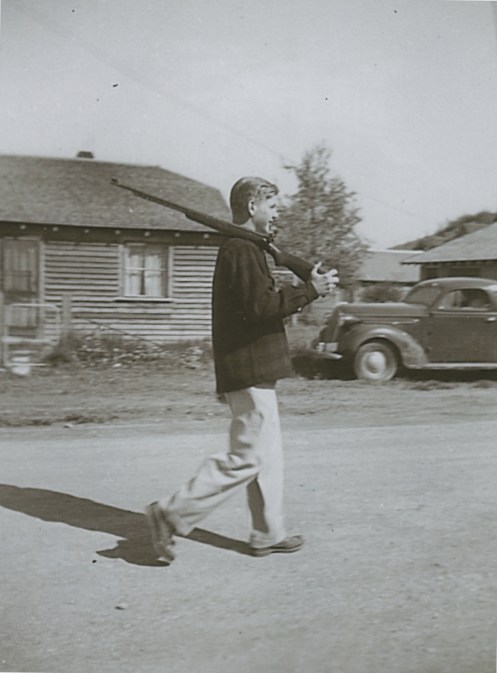
Presumably in Kalispell, Montana, Carl is demonstrating for his sisters how to march with a rifle at shoulder arms. Carl was destined to be shipped to France to fight Germans. He never reached Cherbourg. A German U Boat, sitting on the bottom of the English Channel, hit his troopship with a torpedo, killing him outright.


 insearchofbud