August 13, 2013
Yesterday I received another letter from the Leopoldville Memorial Association (LMA) secretary, Roger Baker, himself a survivor from the 66th Panther Division of US army soldiers. That fact alone, with his very shaky signature, is proof that they are not all gone.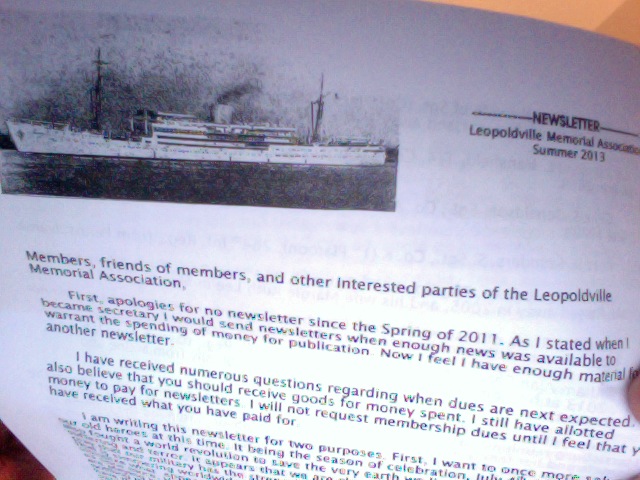
August 5, 2013
Don Christiansen was out on his front lawn when I backed out of my driveway. I saw him, stopped, took it out of reverse, shifted into first, put the car back in.
I like talking with Don. We converse. We share stories with each other. His hearing aid squeals and he jams it back into his head with a thumb. I learned that he and his wife Gert have been married 63 years. While we talked Don glanced anxiously at his front door. Of course, the joke is that she has him on a short leash. Well Don has been ill with diabetes and cancer, but he just got his drivers license renewed for 4 years! Has to be a good omen for us.
Oh, Don is an army veteran from the Korean war. He doesn’t talk about it unless specifically asked, but he doesn’t hide the fact either. He was a good shot. When his brother got drafted he used to sit on the bank of the Clarks Fork of the Yellowstone and shoot at driftwood with his .22. So did his sister-in-law. She and his brother are both gone now.
My trouble today was 14 concrete footings in a local playground. The playground is part of Community Day Care and I am on the board of directors. The program manager of the day care managed to get rid of a rickety jungle gym, but the footings remain jutting out of the softfall bark and wood chips. Worse, the footings have sharp metal fittings protruding, dangerous to 3 and 4 year-olds.
I tend to get along well with GI veterans like Don. We have in common that we were once “important persons,” civilians who lost everything when inducted into the big green military machine and transformed into soldiers. Like my uncle Carl Ralph Bonde Jr. Nothing to do but laugh now. Either that or cry. So we laugh.
I described my problem. The footings are about 8 or 9 inches in diameter and possibly 4 ft deep. Don told me about some fence posts he and his brothers pulled using a wagon tongue and an axle and some chain. They levered out the posts with the tongue and a wagon axle for a fulcrum. “However,” he said, “I’ve got a big jack somewhere…”
His garage is cinder block and about as full of stuff… well, you can’t just walk in. You have to sidle through aisles made of drawers and stacks of boxes, work benches and stuff hanging from overhead. I made a mental note not to keep stuff because you’ll never find it later and have to buy it anyhow. Don easily found his hi-lift jack. He quickly grabbed a heavy tow chain from the cab of one of his pickups and we put both in the trunk of our BMW.
At the daycare playground we lugged in the jack, or he lugged it and I lugged the chain. I tried to hook the tow chain to a hole in the hardware protruding from the footing, but the plate was too large, the hole too small. The temp was 90 and I got light-headed from some prostate gland medicine I take. I felt thirsty, so I suggested we return with better hardware to attach the chain, Maybe later in the day when it cooled off.
Here is how the time travel works. None of the laws of physics prohibits time travel, either forward or backward. In fact, several experiments have demonstrated small increments of time travel.
The paradox exists, however. “What if I travel backward several hundred years and murder my great-great-grandmother before she has a chance to give birth to my great grandmother? The answer to that was that parallel universes exists: a universe in which our great-great grandmother is murdered simply moves along like a clock next to the one we live in.
Now lets consider the plight of the heros on the SS Leopoldville who were wiped out December 24, 1944 by the U-Boat 486 and its torpedo. Couldn’t a parallel universe exist in which they were NOT killed by the torpedo?
What happened was that PFC Bonde or anyone else suddenly got a wild hair and roused his platoon members and got them to go above decks to safety. With Bill Moomey and the rest prior to the attack. Then he somehow got them to follow the example of Hank Anderson and leap 20 feet down to the steel deck of the HMS Brilliant. Even a broken leg or pelvis from a hard landing was way better than drowning in the icy waters of the English Channel on Christmas Eve.
Once that all happened, how can I get plugged into that parallel universe where my uncle Carl survived? I want to get to know Bud. I want to go hunting and hiking with him. Therefore, an imaginary universe won’t cut it. I prefer the real one I haven’t realized yet. The smarties will have to hold their peace for now.
Carl and the rest of the survivors in the parallel universe will have been assigned to guard the Nazi submarine pens at St. Nazarre and Lorient on the Bay of Biscay, France. I cannot begin to tell how this notion eases my mind. My grandmother would have been so overjoyed to have her son back. My mother would have been so beyond happy to see her little brother Buddie. [That was her spelling in high school.] He was a darling to his family and a very strong man to the US Army. In WW II.
At age 4 during the time my father died of cancer I lived with my grandparents. I played with the stuff PFC (Private First Class) Carl Ralph Bonde, Jr. left behind when he went away to the army. (Later I found out he went to Alabama and Arkansas.) I used up or broke many of his things, sold a few things to a kid named Ted who lived down the hill and across the road, ruined some (like a book on the infantry that I left out in the rain). There were a couple of rifles. One of these was a .22 bolt action that my cousin, Dave Judd ended up with. Another was the .30-30 lever action Winchester that I played with frequently. I think my grampa hunted deer with it. The .30-30 was the USA’s first small-bore, sporting rifle cartridge designed for smokeless powder. It was impressive. It smelled of gun oil and precision. I spent hours admiring.
An example of playing with the rifle: As you know, the lever action rifle is a marvel of machinery. You operate the lever and parts slide down, other parts slide toward the stock, and the hammer is cocked all the way back. It makes important sounding clicks.
I squeezed the trigger, and “click.” The hammer strikes the firing pin mechanism. I didn’t have any real .30-30 ammunition, although I looked all around. I did have some .22 long rifle bullets, though, so I pointed the 30-30 at the ceiling and dropped a .22 down the muzzle. I cocked the hammer and pulled the trigger. The result was the hearty “click,” and the bonus was the whole .22 long rifle bullet, lead and casing together, lobbed out of the barrel, propelled by the firing pin. I had me a pretty neat toy!
Next, I dropped the .22 back down the muzzle and carefully lowered the barrel to horizontal. There were some toy soldiers on the bedroom floor. I aimed. I squeezed the trigger.
“Bang!!!” The .22 discharged and the lead bullet shot out the barrel and skittered across the floor past the toy soldiers where I could find it later. The .22 casing fell to the floor when I tipped the rifle, all bulged out in the middle. Of course, the .22 cartridge is a rim fire, vulnerable when lying horizontally near a center-fire firing pin!
The summer after my brother Thomas Tod graduated from high school he told my mom that he was going to hitch hike all around the country with his friends. These friends were Dharma Bums, Jack Kerouak style.
“How are you going to eat without money?” she asked.
“With this!” said Tom, producing a bunch of greenbacks from his pocket. That’s when I found out that Tom had pawned the .30-30 carbine, never again to be seen.
Tom left with his friends as planned and perhaps 2 weeks later he returned. He looked worn out, but happy. I think it was a rite of passage. He took a bath. I went in and cleaned the tub. It had what looked like a half-inch of disgusting skin cells that I had trouble flushing down the drain.
He had spent all of his money. His friend, Larry Miller, ended up losing his wallet that had a fake drivers license. Larry got in trouble with the law and his real license was suspended. Larry advocated weird, by doing disturbing stuff, like having sex with his parents. His parents were friends with our mother. Harriet, his mother was an elementary teacher and his father David was a pilot. Both of them used to get drunk and call me years later in the 1980s. Larry Miller, according to Tom, moved to a city somewhere and became a heroin addict. Tom and I smoked some nicotine tobacco, drank some beer, and long ago even smoked marijuana and hashish, but we were in awe over Larry Miller’s misbehavior! I saw Larry only once more in my life, in Dillon, Montana, when Larry visited Tom for a day or so.
Bud’s sister, Corinne Ackley, hinted that Carl had been a bit of a troublemaker in the army–perhaps he refused to obey an order he considered to be stupid. Carl’s friend Bill Moomey could not corroborate that Carl got into any trouble in the army.
The WW II era is closing. This is what it looks like. I found out my uncle’s army buddy died, so I sent condolences to one of his other buddies. It was returned as undeliverable. No big fat book here.

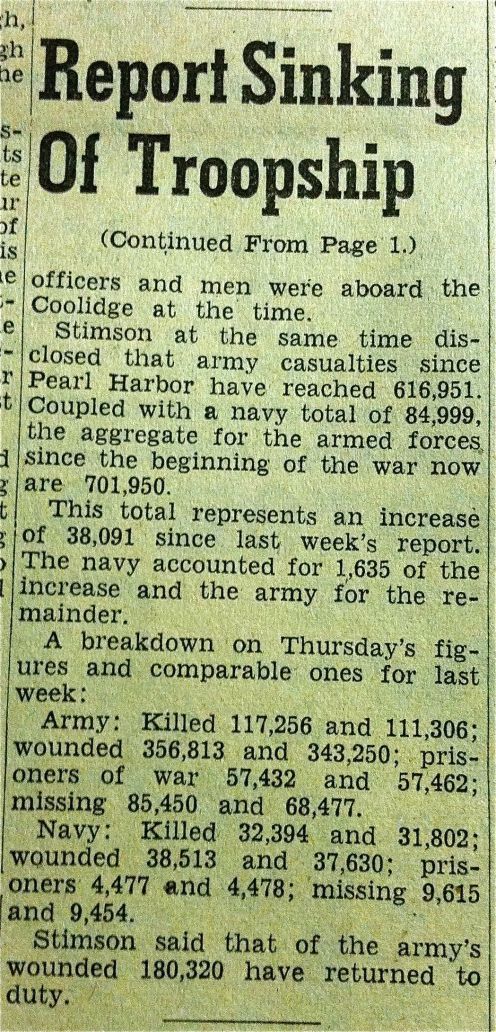
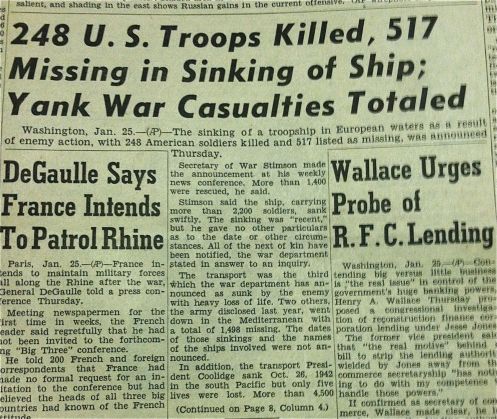
Front page article describing the SS Leopoldville sinking. My nephew Jon Angel and I searched through the dusty volumes in the basement.
July 18, 2013
I’ve thought of some new directions for my book: describing our visit to the “grand blockhouse” at St. Nazarre, France, the Nazi concrete bunker that was an observation post for the huge guns inland. This subject was explored in my friend’s book, “Hitler’s U-Boat Fortresses.” Another would be describing my experiences with 96-year-old Gordon Weber, WW II staff sergeant, as he lay dying (or sat, more often than not) during his final year. I kept extensive notes the entire time. A third would be more details about our childhood WW II games in the aftermath of the actual war. After all, war veterans were ubiquitous.
The old men who remembered Carl are gone now. The ones who remember the ones who remembered are still in the audience. We can speak to them and they will reply in thunder.

I thought of Bud today when I was looking at our bowl made from an African creature’s horn. Bud’s army buddy Bill Moomey’s wife Doris and my sister Carol bought the bowl for us in 2006 when we first visited them in Kearney, Nebraska. Carol and Doris went shopping while Bill and I stayed back and looked at black and white WW II photos.
Bill said he believed the SS Leopoldville sinking with the 763 soldiers lost from the 66th Division saved him and the other survivors from having to fight in the deadly Battle of the Bulge. Instead the 66th Division went to St. Nazarre and Lorient, France, to contain the Nazis who lived in extremely well-fortified submarine facilities. When Bill told me this he broke down. I was soon crying too.
July 11, 2013
I thought today was the 12th all day. Oh well. I see I need to write some fresh stuff for my book about Carl Ralph Bonde, Jr. Fresh stuff is getting hard to get. Bud has been dead since 1944. December 24, 1944. Interestingly, the official date of death according to the US Army was December 25. Christmas Day. The reliable sources I have spoken with all agree that he died on Christmas Eve, not Christmas Day. What can I say? The torpedo hit his troop ship, the SS Leopoldville, Christmas Eve, about 6 pm, plus or minus. The ship sank about 8 pm, plus or minus. Bud was in a compartment where the torpedo hit. That was it. Bud was killed by the torpedo. I spoke with survivors: Bill Moomey was above decks. Hank Anderson was with Bill. Allan Andrade was a scholar who studied the whole mess. He said Carl died when the torpedo hit. The torpedo was fired from UBoat 486, commanded by Uberlieutenant Gerhard Meyer. And so on. And so forth.


 insearchofbud