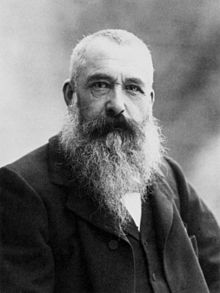
Monet in 1899, photo by Nadar.
It’s hard to be satisfied with one’s own writing. I was inspired when I was lucky enough to view Claude Monet’s painting “Water Lilies.” It is in a museum called, L’Orangerie in Paris.
Claude Monet wanted to give others the chance to experience a beautiful pond with water lilies. Trouble is, he was getting old, like into his 80s, I think. Doesn’t matter how old he was. He was nearly blind with cataracts, so his painting was reddish. After his cataracts were removed the paintings were more bluish. His canvases were, like, 8 feet high, by like, 6 feet wide. They were huge, and Monet used maybe 60 of these. I don’t remember. He worked 20 years on the huge painting. He had to paint standing on a ladder. He was getting frail.
He painted, then sometimes painted over the first try. In the end some of his canvases looked dense, mostly black and splotchy. Was it because he was losing eyesight? Because he was painting a dark scene?

Representative image from Monet’s “Water Lilies.”
Today “Water Lilies” is evidently treasured by many. We waited in a long line to get in to see it. The painting is in eight long sections, so that one enters an oval room, perhaps 50 feet long, 30 feet wide, (I’m guessing) with the painting stretching 8 feet tall, extending canvas after canvas across all sides. You exit the far end of the first oval room and you are in a similar room also completely enveloped by Monet’s painting. Both rooms are bare, except for simple wooden benches down the midline for viewing. The people are silent, or whisper.
One has the illusion of being in the midst of Monet’s pond, perhaps on a bridge, during various times of the day and night, in various seasons of the year.
I was inspired because Claude Monet kept working on his painting, even when he must have had doubts about his ability to complete it. Perhaps he worried about his eyesight. Importantly, he held his faith, and he created a great gift to humanity.
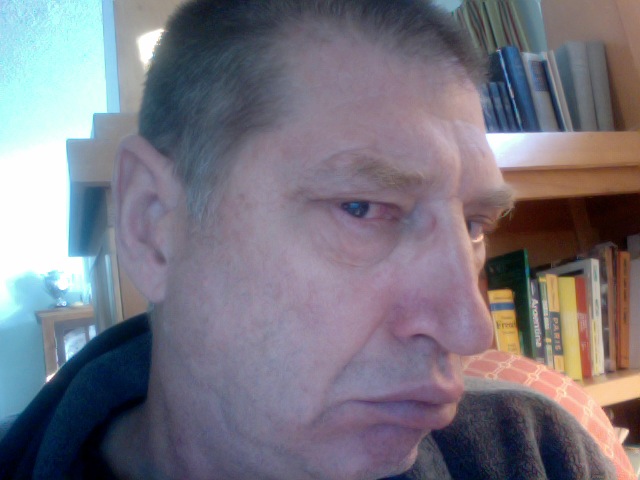
Don’t become a writing junkie. Just declare yourself to say “no.”
September 2, 2015
Of course, lately, my mind has been full of rehearsing for “The Fantasticks.” Tonight I forgot a line here and another there. At one point director Gerry Roe asked me to look down at the stage platform and mentally write in big letters the word “why.” My line was “why do I always find you beside that wall?”
Well, I was carrying a pair of hedge clippers, so I scratched a line in the black-painted platform. I told Gerry I could see it. Well, I could see the scratched line. The actor who plays my son, Matt, snickered knowingly when he saw me make the scratch.
Yesterday, my daughter emailed me with some daughterly advice. She is a lawyer, and I’ve often consulted her for free legal help. She always makes the appropriate disclaimers, but she is generous to me. She is a professional writer, and has shown remarkable talent in writing since she was perhaps 5 years old. I am so lucky! She is beautiful, and she is affectionate to me!
Anyway, she wrote to me questioning why I had inserted some pretty blatant partisan politics into one of my blog posts. She noted, correctly, that my post, in large, didn’t have much to do with my opening paragraph in which I made a (vicious) political attack. Then she questioned my ethics in being divisive. She was right on both counts, so I removed my blog post and the Facebook post that was the portal to my blog. She laid into me, gently, like the wonderful daughter that she is. She noted that I spend a good deal of time writing about myself, egotistically. That is apt to reduce readership, she said, diplomatically. Okay, guilty. I don’t want to reduce readership. My popular blog has tens of readers, and I want to keep the numbers up!
I didn’t really apologize to my daughter, but I did agree with her in an answering email.
I’ve been sort of laying low since, looking inward. Thinking about my sins, my petty literary crimes.
Truth is, I don’t have a lot to say. Never did, really. As you know, I haven’t let that stop me. I enjoy writing. No. It is an addiction. I must engage in free writing, when I let my winged thoughts transmit through my arms to my hands and fingers, down to the keyboard, and up on the computer screen.
Recently I saw the book cover to Russell Rowland’s new book, “56 Counties,” his account of traveling all over Montana. I’m thinking, wow. What an inspiring idea. That’s the stuff for a book. I will own that book someday. It will make a great sequel to a book I bought my wife years ago, one simply titled, “Montana Federal Writers’ Project,” written by the otherwise-unemployed for the Works Progress Administration in 1939, edited by Dr. Paul C. Phillips and Dr. H.G. Merriam.
Ed Kemmick has had great ideas like that, such as attending various church services all over Billings, and writing a critical review of each. Have all of the best ideas been taken?

August 30, 2015
Yesterday Master Director Gerry Roe coached me for several hours to help me play the role of Hucklebee in the forthcoming musical, “The Fantasticks.” This play will open 9/11 in Billings at NOVA theater.
For example, he had me work on a line: “I could tell a great deal about myself. I was once in the navy.”
Previously, I had been standing there, in rehearsal, simply reciting. Yesterday I got the lowdown from Gerry.
Gerry had me go “chap chap chap” with a pair of hedge clippers, walking bent over, downstage and turning right. Then he had me stand up and imagine the word “great” printed on the handle of the clippers. Then he had me pick out someone in the audience, then tell her about myself and my (supposed) naval career.
That added some pizzaz!
And so on. We worked two and half hours. Gerry had me do all my lines with his coaching, infusing meaning, humor, and surprises in new ways. Tonight we start our last two weeks of rehearsals before our opening, September 11.
Thursday as we were wrapping up a rehearsal I suggested that our play was appropriate for remembering the national tragedy of September 11. The rest of the cast laughed at me. Oh, I’m used to it.
However, I Googled. The connection between the play’s song “Try to Remember the Kind of September” and 9/11 was first made by Amy Gamerman, a critic for The Wall Street Journal, who showed up at a performance of The Fantasticks on Sept. 14, 2001. Only about two dozen people were in the audience. This was New York!!
“A familiar old ballad,” Gamerman wrote at the time, “was suddenly transformed into plangent elegy for the innocence we had all lost . . . by the end of the song, I was in tears. So was one of the actors.”
Fast forward to 2015 and Billings. On the opening night at the NOVA theater, following a fund-raiser with appetizers, wine and beer, former Billings Mayor Chuck Tooley will speak to the audience prior to the curtain, reading a child’s essay about the tragedy of 9/11.
This evening 1: Big Dipper for ice cream. 2: Art House Cinema and Pub for a film about Evel Knievel.
Things that surprised me today: Our house was closed tightly to keep out the heat. I walked to our kitchen and I heard a fairly loud “pop.” I looked out the window expecting to see some sort of crime scene. Nothing. I walked back into the kitchen to see if I heard the sound again. No. Was it from the basement? I looked out the front window. Nothing. Then I saw a woman pushing a bicycle with kid trailer. I went outdoors to the street and asked her if she had just flatted [hip cyclist terminology]? “Yes,” she said, and then spoke a bit more, apologetically, while hurrying onward.
I was 15 minutes early and Gerry Roe was waiting for me at the NOVA theater to coach me in my part in “The Fantasticks.” I was surprised at how much meaning and humor Gerry can infuse into just a few lines of dialog. Wow! I think I have said elsewhere that the audience is in for a treat.

This is me.
I started out yesterday feeling grief and shame for the comic portrayal of Native Americans in the musical play I have an acting role in, ”The Fantasticks.”
I had recently attended a day-long symposium on race relations in Billings put on by Adrian Jawort and Russell Rowland, two Montana authors whom I look up to. I idolize them. Additionally, I have experience. I worked on the Crow and Northern Cheyenne reservations for years, with some knowledge of people in both places.
My grandchildren are Crow. I feel strongly against negative stereotypes. Positive ones too.
My grandson is heroic, but I don’t know why I love him so much. Perhaps because he is so good at soccer? Because he pushed me up the hill when I was too tired to pedal my bike? Lots of reasons. Because he is my grandson? Yes. I think I’m closing in on the reason I love my granddaughter so much too.
But I felt shame and I felt grief. I admit that I am inclined toward cowardice. I want to fit in. However, I could not abide the portrayal of a “comic Indian” with the head dress, band with feather and red long johns like I saw in a UTube video of “The Fantasticks,” one done in 2014, I think. Maybe it was 2011. It made me cringe.
So I phoned our director, Gerry Roe. I poured out my heart to him. I told him how horrible I felt about the racism in our play. He was sympathetic and said he thought the problem would be easily fixed. (!)
I also talked to our theater company manager, Dodie Rife. She was clear-headed, helpful.
In the end I feel proud of our theater and of our play and of our cast and of our director. Gerry modified the script to remove the offensive material altogether.
I thanked him, but he seemed more irritated when I did, so I went out into the hall and sat by myself. I shouldn’t rub his nose in it, should I?
Now I am feeling better. However, after meeting with Dodie I went home, felt really rugged, took a nap, ate popcorn and an ice-cream sandwich for comfort. I also felt sort of sheepish that I had felt such grief and shame earlier. Fear, really.
I had had tears running down my cheeks. My ace card was my saying that my daughter-in-law and grandchildren are Crow.
True progress in racial relations will come when I don’t have to play that card.

Me. Jerk.
August 27, 2015
I feel such an overwhelming sense of grief and shame. What have I gotten myself into? I have a role in “The Fantasticks” and I have to admit that I am into the usual struggle to memorize my end of various conversations, i.e., my lines. It’s not a huge role, but there are only 8 actors.
That’s really not the trouble, though.
After just 17 years of commuting to the various Indian reservations in our area to work, I have come to greatly appreciate the tribes, the people. They face everything rural people do throughout Montana, plus poverty, chronic illnesses, and racial discrimination. They often feel the sting of unjust treatment. I mean, frequently, whenever they come to town.
In short, in addition to everything else, their feelings take a beating. They are ignored, marginalized, kept at an arm’s length, spoken to as if they were stupid. Our government tried to exterminate them just a couple generations back. Some non-Indians say everyone should just forget that. I say no.
I hate to add my own stereotype to the mix, but when someone asks about the Native American communities I sometimes tell them to imagine the country post WWII, only with iPhones. It is as though the social norms were in the 1950s. Non-natives may behave that way on the rez and won’t be too far off from being socially acceptable, I advise. You know, dress conservatively, talk politely, smile. Treat people friendly.
Natives are not just old-fashioned, they are often extremely patriotic when it comes to military service. Powwows I attended always opened with a flag song, sung in an old language, with a military color guard for the American flag.
Here’s the problem: in the play “The Fantasticks,” a mock battle is staged when an old actor, portraying an “Indian,” pretends to abduct the 16-year-old girl. The portrayal is ludicrous, yes. Some would say funny. A guy in red underwear has braids and perhaps a feather.
Yes, I’m talking about hurt feelings. They are the essential thing, and to me, they are huge.
On the other hand, “The Fantasticks” has been playing off Broadway almost continuously since the 1960s. Hasn’t this question been dealt with before? Answer, yes, but not often. At least one notable person walked out mid-performance for that reason. Racism, I mean.
A large part of it has to do with it being 2015. Another is, this is Billings, Montana, frequented by many Natives.
We should know better.
I talked to our director, Gerry Roe, and he said he is willing to adjust the script so that it doesn’t denigrate our Native friends and family. God bless him! NOVA theater director Dodie Rife was also understanding.

August 26, 2015
I quit my pharmacy job at Riverstone Clinic, this afternoon, finally I got my pharmacy license from off their wall. I’d go on and on about my day, including some funny stories I heard over at Edward Barta’s, but typing is no fun with a bandage on my little finger.

OLYMPUS DIGITAL CAMERA
Mount Sentinel had one of its grass fires that year. The first day the Missoulian newspaper headline said that the mountain had been destroyed. The next came a retraction, admitting that the mountain was intact, but the grass had burned. As usual, the fire was blamed on children.
My family and I had moved back to Missoula from Southern California the previous fall, when I resumed working on the journalism degree that I had abandoned 8 years previously. We had spent a cold winter in the warm apartment of student housing, one of the x’s. Sisson apartments. We had fun that year, and for the four years following as I finished journalism, then a pharmacy degree. I stuck with journalism because I had promised to do so, on an application for a $150 scholarship that I received in 1967 from the Montana Newspaper Guild. Eight years later I took courses from some of the same professors from 1967. Bob McGiffert. Nathaniel Blumberg. Also new ones. Jerry Holloron. Don Miller. This last one taught photography, and I took his class the following summer after I re-enrolled. Man! It was good to get back to Missoula. I walked into Elrod Hall and got the key to our apartment in Sisson. Just like that. Then we moved in. Missoula smelled like fall that September. I remember that it was the 22nd when we rolled into town. We had two Volkswagens. One of them had a disabled motor because it blew up just outside of Bozeman. I had been towing it behind a U-Haul truck. I had left the VW in first gear and when I towed it the engine started smoking and the volks got hard to pull. Later I took the burnt engine apart and found lots of small metal pieces that smelt like–burnt metal pieces.
Our kids were 2,4 and 5 years old. Our daughter was too young for school, but our younger son could go to Mrs. Everingham’s preschool at the university. Our older son went to a Montessori across from the campus. At least for a while. He had bad asthma and ended up in the hospital.
We couldn’t afford to pay the hospital bill, so I visited financial aid on campus. The man there got me a job helping with audio visual aids. That meant setting up projectors of various kinds in classrooms around the campus.
I went on a Cushman motor scooter to show a film in the science building. One about the baobab tree. The projector was at the front of the classroom, which shined onto a mirror that in turn shone on the back of a translucent screen. I got the film started. Then I left the projection room to watch the film.
What a fascinating film! The baobab tree is so important to a host of African creatures and people too. As the final credits rolled, I ducked back into the projection room.
The room was a great mass of film, piled up like hair on a barber’s floor. I saw to my dismay that the film had jumped off the take-up reel (because the reel was slightly pinched together).
I spent the next hour in the room winding up the errant film, which had much dirt and dust. I wound up the film by removing the reel from the projector and putting fingers in two of the peripheral holes, then going hand-over-hand. I mean, finger-over-finger.
I had only one more misadventure before I resigned my position with the audio visual service. The audience was about 500 world history students and I was trying to show a film that had been produced by Hitler for propaganda. Unfortunately the film warbled and ran poorly, until the professor came back and hissed, “turn off the sound! It sounds comical!”

This is a replica of the wire where a mourning dove landed.
Once upon a time a mourning dove landed on a wire above the alley behind a house. It was the house of the angry woman across the street who played the flute for the town symphony orchestra. This made the angry woman even angrier. Get off the wire, she thought. I wish you would fall off the wire, she thought.
The dove did not fall off the wire. They never do. Instead he called in his mournful way, “coo coo coo.”
The woman didn’t know what to do about the dove that she disliked so much. She tried twisting tissues and jamming them into her ears. Mostly she couldn’t hear the dove, but she couldn’t practice the flute, either. She depended on her ears to get the cues for playing with the symphony. Well, with recordings of the symphony, so she could play along. Actually, she did just fine with or without the tissues. It’s just that she got so angry her blood pressure increased. Okay, she had low blood pressure. She even fainted once when she became dehydrated. Not because of anything the dove did.
She didn’t even hate the doves very much. Her dogs barked at them. No, they didn’t. Come to think of it, she didn’t even feel that strongly against them. She did, however, have low blood pressure that one time.

We went to the Symposium on Race Relations saturday at the library, and I met some old friends from the reservation. I was especially glad to see Dick Little Bear, President of the Chief Dull Knife College in Lame Deer, Montana. Also, I met Russell Rowland, Adrian Jawort, John Robinson, Rick Robinson, Peg Hart, lots of people.
Panelists had been well-chosen. How much I enjoyed their stories! I was hoping they would all be written. John Robinson’s life story was especially gripping, a history of the west, really, full of twists and surprises. And humor.
I got two take-home messages: first, treat people respectfully, listen to them, be patient, be kind. Try a friendly smile.
Other surprises: during the Q & A, a woman in a colorful wool sweater stood up only, instead of asking panelists a question, rambled on for 5 or maybe 10 minutes about how, maybe 20 years ago, she had helped Ted Stephens reach an agreement with Alaska tribes. Soon it was apparent to me that she would not sit down. I mean, what she had done was impressive, but not really germane to the topic under consideration. (I escaped out the back of the meeting room. It was already after 12, a few minutes into the noon recess.) Some friends were already out there.
In the afternoon a gentleman at the back of the room with a southern drawl suggested the need for some sort of conversation between Indians and non-Indians. The man said most of the Indians he sees on the streets are drunks.
These remarks puzzled me, because, as a panelist noted, the meeting we were having was precisely what he said was needed, and that dispelling racial stereotypes, such as he voiced, was the duty of everyone. I was surprised by the generous, kindly way the panelist spoke to the guy with the s. drawl, who did not seem to want to give up the floor to anyone else.
At last, Adrian simply walked to the other side of the room with a microphone, saying that he wanted to give some other people the opportunity to speak. I don’t know what became of Mr. S.D. because I had not turned to look at him. I don’t know that anyone had been put down in the exchange I noted.
Following a speech by another of the panelists, one who is an expert on the mandate to teach about Indians in Montana, another woman stood. This one also didn’t ask a question. She delivered what started as a polite defense of currently used textbooks, but evolved into quite a long-winded monolog that seemed to be more of a demonstration of her great knowledge. She listed from memory specific textbooks and authors that she said she believed delivered United States history accurately. She also suggested there be mentors to help the Native American women teachers to act in a more authoritative manner. She spoke for perhaps 8-10 minutes without stopping. Unfortunately she didn’t seem to be converting anyone to her way of thinking. Just the opposite. I saw annoyed expressions.
Well, the authoritativeness of the (stereotypically quiet and shy) NA teachers had not been called into question by any panelist, who instead discussed the glaring omissions from school history textbooks, vis a vis indigenous people in North America. The panelists said NA history is marginalized in school texts. Additional books are necessary.
Fortunately, another woman from the front of the room interrupted the apologist’s diatribe. She pointed out that less than 10 minutes remained of the day’s symposium. Could others have a chance to ask questions? People looked at each other with relief evident on their faces.
My second take home? To win an argument or get someone else to see your point of view, a rant about your credentials may not help.


 insearchofbud