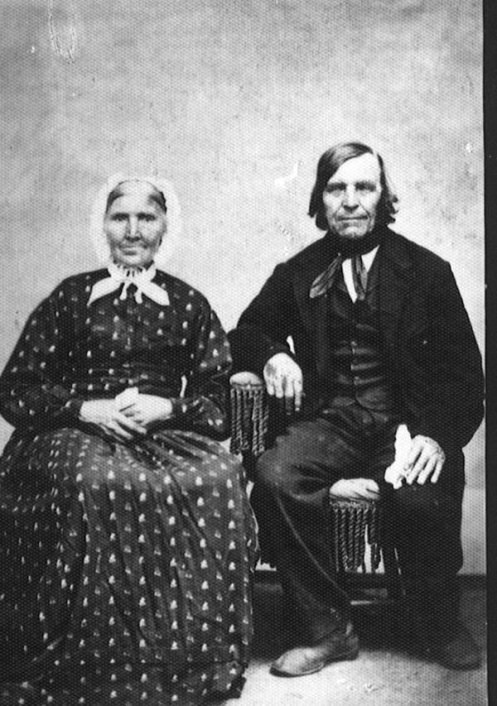
Berit and Einar Bonde, parents of Tosten Bonde, who settled in Nerstrand, Minnesota, along with his wife Ingabor. They were parents of my grandpa Carl T.
My great-great-grandmother grew up in Vang, Norway. I hate to make it sound like I’m boasting, but, well, one of her daughters was Thorstein Veblen’s mother.
Who, you might ask, was Thorstein Veblen? (I clear my throat.) I’m sure you could look up his name in Wikipedia. He was the economist who wrote a book titled, “Theory of the Leisure Class.
Thorstein grew up in Minnesota, near where my grandfather grew up. Only my grandfather didn’t write a book about economics.
Until recently, I always thought I’d never understand the famous book. Then I found another book he wrote in a used bookstore in Washington, D.C. titled, “Absentee Ownership.” I read the forward and preface. Turns out Thorstein’s works were satire. He was a socialist who, in a round about way, made fun of the big shots who did no useful work but bought and sold the work of others.


I did not meet the person who drew the layout of the SS Leopoldville on Christmas Eve, 1944, but he was Bill Loughborough. I missed him by a couple of years, but I spoke to people who knew him intimately. I am thinking of Hank Anderson’s wife, Mary. She seemed familiar and fond of the men of Company E, 262nd Infantry Regiment, 66th Division, better than her veteran husband Hank. I believe she had been to many of the Panther Division Army reunions and had come to love and respect this prolific chronicler whom she called “Luff.” Luff has written the most lucid, complete account of the events leading to the tragic end of the troopship. Indeed, Luff wrote with such detail that he even mentioned my Uncle Carl Bonde. He was the only one who mentioned him by name in any account written in the 1940s. I have speculated why Carl was not mentioned by others who wrote of the SS Leopoldville. He must have been forgettable, somehow. Not distinctive enough to be mentioned by name. Some of us are that way. Yes, even me.
Even though the official Army account lists the day that my mother’s only brother, PFC Carl R. Bonde, was killed in action, as December 25, I spoke to three or four who assured me that he actually died Christmas Eve. In fact, there can be no doubt about the date. A U-Boat torpedo exploded in his troop compartment, probably killing him quickly. At least, his buddies did their best to assure me that he had been killed instantly. They acted as if they wanted to protect me from the horrors of the war they experienced, the way my Uncle Bud would have. Avuncular. Like an uncle.
Instead of comforting me, their efforts had the opposite effect. In trying to protect me they have made me fearful.
In the numerous accounts of the horrific events in the enormity of the sinking of the SS Leopoldville, several soldiers wrote of hearing the terrified screams coming from the troop compartments near the place where the torpedo exploded with such a terrible smell of gunpowder. Soldiers were weeping, bawling, pleading for their mothers to help them. These accounts told the suffering of members of my Uncle’s company, perhaps his platoon, his section. Possibly of Bud himself. At this point in history, does it matter? No, not the particular people, they are all dead. But yes, those who were there suffered greatly until mercifully, they drowned. It may have taken up to two hours for the ship to slip beneath the waves, quenching the suffering of Bud and his fellow soldiers. Christmas Eve, 1944.
That night Hank Anderson said he felt he died the moment he leapt from the SS Leopoldville 20 feet down to the hard steel deck of the HMS Brilliant. The Brilliant had pulled up to rescue as many as possible. But then Hank felt that he had been resurrected once the soldiers had been delivered to the dock at Cherbourg. Many of them were wet and cold, others, like Hank, had injuries from jumping such a great distance.

Bill Moomey, who died last year, was a close friend of Carl’s. He credited Carl with saving his life because the 66th Division had been devastated by the torpedo that struck the SS Leopoldville Christmas Eve, 1944. The 66th was assigned to the cost of France to contain German submariners in their bunkers.
Bill Moomey told me that once he and the others regrouped on the dock at Cherbourg, he was dismayed at how few from his company remained. In the cold night, someone had built a fire. The men called out their company and platoon names, hoping that they would be reunited, but answers did not come. Bill said he saw a pallet of canned rations on the dock. A lieutenant, whom he didn’t know, told him that it might be a good idea if he grabbed a couple cases, so he did. The weather was cold and he and several others moved close to the fire. Sergeant Al Salata was the senior member of their platoon.
Hank said he had a religious experience Christmas Eve. A truck pulled up on the dock at Cherbourg, so he and the others boarded. They rode to a warehouse. Maybe it was a church, perhaps a hotel. A large stone building for emergency housing.
The races were segregated in World War II. The truck delivered Hank and some other soldiers to the quarters of black soldiers. They had just finished a Christmas Eve meal and theywere singing carols. The gospel singing sounded heavenly to young Hank Anderson, who later said that he felt like he had died and gone to heaven. Hank became a Presbyterian minister when he returned to Minnesota. He said that the Black soldiers graciously fed and housed the survivors of the Leopoldville.
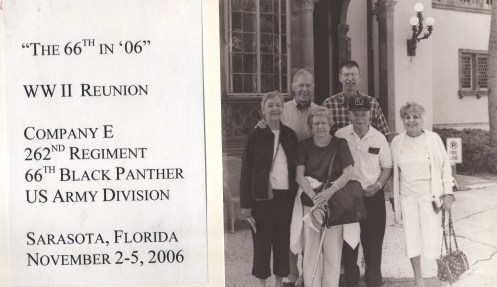
Pictured: some of Carl Bonde’s army friends who survived the sinking of the troopship SS Leopoldville, and their spouses. And me. I am the youngster in the back row. To my right is Hank Anderson and his wife, Mary. In the front row, Mary and Al Salata and Martha Merza. Her husband, Wally, probably took the picture.
I don’t know if Hank Anderson got separated from his Company E, but Bill Moomey told me he and the other 66th Division soldiers ended up camped in canvas tents on a big field, possibly a race track or fair grounds. Bill said that for the first time, he and the others got to sleep in as much as they wanted, eating the C-Rations he carried back from the dock on December 24. At the time the freedom Bill and his buddies had seemed heavenly.
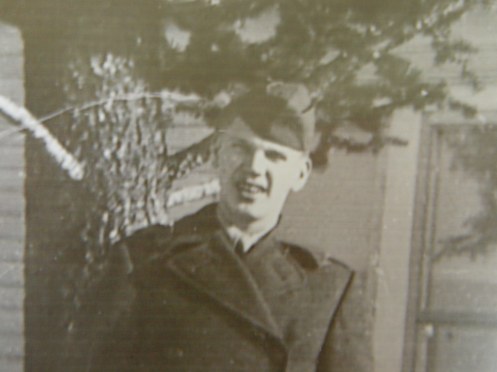
I don’t know who took this picture of Private First Class Carl R. Bonde, Jr. in front of his house in Kalispell, probably in the winter of 1943 or early 1944.
December 23, 2015
On this day in 1944 the soldiers of the 66th Army Panther Division at Camp Piddlehinton in Southern England got orders to drop everything and report to the port of Southampton for further transportation to France. The men were to fall out on their street near the barracks. This came as a shock. They had expected a Christmas dinner of roasted turkey and all the trimmings, but their officers said all of that had changed. They were headed for battle.
They did as ordered, scarcely believing it. Turkeys in the ovens were removed, partially roasted. The birds, buttered and seasoned, in roasting pans, were tossed out onto the dirt in the back. Uncooked fruit pies were discarded. Christmas trees that had been decorated with ornaments made from cigarette pack foil got dragged out the back door of the barracks and heaved into the darkness. All festivities stopped. The guys grumbled. Their hearts raced.
The young soldiers stuffed their all of their belongings: their military gear, plus whatever treats and personal effects that they could gather, into their canvas duffel bags. Then they switched off the electric lights in their brick barracks for the last time.
They hoisted their rifles and their gear and stood uneasily, in formation, platoons, companies, regiments. The order “right face” and “march” came as anticipated. It was almost more than they could believe.
Snow flurries started to dust the ground. The soldiers wore wool khaki coats and shouldered their rifles, packs and duffel bags. Everything they could carry was slung over their shoulders. Soon they were sweating.
Their eyes betrayed their dismay that the sumptuous turkey dinners that they were in process of fixing would never be eaten. Cranberries and dressing had been thrown out the back doors with the pies and the bowls of cooking vegetables. Potatoes, partially cooked, boiled, lay out on the cold ground, steam rising from the cooking water. Some of the soldiers got a sort of forbidden thrill from the waste.
So often, the soldiers had gotten orders that later turned out to be nothing more than drills or false alarms. Many thought the throwing away of food criminal.
PFC Carl Bonde and his friends had not been part of these Christmas preparations. They had arrived back in camp to find everyone packing to leave. They had been in London seeing the sights, hoping to encounter the legendary British women who were said to engage in casual sex in doorways by hiking their skirts and leaning against walls. Carl and his friends made no secret that they hoped for such opportunities.
They had met no women like that. Glumly, well, cheerfully at last, they rode back to their Army camp. The prospect of a Christmas feast cheered them. At least until they found out that they were to abandon camp and ship to France.
They wondered why? The war with Germany was all but over! The Third Reich had been almost entirely defeated by the Allies. The soldiers of the 66th Division really didn’t know what was going on. Their senior officers knew that Hitler had started a surprise offensive in the Ardennes in Belgium that they had to repel. General Eisenhower ordered them to go to France.
The soldiers trudged the miles to the train depot for the long ride to Southampton. Some of the soldiers, tired of hiking, dragged their duffel bags along the road that grew whiter with snow as they went. No cadence could be heard. Each soldier stumbled behind the one ahead in the gloom of night. Seemed like an eternity, but eventually they reached the railhead. The men were loaded onto the “forty and eight” cars. Some were able to catch some sleep on the train in the frosty night on the way to their point of embarkation at the docks.
The railcar jolted to a halt at Southampton in the wee hours of December 24, 1944. The men marched in formation to a place on the pier, between a great rusty ship and a Red Cross building where volunteers served coffee and doughnuts.

Squirrel. Something like the ones in this fable.
December 22, 2015
My muse is not just dead, my muse is an asshole. Doesn’t speak, doesn’t even offer an idea. I hear myself shout, “I hate you, muse!” I listen, but I hear no answer back from the muse. Don’t you think I’ll have to try being nicer?
That said, I think it’s time for
Another fable for modern times.
Yesterday, as I prepared for a grueling workday at Omnicare Pharmacy, I noticed two two-pound bushy red squirrels frisk and scratch as they ran up and down a tree outside my bedroom window. I marveled at their size.
I guessed that they were mating and would soon have, er, an adult squirrel encounter. Of course, I wanted to witness, so I settled in to watch.
Curious as I was, carefully as I watched, the pair continued to run noisily about the tree, out on one limb, jumping down to another, then back to the trunk of the old tree. An ash tree. Same tree our kids nailed boards on to climb and build a tree house. Same one another of their friends hacked the bark of with a machete. P. said they were “lawless.”
The squirrels soon tired of running. That’s when they discovered they were both girls, I think. One might have said to the other, “You are dressed the same as I. Don’t you think you could show some originality?”
The other glared, said, “Goes double for you.”
The first one said, “I’m looking for a good place to hide my nuts. Oops! Sounds a bit risqué.”
The other answered, “I have a place. I’m okay if you want to hide your ‘nuts’ there too.”
The first: “I’d be crazy to do that. You’d eat all of my nuts while I am hibernating.”
The second: “Suit yourself! (bitch) I have enough nuts that you could help yourself and I wouldn’t miss them.”
The first: “I’d like to hide my nuts with yours. What a bargain!”
The second: “Changed your tune, what?”
The first: “Yup.”
The second: “Try to catch me!”
Then the two squirrels ran up and down the tree, making the same scratching sounds, going out on limbs, jumping down to other limbs, heading back to the trunk, getting warm, getting exercise.
Moral: Your nuts, like your face, is your fortune.
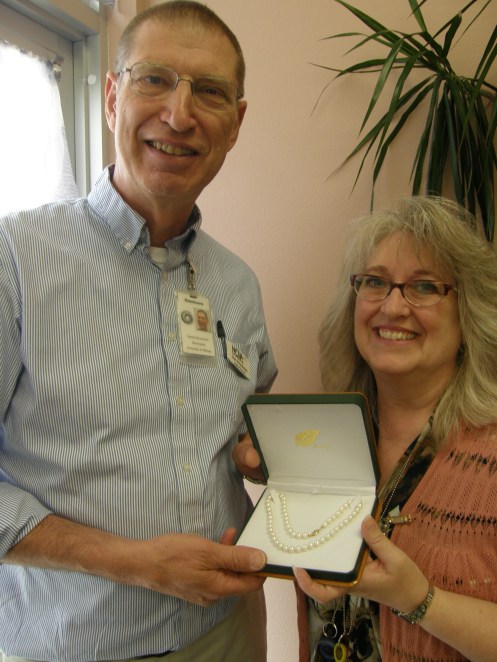
Donna won a drawing to win a $900 pearl necklace. This pissed me off.
Today was the last day I’ll work for Donna Zieske, pharmacy technician and manager extraordinaire. She retires the end of this month and we are traveling to visit two of our children and five of our grands.
I can’t remember how many years ago Donna interviewed me when I applied to work at her pharmacy.
Oh, I was on my best behavior! I wore a necktie. I sat up straight. It’s just that I couldn’t help noticing that her desk was messy, stacked high with medicine, packed onto scores of bubble cards. A bubble card is about 5 x 7 inches with 30 bubbles on its surface, each holding one pill. At one end of the card a label tells what the medicine is and who it is for. Donna had, maybe 100, or so, of these cards stacked in a kind of plastic bin, plus a bunch on top. All on top of her desk. A mess. Impressive, but a mess.
I don’t remember what questions Donna asked me, but I spilled everything. I told her how I had recently walked off my last job without giving notice because the woman who managed Walgreen’s Infusion Service was a, well, a fucking bully and had pushed me too far. “One of us was really foolish,” I added. I told her how, many years ago, a girlfriend had given me the boot when I was 19, and how I had cried and how I had listened to cowboy songs in the small hours.
Then I told her how I had joined the Marines, how I almost got kicked out for hitting my commanding officer. Best of all, she seemed to want to listen to my stories. I had a million of them!
Sympathetic, Donna handed me a box of tissues. Then, at last, she hired me.
Of course, I told Donna how I’d spent a career as a US Public Health Service Commissioned Officer, decorated for excellent work under adverse conditions. No. Not quite. I was decorated, but only for pretty good work under ordinary conditions. That doesn’t sound as impressive, though, but it was good enough for Donna.
Donna, in turn, sent me to a lab for a comprehensive urine drug screen. I remember, sitting on a plastic chair at the lab across town, going right after a truck driver. He was a handsome fellow! I hoped the truck driver was clean if he was going to drive on the same roads as I.
Apparently, I passed the piss test, although the nurse, (Registered Nurse) who administered the test seemed to be suspicious. She didn’t smile or make small talk. She used a thermometer to make sure I hadn’t smuggled in another’s urine. She had me initial the vial of urine in two places.
Donna, as distinct from my cruel, previous boss, accepted that I was fully human. In turn, I took careful notes while she rattled on and on about her goddamn pharmacy. Unfortunately, I seem to have mislaid the notes. I have misplaced everything she told me about sending prescriptions to several dozen nursing homes and assisted living places. All of that was complicated and messy. Very technical.
I spaced it all out while she talked on and on and on. Then she asked me if I had any questions. I snorted indignantly. “No.”
I told her that that her question, “any questions?” was pure bullshit. The answer to that is almost always no, I informed her. If she wanted an actual question from me she would have asked me what questions I had? Then she would have waited expectantly for quite a long time. While I rocked my body back and forth.
I told her that I wasn’t smart enough to work for her. I showed her my head in profile, small cranium. “Do I look like someone who could learn to work here?” I demanded.
She answered, to my surprise, in the affirmative.
“You can give me the boot at any time!” I ejaculated.
“I won’t give you the boot!”

Tales of the subgenius.
December 20, 2015
One fall day in 1983 our sons Bob and Todd came back home from somewhere, a dusty day hike with the Boy Scouts. That was the first I’d heard about the Scouts in Billings. Our son Bob said he had carried a heavy American flag for a long way, perhaps miles, on a road in Eastern Montana. He explained that when the Boy Scouts hike carrying flags the business must be performed in a precise manner. Not letting the flag droop. In those days, the boys and I had been playing Dungeons and Dragons for hours, so I was glad that they finally did something outdoors. But the Boy Scouts? Not my idea! We were hippies! I thought. We raised them in Missoula to be free thinkers. They wore hippie lace-up boots. We drove volkswagen vans. (I rolled my own cigarettes, although that was becoming passe.)
One Monday evening in Billings in 1983, P., Clara, and I picked the boys up at the church after their scout meeting. We went downstairs to a kind of big room, far wall covered with cabinets, doors hanging open, scout gear spilling out. An inner cabinet door displayed an avalanche of tacked-on red, green, blue, and purple ribbons declaring “100% Boys Life” for a variety of years. I looked: the 50’s, 60’s, and, like, 1973. A metal stand with an American flag stood over to one side. Two old gray-haired, fat-bellied, men played what looked like volleyball with perhaps five grade-school age boys. Two of the in the room boys were ours. They darted around, not noticing we were there.
The old guys were Arlie Bornhoft and Dewey Hansen, both dead now. Come to think of it, they weren’t even playing volleyball. They played murder ball. I noticed that the fluorescent ceiling fixtures hung askew and dangling at a couple of points. The scouts ended up pushing the ceiling danglers back into place with a pole. With a game of murder ball, someone flings a partially inflated ball with great force at another, as in a game of tag. Only with welts and broken fixtures. All the while the boys belonged to the group, murder ball dominated the agenda. The meetings went this way: post the colors, recite the scout oath, the scout law, the pledge of allegiance. Then, came a lengthy, punishing game of murder ball. Finally, with everyone trying to catch their breath, they had a closing ceremony. Oh, I almost forgot: they must realign the fixtures. Close the cabinet doors, leave the building. I just got ahead of myself.
First, one had to carefully employ the pole to realign the fluorescent fixtures, then do the flag business: one boy or another always recited the scout oath and law and the pledge of allegiance. Occasionally, a boy would demonstrate how to set up a tent or tie a knot. Sometimes we would talk about a forthcoming trip into the frozen places near Billings to spend the night sleeping in several nested sleeping bags. The day before, somebody’s mother always called me to tell me, almost in tears, indignant, that she wouldn’t let her son out in subzero weather. I controlled my urge to call her son a pussy.
Our kids slept in sub-zero weather. So did I. We earned a special badge, “100 degrees of frost.” That badge did NOT get us closer to “Eagle.” However, it gave us certain strutting around rights. One of the kids in Troop 2 made Eagle. I’ll tell about that another time.
Oops I forgot. Soon I was named by Dewey Hansen to be the Scoutmaster of Troop Two, an old troop in an old church. Stan Bruce kindly agreed to be my assistant. He had a pickup. He grew up in Baker. His sister still lived there. He wanted to teach the Boy Scouts about carburetors. I agreed with him.
Although my late Uncle Carl Bonde had been a scout, had left behind his Handbook for Boys and an official flashlight, I didn’t quite understand scouting. I mean what did Scouts do? The old guys who recruited me spoke of camping trips where they had fed the boys from a huge pot. Then there was our world. We went swimming once a month at one of the college pools. We tried to sleep overnight outdoors at least once each month. We put sleeping bags inside of other bags in the winter. One night a chinook blew and I woke up drenched in sweat.
We had one older boy, a junior in high school, our senior patrol leader, for as long as I could remember. I can’t remember his name, but one day in June he lead Troop 2 for a camping trip into the Beartooth Wilderness to Elk Lake. We had, maybe, six boys, organized into two patrols that lived together, ate together, watched out for each other. They knew how to fix noodles and sandwiches and to eat cereal for breakfast. They got along.
Short of it was, the kids managed themselves for the entire time. Well, except for one kid who got mad at his fellows and disappeared. Yes, disappeared! Man! I was pissed. I stormed around and made everyone stay put. I forget how it happened, but eventually the angry kid made his way back to the rest of the group. I wore him out. He ended up being quite a good runner, a miler for one of the high school track teams. Just coincidence, I suppose.
Another time I almost lost Todd on the trip. We had been hiking up Elk Creek and stopped to rest atop some rocks looking over the tumbling, noisy, distant white water below. Todd took the weight of his pack off his shoulders, facing me, back to the cliff. He raised the pack higher, higher, then — the pack flipped back off his arms, throwing his weight toward the cliff. I reached out and snatched his shirt. He would have pitched backward.
Above Elk Lake, a short river linked to another small lake. A memory: the Senior Patrol Leader shouted at the boys who were wading across a swift water. “Hey goofs!” he shouted. When we got across I found a live campfire someone had let burn. I carefully extinguished it, disgusted that someone would have so little regard for the wilderness.
I learned later that our backpacking trip to Elk Lake fit the ideal Boy Scout model. Boys governing boys.

My nephew, Jon, snapped this picture of me. On the middle left is the black hulking form of the 120-year-old 5×7 Phoenix autofocus enlarger from Dresden, Germany. The bellows are cracked, so I fastened a skirt to prevent the enlarger light from fogging the print.

Pioneer Park in the summer.
Saturday we walked a couple blocks to the rally at Pioneer Park in support of the 50, or so, local Muslims. I heard that someone with a holstered handgun also showed up, his face covered with a scarf. The rest of us were–oh, the usual suspects. Local long-hairs, musicians with Gibson guitars, liberal clergy, my friends, hippies, beatniks, filthy untrained artists. I see them everywhere. Writers, too.
Today in the newspaper I saw his photograph, read that the local police had asked the “Open Carry man” to leave the rally, so he did. Perhaps because he did not support the local Muslims. I guess not, anyway.
I guess I knew about his presence at the rally at the time, but the weather was cold and I didn’t look for Mr. Open Carry. I’m an old man, for Christ sake! Do I have time? I did notice a huge pickup parked near the rally, but I felt comforted that the license plate had the Crow Tribal Seal. Was it fair to assume that if Native Americans were present they would be fair-minded? I think so, and I’m speaking from experience. After all, they tolerated me!
Perhaps the rally would have been incomplete without someone like the pistol packer nearby to demonstrate against. I think most people ignored him.
So in that regard, I guess he did support the local Muslims, albeit indirectly. He didn’t carry a sign, just his sidearm. And his scarf. Was he afraid of being recognized? Even the Muslim women didn’t cover their faces at the rally. Was anyone frightened? (Beside him, that is.) Not anyone I spoke to. Most curled their lip or said some other thing with disdain. “Who gives a shit?” comes to mind. Oh yes, I am the one who said that.
P. and I walked the two blocks back home from the park before the photographer had snapped a photo of the people at the rally. She didn’t feel well! She had been sick to her stomach the previous night and I needed to head to the Family Promise Christmas party at the American Lutheran Church, a couple blocks on the other side of our house.
Family Promise: it is the only homeless shelter program in town that allows men to stay with their families. About four families do one-week rotations at various churches around town. Because the burden of care is distributed widely, every 12-13 weeks our church houses the families and feeds them. We sign up volunteers to spend the night and to provide meals. P. and I and a really lively woman spearhead the effort at our Church of the Fervently Religious. I attend services, but P. does not, although she is solidly behind Family Promise.
I was one of the first volunteers to arrive at the Christmas party, so I walked down to the gift area. Here’s how it worked: kids were ushered down to the gift area and chose gifts for their family members. The goods were displayed on tables: scarves and socks and hats, jewelry and watches, flashlights, lotions, ornaments, toys, stuff like that. My job was to mark their names off a list. I tried to do it without having to actually ask them their names, because I hate asking people their names. I did recognize a few, okay one person, from the last time they stayed at our church, the Church of the Fervently Religious.
As I waited for children to enter the gift area, I saw a young lady nearby, her hair pulled back into a pony tail. She looked like a young adolescent, so I assumed she was somebody’s kid. She had Buddy Holly glasses, in style these days. She said her name was Kate. “Hi, Kate,” I said, “I’m Dan.”
“The pharmacist,” she said. “Wow,” I said. “How did you know that?”
“I met you two or three years ago,” she said. “I’m the veterinarian.” I peered at her. She had teeth that had once had braces.
“Oh, I guess I remember you,” I lied. She was only four-foot something tall and couldn’t have weighed 80 pounds.
“Do they let nine-year-olds become veterinarians?” I asked.

Carol and I love to sit and talk. And talk. And talk.
December 16, 2015
Morning. Phone rang. I let it go to message. [sleep] Phone rang. I answered. My sister Carol asked me over to Jon’s. I found clothes, took morning medicine, drank coffee, gathered sister’s Christmas presents.
As I scurried, I envisioned myself behaving like sister. Chubby feet going this way and that. Hurrying to get out of the house. One cannot leave as quickly as when I was younger. Had to do with being fussy about socks. Ones that match. I remember thinking, these socks match. They were blue. Gold toe.
Okay. My sister is ten years older than I. Maybe 30 years ago, my friend Mike Fiedler talking about his older brother, declared: “he was always good to me!” Since then I’ve said the same thing about my sister. It’s a duty to honor one’s sister. Sure, she used to spank me as a child, reprimand me sometimes, but altogether she has been good to me. Sisterly. I do love her! She is a trial! But I love her! She has bipolar disorder!! Love!
The first time I remember even having a sister, maybe when I was three, our Daddy had yelled at her to wash the dishes. I thought fire came from his throat! What a temper! He was magnificently a college professor and an artist of the first water. In fact, our mother used that expression, “of the first water.” He died when we were still children, but his memory looms large, as they say. My sister says she thinks his anger had to do with him having bipolar disorder. Who can disagree? She said his mania manifested as a bad temper. Carol knows all about mental illness.
She, on the other hand, her mania manifests as generosity. She buys things with her credit card. Nice things, like Persian rugs and porcelain. Mania. She told me she loves her mania, She said she earned it. With depression she endured! Hypomania, I corrected her. She agreed. Hypomania. Good.
In their teens, back in the 1950s, my sister and her friends played with me as though I were a doll. To them I was a doll, because they were ten when I was born. Of course, I liked it. They swung me around, tickled me, took me places. I remember holding onto a pair of their hands on the sidewalk and they’d leap me along, by lifting me up as they ran. I pedaled my feet in the air, then took a couple steps, then pedaled again. I forget where we were going. Ice cream, maybe.
Oh, they bathed me too, but I didn’t like it. I mean, the teenage girls didn’t hang out with me in the bathroom or look at me, at my privates, but they made me bathe after I’d been up on Mount Sentinel getting infested with ticks. Bathing was a huge inconvenience for me, but they had wanted me to do the correct things. For health. They cut no corners where I was concerned.
Today at Jon’s, my sister was laying on a recliner when I got there. No. I remember that she met me at Jon’s front door, but then she retreated to the recliner. She told me about an author she liked, whose name I can’t remember. I’ll get back to that later.
More importantly to me, she told me about her dog that she had had for only about a week, I guess, before she got rid of it. It had a name, like “Skippy,” or something. The dog is gone, so it’s a moot point.
Carol said she spent $400 on the small dog that didn’t pan out. Her psychiatrist had told her, no, ordered her, to get a lapdog. A service dog. So she did. She went to the pound in Scottsbluff, Nebraska, her home town, and paid $160 to have the small dog spayed and vaccinated. And to pay the pound fee. I forget what breed it was. A mutt, no doubt. She said it weighed about 12 pounds.
All was well. The dog cuddled her. It liked to sleep on her bed. It did all of the affectionate things a dog can do. In turn, Carol bought it a kennel, a bed, some food, a dish to hold the food, and other appurtenances, like a leash. How could this have run up a bill to $400? Well, now you know something about my sister. She exaggerates. I used to call her a liar. She tore into me a few times, but she now accepts the label.
What happened? Her service dog shit on her rug time after time. She said she walked her new dog, did all of the right things. The dog did not shit on her $3000 Persian rug, but she had to pay to have her apartment carpet cleaned. Finally, she got rid of her dog. Sent it back to the pound. Carol said she no longer even considers getting a lap dog, a service dog. She wants no dog because she travels too much.
My sister has had a long, good life. I think she has, anyway. At 18, she married a law school student fresh out of the Army. I was in the 2nd grade. Four years later they had their first child, and I became an uncle. I loved that role. It meant I could beat that child into submission. Today, I’m thinking that’s why he feels resentment. I don’t know. I’m not sure he remembers,but he keeps me at arm’s length.
Carol had baby after baby. Seven in all with her husband, the law student, then lawyer. (She lost the 2nd, stillborn.) Carol’s houses kept getting bigger and bigger. My brother Tom tried to keep up with her and keep her houses painted. In turn, Carol took care of my brother. He had schizophrenia. Perhaps bipolar disorder as well? She and I helped Tom get disability insurance payments.
Then Carol’s husband started fucking his secretary and Carol’s marriage ended. On her own, she moved first to Arizona where she scraped out a living in Wickenberg, teaching and tending bar. Then she married a jolly bearded gravel-pit owner and they moved to Alaska. There she taught school until she retired with a good pension. Her second husband ran away, so she dumped him. Both of Carol’s husbands have since died. She is a double widow.
Here’s what my sister ended up with: she gets a generous retired teacher’s pension from Alaska. Her six children are all successful adults. Two are lawyers; another, the oldest and arguably the smartest, is an excellent house painter; her youngest has a PhD in biochemistry and lives in Berkeley, California; Jon is a mental health counselor and finally, her one daughter is the mother of five and married to a police detective in Scottsbluff, Nebraska.
Carol has about a dozen grand-children. And one brother. Me.
The mountain lion and the wild turkey
Out in Montana, in the Yellowstone River breaks, in a rocky lair, a mountain lion curled up with her cub who pulled at her breast. Although the mother lion’s breast hurt from the sharp teeth of her cub, she was patient. This will pass, she thought, adjusting herself under the overhanging rocks. She had been wary of rattlesnakes because the weather had been hot. She said to her cub, “watch out for rattlers.”
She did not see a rattler. Instead, several wild turkeys strutted below where she and her cub nestled.
“Are those rattlers, mama?” asked her cub.
“Those are turkeys, good to eat,” she answered.
“Can I eat one, mama?” asked her cub.
“Yes, once you are weaned from my breast,” answered the lion.
The cub decided to try his luck with one of the turkeys. He waddled to the edge of the overhang and leapt, tumbled, really, into the void. He landed hard on the rocks below, frightening a turkey. Suddenly seeing the cub so dazed and disoriented, the turkey took courage and strutted up to him, pecking out his eyes.
Of course, the cub was blind. But the cub’s mother didn’t know this and called to her son. “Climb back up here.” He simply blundered ahead into the rocks. She bounded down to her cub and picked him up by the nape. She and her cub returned to their lair in the rocks where he resumed nursing her breast as before.
I’m sure there’s a moral here for us:
Even if it doesn’t rattle, it can still peck your eyes out.


 insearchofbud