
Tom Struckman
February 8, 2015
If my brother Tom said he didn’t believe in God, but that he had made himself. He said that made him noble. I don’t think he ever changed his mind about that. He’s dead now. I am certain that he was not afraid to die, because I spoke to him shortly before he died.
Tom is hard for me to describe. He was born April 6, 1944, died in 1997. In Missoula, late August or early September, nobody knows the date because our friend Mark Fryberger found Tom’s body on his kitchen floor, covered with maggots. The body had been there for weeks, probably.
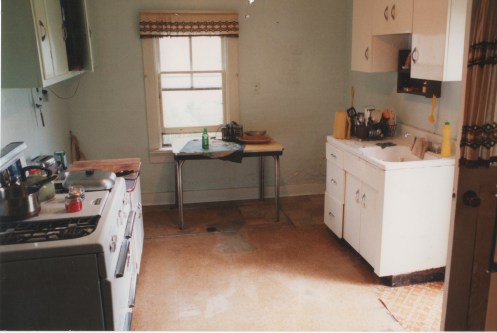
Tom’s image showed as a light-colored area on his floor where his body decayed.
Mark said he had visited Tom’s house because he wanted to see if Tom would adopt a cat. He thought Tom was between cats, you see. Mark said he knocked on the door a few times. Tom was nearly always home. Mark looked through the window on Tom’s kitchen door and saw what looked like a scarecrow on the floor. Mark opened the door and saw what it was, then called the cops. Then Mark phoned me. He said, “Tom died.”
I called our son Todd who went to Tom’s. Todd phoned us later and told us that we had to come to Missoula pronto because Todd’s girl friend was out of town teaching her photography class.
When we arrived in Missoula at night, Tom’s house was dark, except for the glow of perhaps a dozen candles. Nobody was there. The smell was unpleasant and the candles were practically useless. I noticed a used latex glove on the gravel walk leading to the back steps. Tom’s house had the overpowering, almost sweet, heavy odor of death.
The next day when I photographed every room in Tom’s rented house, I noticed a pattern of pink comma-shaped specks on his kitchen walls, ceiling, even into his bathroom through the open door. A prescription bottle on an open shelf shelf above the sink had them. I suspected, then got a confirmation, that after a certain amount of time a cadaver inflates with gas produced by bacteria in the gut. The body eventually reaches the bursting point and sprays its contents like an aerosol. Hence, the many light pink comma-shaped marks on the walls and ceiling. The little tails of each speck pointed to the place Tom’s body had lain.
Right. I can describe Tom’s appearance in death better than how he looked in life. See? I never saw Tom’s cadaver just his imprint on his kitchen linoleum. The imprint came of our son’s scrubbing the linoleum with chlorinated cleanser.
Tom was hip. I mean, actually hip. He was fun. Even for me, once we reached adulthood. He did it all, he did it first, and he did it better. I’ll try to give you a better picture of him.
However, I spent my early childhood running toward, then from, Tom. Our father died early on. I admired Tom and wanted to play with him. He had neat stuff. He chased me away from him. He usually punched me with his fists. Usually in the arms and stomach, not my face. He didn’t like me. I was sloppy. He was a perfectionist and he regarded me with disdain because my facial features were large and plain. You see, I was destined to become considerably taller than him. Therefore I started out looking and acting clumsy and ungainly. My eventual tall stature was not evident during our childhoods and Tom was, frankly, ashamed to be seen with me, so he punched me and ridiculed me so that I wouldn’t follow him around like a mongrel when his friends were looking.
I am here simply telling the truth, not so that you will pity me. If he were alive, Tom would tell you that nobody needs to pity me. Or him either. I just want to tell about Tom here.
He studied Zen Buddhism when he was perhaps 25 years old. The rest of his life he faithfully meditated several times a day, sitting erect in the lotus position, often facing a wall.
I think I forgot to mention that Tom was schizophrenic, but he took no medicine. The U.S. government agreed with the evaluation by the psychiatrist. Tom received a small social security disability pension that he had to supplement with food stamps and several hundred dollars a month his sister and I sent him.
Over the years I have known several schizophrenic patients in my career as a pharmacist and none of them acted like Tom. He was not delusional, suffered no apparent discomfort, was not paranoid. However, the last 10 years of his life he wanted nothing to do with me. He was fairly socially isolated by that time. He disliked me, and that was that.
Tom was scholarly. He studied English literature in Missoula, getting A’s from even the most demanding professors, then got into the graduate program in Eugene, Oregon. In 1976 he dropped out of school. He became a hippie and moved in with his friends in Seattle. Our uncle in Seattle bought Tom a 1953 Chevy sedan and had Tom visit a doctor who prescribed Triavil. No longer available, Triavil was a combined antipsychotic/antidepressant pill and Tom did well. Tom and his friends got jobs with the Seattle Parks Department. It was a sweet job that was undemanding, but paid well. It was the perfect job for him and his friends. They all smoked hashish. Really good hashish from Lebanon. They played music on guitars and drums and drew pictures with colored pens. Life was good.
We knew Tom was an unusually gifted person, although I’m not sure what his gift was. I guess I was first aware when I watched Tom make a soap carving with Ivory soap. I remember that he copied an image of “Sir Edmund Hillary climbing a mountain” in our encyclopedia, the 1950 edition of “The Book of Knowledge.” The figure was perhaps three inches tall, perfectly proportioned, complete without any broken limbs, of a mountain climber wielding an ice axe, carrying a huge pack and coil of rope. The space between his legs was empty of soap, same as the areas around his arms. The detail was perfect, right down to the expression on his face. It did not look like the work of a 7th- or 8th-grader. Of course, I tried my hand a soap carving also, and I tried to make a duck or a fish or a cat. Didn’t matter. They all looked about the same. Tom’s derision of my lame attempt was heartless and merciless.
You know how kids like to draw? Tom’s drawings looked like the illustrations in books. He was so into mountain climbing that he typed up his own book, titled “The Conquest of Everest,” complete with full page illustrations of climbers and Sherpas, maps, drawings of the mountain, with all of the climbing routes labeled.
Tom picked and chose at what he would excel. The French horn in high school, then the classical guitar in college. (He traded his horn for a Gibson guitar.) Folk ballads. (He could play and sing all of the verses to many Joan Baez songs.) Marvel Comics. He was into Marvels the first year they came out. He wrote a play when he went to the University of Oregon, titled “It.” (He gave it to our mother for her birthday.) He could play marbles. (He had a canvas bank bag fat with marbles.) He collected baseball cards, he built model airplanes, he made a telegraph set, he built a wooden castle complete with moat and drawbridge. He carefully painted every knight and every knight’s horse. The list goes on.
Even as an adult he learned to swim by reading a book. He became even better at drawing from life by reading another book. He built a harpsichord. And a clavichord and years before, a banjo.
You get the idea. He read books. Hundreds and hundreds. The last book he read before he died was Adam Smith’s “Wealth of Nations.”
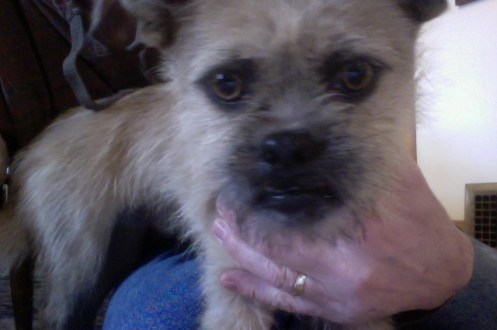
A Fable
At first, Daniel could not believe that his dog, Gunther, could speak. No, not like another dog speaks, such as “yap yap,” but actual words, whined out, the way dogs do when they whine. Perhaps you have heard such whining.
At first Gunther’s speech sounded like “rrrrrrrroooooooorrrrrrrrrrmmmmmmmmm.” Plus, whistles and variations of that.
Until Gunther said, “mmmmmmaaaaaamaaaaaa.”
“Mama,” Daniel said. “Wow.” Daniel responded by giving Gunther one of the chewy chicken-flavor treats that he kept in his coat pocket. Daniel had previously rewarded Gunther only for pooping outdoors. Daniel certainly didn’t expect human-sounding verbiage from his dog.
Daniel kept the treats in the plastic, zip-lock, self-closing pouch, at the ready, in case Gunther said anything further. Well, he did.
“Arrrrrowww,” said Gunther, speaking of the projectile from a bow. Often Gunther put sort of a whistling sound into his speech, but I don’t know how to tell you about that here.
One spring day, when Gunther was more mature and able to speak much clearer English, Daniel and he hiked in the foothills of the Beartooth Mountains. They encountered a damned large grizzly. Gunther, believing that he was bigger and stronger than any other creature, launched himself with great force toward the bear. The bear responded by opening his huge mouth, dripping with saliva, festooned top and bottom with sharp teeth.
The bear, as you might guess, swallowed Gunther whole. If the bear had bitten Gunther in two, this fable would be over and you would have to turn off the light and go to sleep.
But the fable is not over. Gunther loved to burrow, so he dug his way down the bear’s esophagus to his stomach, which was half-full of roots and grubs. Gunther would have made it into the bear’s duodenum, but the passage was too small, so Gunther turned around and faced upward, toward the bear’s mouth.
The bear, meanwhile, had run away from Daniel, carrying Gunther in his stomach. Daniel started to cry, then he headed back down the trail.
Gunther barked from inside the bear. He also whined, “Maaamaaaa.” And whined, “No arrow.”
Daniel, meanwhile, had reported to the Forest Service Ranger that a grizzly had eaten his dog.
The Rangers soon located the great bear and prepared to shoot the bear with a dart to make it sleep. However, the Rangers heard Gunther. They thought the bear was crying for its mama. Also, pleading for them to not shoot the dart. None of them had ever heard a bear talk before.
The bear ended up being trapped alive and put on display in a menagerie so that other people could hear it ask for its mama. Nobody ever suspected that Gunther was inside the bear’s belly. Eventually Gunther died and was digested. Of course the bear stopped talking, but nobody was surprised by that.
Moral: One can be too brave and clever for one’s good.
“You and Mike hunted rattlesnakes barefoot, and we were just horrified,” said my aged Aunt Corinne. She made her pronouncement. Then she waited for my rebuttal.
However, I gave up arguing with Corinne even when she was sober. She was always sober before supper, but afterward she sometimes poured a generous Jack Daniels on ice. Corinne wasn’t interested in my side of the tale, so I will convey it here for your benefit.
Yes, we did catch and bring home a prairie rattler at what’s called the Hogback, a long butte in the high sagebrush country between Dillon and Melrose, Montana. I’m sure we wore work boots, or at least tennis shoes, but not barefoot. I hardly ever went barefoot.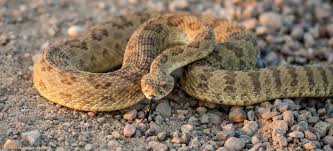 Too many prickly pear cacti for barefoot. We might have worn low-cut Converse all stars.
At school I sometimes wore pointed toe leather shoes with the compulsory gorilla-hair vest and probably a red button-down short sleeve shirt and tight leg pants. I’m talking 1966. By summer I had returned the shoes, shirt, and vest to my friends from whom I had taken them.
The summer of 1966 I had a split shift job moving aluminum irrigation pipes every 12 hours in barley fields, so I had all morning and afternoon free for hunting rattlers. More precisely, it’s the prairie rattlesnake, Crotalus viridis viridis, which lives in the high dry valleys of Beaverhead County.
Laurence M. Klauber, who wrote the definitive two- volume book, Rattlesnakes, published in 1956, has chapters of information collected from people in Beaverhead County who told him stories of their encounters with the charismatic reptiles. At least I found them charismatic, or scary, or fascinating.
As a child I had never seen a rattler until my mother drove my grandma and me to Ann Arbor, Michigan, in 1961. We stopped at Reptile Gardens near Rapid City, South Dakota. A Wikipedia article said R.Gardens was started in 1937 to exploit the widespread fear of rattlesnakes and the public’s willingness to pay to see them. Many of the rattlesnakes there were much larger than the Crotalus Viridis Viridis of Montana, which seldom grow longer than three feet and are typically half that length. But they are a fat snake. Fatter than a garter snake of similar length. I still have not seen more than eight or ten rattlesnakes in my life, except in zoos. I suppose that is a good thing.
A few other people I knew encountered rattlers more frequently than I ever did, such as Penny’s cousin Ronald Rowton, former sheriff of Fergus County in Central Montana. About 20 years ago I asked him about rattlers and he said he didn’t care much about them. However, on the same trip to Lewistown when I asked Ronald about the snakes, we saw a dead one on a dirt road between Lewistown and Grassrange. Someone had cut off the rattle at the end of its tail, so evidently at least one person cared about it enough to decaudicate it. I may have just invented a word.
Anyway, another time in 1966, when my friend Tad Henningsen and I found a rattlesnake — he found it actually — on the Hogback, I came prepared with a four-foot steel pipe with a wire running through it so I could snare its head. I also brought a galvanized garbage can to carry the snake back. We were in my mother’s metallic blue Ford Fairlane 500 sedan, so we just put the can with the snake into the trunk and left the trunk lid open. As I recall we didn’t remove the loop from the snake, either, so the trash can rode with the pipe sticking out and the snake was still alive when we returned to Dillon.
Tad and I were thirsty so we stopped at the A&W Root Beer stand on the way into town. I think Linda Cook, car hop our age, waited on us. She liked Tad, so she approached his side of the car. After we ordered the usual free paper cups of ketchup (which we usually just licked out with our tongues) and root beers, Tad asked Linda to get him his hat out of the can in the trunk. As Linda started back, Tad, panicky, bolted back after to prevent her from reaching in.
We ended up killing the snake at my house, and I gave the rattle to my nephew who took it to school to show his friends.
In recent times we have seen a lot of racers, garters, and bull snakes in the Billings vicinity. Well, we did see an occasional rattler (like maybe four in the last 30 years) but most often we saw bull snakes, often way bigger than most rattlesnakes.
In 1989 two of our high school age children, Clara and Todd, went with us on the 4th of July to float about six miles of the Tongue River between “White” Birney and “Indian” Birney in Montana. The Tongue borders the eastern boundary of the Northern Cheyenne Reservation. Penny and I drove a station wagon, Todd and Clara followed in the 1965 VW van with the raft and food and other necessities for floating.
On the way to “Indian” Birney, or Birney Village, as it was also called, P. and I noticed a large snake lying on the highway. “They’ll get the snake,” I said.
Our plan was to leave the car at Birney Village and for all of us to pile in for the drive to “White” Birney, or Birney Town, upriver. When we stopped at the getting out place at the bridge on the river, I asked Todd if he saw the snake on the road.
“Yeah,” he said, but admitted that he hadn’t stopped. I was, of course, disappointed. Todd later asked me to get him the lunch food out of a bag in the back of the van. Of course, when I touched the snake, I screamed.
Todd and I always wanted to fix up a snake skeleton, so we picked up a dead bull snake on a road outside of Billings, took it home, skinned it, and I boiled it on the camp stove for three or four hours, hoping to clean the bones that way. Instead, the snake’s flesh was like hard rubber. I ended up tanning the skin and giving it away. I found a bird cage in the basement and dug up the compost in the alley bin, put some compost right on the snake carcass, and buried the whole bird cage. Months later I dug up the cage, found what looked like hundreds of rib bones, and the spinal column. I used a thin wire to hold the column together with a nut fastened to each end and I gave the bull snake spine to a great nephew.
The best family story about rattlers came from my wife’s Mom, Lillian Meakins. In 1920, when Lillian was about six, on a homestead in Eastern Montana, she had an adventure with her Grandma.
In that part of the Missouri River country, adjacent homestead claims were frequently staked by family members. A single 40- or 160-acre homestead was too small to support a family. To “prove” the homestead, Lillian’s Mother and Grandparents built tiny houses from parts that came on the train from Missouri and then overland by team and wagon. Just building the house was insufficient, one had to sleep in it a certain number of nights a year. Lillian and her Grandma rode their horses several miles to the one-room house, sided with tarpaper, with a low arched roof also tarpapered. Rattlesnakes were plentiful in that country, sometimes showing up in hen house nests. Lillian often gathered eggs, she told us later. She didn’t shudder as much as look sort of angry about snakes.
At the distant homestead “house,” Lillian’s Grandma got up in the night to visit the outhouse. She didn’t light the lantern she kept by the bed where she and her Granddaughter slept.
Back in the house, just inside the door, Grandma heard the sound of a rattlesnake’s buzzing rattle on the floor at her side of the bed. She did not dare walk toward the bed.
“Lillian, wake up! Light the lantern,” shouted Grandma. But Lillian didn’t stir, being sound asleep.
Grandma shouted to Lillian over and over, to no use. Grandma grabbed a walking stick that she kept near the door. Each time she heard the buzz of the rattlesnake she brought down the stick to kill the snake. She smashed it again and again until she no longer heard a sound. Lillian slept through all of that, too. Finally her Granny got in bed with her.
Lillian told us the story and chuckled. She said, “you should have seen what was left of that snake! It had no tail left!”
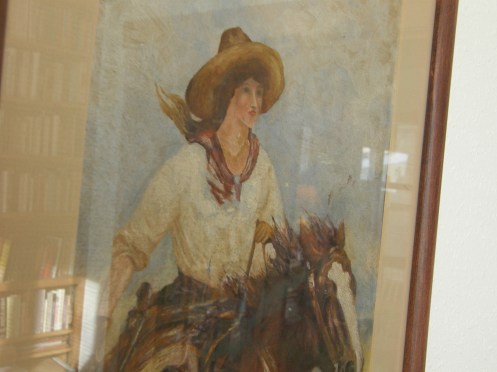
Ralph Wichstrom’s painting of a woman riding.
The old man sat in his front room, an abandoned crossword at his left elbow. Also, a telephone, his hearing aids, a Leatherman tool, a calculator, an empty disposable plastic food container, a set of coasters, assorted papers, cards and a copy of Ernest Hemingway’s “The Old Man and the Sea.” Oh, and a cup of coffee. He still had hope for the puzzle. The cup still had a swallow left.
A fire burned orange in the wood stove. It made a quiet wind sound and an occasional metallic click. The dog in the chair across barked. The clock chimed.
“Why are you barking?” asked the old man. The dog slumped back down, head on the wooden arm of the chair, eyes closing. His posture looked uncomfortable, but he was a puppy, and flexible. It even slept on the old man’s head one afternoon. His wife had remarked on it when she came home from work. It made her laugh. The old man didn’t laugh.
His reverie was interrupted by the sound of a kid’s wagon outdoors on the sidewalk and a barking dog. This made his dog bark too.
“Stop it! Stop it! Insisted the old man.
His dog said, “woof.”
“Always have to have the last word?”
“Woof.”
“Stop!”
“Woof.”
“Where’s your ball?” he asked his dog, who ignored him. “Where’s your squeak ball?”
The dog sat alertly. “Woof,” he said, almost in a whispered voice.
At least he’s not barking,” thought the man. His dog put his head down again.
He studied an oil painting on the wall in the front room of his house, a part that had been added on about 50 years ago, he thought.
His family had moved in 32 years ago, and the room was old then.
His oil painting of a woman on a galloping horse with a coil of rope and a pistol in a holster had been made well before the old man had been born. He remembered seeing it upstairs at his grandparents’ in Kalispell, Montana, when he was a small boy.
The painting was the work of his Great-Uncle, Ralph Wichstrom of Billings, who had once lived on the 500 block of Wyoming Avenue, just a short walk from where the old man was sitting. Ralph had been his Grandma’s little brother.
More than a hundred years ago in Valley City, North Dakota, his Grandma Ellen Wichstrom raised her younger siblings when they were orphaned. Ellen was only high school age then. She took up her mother’s business as seamstress and boarding house landlady, and not only fed and cared for her siblings, but she finished high school, and then she finished college. In 1907 she married Carl T. Bonde.
Ellen was the old man’s Grandma, the artist’s sister.
Ellen’s younger brother Ralph went into the Army for WW I, and survived to move to Billings, Montana. Ralph ended up working for the school district as a house painter, painting oils when he had time. Ralph married Agnes. They had two children: a boy and a girl, who grew up in Billings in the 1930s.
The old man’s dog jumped off the chair, walked behind it, and laid down for a nap.
 Of course, one of the kids took this picture from the back of our 1964 Volkswagen van.
I was driving at maybe 3:30 a.m., cursing at someone who had just about driven us off the narrow road. The weather was good, but the car was covered with dust from the road. P. is in the passenger seat. We were way far north so it was light most of the night.
I wish you could have been there, not for the close brush with the borrow pit, but for the adventure of traveling north for almost a week, sleeping in the back of the van. Not just riding and sleeping, but changing a flat with a spare that was in a box bolted to the roof. In the box, along with the spare can of gas and most of the camping equipment.
We took off from Billings to drive to Alaska the day school was over for the summer because our teenagers were trouble-prone, up to devilment, for sure. It was 1985, maybe or 1986. I don’t remember. It was early-June, for sure.
Our van was loaded with extras: extra carburetor, extra generator/fan combo, extra distributor and coil. All of the things one might need, plus the tool chest and container of hand cleaner. And motor oil. Lots of that.
A good thing too, because our motor blew up near Edmonton. We bought a new engine, installed it, took it out, installed it, took it out, installed it, and we were on our way again.
We soon learned the best places to pull off the Alaska Highway for roadside adventure was at bridges. That’s where we found Edith Creek, a paradise without anyone else’s tracks. You could drink the water, go swimming and come out bright red and blue, or make a fire and hunker. A great place to go for a break.
Funny how a blurry picture of the back of someone’s head can bring all of that to mind.

Bill Moomey said this photograph was probably taken when Carl graduated from Army Basic Training. The location is not stated on the photograph, so it remains a secret.
My bitterness of the loss of this handsome man, my Uncle, galls me today, in 2016. All of this grief stems from a German submariner’s pulling a trigger to release a torpedo from U-Boat 486, commanded by Uber-Lieutenant Gerhard Meyer. This on Christmas Eve, 1944. The U-Boat sat on the bottom outside Cherbourg. This tactic had been employed often without any success. Until then.
Carl and many of his fellow soldiers of Company E, the 262nd Regiment of the 66th Panther Division, were trying to sleep deep within the troop ship following an exhausting hike with all of their equipment from Camp Piddlehinton to a railroad station some kilometers distant, thence to the port of Southampton. There they boarded a ship, the HMS Cheshire. Wrong ship. Then they disembarked and waited hours on the pier. Later, they boarded another ship. This one was the SS Leopoldville. December 24, 1944.
As they walked up the gangway, someone was heard to shout, “To hell with this rusted piece of shit! I’m going to swim to France!”
Another hollered, “This won’t get us where we are going.” Another cried, “But where are we going?” The answer: “To the bottom!”
The second wise-ass remark was accurate. The SS Leopoldville did indeed reach the bottom without ever reaching France.
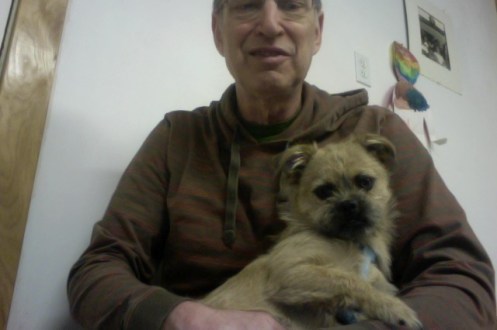
I promise there is no moral to this tale.
January 31, 2016
Last night before bed I noticed a place on a rug in the basement where I believe Gunther peed. In the house! I blotted it up and rinsed it best I could. I had nightmares all night.
This morning was busy. Church stuff. I call it the church of the fervently religious because a relative once called it that about 20-some-odd years ago. She has always been a smart-ass. Of course. It is her charm. Her face and her charm are her fortune.
Anyhoo, this morning: the usual choir practice, a committee meeting, the service, then a dozen folks set up to take care of Family Promise families this week.
But I was still exhausted from our anniversary activities yesterday, so I took a nap this afternoon. I am talking watching a movie, going to supper, watching a basketball game. Exhausting. Yes. I needed sleep today.
Then, as I rubbed my eyes after my nap, P. told me that this morning she stepped in dog poop in the dining room!
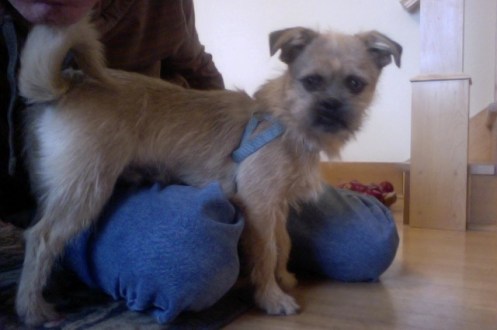
January 29, 2016
Today in our unfenced back yard I let go of Gunther’s leash so he could trot around, dragging it behind him. I wondered if I would regret it. Would he sprint away?
I watched as he visited all of his usual places. Oh, the big tree behind the swing set where he often pees. P. called it the “message board.” Then he walked past the woodshed, cut past the aluminum duck boat that we sometimes use as a wading pool for our grandchildren. In the summer we can fill it with water. The kids sit in the water and pretend to paddle and fish on the dry lawn.
Anyway, Gunther sniffed around next to the garage in a pile of snow. He did not seem inclined to bolt.
He came to me when I asked him and I picked up his leash and we walked around the block.
He pulled me uncomfortably hard, despite my objections.
But then he made me proud when he defecated and urinated. I learned from the grandkids the guilty pleasure in squishing the poop inside a plastic bag. Try it. You might enjoy it.
When we returned to our driveway I unhooked his leash and he trotted past the back steps into the back yard. “Gunther,” I said quietly. “Come here.” He trotted to me, then up the steps and through the door to the back porch.
I love Gunther. He follows me around the house, but not into our bedroom where he knows he is not permitted. Except today he did come in, but I reminded him to stay out.
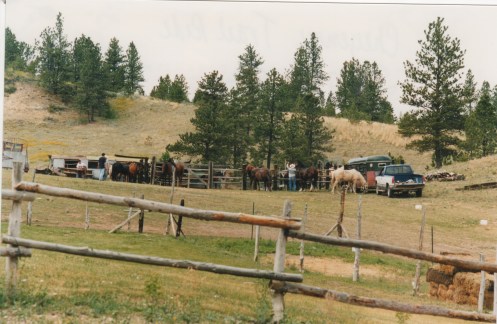
At Sandy and Zane Spang’s Ranch near Ashland, Montana.


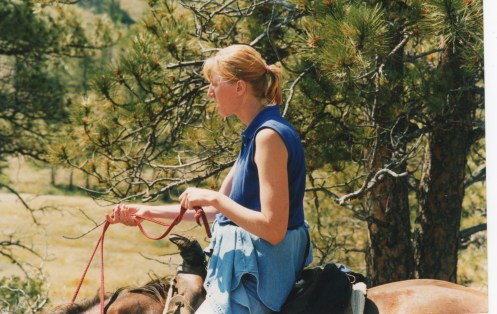


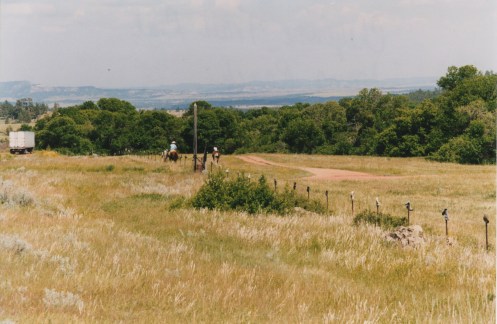


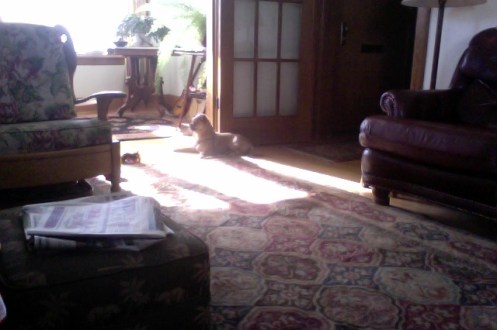
Gunther at home. Hears something outdoors.
January 27, 2016
Gunther whined at the back door. So, for the second, maybe third, time this morning, I stepped into my winter boots. They are easy to put on. I imagine fireman boots are easy like that. I got my coat with hood, checked pocket for plastic poop bag. Yup, I had one. Plus two in my pants pocket. No three.
I don’t want any more dog shit on our floor. On our carpet. On Becky’s walkway upstairs. Gunther doesn’t have to whine much to get me to go outdoors with him. I’m learning.
I clipped his leash on his harness. Then, out on the driveway, he managed to pull on his leash hard enough so he gacked, making a hoarse croupy cough. Annoying.
“Gunther, Gunther,” I said softly. He stopped pulling and hacking. Looked at me. We started walking. We are hiring a man to help us train Gunther not to pull on his leash.
He pulled me with the leash again, then when he got interested in the snow, I pulled him. He weighed 15 pounds at the veterinarian’s. I weighed 212 at the psychiatrist’s today.
This morning I barely made it to my 7 a.m. appointment on time. I was to be there at 6:45, but that’s when I woke up. His office is just a few blocks away, so I got there okay. I am afraid of being late. I’ve heard about people who missed an appointment and were never given a second chance!
Dr. Stiles said he was pleased that the medicine he prescribed is helping me. I managed to tell about my new dog and about joining the chorus of Turandot, Puccini opera. He smiled and nodded. “Good,” he said.
He upped the dose of one of my antidepressants and urged me to stay busy. And to see him in two months.
This morning I walked Gunther around the next block east of ours, past the man I mentioned earlier, the friendly neighbor with the cats with bibs and bells. At the end of his block I greeted a teenager as he walked in front of us.
“Just one more day in paradise,” he said, with a sort of mirthless laugh, crossing the street. I wondered if he was in high school. Then I wondered if he was depressed. Why shouldn’t young people expect to feel at least neutral, if not good? I thought.
At the east end of the block, part of a car tire caught my eye. I had never seen a tire’s bead lying on someone’s lawn before. Just an 18-inch, or so, circular piece of rubber with nylon fibers protruding, maybe 2 inches wide, the part you can’t see when the tire is on a rim. Only this wasn’t on a rim. It was just the bead, on the lawn, a bare place where the snow had melted.
Thus absorbed, Gunther and I crossed the alley, heading for Alderson Avenue.
One time, perhaps 25 years ago in the summer, P. and I walked past the two houses on the corner of First and Alderson and observed a great fat man reclining on the front steps. It was hot, but late enough that the sun wasn’t beating down. The steps had no porch. The big man wore a sleeveless T-shirt and trousers. His arms and legs were sort of spread out. The house next door, a near copy of the one with the man, has a 2-foot circular attic vent. The unusual vent added to the quaint feeling I felt when we saw this man resting that hot evening.
We walked past the two houses. Gunther made his usual annoying stops to listen to a distant dog until we walked down the block and I saw one of the cats with a bib. Maybe it had come over from the Burlington side of the block. The cat had a bell and a bib. It may have been hunting, on the bungalow, near the lower edge of the roof where a vine or bush had a flock of birds. The birds flew as Gunther and I walked by. Gunther menaced the cat, which seemed to ignore us. Of course you can’t tell with cats.


 insearchofbud