Carl was down the hill, working in his garden, spading the soil, when his friend Ted walked around the barn toward the apple tree. “Hey” Ted said.
“Hey yourself and see how you like it,” Carl answered. Carl was trying to spade the soil to plant a garden. He hoped to plant some seeds that his father had given him: radishes, corn, beans, peas, squash. Turns out this was hard work for a kid in the fifth grade.

“Come on over the other side of the bridge,” Ted urged. “We’re getting some loving.”
“What’re you talking about?” Carl asked.
“We’re ‘getting it on’ over on the other side beyond the bushes,” Ted said carelessly. “It’s me, Mike, my sister, and Neona. Marge asked me to ask you to come over there. She wants to ‘make out’ with you.”
Carl sort of had a crush on Margaret, or at least he did once. She was his age. Her brother Ted was a couple years older.
In fact, Carl had taken Margaret to a movie once last summer. He couldn’t remember the movie at all because his finger had hurt so badly. Cut it on the blade of a power lawnmower that same day and it throbbed.
Ted said, “You’ll see. Follow. Wait. Gotta piss.” That’s when Carl noticed that the older boy’s penis was way larger and darker than his own. Carl couldn’t help being impressed. He never noticed any of his friends’ penises looking like that before.
Carl and Ted walked across the bridge in the cool June sunshine and sure enough, once they got past the big bushes, they saw Ted’s sister; also, another shorter girl named Neona, and a freckle-face kid named Mike. Mike was kissing Margaret on the mouth, taking a long time to do it. After a couple minutes, Margaret and Mike separated and she asked Carl if he wouldn’t like to try kissing. “It’s really fun!” Margaret said.
“Awwww, that’s okay,” said Carl. “I don’t think I know how.”
“Just watch Mike,” Ted said.
Mike kissed Neona on the mouth, pulling her around to hold her against him. Kind of like in the movies. Again, the kiss lasted about half a minute. Then Ted took a turn with Neona.
Carl couldn’t imagine doing or even wanting to do anything like that.
Margaret kissed Carl on the cheek as he turned to walk back toward the bridge, toward home.
Later, Ted jokingly asked Carl if he still wanted to screw his sister.
For years after, Carl thought “screwing” meant kissing a girl on the mouth while pulling her around.
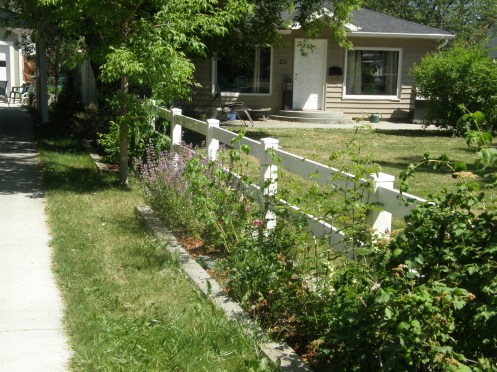
House next door where Service Dog Sue lives.
June 12, 2016 @0732
Clock two minutes slow, just chimed. Returned from Mr. G.’s daily morning rounds. Of course, his “Facebook” is the line of trees down the street where he tells what’s on his mind. His “posts.” Then he downloaded some shit down the block, which I dutifully apprehended into a bag. Out front of our house a small pile of excrement caught my eye. ‘Did Gunther leave this here last night?’ I wondered.
’No,’ I concluded, picking it up with the bag. It was inferior. Gooey, friable, not cohesive and crisp like Gunther’s. That was some bad shit.
June 11, 2016 @1910
What I learned about being on the bum. The best lesson of all: if hitch hiking, stand by a stop sign with your thumb out. That way, people have a chance to get used to the idea of picking up someone. Look like the person you want to pick you up. Look decent. You know what I mean. Wear clean clothes. If you have a pack or a suitcase, put it out of the way behind you. I’ve done all that and been picked up in less than 10 minutes.

Tom Struckman, about 1964, with nephews Chris and Chuck Angel in Dillon, Montana.
If you want to take a freight train, just go to the freight yard, find a railroad worker, then ask him or her where to get on a train that will take you where you want to go. Nine out of ten times the person will help you. Be warned. Boxcars are notoriously uncomfortable, once you get rolling. The jolting up and down will rattle your jaws and make you want to stand all the time to absorb the shocks. Better than a boxcar is a gondola car full of just about anything that will absorb the impact of the rails as you roll along on them. A load of steel rods or sheet metal is a pretty good cushion. I’m speaking from experience.
Like Frank Zappa famously said, “I’ve got to do something / to make my life complete. / I’ve got to live my life / out on the street.”
How did the transition from beatnik to hippie happen for me?
My brother, Tom Struckman, was a true beatnik. A musician in the 50s, he played the horn, then the guitar in the early 60s. He and his friends listened — and played — all kinds of classical and jazz music. They drank beer and wine, recited poetry, read widely, smoked cigarettes, wore black, and listened to Joan Baez, Bob Dylan, Pete Seger, and others from the 1964 Newport Jazz Festival. Tom flunked out of the university at Missoula, Montana, then took remedial courses at the College in Dillon, then went to the University of Oregon at Eugene. Tom flunked out because he quit going to classes.
When Tom came home after a school term at Eugene he brought with him some issues of the Berkeley Barb newspaper and some Marvel Comics, like Spiderman. These both had a huge effect on me. I started thinking a lot about the idea of freedom of thought, freedom from religious dogma, freedom to drop out of society and to turn on to the counter culture that was growing in the cities like San Francisco, Eugene, Seattle, and especially, Missoula, Montana.
I corresponded with my brother by mail while he was at Eugene concerning the counter culture. Ultimately, I broke up with my straight laced high school girlfriend in Dillon, stole a friend’s car, and drove to Eugene to spend some time with my brother, Tom. Tom had friends in Eugene, the McVeys, Jerry and Judy. These three were into marijuana and they shared it with me when I arrived. They helped me get over the breakup with my girlfriend.
At first, when I smoked it, I couldn’t tell what was different. Then I felt paranoid, then I learned what being stoned was like. Lastly, I returned to Montana where I returned the car I had stolen. Luckily, the friend from whom I had stolen the car forgave me. Another friend and I traveled to Chicago in the same car I stole and, although we drank a lot of beer on the way, we smoked no grass. That was me and Tad. We had permission to drive the car, this time.

Allen Lenhart, Steve Franklin, Becky Cuffe, about 1968. Certifiably hip.
Finally, in the Fall of 1967, I enrolled at the University of Montana and fell into the company of a mass of hip teenagers who did smoke. Soon we were smoking socially and enjoying each others’ company. We weren’t old enough to drink alcohol, so we didn’t. We did smoke plenty of pot and occasionally took what someone told us was LSD. Who knows what it was really? We just had to take the word for it from whatever scruffy character sold it to us.
One thing was clear. We hippies had to grow out our hair and wear scruffy clothing, such as bell-bottom pants, or we had no credibility with each other. No credibility meant no pot or other mind-altering drugs. No pot meant no fun. Therefore, we all grew our hair long and tried to formulate an ethic that would set us apart, somehow. Some sort of cross between the Beatles, the Stones, Bob Dylan, and Joan Baez. Anti-war.
Next: Shoeless in Seattle on Hippie Hill.

I don’t know who took this picture of Carl Bonde in front of his house in Kalispell, probably in the winter of 1943 or early 1944.
Carl Bonde remembered when he hadn’t known what to do with himself. He had gotten all of the attention from his girlfriend, Virginia Clark, that he wanted, and he had been afraid that she might call him on the phone. If he didn’t want to speak to her she was apt to say, “Well….” and leave an uncomfortable silence until he spoke up. She had been the clingy type. Only he really loved her. At least he thought he did.
Only now Buddy — his family called him that — was in England, in the army, an hour by train from London. He was sitting on the step to the brick barracks at Camp Piddlehinton, reminiscing about his old girlfriend back home.
He had not spoken of her to anyone because he had said his last goodbye when he left Kalispell to be inducted at Butte. He had been certain that he wouldn’t survive the war with Germany when he was drafted into the U.S. Army in 1942, so he told his girlfriend they were through with each other.
Things sure looked different now. The U.S. had practically won the war. After D-Day, the allied forces then pushed the Germans out of France. The rumor was that the Germans were on the verge of quitting and accepting whatever peace terms were thrust upon them.
Best of all, Buddy had gotten plenty of female action in England. He learned how to do it standing up in a doorway with a few women who had been, well, drunk. Then he had met Penny Lane. Penny was not only beautiful, but classy, for a British woman. He called her his “lime-ette.” He called English men “limeys”
Buddy didn’t know what to do with himself, so he stood and returned to his bunk with straw mattress inside the barracks. He collapsed on it. About that time, Hank showed up, a tall lanky guy from the mortar section, with enormous feet. “Let’s go into town, Carl,” he said. “Let’s go see if we can get a piece of action!”
“You know there’s more to life than ‘action,’” Carl replied. [Pause.] “There’s great big bouncy babes, too.” They laughed.
Carl grabbed his tie from the foot of his bed, inexpertly tying it as they walked over to the command tent where they could get 24-hour passes to town. With the Germans on the run, passes were easy to get.
Inside the tent Carl and Hank had to stand for a couple minutes behind five or six other GIs who were waiting to speak to the clerk who worked for the First Sergeant. The men called him the “First Shirt.”
Sure enough, the clerk filled out passes for them. They didn’t need to be back until Saturday morning at 11 a.m. Christmas Eve was Sunday and the men had high hopes of spending some of their pay on presents for their sweethearts and for their families back home. Carl was hoping to do a little bar-hopping with Penny Lane, maybe get her a bit tipsy, then “va va voooom,” he thought, smacking his lips. He loved to kiss this beautiful British woman. She wouldn’t let him go all the way with her, not even to first base. Hell, there were plenty of other women in London who would do it in a doorway for a pair of black market silk stockings or a carton of GI cigarettes.
The train station was about six miles away in Dorchester, so the men stood by the road with their thumbs out. Soon a soldier they recognized as a general’s clerk stopped his jeep for them. He was able to give them a ride the whole way. The clerk had to pick up something from the train station, a package of top secret material, he boasted.
The train car was wooden, wooden seats covered with plush cushions, wooden walls, varnished and shiny. The train locomotive spewed huge clouds of tarry black coal smoke. Luckily the wind was blowing from the land out to the channel that morning, because the cloud didn’t gag the men in the train as they headed for London. The group had the above-mentioned Hank and Carl, but also Bill Loughborough, Bill Moomey, Al Salata, Maurice O’Donnell, and Randy Bradham. Enough to start a game of bridge, even though they’d have to stop playing in just over an hour.
The train took them to Piccadilly Circus in London and they all piled out. Some of the men went to find something to eat. You could get fish and chips almost anywhere for a schilling. A couple of schillings and you could get a warm English beer, too. Only the beer in England was a true pint, way bigger than American beers.
Carl managed to slip away from his friends, saying he wanted to go browse a store for a chess set. He did this after all his friends committed to going to a show. A burlesque show with honest-to-goodness women with big, bouncy breasts.
Here’s where the story gets murky, since Carl never did kiss and tell. Bill Moomey and Hank Anderson swore that Carl returned to the camp with them, but Bill Loughborough said he wasn’t quite so sure. In any case, subsequent events didn’t permit any easy answer to this question.
In 2016, Carl’s nephew, Dan Struckman, wasn’t convinced that his uncle Carl had returned to Camp Piddlehinton with the others that early Saturday morning, because he knew about Miss Lane and how in love Carl had been with her. Penny Lane remained a shadowy figure in the story of what happened to his Uncle that fateful night. He knew that on Saturday, about noon, the mystery of the contents of the classified package that the general’s clerk had picked up at the train station the day before was revealed.
Everyone had to return to camp. The Military Police were dispatched into London to round up any stray men and have them report immediately to quarters. Again, Loughborough said that Carl was among those accounted for when the troops were mustered that Saturday afternoon. That’s when the trouble began.
The lieutenant in charge marched everyone to the parade ground where General Kramer gave them the news. The Germans had overrun the allies in the Ardennes Forest in Belgium a week before and the allied troops were fighting for their lives. In order to repel the surprise attack, everyone at Camp Piddlehinton was being mobilized that day to deploy to France, then to Belgium to fortify the line of defenders.
This is what they had been trained to do! Once General Kramer had read the men their orders, they dispersed immediately to their barracks. Army cooks threw half-baked turkeys out onto the ground outside the buildings. All of the men’s belongings were hastily stuffed in duffel bags and field marching packs. Hats were stacked on hats and placed on heads as the men staggered under all the weight of their belongings. Some of the men had bottles of whiskey stowed in their bags. One even had a turkey he hoped to eat the following day, which was Christmas Eve. Off they went, most carrying, but some dragging their duffel bags. Soon the dragged bags wore through and the contents leaked out: shirts, trousers, underclothes.
They did not march as much as they simply struggled along. And this time nobody in a jeep was there to help them on their six mile hike. Not that they were unused to great distances hiking. In training they often hiked twenty miles, stopping for food and drink only. Of course, once the men’s parents found out they complained to the commanding general who prohibited them from marching more than ten miles a day. The platoon commanders got around that by marching the men ten miles until midnight, then marching them back the other direction from midnight until the small hours of the morning. Thus, technically, the men only had to march ten miles a day.
Carl’s nephew Dan learned all this from reading letters written by his uncle’s friends after the war was over. Bill Moomey told about the trials and tribulations of training and Bill Loughborough told about the hasty assembly and embarkation to France. As mentioned before, both men said they were reasonably certain that Carl was among the soldiers who deployed to France. And again, Dan Struckman wasn’t so sure.
The reason? The British, in 2008, said their investigation differed from that of the others, in that they placed the strike of the torpedo to the SS Leopoldville about halfway between the bow and stern on the starboard side. All of the others said the torpedo struck aft, approximately where hold number four was, the hold occupied by the men of the weapons platoon, company E, 262nd Infantry Regiment. It is true that only about eight men from the platoon survived the sinking of the SS Leopoldville, about half of the company had been aboard a different ship, the HMS Cheshire, which rapidly continued on to the French Port City, Cherbourg. Those who survived the torpedo blast escaped death either by swimming and getting rescued by a tug or PT boat, or they leaped or climbed to safety on the HMS Brilliant, a corvette that pulled up alongside the Leo. Several hundred men made the jump or climbed to the Brilliant before the captain had to pull away to keep from becoming overloaded with men.
In all 786 men died Christmas Eve when the SS Leopoldville was sunk.
Carl’s nephew Dan became interested in his uncle’s fate from his youngest age, when Carl’s sister, Helen, sat with her son Dan on his bed and told him about the courage of the soldier who had been her brother. Dan was saying his prayers and his mother said he could pray for his uncle Carl, same as for people who were alive. His mother assured him that the dead people are still with us, or at least their spirits are.
Carl’s mother, in 1945, didn’t even get an assurance that her son had been killed. Instead, she was notified that Carl was missing in action. A month later, a not-to-convincing letter arrived confirming that Carl had been killed in action. However, Carl’s body has never been recovered. This was not unusual, though in this circumstance, because so many men had gone to a watery grave, trapped in the wreckage of the SS Leopoldville.
Some disturbing facts: many men said they had heard screams and crying from men, but nobody has come forward claiming to be one of those men. Men were said to have been crushed by the wave action of the SS Leopoldville and HMS Brilliant crashing together, but nobody has been identified as being one of those poor souls. Another man was said to have died because the litter he was strapped to as an injured soldier, fell into the sea. That person has never been identified. In fact, despite the fact that scores of bodies have washed up, many soldiers remained unidentified and listed as missing in action.

Let myself into the NOVA theater to see if my new dado saw blade kit would work on the shop table saw. Well, I suppose it could, but the shop’s saw doesn’t have the proper safety accessories. I quickly abandoned the notion.
I’m thinking the shop compound miter saw might be a better bet for such a setup. If we want longer slots cut than that I’ll use a router and a straight edge. However, I didn’t put the miter saw to the test either, not today.
Anyway, I encountered a friend who advised me to try the dado business at home first, so I tried it on my son-in-law’s table saw. Worked well. I mean I set the two outside blades and ran a quarter inch slot, clean and straight. Then I added an eighth inch at a time for three chippers. I could add a bunch of shims and cut a slot up to 3/4 inch or a bit wider. Perhaps an inch or two deep, but I’d have to make multiple passes.
Dados are useful, but the paraphernalia adds to the danger of an already dangerous tool. I made sure to wear eye protection and to unplug the saw when fiddling with the blades and chippers.
If I remember my physics 101, adding mass to the spinning blade increases the inertial energy. I’d hate to be standing in front of a two x four if the dado setup kicked the board back at me. I might have to visit the ER if I wasn’t killed outright.
Where’s Gunther, you ask? Oh, he’s in the back yard playing with an empty ketchup bottle. I’ll let him into the house pretty soon before it gets very hot back there.
Have another cup of coffee? Don’t mind if I do. Don’t mind if I do.

Our house
I did get up at 0300, or thereabouts, but I couldn’t get my eyes to point together. I even tried a cup of coffee with a spoonful of ice cream. That almost synched things, so I tried reading with limited success. I had bought a copy of Fifty-Six Counties, by the notable Billings author, Russell Rowland. It will make an amazing gift, especially when it comes out in hardback.
Anyway, I went back to bed until seven, found a bug in the tub. Liberated the bug out the back door. Large for around here, it measured about two centimeters long. I dropped it onto the barbecue grill, where it marched away. Happily, I thought, because it seemed to swagger like Gunther.
I took my five prescription morning pills: three for mental illness, one for prostate trouble, one for cardiovascular health. Now I will awaken Gunther.
I am thinking of a time 56 years ago, when I was in the Marines, in jail. Caged, like Gunther. When the jailer brought breakfast to our cells, we sang spontaneously together, “Good morning to you! Good morning to you! We’re all in our places, with bright shining faces, good morning to you!” Most of us were in jail for leaving the Marines and going home. Me? I had popped my C.O. in the chin with my fist. Hey. He asked me to do it. That’s right. He said, “Why don’t you put me on my back?” Many of you have heard this story already.
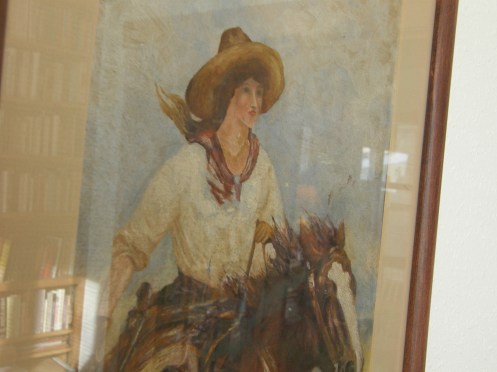
Ellen Bonde’s brother Ralph painted this.
The house cooled off in the night so I’m up now, at 4:41 a.m., waiting for some acetaminophen (paracetamol for you Canadians) to kick in. Where does it hurt, Penny sometimes asks. I list them: my left knee, my neck, my right shoulder. I don’t know why, they just do. Okay, so does my right elbow. I was going to skip that, but I don’t know why.
I plan to work at Omnicare today, filling in for someone. Perhaps it’s Dave Fisher. Funny how, in Montana’s largest city, I know pharmacists in almost every pharmacy in town. Not true. No. I know a lot of pharmacists, though. That’s not true either. I know about a dozen.
At Omnicare I work with Steve Normand and I’ve worked with him in various pharmacies over the past 44 years.
Then there’s the youngsters, the brilliant, the smart. Here’s the deal. Pharmacists are much smarter and better trained than they used to be. I hear that you have to have close to an “A” average coming out of high school. For that reason, most of today’s pharmacists are women and ultra smart men. I work with a tall beautiful woman who reminds me of my daughter. She is a young mother too. The young man, also quite tall and slender, was a biochemist before he went to pharmacy school. He is damned resourceful and smart.
Then there’s Steve and me. Two kind of old guys who laugh a great deal, mostly at ourselves.

Drove downtown. I mean, I could have ridden my bicycle, but I had a couple stops on the way. I went to NOVA community theater this afternoon to see if I can clean the workshop or help out some other way.
Answer: not necessary. The shop is still clean from when I cleaned it a week and a half ago. The manager approved of the work table I built then.
Dan Nickerson has been designing the set for You are a Good Man, Charlie Brown, that the youth conservatory will be producing this summer. I helped Dan move some stage platforms from one acting space to another. I also visited with the managing director, Dodie Rife, and raised $75 for the next season by phoning my mechanic’s wife.
Busting licks. It’s all community to me.

June 9. 2016
Gunther was acting like a madman, so I let him out the back door. Of course he streaked away, two doors down to Don Christiansen’s house, where the old man was seated on a lawn chair. Gunther seemed drawn to him, so I padded over in my socks. I asked if I might grab a lawn chair and join him. He noted that the chairs are getting rusty; that he wished he’d taken better care of them.
Don loves to reminisce these days. How we laugh! A couple years ago he and I decided to brave the 100 degree heat and pull up some concrete footings from Community Day Care’s playground. How I got in trouble for that with Gert.
At that point in the conversation, Don leaned over and asked, “Did she really get after you?”
I said, “Yeah.”
He said, “Good for her! She’s not so bad, is she?” [Mutual laughter.]
Lots of the reminiscences are what I call “slice of life.” He told me about the cream separator his dad bought back when he was a kid. A nice one, he said, with an electric motor. They didn’t have refrigeration, so a cow was a life saver. They always had something to eat, then.
The cream separator was a pain to wash, he said. The hot water was in reservoirs on the sides of the stove. You’d dip it out so you could wash the parts of the separator.
We talked about dogs, about his Uncle Al and aunt Rose; her birthday was the same as Don’s.
Don told me that when he was in his second year of school he got an award for being a good student. It had a lifetime beneficial effect, he said. Don ended up going to college, learning how to be a science teacher, and teaching science in Billings for a career.
We talked about how his dad fixed up a radio that attached to a car battery, about the time they got electricity to their house.
Meanwhile Gunther did exactly as he pleased, running over to us old guys for a frisking of the whiskers, from time to time.
What a wonderful bird the frog are
When he stand he sit (almost);
When he hop he fly (almost).
He ain’t got no sense hardly;
He ain’t got no tail hardly either.
When he sit, he sit on what he ain’t got (almost).
This poem, according to Wikipedia, is attributed as a being a folk poem that has been recited or chanted. Our son Bob used to read it to us out of the Oxford Book of Humorous Verse, a handy book he got from my sister on his birthday in, like, 1986, when we camped on Edith Creek on the drive back from Alaska. Bob’s birthday is June 29.


 insearchofbud