Finished June 25, 1945
My Darling Jean,
I know you are curious about my eventful trip from England to France. My folks have also asked me to describe it. Walrath wrote about it as soon as censorship was lifted, and his mother called mine to relate the little bit Don had known about it. When censorship was discontinued, we were asked not to write about troop movements until 6 months afterwards. That is the reason I have not talked of it. To save my writing two letters on the subject, will you please send this on to my folks, Honey?
I went to London on the morning of the 21st of December [1944]. Jack Yarbrough, Chuck Gere, Bob Rogers, Bill Moomey, Tony Lemos, Carl Bondy, Dick Vester, and Jim Grunewald were in the same pass group with me. We left the London railroad station about midnight of the 22nd and arrived at our camp in Dorchester about 5 A.M. on the 23rd. After an hour’s sleep, we were awakened along with the rest of the camp and told to pack. All day Saturday the 23rd we worked frantically to get the supply room, kitchen, and orderly room packed and ready to move. There was the usual arguing on rather this proposed move was to be a “dry run” or the “real McCoy”. We were to be ready to leave by 5 P.M. Because of this short notice, we were almost sure this was just a practice move. We were “good to go” at about 4 P.M. so I went over to see Bill Klostermann, whose barracks was just a few yards away from mine.
Bill was not his usual self that day and seemed to be in very low spirits. I don’t know what was bothering him and whether or not he was worried about going to France. There was a crap game in progress in one corner of the barracks and a bull-session in another. I thought it strange that Bill was not in either of these. I believe he was just plain homesick that day. He read me his latest letter from home in which his mother told of the nice gift you had sent her and of how much they liked you. I left him to go eat.
We finally left for the railroad station at about 9 P.M. One group had left approximately two hours earlier; and, when they didn’t return, we figured this must really be it. We carried everything we owned for the mile and a half to the station. I had a pack-board, with blankets, shelter-half, pack, etc. attached, on my back. My carbine was slung on my shoulder, my gas-mask drooped from the other shoulder, my steel helmit pushed my head down into my collar, and my over-crowded dufflel-bag was carried first in my arms, then over one shoulder, then over the other, then on top of my pack and resting on my neck, and finally dragged along the pavement. My rather weak right leg gave out on me about a quarter of the way and I took a tumble. From then on I went along at my own speed and fell further and further back. The entire regiment started out in regular formation, but was really strung out before we reached the station. Bill Bailey of the 3rd platoon joined me in the rear and we helped each other with our bags. We sat down on them about every 100 yeards. Of course this was all done in the dark and thru the blacked-out town of Dorchester. By the time we reached the train we were all very bitter because trucks could have just as well carried us.
Eight men with all their equipment were squeezed into each compartment on the train. In spite of this sardine-like living, almost all of us slept during the two hour ride.
It was about 1 A.M. when we dismounted at the Southampton Station. Here we loaded our duffle-bags on trucks and then marched across town to the docks. We didn’t see much of this great port because it was in total blackness, and we were on the low road by the docks: Most of the city is on high ground. The docks were really buzzing with activity even at such an un-Godly hour.
At about the last dock we finally did a column right and passed by the gate of a brilliantly lighted pier. Two grey hulks loomed up at their waiting positions. We were marched into the large frame building on the pier for doughnuts and coffee from the Red Cross. They had two clubmobiles set up and American Girls to hand out the stuff to the long lines of G.I.s. The bunch who had left Dorchester before us had already had their refreshments and were beginning to load on one of the ships. After standing around kidding for about an hour, we marched on to the other ship. As we left the dock we picked up anyone’s duffle-bag, that is, in our own company group. We carried these up the gang plank, along the deck a ways, and then down a narrow, steep stairway to our compartment in the hold of the ship. We were on E deck, which is well below the water level. We dumped the bags in the middle of the floor, and the first men down grabbed the hammocks and began tying them up to hooks on the ceiling. The next ones down laid claim to table tops and benches as their “beds”. This compartment evidently was the ship’s mess hall. Being in the 3rd mortar squad in the 4th platoon, I was always #186 in a company of 187 men on these troop movements. Consequently, when I got below, the only place to establish a “bed” was on the floor beneath a table. Bob Rogers was next to me under the table, and Len Benda was on top of the same table. Dick, “Nick”, Matthews, Jack Yarbrough, and Everett, “Mac”, MacDaniel were hanging in hammocks above the table.
The remainder of our 4th platoon, the entire 3rd plat., part of “F” company, part of “H” company and a small portion of battalion hdqt. company were in this same compartment. We were crowded beyond description.
The rest of our compnay, company hdqt., 1st plat., and 2nd plat., were on the other ship. The remainders of the other companies mentioned above were in other parts of our ship. Some of Klostermann’s “F” company were directly below us in the bottom deck. Bill, himself, was in the same compartment I was.
When we got “settled”, it was after 4A.M., so we all fell asleep in spite of our surroundings. Breakfast was at about 8:30, but I slept right thru until our next meal which came at 3:30 Sunday afternoon.
These meals are the worst I have ever tasted. One big pot of “slop” was passed out to each group of about ten. The individual then ate off of a very dirty plate that was washed by just dipping it in water.
You see, this was not an American manned ship. It was a British controlled Belgian ship, the “Leopoldville”. A large part of her crew were Belgian Congo negroes.
The Channel was extremely rough this Sunday afternoon; and that combined with the lousy food made most of the boys sick. Right after “dinner” Hank Anderson, Jack Yarbrough, George Miller, and Dick Matthews headed for the fresh air of the upper decks. They asked me if I wanted to go up with them. I was all slept out by this time and was collecting my stuff which had been pretty well kicked about in the shuffle, so I told them I would meet them on deck in a few minutes. In the meantime I found my duffle bag in the pile and discovered it had a big hole in the bottom of it from the dragging it suffered the previous night. It also had a “fetching” aroma. A medicine bottle of American whiskey which I had carried from the States to have on Christmas Day had broken on Christmas Eve!
When I left to join the boys on deck, the rest of the gang were either asleep or lying in hammocks looking very green. I stood on Starboard and talked with the boys for about an hour, after which I went up to the bow to stand in the wind. Ole Jensen came along in a little while, and we sat on a hatch on C deck at the head of the stairs leading down to D deck, the last open deck. Bill Klostermann and two of his “F” Co. buddies came up the steps about 5:30, stopped and talked a minute, and then moved aft on C deck. Bill said he was too cold and was going below to get out of the wind. That was the last time I saw Bill.
Shortly, Ole and I went in out of the wind, but we went up on B deck which was partially shielded. We sat on a bench in a little alcove on the Starboard side and watched dusk come on. Bill Moomey soon came by and sat down with us. He had left his hammock when Tom Bowle and Tony Lemos had parted company with their dinners. The resultant oder was too much for him and he came up for fresh air.
The other troop ship carrying the remainder of the infantrymen of the Division was a little to our rear and slightly to one side of us. Destroyers and corvettes roamed the waters in front of us and way out on our flanks. At about 5:40 we spotted 3 destroyers or corvettes in a little huddle way off to our starboard. We guessed they had a submarine trapped. Beyond them and about 10 miles from us were the lights of the outer breakwater of the Port of Cherbourg. By this time my squad leader, Al Salata, had come along and joined our little group.
Ole suddenly felt his insides rising and hurried to the rail at a point about 15 yards aft of where we were sitting. He returned, and we contemplated procuring a blanket to keep our legs warm. We didn’t consider it very seriously, though, because we were all too lazy to go down after it. Ole hadn’t been back from the rail two minutes, when the ship jarred, a terrific explosion was heard, and a piece of metal hurtled overboard at just about the point where Ole’s dinner had gone over.
Ole, Bill, Al, and I rose simultaneously and began tightening our own and each other’s life preservers. I believe I said, “Looks like we’re hit”, without much feeling. It was really quite an amazing observation, don’t you think? We automatically headed for the bow of the ship, but not in any great haste. We went to the same hatch on C deck where Ole and I were sitting about a half hour before. The open decks were quickly filling up with soldiers. Presently we were joined by Hank, Jack, and George; making 7 of us from the weapons platoon standing there together. Dick Matthews, who had been with these 3 boys, had gone below just about 3 minutes before the explosion.
Soon C and D decks in the bow where jammed. There had been no announcements over the public address system. No one seemed to know whether we had been torpedoed or had struck a mine. All the lights onboard were turned on or awhile and our ship must have stood out like a sore thumb. This led many to believe it could not have been a submarine because we now would make a wonderful target.
The destroyers came back and hung around us like flies. I didn’t see what the other troop ship did, but learned later she took off like a “great-ass bird” around our port side. She zig-zagged back out into the Channel and returned to the Port of Cherbourg in the wee hours of the morning. The boys on her, including Eich, Walrath, Saxton, and most of the boys we knew at Missouri, disembarked Christmas Morning.
As we “E” Co. men stood together in the bow, we were naturally worried about what was happening aft – especially in compartment F-4. We knew the explosion had come from very near our compartment. Bill Moomey was the only machine-gunner in our little group, and since all his close buddies were down in the hold, he spoke the most often of them [including Carl Bonde]. The rest of us tried to act and talk optimistically to cheer Bill, but there were doubts in all our hearts.
There was never any real thought that the ship would sink. Everyone in the bow was very calm. Some believed we would be put off onto destroyers, tugs, and lifeboats. Others said we would be towed in by the tugs which we were told were on the way. We watched the crew attempt to lower a lifeboat. They got it swung out over the water but couldn’t lower it because it was tied up incorrectly. They left it swinging there and moved onto another one. After much effort they finally got this one half way to the water when one man cut one of the ropes. Of course all this bungled work by the crew brought intermittent cheers, handclaps, and Bronx cheers from the G.I.’s. What would we do without that ever-present American humor?
About 7 a tug passed very close by our port side. She was manned by blue-clad English sailors, and there was the usual exchange of cheers and humorous cracks. There was a girl dressed in red standing before the cabin of the tug. She, of course, received a hearty greeting.
[Omitted is a drawing of the Leopoldville by Bill Loughborough that shows where the torpedo hit.]
Yes, about 7:30 we saw the nose of a destroyer draw up close on our starboard side. It jockeyed back and forth several times and then stayed even with us; only her nose showing to us. She had been lashed to our ship’s side. Someone yelled to those on the starboard half of this part of C deck to file along the railing and to board the destroyer. That order included our little “E” Company group. We were in no hurry to get off our big ship which still stood perfectly erect. No one hurried, in fact. We knew there had been only one explosion, and figured the water-tight doors would keep water out of the other compartments.
Nevertheless, one by one we climbed up on the rail and made the big leap to the destroyer. Big Hank was one of the first to jump from our particular point, and of course fell over his big feet as he hit the destroyer deck. I called down, “Nice one, Hank!” He looked up and grinned at me as I hung overboard on one strand of the rope net which was slung over the side of our ship. There were too many on the net, so I let go and really leaped. The waves were tossing the two ships like kites in a heavy wind. When the waves forced them apart, there was quite a gap between them. Seeing this, I gave such a leap that even had they been away apart I would have been O.K. They were just coming together, though, so I sprawled out on my belly in midship against a ventilater stack. Old laughed at me from above.
I spoke to a weather-beaten English sailor who was straining to hold one of the huge ropes which lashed the ships together. We were moved quickly around the starboard side of the destroyer and finally down into the hold. I saw Hank a few men ahead of me but was kept from catching him by a sailor who directed me down a ladder leading to the bottom deck. Lo and behold, this was the galley! It soon filled to capacity. Al Salata was across the compartment, about 150 G.I.’s away. The cook passed some cups of hot soup around. We were all plenty cold, and the soup really hit the spot. A great many boys were too seasick to enjoy it, though….
Shortly…we learned the ship had sunk! The word spread thru the shivering crowd like a fire thru a dry forest. The ship had sunk! It was unbelievable!…
From our great bunch of the Weapons Platoon we lost our big, tall, likeable platoon Sgt, Billie Ragle, the two section Sgts Bob Hoyt (who ran the party we attended in Ozark) and “Skippy” Ransome; all our squad leaders except Salata, Bradley, and Junior Weaver of the machine-guns, and “Mac” MacDaniel and Jim Mortimer of the mortars; mortarmen Bob Rogers, Herb Koehler, Sam Noto, “Mac” MacKensie, Frank, “Whit”, Wyatt, Leonard Benda (who came to our house in Dothan once for some drinks. He was accompanied on that visit by George Eastburn another mortarman who is still with us because of being on the other ship), and Dick, “Nick”, Matthews; machine gunners Dick Vester (you met him at the Red Cross in Little Rock, Carl Bondy, Tony Lemos, Eddie DeSilva, Carl Nelson (the big, fair-haired boy you met at the Ozark party and liked so well), Pete Acri (like Ragle and Ransom a recent father!) and Tom Bowle. What a terrific gang they were! Almost all ex – ASTP and Air Corps men, too…
Bill [Moomey], please let me know any parts of this story that you would change or add to.
Love,
Bill [Loughborough]
Carl Bonde’s name appears twice in Bill Loughborough’s letter, misspelled Bondy.

Mom and Dad Bonde, Kalispell, Mont. 1943
Private Carl Bonde, Jr.
Third Infantry Training Company
Platoon 3213
Army Training Depot
Camp Crowder, Missouri
March 19, 1943
Dear Mother,
Boot camp is relatively easy, but exhausting because the days are long. What I mean is, they wake you up early, make you clean everything up, make you line up on the “street” outside our quonset hut in platoon formation. This means there are four squads or lines of men, formed into a huge rectangle about 15 men long by 4 men wide. At the head of each platoon is the platoon guide, who carries a banner with our platoon number. It is 3213 for us. The stick with our banner is called a guidon. I suppose this is a term from knight heraldry. Tell dad about this, will you?
Anyway the drill instructor marches us to breakfast with a singsong “left right left right.” It sounds like this: Pla-toon Ten HUT! Ryeeet FACE! For-weird HUT! Yo lelft, righto lelft, . . . .righto lelft righto left right left right left right left. Pla-toon HALT! Left fACE! Then the instructor talks to us again. Tells us what we will be doing next.
At first, before we learned to march, we simply put our right hand on the shoulder of the person in front of us. Then we walked together as a sort of haphazard group. The instructor then said, “hippity hop mob stop.” That seems like a long time ago. Now we are pretty sharp when we march. We march everywhere.
I told you about our eating already. The instructor tells us when to start and when to stop eating. Man! Mess hall dining was what we lived for after a few days. The food is generally pretty good, but I am not used to eating hominy grits or ochra or black-eyed peas. Stuff they eat in the south.
Lots of the other guys are from the South: Georgia, Tennessee, Texas, California, Arizona, Arkansas. Just a few of us from the North. Montana, Idaho, North Dakota. Three of us from Montana; two from Great Falls. Tough boys. When people ask me where I’m from I always tell them about the Mission Valley.
We go to drill practice on the parade ground, then get physical fitness training, then lunch, then classes in the afternoon: how to take apart the M-16 rifle. It is a new rifle, not much like the guns me and Dad go hunting with. They have no scopes, just open sights. Eventually we will shoot them at a rifle range.
After supper we are expected to clean our rifles and polish our belt buckles and boots. Then the platoon commander comes to our hut, we fix him up with a place to sit, and he talks to us. Then we get our mail. Whoever gets cookies or anything like that has to do 40 push-ups before the cookies are taken away from him. So PLEASE DON’T SEND ANY TREATS.
We have to stay up until ten. We go to bed on command, and go to sleep on command. (Not really, but we have to pretend to sleep.) One of us always has to be on watch, but don’t worry, mother, we take turns and watch is only four hours long, except the third night watch is only three hours because we all get up at five. That’s to prepare for reveille at six each morning, even on Sunday. We get the day off on Sunday, but we have to stay close to our quonset hut. We can go to church or read the newspaper. Each squad can buy a newspaper. We get the St. Louis Post-Dispatch. We take it apart and share it.
And so it goes. Long days of routine drill, hour-long classes in weapons and tactics, physical fitness training, and meals. How we enjoy the meals! Give my best to my sisters, especially, well, all three.
Your Son,
Buddy
Carl Bonde with a friend in Grand Forks, North Dakota, January, 1944. I can’t figure how to tell it. As a child of five, I learned it was over. The story had been long ended and the dust had settled on all the evidence about the details of the fate of Carl Ralph Bonde, Jr. To hear my mother tell it, the evidence was all in, the deed was done and years had passed. All of that was true. Except for a few nagging questions.
Okay. Carl’s mother was depressed. She was Norwegian. Doesn’t that explain it? Perhaps. Or probably she was sad and bitter because she had lost her son because of World War II, a war she didn’t believe in. She hated the liberal President who took the country to war, Franklin D. Roosevelt. Now all she had of her son was the folded flag and the purple heart award in a little presentation case. Who would understand? She wasn’t a complainer, although the look on her face most days did plenty of complaining for her.
When Carl’s father died in 1960 the finality of the young soldier’s life was more real to me because his mother sold the house in Kalispell and moved to Missoula. We visited the old place later and the old house had been radically changed for the worse. The beautiful old high ceilings had been lowered to look “modern.” The place smelled altogether different too. Less tobacco smoke.
So how do I tell the story? On the one hand I’ve collected what I can of Carl’s life’s story, all 21 years and three months of it. He was a smart, funny character. He had friends whom I visited and interviewed in 2006 and 2010. I’ve pieced together his childhood, his school years, his adolescence, his teenage years and his experiences in the U.S. Army. I know a depressing amount about his final 48 hours. So there’s that. Carl’s story.
Then there’s my story, my searching for Carl. The quiet brooding and musing of about 55 years before the breakthrough.
The breakthrough was the television program about the wartime tragedy that included Carl’s demise. Then came 16 years of research and writing reams and reams of stuff nobody would want to wade through. Most of the writing had little to do with Carl, more to do with the contemporary world of mental depression and dogs, hand wringing and writing.
I’ll spoil the story right here. War stinks. Nobody ever wins and no war is ever over. The lucky guy is the one who gets to write reams about his old girlfriends, drinking bottle after bottle of wine, trying to remember their names. Did they have a sister?
Wondering how to tell it. The dog, depression, the Great North Trail, Carl Bonde.

Although World War II is long over and the Germans lost the war in Europe, I still harbor resentment, even though I know better. I shouldn’t feel conflicted. Here’s the situation.
Our pharmacy technician’s maternal Grandpa, Helmuth Walter, was indirectly responsible for my Uncle Carl’s death in World War II. I’ve been re-reading Joaquin Sanders’ book “A Night Before Christmas,” in which Mr. Sanders said:
“A reception [by the Germans] was being arranged across the Channel.
“U-486 was one of the new Type VII C German submarines. It carried a crew of 48 and was commanded by a young and previously undistinguished oberleutnant named Gerhard Meyer. It was equipped with the latest of the snorkel devices.
“For a U-boat U-486 had led a dull and uneventful life since its commissioning at the Kiel Shipyards nine months before. The bulk of its career had been spent in unadventurous little sorties from various Baltic ports and in cautious cruising of the relatively less dangerous Scandinavian waters. This period, of course, corresponded with one of the lowest points of German submarine activity during World War II. But winter of 1944 saw a change, a recrudescence of the U-boats, brought about partly by desperation, partly by the development of the snorkel [my emphasis] If the subs still did not have an even break against Allied convoys, with their radar and all-out attack tactics against U-boats, at least they now had a fighting chance.”
So what? The late Helmuth Walter, who has his own website and Wikipedia article, was the German engineer responsible for designing the “latest of snorkel devices” at the German port city of Kiel in the mid 1940s.
Our technician is proud of her Grandpa. I, on the other hand, still weep when I think of my heroic Uncle Carl Bonde’s death when a U-486 torpedo ended his life Christmas eve, 1944.
That’s why I struggle.
Similar to my feelings yesterday, when a theater technician enthusiastically showed me a photograph of his “new toy.” Interested, I looked at his phone.
Turned out to be a semi-automatic pistol. I said, “My goodness!” but my mind said, ‘fuck no.’ I heard him drone on about “concealed carry permit,” but I didn’t pay attention.

Thursday, December 24, 1944
Everyone assumed Carl Jr. followed his platoon members onto the T.S.S. Leopoldville to his doom. That is, through the several passage ways, down three long sets of stairs, down, down to the lowest level. All the way down to the fourth hold, the dark space where he found as soft a place as he could to sleep. Ultimately, a German torpedo would tear through killing everyone instantly.
In fact, it didn’t happen like that at all.
To begin with, Carl and his buddies sat on their duffel bags in the vast staging area at Southampton Docks waiting for orders, waiting. Someone started singing a Christmas song. Well, it was just after midnight, Christmas Eve day. But they waited. Waited for anything to happen. At all. All down the vast pier they could see ship after ship tied up, each with a gangway descending to the dock. This captured their attention momentarily before they settled down to grab a nap. Their lieutenant had given their sergeants orders to put them “at ease.”
Carl considered asking his friends Bill Moomey, Bill Loughborough, and Hank Christiansen to play a few hands of bridge because he always carried a deck of cards, but he was exhausted. He laid down on the deck with his head on his gear, smelling the familiar Cosmoline preservative that permeated all new army web gear. And much of it was new. In fact, Carl’s M-1 rifle lay next to him, along with his new cartridge belt with its four magazines of ammunition.
The magazines with live ammunition was a new feature of this exercise and made what usually was just a drill seem more realistic, Carl thought. They had many drills before, but this one was most realistic.
About 25 yards down the pier American Red Cross women served coffee and doughnuts to another outfit, lined up. American women sure beat the limeys, Carl thought.
Soon Carl was asleep. He was dimly aware that a company of paratroopers was on the steep gangway to the Leopoldville. Turns out they were getting on the wrong ship and would soon be turned back.
Carl and the rest of his company E never did get any doughnuts from the Red Cross. As Carl dozed he could hear the distant sound of sergeants shouting orders.
Finally, after some four hours of fitful sleep, Sergeant Weaver gave the order to fall in line for boarding the Leopoldville. Carl felt revived enough to holler, “This rusty piece of shit will never get us where we’re going.”
Someone else cried, “Where are we going?”
A chorus called out, “To the bottom.”
Someone else called out, “I’ve caught crawdads in better tubs than this.”
Another called out, “Fuck it! I’m swimming to France.”
And so on.
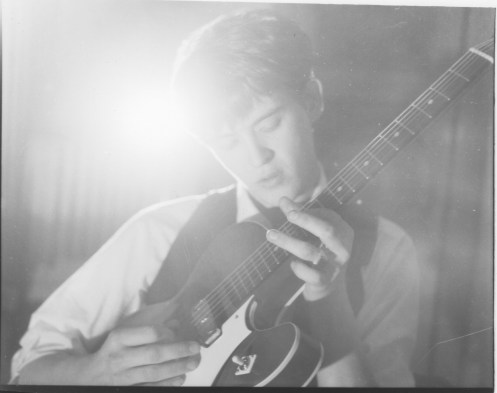
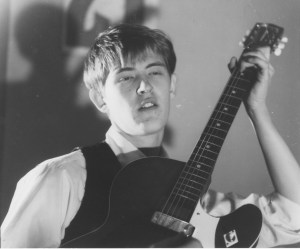 Lead guitar Steve Elwood of the 1966 Dillon, Montana, rock band, “Fyne Lyne.” Here’s what I remember or, rather, what Steve himself told me the last couple days:
The other players were George Miller, Johnny Walker, and David Lenhart, so they had bass guitar, drums, keyboard, and rhythm guitar. Their manager, to whom they owed much of their economic success, was a radio guy named Don.
Eventually, the band graduated from high school, split up, went their separate ways.
I have other photographs I’ll contribute later.
David Lenhart belonged to the Musician’s Union, as did the others, I hope.
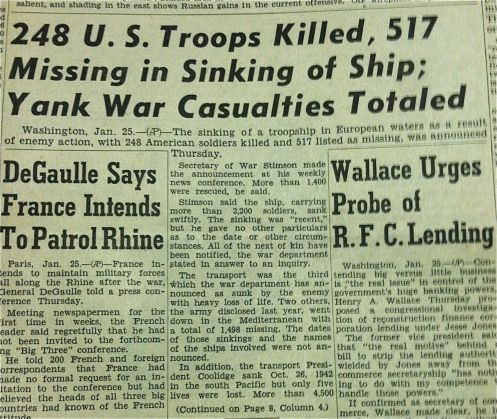
As a result of the torpedo from German submarine U-486, 14 officers and 759 enlisted American soldiers lost their lives aboard the T.S.S. Leopoldville, Christmas Eve, 1944. Much is known about the T.S.S. Leopoldville. It was built in Hoboken, New Jersey, in the 1920s to be a luxury passenger liner. For 12 years a Belgian company took a couple hundred passengers at a time from Europe to Africa in wealthy splendor.
World War II changed all of that. The Allies requisitioned the Leo, fitted it to carry more than 2000 troops, then had it shuttle men from the States to Europe and from England to France. In all that time the Leo remained unscathed until Christmas Eve, although the heavy use made it look like hell. The men of the 66th Infantry Division made the following remarks as they boarded the doomed ship:
* “I’ve caught bass in better boats than that.”
* “It’ll never get us to where we’re going.” [Someone: “But where are we going?”] Chorus: “To the bottom.”
* “Hell, I’d rather swim across the channel.”
One recommended activity for would-be writers like me, is to write for a certain amount each day. I’m going to try to write for two hours or when my wife comes home, whatever happens first.
What to write about? Turns out that the story is only part of the tale. There are always parts left out, there are always surroundings and that is part of the story too.
I’m sitting in the living room of our small house writing. Fans are keeping me cool by blowing air on my sweating body. Well, it’s about a hundred degrees today. My dog Gunther is in the backyard. I put him out there for about 30 minutes at a time in case he has to pee. I don’t think he’ll pee in the house, the way he did when he was a puppy, new to us.
Gunther has water. Hey! We have a new gate. Almost new. The problem was after we got back from camping with Todd, Susanna and Cyrus and Roland the gate to our dog-proof fence wouldn’t close all the way. Oh, I could get it closed, but I had to lift the end with quite a bit of strength.
I used a wrench and a hammer and assorted prying tools to force and bend the gate so that it would close better, but I had only slight success. Penny didn’t like it, so yesterday I called the company that installed the fence. A pair of fine young men showed up with grinders and drills and modified the latch. P. didn’t think that repair was suitable, so I asked the company man to try again. Now the latch works flawlessly. What a joy!
It’s hard to keep my fingers moving on the keyboard, but I think I can get into some sort of a groove here. I used to get in a groove making music, and the art of writing is something like.
Some people I know said that there are things that cannot be expressed in words, but I subscribe to an opinion expressed by Peter Koch more than 40 years ago. He said, “Of course you can say it. If it’s there you can say it.”
I believe that is true. In the I Ching the text mentions the thoughts of ancient ones who wanted to find expression through the use of images. Well, words can certainly bring forth images. For example:
I’m looking at my wife’s reading chair, a wooden frame easy chair with two flowery cushions that look like water lilies or Bitterroots. The chair sits at a raked angle for easy sitting, next to the round table from my youth. The chair, by the way, had originally been painted white on its wooden parts, and had some sort of a web surface below the seat cushion. I replaced the webbing with a piece of plywood that still sits there. I can’t remember where I got the plywood, but I think it has some sort of printing or words painted. I’ll go take a look later, when P. returns from work.
Trouble with describing chairs, is, it can be boring. But chairs are exciting to some people, like me. Did I just hear a car door slam? I’ll bet Penny’s two-clock home visit canceled. It’s like five minutes after two, so I can almost hear her stepping into the back room. If I had a chance to get visited by Penny, I’d take it. She is respectful and gives her entire attention to young mothers and their children. She measures and observes the children, then clucks approvingly. She also finds opportunities to help out a young mom if she needs to go to a doctor appointment, or the like.
I like summer. As one who is nearly retired, I have a fair number of days off, including this one. Well not quite the day off. Because we volunteer for the homeless shelter program at church, P. and I will have to stay overnight at church from about 8 at night until seven the next morning I think I’ll do some reading at that time. I have four different books I’m reading, depending upon what mood I’m in.
The fans keep us cool. You know, I’ve been writing just ten minutes and I’m starting to get tired.
I’ve been thinking about the story I’m trying to write about my maternal uncle Carl R. Bonde, Jr. I’ve got little glimpses into his life as a first and second grader, I could try filling in a few gaps when he is say, a fourth grader.
For example, Carl’s mother was a stay-at-home parent, so it didn’t do Carl any good to play hooky if he wanted to stay home in bad weather. Instead, he would have to be ready for a day spent outdoors in the weather. Suppose he and his friend did decide to play hooky and things were going great until a snowstorm hit. They wouldn’t be able to go home without getting into trouble.
On the other hand if they stayed outdoors they’d get really cold and they’d get into trouble that way. They could try going to a third child’s house, or to the home of an adult with a sympathetic bent.
When I grew up in Kalispell, some 25 years after Carl did, I could generally find some old family friends who would have been apt to let me in out of the cold, even sympathetic enough that I could tell them what the problem was. I don’t know if any were good enough to avoid spilling the beans.
At this point I’ve been writing 15 minutes.
So my hero, Carl Ralph Bonde, Jr., is playing out in the cold with his friend and they are both home from school “sick” because why? Probably just to be having some sort of an adventure. I am guessing that they are each capable of either forging a note explaining they were sick, or just giving a verbal report to their teacher.
Not everyone required a written permission slip in order to stay home, especially in the late 1930s. Lots of people in those days didn’t get much education beyond the eighth grade. Of course expectations were high for Carl. He came from a well-educated family. Both of his parents had post secondary education. His mother had graduated teacher’s college and his dad had been to business school.
Let’s say that Carl gets away with playing hooky perfectly. Gets into school the next day, just as if nothing had happened. I’m guessing the teachers and other students will ask, at some point, why he was absent, and that would require Carl to lie and say he was ill. He could be more creative and say that his sister was near death. In fact, in 1918 one of his sisters did die of scarlet fever. People did die young in those days.
What if Carl had told a different huge whopper of a lie? He could have claimed that his father was in a car accident and had been pinned down when the car rolled onto its roof. He could have claimed that his house had burned to the ground. Any of those lies would suffice.
Any of those scenarios would make Carl seem like a real human being, albeit someone I’ve never met. I know that he was brilliantly intelligent and had a great vocabulary and vivid imagination.
I’ve now been writing for 25 minutes. Time does seem to fly once I catch the fire of creativity. I could talk about Carl and his relationship with his dog, Prince, a German shepherd. Prince was very intelligent and a good dog.
That reminds me that I’ve left Gunther, also a very good dog, outdoors in the intense heat of the midday sun for at least a half hour. I”m going to interrupt my writing and go out and bring him into the coolness of the house. I hope if he had to urinate that he will have done so by now.
[A couple minutes later.]
Now Gunther is sitting at my feet. I’m thinking about how I can come up with other work to do besides writing, but writing is what I must do. I must write about my uncle Carl. I must put the entire book together, chapter by chapter, then I must find an editor willing to polish the works in a professional manner. Then I need an agent of some sort to help me sell my book.
At times, I think all of the books have been written, all the stories have been told. Then a little voice in the back of my head wonders if the story is still there, still waiting to for me to put it down in writing.
The story of Carl Bonde. I’ll likely use some of my weird childhood experiences to embellish his story.
For example, once I found a couple silver dollars on my sister’s chest of drawers. I took them, gave one to my friend across the alley, kept one for myself. I think I remember denying that I had taken them, but my sister knew damn well I had, so she told me so in no uncertain terms. I quickly gave her my dollar and went to my friend’s mother’s where she demanded that he return her dollar from her as well.
A dollar was worth considerably more in those days. What could you buy for a dollar? I don’t know. You could fill up a car with gasoline, or purchase enough groceries for a supper. Since I didn’t ever have that much money in those days, I don’t know. I remember that a comic book cost about a dime, an ice cream cone cost about a nickel. I’d have to work all day to earn 50 cents. I never had as much as a dollar. What a lie! I rarely had as much as a dollar.
Now I’m coming up on forty minutes of writing. I’m hoping this will make me more patient with writing, that I’ll take the time to do a good job of describing things, without telling too much. I realize that telling too much to the reader is just as bad or worse than not telling enough.
I’ve just read some of my previous writings along with the edits and remarks of a couple of the editors and writers I respect most from my old writing group. Beside the admonition for “more,” that was inevitable, sometimes what I wrote just wasn’t clear or I made reference to something that was vivid only to me.
One problem I noticed right away was my ramblings went on for huge paragraphs and those would be too deadly boring for even me to read. And I wrote them!
Short paragraphs are a treat for the eye. I like being able to stop reading at any point.
Where is the humor? I don’t know where. I find that humor is elusive and difficult for me to corral. If I could reliably write something funny I would. What is funny? Chickens are funny.
My son told me about someone who encountered a rooster. Or rather, his son did. The son came running to his father and said, that he was being attacked by a chicken so they’d better get the hell out of there. I guess what was funny was the child was maybe in the first grade, being attacked. My son would have given the offending fowl a swift kick, sending it sailing over the goal posts of chicken heaven.
What else is funny? I am always amused by my good dog Gunther. Gunther is now cooled off, curled up on the couch, his eyes closed. When was he funny enough to make me laugh? I think I delight in his pooping. He’s getting easier and easier to fool. At first I had to walk the little fellow clear to the far side of the block before he’d do his pooping thing. Now I just walk him the opposite direction, around the corner just fifty yards or so, away from our door, then up the side street almost to the alley. Then, if I dawdle and tarry, he is apt to poop. This satisfies me immensely because it takes so much less time, especially if I wake up very sleepy and tired at say, six o’clock in the morning.
I have now been writing for about fifty minutes, and guess what? Penny just came home. I’m guessing her two o’clock visit cancelled.
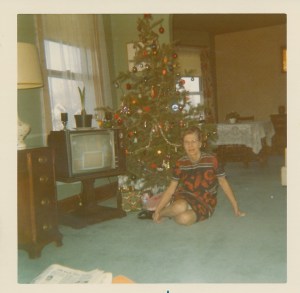
Mother is sitting where Ellen’s chair used to be before she went to the hospital.
Prologue: Ellen Wichstrom Bonde
The doctor spoke as though talking to a deaf person: “Ellen, do you want to die? Is that—is that it?”
She suffered in silence, a Norwegian. Grandma often said she didn’t trust doctors and I knew she didn’t trust this German bully, the one who prescribed the mercury tablets for her kidneys. In 1967, in Montana, doctors still made house calls.
Our house stunk. Mother gave Grandma soft-boiled eggs she then vomited.
We talked about fixing a hospital bed in our front room because Grandma was too weak to make it upstairs.
You know, I could have carried her, but she disliked me. I was a senior in high school, a football player, a track runner, a drunk. But Ellen didn’t trust me. Said I stole her kitchen utensils. Well, I did. Also, I used to pawn her projector screen and camping stove for beer money. Either one of those would get me $5 from Gracie’s Second Hand Store, the price of a case of Lucky Lager.
I carried her up the stairs to her room that Sunday when the Beatles were on Ed Sullivan.
When I got home from school the next day I learned that Mother sent Grandma to Barrett’s Hospital by ambulance.
It was two and a half blocks away, so I walked over to see her. The building was old, granite, and easy to get around in. Smelled like carbolic acid antiseptic.
Grandma and I didn’t get along. Hell, we usually fought. She had often called me a “little piece” and a “puke.” In turn, I had called her a “nasty old bitch.” The abuse was always verbal and mutual. I don’t know who started it. She had strong right-wing political views.
In the hospital, I was surprised that Grandma was glad to see me. With me she was sincere. “I give it to you straight from the shoulder,” she said.
However, I noticed Grandma was shy around strangers, often passive when she didn’t like what they said. Most times she saved her harsh criticism when she was out of the other person’s hearing.
Not always. Once I heard her argue with a policeman who wanted to give Mother a traffic ticket. She did know how to turn on the charm.
At the hospital: After a few pleasantries, she said “You are a good boy. Your Grandma said so.” She asked me to get her purse for her. She gave me five bucks too. Sort of hurt my feelings because I didn’t visit her to get five dollars. I was her grandson, after all. I wanted to cry. Even so, I soon bought a case of beer.
The next time I saw her, Sunday, Grandma was in Park View Nursing Home, across town. When Mother and I visited her the skin on her eyelids looked swollen and greasy. Her breathing was labored. Her half-closed eyes had a kind of wild look as she surveyed us. Even so, I’m not sure she knew who we were. If either one of us spoke to Grandma, I’m not sure what we said.
She died that night. She had reached a goal: She lived to be 80, and like, nine days.
However, she died without ever learning what happened to either her son or her cat. Both disappeared, entrusted to others for their well-being. Neither returned. No bodies were recovered.
The last years of her life, Ellen looked to me bitter and depressed. She held her head in her hand. Looked like she might cry.
Her son whom she lost in WW II, Carl Ralph Bonde, Jr., had been named after her husband Carl and her brother, Ralph Wichstrom. When he was 19, Carl had gone into the army, destined for the European war.
Her beloved cat? It disappeared when I was in the seventh grade.
One day her son was in England, writing letters, telling her about “limeys,” then . . . nothing. He was gone. Missing in action. A month later she got a telegram from the War Department stating he had been killed in action.
Ellen died without learning what happened.
Her cat? I took it for a walk in a makeshift rope harness. A block away from home, I tied it to a tree so I could visit my friend Chuck Mann who often peed in his basement drain. An hour later, only the harness remained. Grandma didn’t believe me when I told her.
“I think you did away with my cat,” she said.
July 17, 2016 @1608
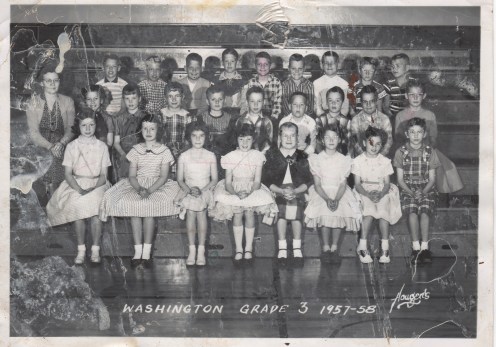 Girls played “horses” at recess or kicked the boys in the shins with the toes of their leather shoes. I wanted nothing to do with them either way, but they often found some way to trick me into chasing. I’d catch one and get kicked. And cry. One day the scab on my shin came loose and I bled down into my sock. Recess was horrible. What good were girls anyway? Why did they always want to play horses?
The boys weren’t any better. The choice there was to play marbles in the snow and mud puddles until you lost all of your brother’s marbles or play baseball and get yelled at. My nickname was “strikeout” because I couldn’t seem to hit the ball.
Bigger kids were willing to punch you out. After my brother’s marbles were gone, that is. I saw a big fat kid punch another in the face and wouldn’t quit even though the smaller kid begged for mercy.
Another time at the playground I saw a group of boys clustered in tight around another who had a Trojan prophylactic he was showing off. I overheard the boy reading from the package, sounded like “one lubricated skin. . . .” Didn’t make any sense. Skin? Didn’t know what was going on, but it had to be creepy.
Fifth graders were capable of unspeakable behavior. I saw one sit on another boy’s chest and spit into his mouth while the smaller one squirmed. We went crying to the boy’s mother, who wasn’t even horrified. She only smiled.
I liked to stand by the building during recess where it was warm, close to the teacher for safety. Ugly girls and stupid boys stood next to the building. I once got into trouble for looking through the window into a classroom. Mrs. Olson — Ruth Olson — said I made an ugly face. I didn’t mind getting into trouble for looking through the window, but I cried at home because she said I had an ugly face. Just like the girls who stood by the building. The ones who didn’t play horses.
One time I was crossing from the building to the swing set when a big fifth-grader saw me and came after. I ran away as fast as I could, through a group of girls playing horses. Usually that strategy would be enough to lose a big predator, but after I cleared the group I looked behind me and. . .the big boy was still coming. Fast.
I was scared. I ran so fast I could feel heat coming from my upper thigh where it met my torso. I sailed over mud puddles and over snow and settled into a fast run. The big boy was still coming. Relentless.
At last I looked up ahead and around. By now I was starting to run parallel to the sidewalk on the north side and I was coming to the intersection of the sidewalk on the east side of the playground. In other words, I was running into the corner and I didn’t know what I was going to do. All kids were forbidden to leave the playground during school hours.
When I could run no farther, I stopped and turned to face my pursuer who was only about 50 feet from me and running toward me fast.
What could I do? I fastened my gaze at the boy’s belt and ran right toward the fifth-grader as fast as I could, all the while wondering what I would do when we met. I never did come up with a plan, so I ran right into the boy, dropping at the last moment so that I struck the big boy in the legs with my body.
The boy seemed to fly up over the top of me and I rolled a time or two in the slushy snow, then jumped up and ran with all my speed toward the school in the distance.
The bell signaling the end of recess rang just as I sprinted back across the paved section of playground and I cruised in the side door of the building.
Four o’clock doesn’t seem too early to be up writing when I can’t sleep. I look at old photographs like this one here. My sister Carol looks to be about four years old in this shot taken at her grandparents’ place on the 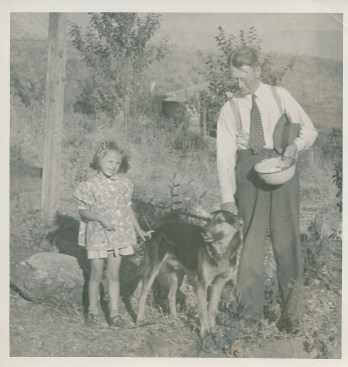 outskirts of Kalispell, Montana. She was born in February, 1939, so this would have been taken in 1943 with her grandpa, Carl T. Bonde. Carl is holding a bowl of chicken feed. I imagine Carol’s dad, Robert Struckman, took the picture with his 4×5 Graflex. I still have the negative and, as a child, I played with a couple Graflex film holders my mother kept up in her closet.
Carol’s fingers appear to touch Prince, part German shepherd, as Grandpa looks like he might be restraining him by his collar. Or not.
In Europe in 1943, World War II seemed to be winding down with Germany being driven out of Russia, Italy, and France. These happenings no doubt brought some relief to Carol’s grandparents concerned about their son’s safety as the United States prosecuted the war in Europe. Mopped up the war, really.
In December that year, Grandpa wrote a cheerful Christmas letter to his brother Alfred that his son, Carl R. Bonde Jr., was in England with the “Limeys,” and that he and his army buddies made several trips into London to see the sights and drink in the pubs.
On December 23 that year Carl R. Bonde, Jr.’s 66th Black Panther Infantry Division abruptly–over just a few hours–pulled up stakes and embarked to France.
The week before Hitler had launched a last-ditch offensive in the Ardennes in an attempt to retake Belgium and France. Thousands of American troops were mobilized.
Christmas Eve found the Carl Jr. and his buddies on rough seas in the English Channel just five miles from Cherbourg, France. A U-Boat near the entrance of the harbor fired two torpedoes at Carl’s troopship. The first one missed, but not the second. The Bondes never saw their son again.
Carl R. Bonde, Jr., with his German shepherd, Prince.


 insearchofbud