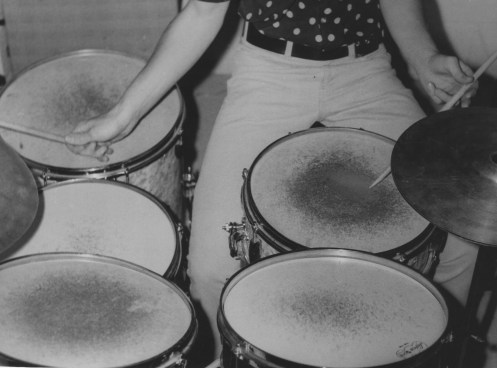
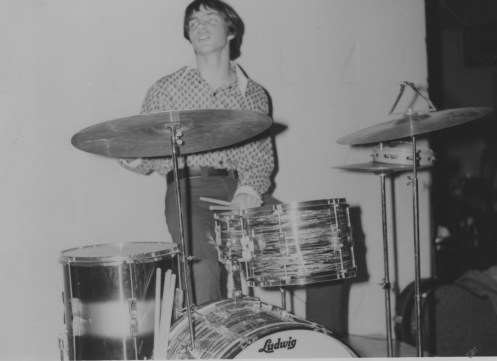

My old friend Divad Trahnel wanted to see some photographs of his favorite drummer from 1967. Notice the chicks standing off to the left of one of the photos.
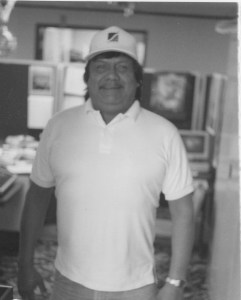
Lloyd in 1988
I have barely started telling about Lloyd Yellowrobe, a hero to me. Tomorrow Lloyd, a decorated Vietnam veteran, will be honored at the Ashland Labor Day Powwow.
I remember a time twenty years ago when a gathering of Lloyd’s family and friends began weeping when a priest administered last rites to Lloyd. He was in Billings in intensive care after his truck accident. Lloyd’s mother passed a box of tissues to me. Must have been a miracle that Lloyd survived.
I don’t remember the first time I met Lloyd but he has always been a friend to me and he made me feel like I was working in the right place once I started at Lame Deer. Was sort of a shock for a city kid like me to suddenly start working in a rather remote Indian Health Service clinic.
First, Lloyd proved himself to be an artist. He drew a caricature of our friend “Rabbit” Hiwalker that looked like a Playboy bunny. I didn’t know that I’d be destined to go on adventures with Lloyd, or that I’d keep cedar in the pharmacy for Rabbit’s use.
Here’s an example: Lloyd always claimed to know about a huge meteor crater out toward Ashland, east of the prairie dog village. He and I drove there once, right after work, tracking up and down red dusty roads, even finding a sinkhole in a hayfield that had a log poking out, apparently to let whoever was cutting the hay know it was there. We ended up locating an irregularly shaped valley, not too convincing to me. I never did believe it was a meteor crater, although Lloyd said he saw an areal photograph.
On our way back to town Lloyd had me pull over onto the shoulder of the highway, over the top of a hill, on a downhill slant. “Take your foot off the brakes,” Lloyd said. To my amazement the car backed up the hill by itself, as though a magnet were pulling it. I figured that was some sort of optical trick, but hey. Why not believe it was a magnet? I could believe in the magnet long before I’d believe in the meteor.
Another time Lloyd and I looked for the buffalo herd up by Crazy Head, but didn’t find it. Still another time Lloyd took me up on the big plateau on the Birney divide to the buffalo jump. We walked around down below and Lloyd found a buffalo bone with tool marks where someone had scraped off the meat. I was always impressed by the respect Lloyd had for the ancient sites on the reservation. Then we traveled onward, on the dirt road near the abandoned car.
I might not have thought much about it, but Lloyd pointed out this car a couple hundred yards down a steep bank into a ravine. Lloyd knew the story of how the car got there. Did he put it there? He said he saw it as it coasted down, never to rise again. For all I know the car is there today.
That same adventure he showed me Wild Hog basin as we approached the lookout tower. Lloyd’s father used to watch for forest fires from the tower. The tower was the same kind of Chicago Aeromotor Company structure that stood atop the hill near Crazy Head Springs. Those were happy times.
Lloyd lived in a blue house in Busby in those days. One Saturday we went fishing in the after bay at Yellowtail Dam. Didn’t catch any fish. In fact I don’t think we ever did catch a fish, but Lloyd pointed out a red-tail hawk to me.
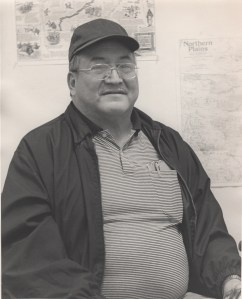
Walter Blackwolf’s father was James Blackwolf.
Far removed from ordinary life in Lame Deer is the Northern Cheyenne Sacred Medicine Hat. Who knows how old it is? Here’s what I have learned about it. Someone very trustworthy and wise is chosen by the wisest people in the Northern Cheyenne tribe to take care of it. Such a person is known as the Hat Keeper, and the hat is kept wrapped in a bundle that is not opened. This object has been compared to the Holy Grail by Roger Clawson, when he was a columnist with the Billings Gazette.
Whenever the hat is unwrapped it is a big deal. A damned big deal. Books are written. Highways are closed. Heads are bowed. Tongues are silent. In fact, time is judged by the number of years since the hat was previously opened.
About 1997 or 1998 I had the privilege of meeting James Blackwolf, a recent hat keeper, at a pow wow in Billings. He radiated wisdom and greatness in a way that can only be described as profound respect. One doesn’t meet people like that often. He passed away soon after I met him, but I remember that his hair braids were tied with bits of cloth and that he wore fine woolen blankets. He fixed me with a gaze that I’d describe as that of a newborn who recognizes his parent for the first time.
Actually, I had met Mr. Blackwolf only once before, when he was a patient at the clinic. He was to receive a prescription, so I opened the door to the pharmacy and called his name. A young man, intelligent, strong, clean shaven and short haircut, appeared at the door and came in. Soon after, James Blackwolf himself came in. The young man was a sort of lieutenant for the Great One, the Hat Keeper. I gave the prescription bottle to the young man who gave it to Mr. Blackwolf. Mr. Blackwolf then stood, took my hand with both of his, and thanked me.

Nineteen eighty-eight had the forest fires in Yellowstone, but also near Lame Deer, specifically the divide between that town and Ashland, at Crazy Head Springs. We used to go fishing at Crazy Head Springs, deep ponds of icy water with planted trout.
The tribal sanitarian, a white guy, Italian, I think his name was Mark, took me fishing one day after work. The fishing was so good I felt guilty and released mine back into the pond. We used worms, but I think any kind of lure would have worked. I forget what kind of trout we caught. It all happened so fast.
Mark quit shortly after that and another named Matt came. Matt broke his hand riding on a small motorcycle and we took him a milkshake from the local restaurant, the “Chicken Coop.” As I handed him the shake Matt’s face got serious and he said, “That filthy place? I mean, thanks!”
After work the next week I returned alone to Crazy Head Springs to try a lure I brought from my home in Billings. It looked like a yellow jacket, yellow and black. Turns out the trout weren’t interested. But that’s when I invoked the name of my friend Lloyd.
Lloyd Yellowrobe was the clinic supply man, and even the depressed pharmacist I worked for, David Miller, spoke Lloyd’s name with reverence. After all, Lloyd kept government issue pharmaceuticals and we ordered them from him by the case: cough syrup, penicillin, acetaminophen, prenatal vitamins, and rubbing alcohol. This last item was said to have helped destroy the clinic seven years later when a light fixture exploded early on a Sunday morning in February.
I invoked Lloyd’s name whenever I drove aimlessly on the miles and miles of logging roads that crisscrossed the Northern Cheyenne’s reservation burned out areas on the divide between Ashland and Lame Deer, Montana. Well, I was appreensive. In 1988 I had no experience with the Northern Cheyenne tribe and I was out of my element, not sure if I was trespassing.
I would drive the logging roads in the evening after work until my car’s gas tank was half gone, then return the same way. That’s when I discovered the Badger Peak lookout tower, a metal structure built by the same Chicago Aeromotor company that made many metal windmills. “I know Lloyd Yellowrobe,” I reassured myself as I drove, in case anyone stopped me and asked me what the hell I was doing. Nobody ever did. In fact, I didn’t see anyone else at all.
The road forked so many times that I took only rights for a long time, then switched to lefts. Didn’t seem to matter. I couldn’t tell where I was, the land was so hilly, crusted with a peculiar, bright pink rock, that someone told me was clay that had hardened from subterranean coal fires long ago.
At work Lloyd teased Larry “Rabbit” Hiwalker, who used to weigh about 350 lbs., he told me once.
In 1995 the tribe took over cleaning the clinic and Rabbit and the rest of the cleaning crew was fired. A couple years later someone from the tribe decided the clinic was no longer getting cleaned properly, I guess, because someone went to Rabbit’s house and offered him his job back. Fortunately Rabbit returned, about 100 pounds lighter and physically fit.
Lloyd had called Larry “Rabbit,” but Hiwalker called Lloyd “Coyote.” By then Lloyd had suffered his broken neck in a pickup wreck and had to take disability retirement because he was no longer able to work.
One time when I was in Lloyd’s supply room he showed me a massive certificate on his wall, a Bronze Star for valor in battle during the Vietnam war. The certificate ultimately burned in the fire and I doubt that Lloyd was able to replace it.

I publish this photograph because I want to show how I am dressed. In 1978 I didn’t need either belt or suspenders to keep my pants up, even though my pocket is weighed down with a huge bunch of keys.
We were getting ready to climb a damned steep trail to the Forest Service lookout tower on Indian Mountain. The trail starts in Idaho and ends up in Northeastern Washington.
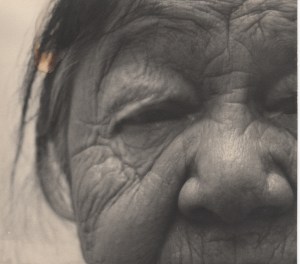
Lloyd Yellowrobe’s mother lived to be an old woman.
Dave Means was activist Russell Means distant cousin. Dave had a rare gift of quiet humor and self control that made him well suited to his demanding job as Indian Health Clinic Service Unit Director.
I remember sitting in his office at the clinic. He told me he was successful because he studied theater at Montana State University.
We liked each other immediately and he is the one who hired me to be the Chief Pharmacist at his small clinic in 1988.
No he didn’t. I worked for the Chief Pharmacist, a guy named Miller, who quit when I told him I would wait for him to leave, then do everything my own way. That’s when Dave Means promoted me. I already told the tale of the pharmacist I hired to be my assistant.
Ultimately my boss, Dave Means, and I lived in each others’ apartments and had identical, albeit opposite, commutes 106 miles each way, between Billings and Lame Deer, Montana.
Thirty years ago, most of the doctors and nurses of the Indian Health Service lived in a neighborhood a block away from the clinic.The rent was about $200/mo, but the price of electricity to heat the houses was high in the winter. Anyway, I always planned to commute the 106 miles from Billings to Lame Deer because nobody in my house wanted to move from Billings.
In the beginning I had old cars that broke down. That plus the last 40 miles of the road to Lame Deer was tortuous and narrow. In the winter the road had ice. I did a complete spin once when I lost traction. Scared me, so I asked Dave Means for a place to stay in Lame Deer during the week, especially in the winter. Dave asked me to write a letter to the housing committee.
They offered me a basement apartment at the fitness center for about $100, which I took. It had one bedroom and combined living/dining/kitchen room. Oh yes, a bathroom. My apartment was right beneath the fitness center treadmill. I remember Dave Means was running on it when I went up to complain that the light fixture was about to come loose from the incessant “clomp clomp clomp.”
There were two of the basement apartments, the other was occupied by a BIA policeman named Mike Oldmouse. I think that was his name. Later Mike had a roomie named Lonnie Spang, a young man who could play the guitar. Lonnie moved in with me when Mike kicked him out. Lame Deer has a truly socialist style society. Other times Lonnie stayed with the school superintendent’s family.
I had been glad to move to the furnished basement place with a load of stuff I carried in our old volkswagen van. Ultimately, the field mice that played in the walls near my bed drove me from that basement apartment. Turns out Mike had left a box of commodities with split peas and such in the back room between our apartments and that was feeding the mice.
I tried controlling the mice with a cat, but the animal ended up spraying urine throughout my apartment. I ended up “selling” the cat for a $1 rebate to a woman named Gladys. She told me a day or two later the cat ran away from her. I did not ask for my dollar back.
I had a mouse trapline I set twice or three times a day. I caught many mice but the scratching in the walls did not abate.
This was 1989. At first, when I wanted to use a telephone to phone home, I had none, so I walked downtown. The “big store,” the IGA, had a pay phone out front, but there was quite a line of teenagers standing there to use it. I asked around and the only other pay phone was at the police station, so I walked over there. In the vestibule I found no competition. I called home.
In those days the Rosebud/Bighorn county phonebook was quite thin. Even thinner was the Lame Deer section. Most of the numbers were tribal and federal government agency listings. The entire town of perhaps 3500 people with BIA, IHS and tribe had only enough phone listings to make up one page (front and back) plus half of another. In fact, nobody knew for sure how many lived in Lame Deer. My 3500-person figure was a wild guess.
Like I said, famous American Indian Movement activist leader Russell Means was Dave Means cousin, but they were distant, one from another. Dave was a man of few words, so I didn’t find out more.
Here is how things worked out: In 1990 I ended up quitting my job in Lame Deer when a staff pharmacist job at the hospital at Crow Agency opened up. Cut my commute almost in half.
Said David Means when I quit: “Well fuck you then. There. I said it.” Then we shook hands and he wished me well.
During the next five years the BIA redid the road between Lame Deer and Crow Agency, straightening and widening. In the meantime Dave phoned me to see if I wanted to return to Lame Deer to work in the pharmacy again. Well, I did. I missed the people there. So I quit the hospital at Crow Agency.
The Lame Deer clinic had changed. More patients, more doctors, three pharmacists and two technicians. Lonnie Spang had moved to Billings and worked in a car repair shop. I hardly ever saw him again.
Dave Means was still Service Unit Director, but shortly thereafter, the clinic burned to the ground. He was arrested on a Friday afternoon on a charge that he had once, long ago, molested a young lady. Dave protested his innocence. Turns out she had been to one of those therapists who help bring forth “repressed memories.” Although the charge was ultimately dismissed, Dave had to go to jail and he suffered damage to his pride, his reputation, and to his health.
Soon we were taking up a collection to buy Dave some clean socks and underwear for jail. That’s what you did. People in jail ate a lot of chicken pot pies. Turns out that being arrested in Lame Deer isn’t even a very big deal. Most adults there have been arrested at one time or another because of changing tribal politics. Oh, and before that Friday when they took Dave away in handcuffs, Dave lived in the same basement apartment where I had once lived. I don’t know why he lived there, perhaps because of the chaos that ensued when the clinic burned.
By then I commuted the 106 miles five days a week. By the time I retired, we had bought and worn out a Ford, three Nissan Sentras, three Honda Civics and a BMW. Well, the BMW has almost 300,000 miles on it and still runs fine. Almost fine.
The fire’s cause was never certain. My friend Lloyd Yellowrobe may have stacked too much rubbing alcohol near a faulty light fixture in the supply department. On the other hand I always thought I had left the coffee pot on through the weekend. However it happened, the clinic was a total loss. All of the medical records burned. Monday morning we met at the Lame Deer Boys and Girls Club. Linwood offered his building to the pharmacy.
I had always been on great terms with Lynwood Tallbull, Community Health Representative Director, and he and his people moved out of a nearby double-wide trailer during a busy morning and allowed our pharmacy and administration to move in. The physicians were not so fortunate. They had to work a block away at first. We dispensed our first prescription within 48 hours of the loss of the clinic. Oh, I think I dumped out a bottle of Tylenol and put the prescription in there.
Remarkable how things change. I ended up lending, the guy who hired me twice, several hundred dollars for his legal defense. Like I said, the charges were ultimately dismissed, but he had been replaced by another for Service Unit Director. A string of them, actually, before they found a strong woman, Debbie Bends, who has held the job the last dozen years. Dave repaid me.
Dave commuted from Lame Deer to Billings to work at the IHS Area Office while I continued to commute from Billings to Lame Deer. Five days a week we’d wave to each other as we passed, usually over by Busby, somewhere. He drove a little white pickup.
Lloyd Yellowrobe got into a car wreck, broke his neck. He pretty much healed up and takes care of his grandchildren over at Busby.
Lynwood Tallbull was replaced as CHR director, but now teaches traditional medicinal botany at Chief Dull Knife College, the best place to get a meal in Lame Deer. I don’t know what happened to Mike Oldmouse or Lonnie Spang, as I haven’t seen either one of them in ages.
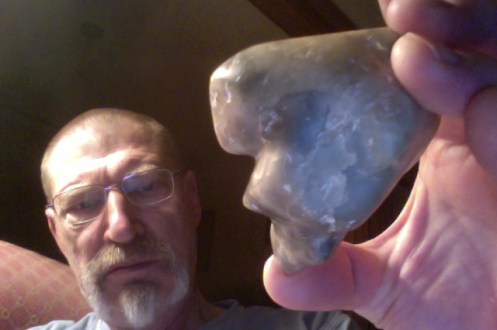
In 1988 or 1989, soon after I had been commissioned as a pharmacist in the Indian Health Clinic in Lame Deer, Montana, on the Northern Cheyenne Indian Reservation, I recruited for an assistant pharmacist. The prescription volume was increasing and, although I’d gotten a volunteer to help me prepare prescriptions, I needed another pharmacist.
I didn’t start out as chief pharmacist. The person who at first held that title, Dave Miller, got discouraged when he couldn’t control me and he transferred to the Bureau of Prisons in Allentown, Pennsylvania. Dave had recently gotten divorced and his kids lived in Ohio, so he didn’t leave just because of me. We mostly just counted pills and read the labels to the patients. I thought reading labels to people, whether they could read themselves, was silly. I advocated getting to know the patients a bit better.
Soon Bob Ashmore, the Billings Area Pharmacist, gave me the name of Walter O. Scott, a pharmacist in Alabama, who had just received a commission with the U.S. Public Health Service Commission Corps as a Lieutenant. “He seemed pleasant,” observed Bob.
I phoned one of Scott’s references at the pharmacy he was currently working in in Alabama, and a pleasant woman with a southern accent told me with a laugh, “you’ll hate him!” I responded with a thanks, believing she was making some humor. Soon I did hate him. Importantly, most others in Lame Deer loved him.
No other applicants to choose from, I hired Lieutenant Scott, a great tall man, with a charming manner and mild voice.
He moved in with his beautiful family of three kids and wife. She was second wife and the two older kids were hers by a previous marriage.
Walter proved to have some extreme views, in my opinion.
He didn’t know that before he arrived a policeman, Mr. Spottedwolf, had recently been killed in a collision with a horse near Busby.
Walter and I clashed. He told me he doubted the veracity of most scientific evidence, especially if it concerned matters addressed in the Bible, such as creation. The Scott family homeschooled their children. His wife, Camilla, had long black hair. She could almost pass for a Native American. In fact she was listed as such by the bank who loaned them money for a home in Ashland, just off the reservation, thus proving they didn’t discriminate. Only they did discriminate, by indiscriminately falsifying the loan application. Walter boasted that the bank official wasn’t making a careless mistake, but was deliberate.
Once when Walter and I were discussing the burgeoning AIDS epidemic and the loss of life, he exclaimed “Good!” I told him how horrible I thought his attitude was, but he said he thought homosexuals deserved to die for their lifestyles. We argued about this. I began to understand his views.
Walter bristled when I put a condom dispenser out where our patients could reach it without any interaction with us pharmacists.
Eventually, the chief pharmacy officer of the Indian Health Service, an admiral, was so impressed with this, that when he visited us he took a photograph of the dispenser. The clinic eventually burned to the ground in 1996, but Walter had divorced and remarried by then. He had also moved to Nixon, Nevada.
Another time, a young lady received a medicine for anxiety from one of the physicians and Walter called the girl’s mother to tell her not to allow the girl to take the medicine. I thought this was a breech of ethics and told him so.
Surprisingly, several of the elderly Northern Cheyenne loved Walter because he made an effort to learn the Cheyenne language and practiced it whenever they came to the pharmacy. Walter could greet them and carry on a simple conversation. For years later, old Dan Pine asked about Walter, adding that he could “talk Cheyenne.”
Things are never so simple. After a couple of years arguing with Walter I transferred closer to my Billings home to Crow Agency to shorten my commute from 100 to 60 miles one way. Walter became chief at Lame Deer and hired a woman from Chicago who began phoning me, complaining that Walter made her life miserable. He refused to do any work, making her do all of the prescription filling while he either sat at his desk doing nothing or was off somewhere at meetings. The woman phoned me repeatedly, sometimes in tears.
During the first year of Walter’s tenure at Lame Deer the Scott family bought the house just over the border of the reservation. Their house burned to the ground and the people of Lame Deer generously held a benefit powwow to raise money to help the family rebuild their lives.
During the next five years Walter managed to discourage the woman from Chicago until she quit; then he hired a motorcycle hippie named Tim Dodson who was uncontrollable, hence popular with everyone at the Cheyenne clinic. Tim drove off Walter.
Walter and his wife had divorced after he caught her cheating on him. This made one of the clinic doctors ecstatic. Jim Bischoff, doctor of medicine, hated Walter, who hated him back. For good reason. Bischoff had been stealing antidepressants from the pharmacy after hours, and Walter set a trap for him. Bischoff wasn’t all bad; he espoused the prescribing of the cholesterol-lowering drugs to prevent heart disease. Walter was against the use of them, saying they were too expensive.
Here’s the strange part.
Walter who had high cholesterol, developed heart disease and had a heart attack within ten years. Walter had married Anna Spottedwolf, widow of the policeman killed just before he moved away from Alabama.
Dr. Bischoff quit the public health service and became a clinic physician in a small town near Yellowstone Park.
All was well until he allegedly killed an elderly woman with an overdose of narcotic and, near the same time, Bischoff also was accused by the clinic nurses of stealing narcotics after hours.
Bischoff’s wife died in an auto accident. But that’s not the last of the misfortune.
In order to hire a lawyer to defend himself from the narcotic charges, the doctor attempted to rob a bank at gunpoint and ended up in the Montana State Prison, stripped of his license to practice medicine. He is out of prison now, according to Fb.
The last I heard, Camilla and Anna are both alive and well, as are Camilla’s three children.
By weird coincidence, I later met the daughter of the woman Dr. Bischoff allegedly killed. In fact, she came to our house with a mutual friend.
That’s how things happen.
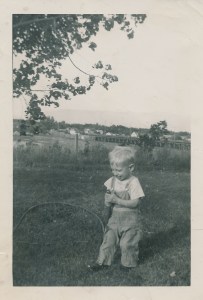 About 60 years ago when the Gaul family children were my best friends, Johnny Gaul taught me a valuable skill to use at the Sunshine Store, a mom-n-pop across the street from our house.
You could pick out whatever you wanted and you wouldn’t have to give the lady any money if you said “charge it.”
I immediately put it to use. On various trips to the store I got a comic book, a bottle of pop, an ice-cream cone, and plenty of candy. “Charge it. Charge it.” I chirped. Of course the owner, a frequently divorced and remarried woman named Betty, asked me if it was okay with my mother. I answered “yes.”
“Are you sure?”
“Yes,” I lied.
I distinctly recall mother cursing at me when it came time to settle up her account at the Sunshine Store. “God DAMN you,” she said, “You are NOT to charge anything else at the store unless I send a note along with you.”
Well, I did try to charge a few more after that, but Betty stopped me at the cash register, demanding a note which, of course, I had only when my mother demanded that I buy cigarettes for her.
The memory of Johnny Gaul and the charge account at the Sunshine Store followed a painful memory of an event that took place around that time, one sunny day. My friends Johnny and his sister Martha and I were playing on the sidewalk near our house and my mother and another adult were chatting away when someone smacked me on the top of the head with a croquet mallet. Made me cry.
I cried so hard that I couldn’t make myself understood when I tried to tell the adults that I had just taken a whack to the top of the head. Worse, while I was trying to tell my story, she let me have it again and again, perhaps not as hard, but it still hurt like hell. I don’t think the adults ever suspected what was happening right in front of them.
In a kind of cosmic retaliation, I remember chasing a kid out of our yard when I threw a good-size stick at him. I led him just enough so that the stick hit him on his head as he ran away, probably a good thirty feet. This caused him to bellow with pain and run all the faster. I felt pretty good about my throw, right then. Oh, maybe my mother got after me. I don’t know. I do remember feeling satisfied that I had made a cool throw.
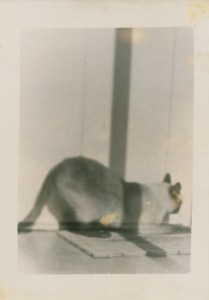
Another time I was feeling peckish toward my friend Mike Kohler. We played together for many hours at a time, making up elaborate games of cowboys or spacemen, or even atomic scientists. One time when he was angry at me and turned to leave I tossed our cat at him, which dug its claws into his back, thus making him run away crying. I had forgotten this crime until a year ago, or so, when he reminded me of it on Facebook.
Actually, we didn’t even have a cat then. I think he was thinking of the time I hit him with the dart.


Squirrel. Something like the one 1n this fable.
Once a squirrel, thinking he saw a nut across the street, ran in front of a speeding car. The car narrowly missed the squirrel, but hit his tail, snapping it off short.
“Oh boo hoo,” cried the squirrel. “Now I cannot run with my brothers and sisters on the high wires behind the houses without losing my balance.”
The squirrel did succeed, however, in getting across the street, grabbing the nut, and eating it.
He ate it while dabbing at his tears with one paw.
While the squirrel was eating the nut, shedding tears of self-pity, a hungry dog named Luke sneaked up and — “gulp.” He ate the squirrel in one snap of his hungry jaws.
At least the squirrel didn’t have to worry about falling off the high wire any more.
Moral: In every cloudy day is a ray of golden sunshine.
Monday, August 22 @ 1909
I think it was April, 2011, when P. and Josiah and I went to Paris, France, to catch a train to St. Nazaire. Did I already tell you that on the appointed day we showed up at the Gare d L’Est about 30 minutes early to find our train to the coast. We found the train, slipped into the car, found comfortable seats, and settled in for a wait. The time for our train’s departure came and went. I looked out the window. Nobody there. It dawned on me. Whoa. Wrong train.
Thanks to our grandson, Josiah, who figured out that we needed to find a ticket window with a British flag (signifying English was spoken). The woman told us that we had one chance to trade our ticket for another. If we paid a huge sum. We paid the sum, lined up for the correct train, and squeezed in.
The train took us out of Paris, out into the countryside. Oh, I remember seeing many a stonewall with sort of good-natured graffiti sprayed all around. Then more stone walls. More graffiti. Eventually we came to countrysides with farms
I remember a farm with a tractor. Most of the farms looked small, but I don’t remember seeing much livestock. Just telephone poles, occasionally big barns, large white buildings, I gave Josiah my camera and asked him to take a few pictures. He didn’t look enthusiastic, so I assured him that he could take as many photographs as he wanted. Result? Hundreds of pictures from the train, mostly blurred green from the April countryside. Exactly what I’d hoped for.
Eventually we reached a station where we would be required to detrain, find another train, and entrain. This proved to be too much. I believe Josiah asked a trainman who hustled us away from where we had been heading and toward another place where we caught a train.
I almost forgot that we found a WC for men, and another WC for women. Also we found a place to purchase some bread and probably some cheese and perhaps some fruit. These things gave us the strength to continue our journey.
Throughout all of these adventures Josiah kept steering his grandparents toward St. Nazaire. Toward the goal of the trip.
Why St. Nazaire?
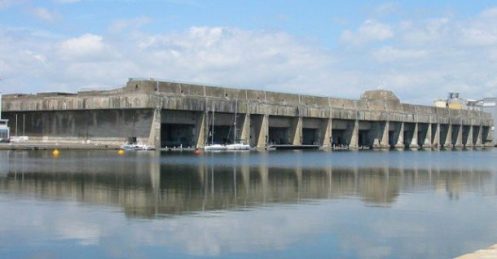
Did I remember to tell you that St. Nazaire was one of two submarine bases held by the Nazis during World War II? My uncle Carl’s 66th division got orders to contain the Nazis within the bases at St. Nazaire and Lorient. Unfortunately, my uncle Carl Bonde was not with the rest of the division. He vanished when his troopship was torpedoed on Christmas Eve, 1944.
When I had been to the final reunion of Carl’s army company in 2006, the old men there told me about their duty during WWII was to contain the Germans who were holed up in the impregnable fortresses at St. Nazaire and Lorient. I chose St. Nazaire to visit because of one of the old veterans, Wally Merza, who told me about the museum there where he donated his Army uniform. I had a photo of Wally in my pocket.
I ended up seeing Wally’s uniform at a museum called, “The Grand Blockhouse,” or “Le Grand Blockhaus,” at La Baule. Turns out La Baule is a famous beach in France, something like Miami Beach in the U.S.A. Josiah, P. and I took a taxi to the Grand Blockhouse and saw La Baule. We saw riders on horseback galloping on the beach. Jacques Tati staged his great films about Monsieur Hulot there.
You know, we never did visit the submarine pens at St. Nazaire, but I got photographs from the Internet.
We did enjoy visiting the museum and we enjoyed allowing Josiah to steer us back to Paris. April in Paris. And many more of his photographs.


 insearchofbud