March 16, 2020
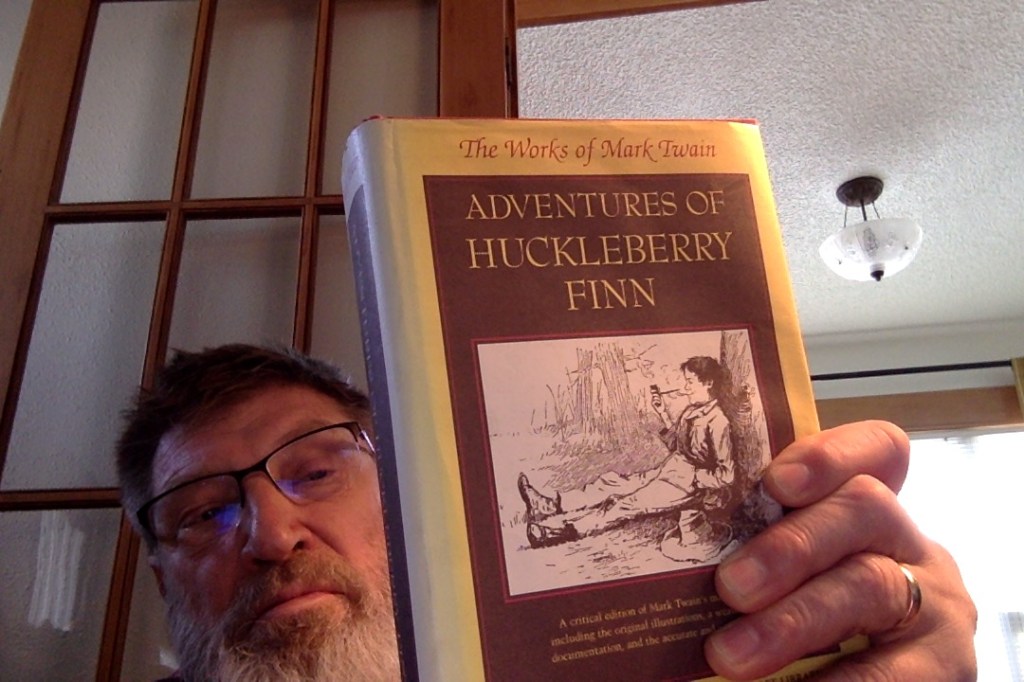
Returned from Gering, Nebraska, where I enjoyed a couple evenings with my sweet sister, Carol Hotchkiss. She’s 10 years older. And she’s smart, too. You’ll have to trust me on that. Our idea of fun was reading poems to each other. We also told how we used to sneak into university buildings to explore and pillage. We come from Viking stock.
Here’s a poem by Mark Twain, published in his Adventures of Huckleberry Finn. Helps to read it aloud. Pause after you read the first word of the second stanza, for additional mirth.
Ode to Stephen Dowling Bots, Dec’d.

And did young Stephen Sicken,
    And did young Stephen die?
And did the sad hearts thicken,
    And did the mourners cry?

No; such was not the fate of
    Young Stephen Dowling Bots;
Though sad hearts round him thickened,
    'Twas not from sickness' shots.

No whooping-cough did rack his frame,
    Nor measles drear, with spots;
Not these impaired the sacred name
    Of Stephen Dowling Bots.

Despised love struck not with woe
    That head of curly knots,
Nor stomach troubles laid him low,
    Young Stephen Dowling Bots.

O no.  Then list with tearful eye,
    Whilst I his fate do tell.
His soul did from this cold world fly,
    By falling down a well.

They got him out and emptied him;
    Alas it was too late;
His spirit was gone for to sport aloft
    In the realms of the good and great.

###
March 6, 2020
Back in Billings after a three-day jaunt into Wyoming. First day, Heart Mountain Relocation Camp near Cody. We saw tarpaper buildings where several thousand Japanese were interned during 1942-1945. The hospital, with its huge smokestack, still stands in tatters. Several hundred souls died there, perhaps 500 others, born. I learned:
- Each internee, in 1945 when being discharged from the camp, received $25 and a train ticket to anywhere in the U.S.
- The experience was humiliating, like being in a concentration camp with barb wire and guard towers.
- The children of the detainees could play sports, go to school, and join activities, like the Boy Scouts.
- Heart Mountain was Wyoming’s third largest city in 1944.
- A high school, complete with auditorium and gymnasium, was constructed at Heart Mountain.
- Once discharged, the internees faced cruel racial discrimination.
- The young male internees were subject to being drafted into the military. Those who resisted were imprisoned. At least two who were drafted received the Congressional Medal of Honor.
- One internee built a photographic dark room beneath his tarpaper residence. His enlarger is on display at the visitor center.
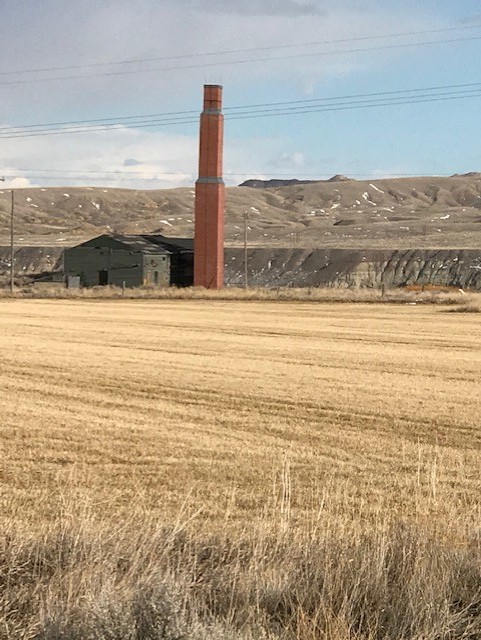
Because it is off-season for Yellowstone Park, we saw few fellows traveling the road from Cody on the Shoshone River road to the East entrance of Yellowstone. We did see a herd of big horn sheep. We saw a photographer, actually, then we saw the sheep he was pointing his camera at. The East entrance was closed for the winter, until May 3, so we returned the same way. There was the photographer, this time walking back on the hillside. One of the young sheep had walked up to the photographer’s car. I took a photo with my trusty telephone.
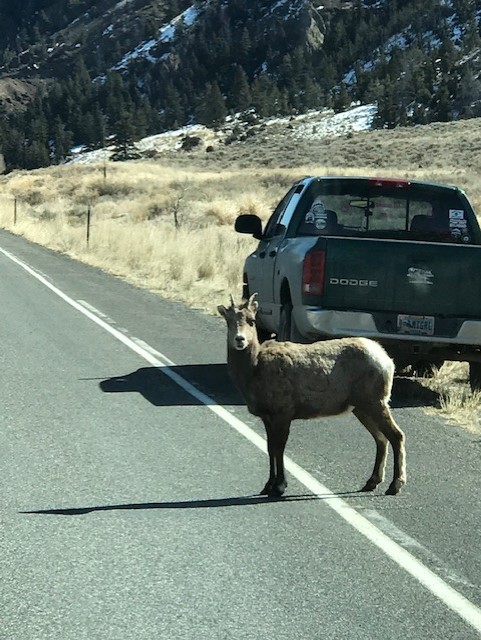
I’ve taken pictures—and developed them in my darkroom—since I was in the fourth grade, but I’ve never had as good a camera as is on my phone.
We drove farther and saw a coyote walking across a frozen stretch of river.
A jumble of add-on rooms and balconies on a ridge-top house was the Smith Mansion. We stopped so P. could take a photo. A mule deer grazed a few feet from our car. A black SUV stopped across the highway, the man evidently watching us. I waved and he waved back. We drove on.

After perhaps 10 miles we saw a golden eagle picking at a carcass in the borrow pit. I turned around the car to go back to take a photo. Or rather, for P. to take a photo from the passenger window. She felt bad that we disturbed the athletic-looking bird. The magpies that took the eagle’s place at the carcass did not seem to feel bad, though. We got back on the highway, again headed toward the park.

I needed to turn around again, so I pulled off the highway into a driveway. Another car, right behind me, also turned into the driveway. Now I was blocked from returning to the road. A fat little man, a guy I later learned was named “Keith,” told us he had lived in the Cody area all his life. He said he was the one watching us photographing the Smith Mansion. “Lee Smith built the house,” he said. He also helped design the Cody hospital, including an integral “peace sign.”
Keith recommended a restaurant called “Our Place” in Cody. We stopped there. We were surprised to see Keith again.
As we entered Keith held the door for us. He sat a table away, but chatted with us and another couple, also a table away. That’s when I realized that Cody doesn’t have many people; some have to do triple duty. They were friendly, though. I wondered if they would have been friendly if we didn’t look like them.
Although he didn’t look it, Keith was an accomplished skier, or used to be.
Keith also recommended we explore the South Fork of the Shoshone River, so we drove to the end of the road 190, 40 miles. We saw lots of deer. Hundreds, probably. No elk, no bears, no skunks, no porcupines, no wild sheep or goats.
We bought swim suits at the Cody Walmart.
Took us a couple hours to get from Cody to Thermopolis, purported to be the world’s largest mineral hot springs. We remembered from long ago a great Mexican restaurant, “Las Fuentes,” and quickly found it. The food was great, but I remembered fondly that perhaps 10 years before, when I had ordered a bottle of wine, the vintage was unusually old and the price unusually low. So I asked for a bottle of merlot. The waiter brought a bottle of “14 Hands” 2013 for $17. Not as great a deal as I remembered, but still pretty good.
The waiter recommended we camp at “Wyoming Gardens,” a relatively short distance away. I phoned a woman who had recently gotten cataract surgery by a Billings ophthalmologist. Turns out she and her husband also own “Las Fuentes” so they gave us a discount.
We soaked in the state-run hot springs spa free of charge. Twenty minute limit. P. rented a towel for $1, for me to use.
Driving over the amazing Ten Sleep pass (our name for it) to Buffalo, then North to Billings took perhaps five hours, including lunch break.
March 2, 2020
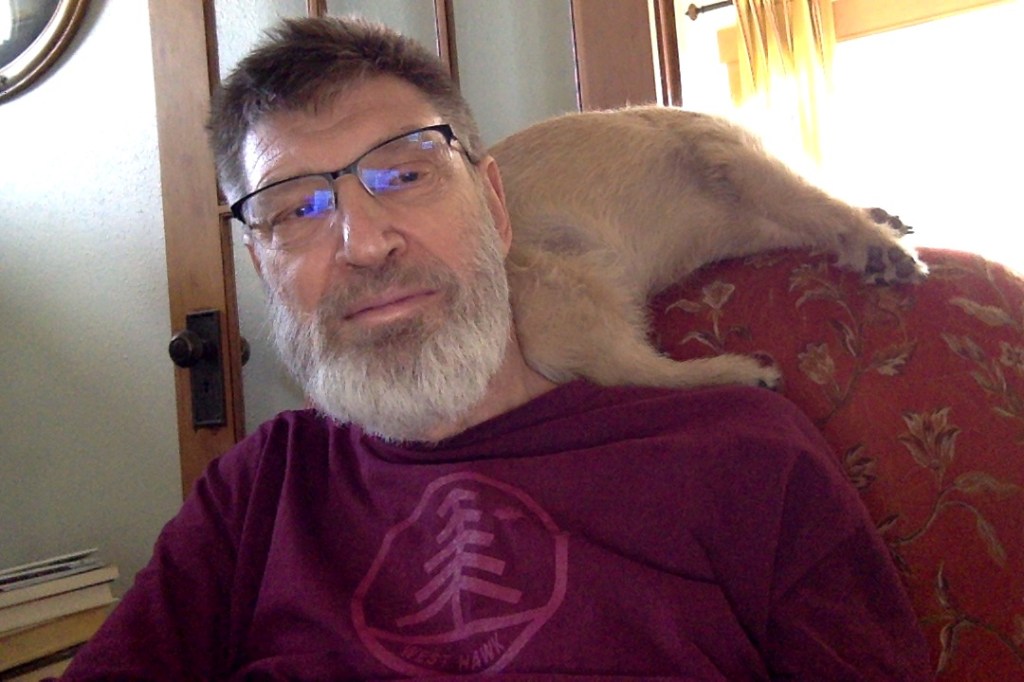
Gunther, my famous Brussels Griffon, will be four years old soon. As I type this he is sitting on the back of my chair, most of his weight on my neck. He’s warm! The vet said his normal temp is about 101 Fahrenheit. Good for my neck, although I had a couple vertebrae fused by a young Italian surgeon whose name I can say but cannot spell. He did a great job! Or I was lucky! Either way, the numbness in my arm went away and my neck doesn’t hurt much anymore.
Once in a while, when I’m feeling especially vulnerable I hold Gunther like a baby and hug him. He doesn’t seem to especially like that, or dislike that either. It soothes me, though. His face is humanoid, unnerving.
P. is out visiting an old friend of hers who is dying of cancer, in hospice care. I believe she is doing a good thing. If I in hospice care I’d want visitors. They could keep me company.
I used to help hospice patients. In my experience, hospice is under-used by those facing the end of their lives. This is probably because many people don’t like to admit the end is within six months. I think it’s easier for the patient, harder for the patient’s family members.
I visited an old gentleman, Gordon, whose terminal condition was heart failure and he was 96 years of age. We talked, told jokes, recited poems:
There was a young man from Stamboul, / who soliloquized thus to his tool: / “You took all my wealth / And you ruined my health, / And now you won’t pee, you old fool.”
Kurt Vonnegut, Jr., in Slaughterhouse-Five or The Children’s Crusade.
Gordon liked that one. He was a WW II veteran, served in France after D-Day. He also served in North Africa. We visited and talked and had thoroughly enjoyed each other’s company for two years until he died.
We had run out of things to say to each other.
A week later the Hospice volunteer coordinator phoned me, asked me to visit another nonagenarian, a retired grocer from Spokane.
He didn’t seem like a guy at the end of his life, though. He was strong, albeit depressed. I visited him for about an hour, and we got to know each other. Finally, I asked him if he wanted me to visit again.
“No,” he said. “Don’t bother. We don’t have much in common.”
Hurt my feelings. The old man died about a week later, I saw his name in the death notices in the paper.
As I write my cell phone goes “ding.” Someone (whom I don’t know) on Fb messenger asks “How are you?” I resolve to unfriend whoever that is immediately. My answer is an unsociable “none of your business.”

February 23, 2020
Had a good day. Started out with Gunther, walking just a short distance from home before he eliminated his waste product, which I dutifully collected in a plasticized bag, then tied in a knot. Gunther did not respond to my repeated calling to “go in,” so I went in our back door without him. I was rebuked by my beautiful and talented spouse for leaving him outdoors to menace our neighbors, so I stepped back onto the back porch and murmured, “treat.” Low tone, barely audible. Soon I heard his collar ornaments jingling and his toenails clicking on the driveway. He can hear what he wants. I always supply the promised treat, even if it is a pea-size peanut butter goodie. He goes bananas.
Went to church where our new musician, William De Manilow, played some wicked piano and sang. After church, a cadre of volunteers swarmed the Sunday school rooms to fix them with beds into sleeping rooms. Three Family Promise families who are temporarily homeless will live in our church this week. Many of us feel glad to help folks get their lives back. Wages are so meager these days. It’s hard to get started with an apartment.
Our minister, Pastor Mike, had a few moments with the children of the church during the service. He asked the kids to name their favorite part of the body. One boy volunteered that his favorite part was his bones. He writhed around, pretending he didn’t have any. Another, after some moments of hesitation, said his brain. I thought that was a good choice, although I thought a better answer would have been “my penis.” Well, he asked for someone to name their favorite part. I can only speak for myself.

February 21, 2020
Going through our file cabinet today drew forth obscure memories and emotions. While shredding tax papers, I held back our return from 1975, the last year I was in the Marine Corps, stationed at El Toro, California. Cryptic information on a government form.
Then we lived in Tustin, perhaps five miles from the Marine Air Station, in a two-bedroom duplex on a dead-end section of C Street. Our kids were 2, 4, and 5 years old. Our gray poodle rescue dog, Pepper, had run away.
We bought a Peking duck we named La Sa Lusa to keep in the back yard. Her nickname was “Juicy Lucy.” We found an egg most days under a bush in the back yard. La Sa Lusa liked to escape out the gate to the front yard to gobble snails before I could catch her and put her back. I was amazed how quickly and efficiently she could get the snails.
I examined the 1975 tax form from our file cabinet.
On the 1040A, I checked a box “no” asking if we lived within the Tustin city limits. Here’s the obscure memory: our neighbor, Sadie Chafee, who lived across the C Street from us, remembered when the adjoining street was a county road that stretched miles from Los Angeles to remote places to the south. I remember she told us our corner of the world was a tiny unincorporated part of Orange County. (Yes, of “Arrested Development” fame.)
Next door to Sadie a woman lived by herself with an ocelot for a pet. She invited us in once to meet it. She guided us into an empty bedroom and gestured toward an open closet and there, on a high shelf, was a sleek wild cat.
In the 1970s Gulf oil crisis, the price of gasoline shot up from 30 cents to more than 70 cents/gal. (Remember when a standard typewriter keyboard had a “cents” sign (a lower-case “c” with a vertical line through it)? My laptop has no “cents.”) A gas station was around the corner from our house. Near an Alta Dena Dairy and a U-Haul rental.
Our family of five lived on exactly $7124.37 in 1975. (Plus, what I earned delivering the Orange County Register and buying, fixing, and selling old Volkswagens.) In 1975 we earned $38 interest from a savings account, a greater amount than we earned in 2019—or any other year I can remember.
Of course, we were saving to move back to Montana. I got readmitted to the University of Montana School of Journalism and into family housing for a reasonable monthly rent. We got a four-bedroom apartment in the X-s, across the street from the green hill and Mount Sentinel.
Our duck, on the other hand, lived on commercial poultry food and the occasional snails. We tried frying her eggs, but they tasted fishy, so we made Christmas ornaments of them. We poked holes in each end, blew out the contents, then decorated the shells with glue, glitter, and rick-rack. We still have a few, packed away with the Christmas stuff.
Before we moved away from California we got permission to leave La Sa Lusa with a great flock at the Santa Ana Prentice Park zoo. We looked back and she blended in perfectly.
Back to the present, 2020. I took Gunther around the block, off leash because our mail carrier, Gordon, had come and gone. Busy, Gunther ran up on a nearby porch to check for snacks. As usual, he found none.


February 11, 2020
I’ve been checking out some of the more obscure books in our house. One example: [Thomas] De Quincey’s Works. Copyright 1877 by Houghton, Mifflin & Co.
When I was in the Marines a fellow supplyman, Lance Corporal Ziewall, gave me a fat little volume by the above-mentioned De Quincey. I liked to call him “Eyeball.” He always called me Stork.
Ziewall claimed to be a genius, not boasting. He understood the computers of our day (the late 1960s). He explained to me about the differences between programming languages like COBOL and REBOL. I didn’t quite understand. He said a great example of analog computer was the automatic transmissions another Marine, Corporal Eddy Bonk, rebuilt in the hydraulics shop during his lunch hour.
In turn I told him about the I Ching, translated by Wilhelm and Baynes. I dwelt on the mathematics and probabilities, the primal images of earth and sky, parents, siblings. Landscape features, skyscapes too.
I never did get very far into De Quincey, but Wikipedia said he was an English essayist who became famous for his Confessions of an Opium Eater. This heralded a kind of drug-use literature that blossomed during the so-called hippie era.
Then I spoke to my sister, who will be 81 next week.
Do you know who Louis Untermeyer was? Maybe you do, but you might not. We knew who he was at our house when I was a kid because of a hefty book in the living room bookcase.
We Struckman children grew up with Modern American and British Poetry. Untermeyer edited it.
My brother Tom memorized several poems including Vachel Lindsay’s The Congo. Published in 1912, The Congo is overtly racist, so has rightly met with derision and condemnation. Fortunately, times are changing. However, in the seventh grade I also learned a lot of it when our teacher had us recite poetry.
I could also recite Gentle Alice Brown, by W.S. Gilbert. Actually, I memorized several in the seventh grade by Mr. Gilbert because some were sort of gruesome and, I thought, therefore naughty.
Anyway, Mr. Untermeyer was a poet, anthologist, editor, and critic. He was branded a Communist in the early 50s by the House un-American activities committee.
He was friends with publisher Bennett Cerf and Untermeyer appeared with him on the TV show What’s My Line? until he was fired. The sponsor of What’s My Line? (a company that sold Stopette deodorant) was picketed by military veterans.
Our mother heard Untermeyer speak when she attended a teacher’s union conference in 1966. I remember she told me about it.
The reason I mention him and the book is my sister Carol and I have been mailing it back and forth to each other on our birthdays the past few years. I sent it to her yesterday.
One can read about Louis Untermeyer in Wikipedia. He died in 1977.

George was seated across from me at Della and Lawrence’s table at their place in Hall, Montana, in the early 70s.
February 4, 2020
Day before yesterday at 8:30 a.m. I overheard Penny saying to someone on the phone how shocking and terrible the news was.
You may have gotten calls like that, bad news of someone’s death. Yesterday it was news of my sister-in-law, Della Jones,’ death. Nearly 80, she had undergone open-heart surgery three weeks earlier to replace her mitral and aortic heart valves. She seemed to be healing, but had trouble breathing. She died in the night, shortly after her husband Lawrence visited her at the rehabilitation hospital at Big Timber. Lawrence said he saw her winding and unwinding a skein of yarn, not speaking.
I am unqualified to tell about Della. She was nine years older than Penny and me, grew up in the “hit parade” years of bobby socks and saddle shoes.
But Della has always been kind to me and now we are grieving.
I remember the first time we met, in 1970 or 1971, in a little old farm house near Hall, Montana. The house was perhaps a couple miles out of town on a dirt road. Della and Lawrence must have been working on a ranch there, and Penny and I were still childless. I met P’s father, George Meakins. He and I washed the breakfast dishes with water heated on a wood stove, while everyone else went to town on some sort of errand. Then George took me into Hall and introduced me to the lady that ran the Stockman’s Bar. George bought some candy bars and a couple packs of smokes.
I remember we slept the night at the small house. It was heated by a wood stove in the front room that was cold by morning.
A year later, P., and our baby, Todd, and I visited Della and Lawrence at their new mobile home right in Hall, across from the Hall school. Again, George was there. I took a picture of him across the dining table.
I have to leave the good stories about Della to those who knew her better than I did. I’ll remember her kind face, her laugh, her love for her family.

These vocal cords are resting. Probably a wise move.
January 29, 2020
Today at NOVA theater I rearranged the unused scenery in the shop. I deeply respect the previous technicians who set up the scheme in the first place. However, I’m the go-to guy now! Here’s what I did, after carefully consideration.
The original scheme was to arrange the 9-foot tall flats book-wise on a 7-foot-high shelf on a side wall. The shelf was elegantly constructed with jutting pipes to keep the flats organized. I still admire it.
However, most of us are not strong enough to lift the tall flats over our heads to the 7-foot-high shelf. As a result the recently used flats have been stacked flat on the floor against an adjacent wall where only the most recently placed were easy to get. None of the flats on the shelf could be gotten without a ladder.
Therefore, I used a ladder to bring down the stored standard-width flats, the one- two- three- and four-foot-wides. These are now at the back of the room, placed like books on the floor, widest-to-narrow, left to right. Easy to find, easy to get. All of this took like, three hours. I didn’t get hurt, either, just dusty and dirty.
At 8 this morning I visited a speech therapist. Kay. Kay put a black tube with a camera into my right nostril. She pushed it until the tears streamed down my cheeks. I was watching the monitor and I was surprised at the amount of hair in my nose.
Distant memory: As a young child I looked up at my daddy and could see lots of red hairs in his nose. He died when I was four years old. Yes, I digress.
Back to this morning. I was hyperventilating and Kay asked me to relax and sniff. She gave up on that side and tried pushing the tube into my left nostril. Hurt worse. Ow! I sneezed. She pulled the black tube gently out. She was successful when she again tried the right nostril. At last I could see a bunch of white thrush on the way back of my tongue. Was this a fool’s errand?
Then she asked me to sing, “eeee.” My vocal cords looked like a pair of white pillars that fluttered like fish gills. I glissando’ed up the scale but was disappointed that my cords didn’t do anything spectacular.
But Kay was spectacular. She gave me some photos of that secret place in my body where my voice comes from. She said I most likely had gastric reflux that bothered my vocal cords, that could cause coughing while singing. She called this “LPR”: larynx-pharyngeal reflux. She gave me a list of foods and drinks to avoid. As you might suspect, they include every refreshing drink and every delicious food. Also a list of easily done exercises. She explained that the goal is to minimize the damage that stomach acid can cause, while strengthening the tissues that sing.
If the goal of good theatrical scenery is to enhance the story, the goal of singing might be to enhance the song. In the first instance, the work of the theater tech might be invisible to the audience. In the second the audience might enjoy the lyric without being overly aware of the person singing.

January 28, 2020
We discovered our current house while walking the neighborhood more than 38 years ago. Our quest that Fall day: walk to the castles on Clark Avenue and admire old Billings. I had recently gotten a job making antibiotic and other intravenous infusions, to be “piggybacked” into various patients’ hydrating IV infusions. Hence, I was “Dan the piggyback man.” I earned $5.60/hr, enough to pay rent for my family of five, and feed us. And our cats, Burton, Leo, Annabelle. And a nephew or niece or two. We enjoyed walking then and we do now.
We admired the castles that day in 1982, including the Moss mansion.
We returned to Burlington Avenue, headed home.
In front of a green house shined a pickup’s tail lights. I walked to the door and notified a young man who thanked me, said the brake pedal caused the lights to go on. He trotted out to the truck while P. and I walked two blocks home on the 400 block of Burlington Avenue.
More than a year later I got a job working the night shift at the hospital and a raise to $10.20/hr. P. and I looked to buy a house, but they were scarce in 1983. They only suitable house available was the one where we asked about the truck tail lights.
We thought we could afford a $500/mo payment, so we asked the real estate lady to offer the owner, John Frasco, a suitable amount. Of course, he turned us down, but ultimately accepted. We moved in during a blizzard, January 1, 1984.
To our sorrow, Burton the cat ran out the door never again to be seen and admired. The temperature was at least 20 below and we had no fridge.
We needed a fridge to keep our milk from turning sour, same as other times. Also, to keep the milk from freezing if we tried set it outdoors.
Well, we drove out past Lockwood and selected a 1950s-style fridge for $150 (They don’t make them like this anymore, boasted the seller.). A guy in a truck delivered it to our driveway that night. He said to warm it to room temp before plugging it in. It was a fine old round-ey fridge, but it lacked a door handle, but we used a wire coat hanger to pull the mechanism. Hay and manure were frozen to the bottom.
We felt buyer’s remorse, so P. went to the bank to stop our check but saw the guy we bought the fridge from leaving as she approached the bank. I tried phoning the guy an hour later but a woman hung up on me. I called her back but she didn’t pick up. Or maybe she picked up and hung up. I guessed she didn’t want the fridge back. Smarting from feeling swindled, I couldn’t think of any recourse, except to call the better business bureau. I’m not sure there is a better business bureau in Billings.
I told our real estate agent who gave us an avocado green fridge with a door that opened and shut without a coat hanger. She didn’t charge us, so I forgave the asshole who sold us the crap fridge, now sitting in the garage. Someone told me the old fridge would make a fine smoker, but I ultimately took it to the landfill. In turn, I brought back a fragment of a discarded station wagon, that is, the kind of wagon found at train stations to haul luggage from the depot to the baggage car. It has two big steel wheels and an axle.
The house—a 1925 bungalow— we bought may have had some mixed karma. The family who lived there before us had tragedy; they lost their mom to a heart attack, apparently. They had a couple of kids, at least, past high school age.
Originally it had two official bedrooms, a vast unfinished attic, a full basement that had been mostly finished, but flooded years before. The washing machine and dryer were parked in the unfinished part of the basement. I sat on the washer. I looked up at the floor joists.
I loved the floor joists, the pipes, the wires. The concrete floor, the furnace. The furnace had been a coal burner, then an oil, then a natural gas. A squirrel cage fan forced air through the steel ducts. I loved what I saw.
The steep stairs to the attic led from a door in the back bedroom, made two left-hand turns. A bare bulb illuminated the huge wood-floored space. Marks showed countless roller skates.
Took a day to break a hole in the dining room wall, move the door from the bedroom, and cobble up a straight stairway up. A nephew helped me insulate and frame and sheetrock the attic. By then it was Spring and our two sons moved upstairs. It has been floored and carpeted, windowed and re-windowed. A great place to freeze in the winter and swelter other times. Look how tough it made our kids. Our older boy is a man, now, sleeps in an old house in Duluth—upstairs without heat, with his wife and two sons of his own. Doesn’t everyone wear a stocking cap to bed?
These days, I am retired. And tired. We keep the attic closed with a quilt stretched over the opening. Our daughter’s bedroom houses the occasional guest. The attic will hold any number of persons willing to wear a hat to bed in the winter or brave the heat in the summer.
The door that used to lead to the attic has been removed and the stairs replaced by a real carpenter. A couple months ago I took the door to NOVA theater to install in its frame as part of the set for “A Christmas Carol.” The door was successfully opened and slammed shut (after suitable reinforcing) numerous times. Then the door appeared in the play “No Exit.” And “Free Birdie.” Now it has increased its repertoire to include Shakespeare’s “Macbeth.”

April 21, 2016
As excellent–no perfect–as Mark Twain’s writings are, his stories lacked any mention of bedwetting, a common form of enuresis, or involuntary urination.
So I did a cursory literature review of fiction about children and found that most authors omit it. Certainly the boys’ books did, such as Tom Swift, the Hardy Boys, Nancy Drew, Mark Tidd, Penrod, and that wonderful work of fiction, G-Men Trap the Spy Ring. I forget who wrote the last one. Wait. It was Laurence Dwight Smith.
James Joyce, in Portrait of the Artist as a Young Man, included a bedwetting character, as did Orson Wells in one of his stories.
My niece’s son wet the bed last night. I can sympathize. Identify.
I used to wet the bed almost every night until the eighth grade. As a result I slept on a stinking, soggy mattress. Kids in school told me that I smelled funny. I declined to sleep overnight with the Boy Scouts even if the trip was one night only. Embarrassment factor. Freezing factor in the winter.
Eventually I developed a method of sleeping with vast quantities of urine. I considered, and discarded several options: Sleep in a bathing suit. Sleep in the bathtub. Sleep curled up over a funnel of some kind. Reminds me that in the first hours of my Marine Corps basic training a sergeant told us that we had to surrender any condoms we might have. He didn’t tell us why, but I assumed that a condom could catch urine and prevent a wet bed. By the time I had found out how and where to buy condoms I no longer wet the bed. I wonder if a condom would even stay on a flaccid penis, without duct tape. I have my doubts, but I don’t know because I have never tried to unroll a condom over one.
My method of coping with my habit of bedwetting in the 8th grade worked fairly well: 1) Place a rubberized pad over the mattress, still wet from the last episode, then make the bed in the usual way with sheets and several blankets. 2) After wetting the bed that night, climb out of bed and sleep on top of one of the blankets that used to cover me. 3) Find a blanket to backfill the one now in use beneath me. 4) Repeat steps 2 and 3 until all of the available blankets have been used. 5) get in trouble each weekend for making a kind of “piss lasagna” of the bedding.
(Mother always seemed to ask me the rhetorical “Why don’t you get up and go to the bathroom?)
Actually my sweet mother finally sat down with me at bedtime. She asked me to mentally visualize needing to use the toilet. “Go ahead,” she insisted, “pretend you have to go.” I did so. I did so several times to practice.
“All right,” she said, “open your eyes. Wake up. Get up and use the bathroom.”
She had me repeat this several times. Well, I really wanted to stop wetting the bed. I really wanted to stop wetting the bed! I practiced several times each night for a couple of nights. Damned if it didn’t work! I was desperate!
Just one more reason I loved my mother so much. Turned out, that was the end of my bed-wetting. Didn’t miss it. I needed to leave home for college in just a few years.


 insearchofbud