Fort Missoula: my first home in 1949

The left side of our duplex at Fort Missoula, as it was yesterday.
1947 Fort Missoula
I gleaned some of the following facts from a Wikipedia article and most of the rest from my sister, Carol Hotchkiss Struckman. She is 84 years old and lives in Nebraska. I was too young to remember anything about Fort Missoula but the location of the refrigerator. I know that sounds unlikely.
After World War II, the state university in Missoula swelled with ex-GIs who survived the war and were entitled to government education benefits under the GI Bill. My father, Robert P. Struckman, who had been too old for the military, was one of several who got college teaching jobs. Housing was in high demand after the war. In 1946, the new faculty, including our family, lived in tarpaper strip houses at the end of Arthur Avenue in Missoula, walking distance from the university. The strips were better suited to students who had families, so in 1947 the teachers moved to some housing the university rented from the army at nearby Fort Missoula.
Fort Missoula, a group of buildings a couple miles west of town, was built in 1877 for the 7th Infantry as an army outpost to protect settlers from indigenous tribes. This unit, along with other soldiers and civilians, fought, and lost, a battle with the non-treaty Nez Perce at the battle of the Big Hole. The Nez Perce were led by Chief Joseph and Chief Looking Glass. Later, the fort was home to the 3rd Infantry, and in 1888, the 25th Infantry, composed of Blacks who tested the feasibility of riding bicycles instead of horses. Fort Missoula had no walls; it was an open fort amidst miles of open spaces. In the 1930s, the fort housed New Deal Civilian Conservation Corps workers.
A mile-long straight road connected what is now Reserve Street to the fort. That road is no longer in use, although I rode my bicycle on it in grade school.
During World War II the US Department of Justice housed at Fort Missoula 1200 Italian Americans and, for a short time after Pearl Harbor, about 400 Japanese Americans deemed a security risk. The Japanese were soon relocated to other internment camps, such as the one at Heart Butte in Wyoming.
Today Missoula has grown to surround the fort, with its historic buildings, a U.S. Forest Service fire lookout tower, a museum, and other attractions, like a streetcar.
Wikipedia’s article about Fort Missoula doesn’t say a word about the university faculty having lived there. I found no photos of the building that was my first home.
By 1947, Fort Missoula no longer kept Italian Americans interned there, and the fort had some unused officer and enlisted quarters available for faculty housing. One of the those faculty, long-time family friend, Gordon Browder, told me in 1978 that my father Robert was good with a hammer. Robert helped refurbish the fort’s NCO quarters that, last time I was there a couple years ago, stood boarded up. I saw two duplexes. Gordon told me Robert divided the upstairs room of his apartment into two bedrooms. The university responded by increasing his rent.
One side of the street had the Struckman and Browder families sharing one duplex; and next door, the Snodgrass and another family that my sister Carol didn’t remember the name of because they had no children. The Fiedler family lived across the street.
Journalism professors Ed Dugan, Olaf Bue, and their familes lived a block or two away. Carol said our daddy lowered the Dugan’s 12-foot ceilings to make the rooms easier to heat.
Our neighbor and family friend, Leslie Fiedler, in his 30s, earned his PhD in 1947 and taught English at the university. He served with the US Navy in the Pacific as an interpreter. By 1947, he and Margaret had three children: Kurt, Eric, and Michael. Their house at the fort was across the street from our Struckman/Dugan duplex and had a big garage. Margaret Fiedler helped the children fix it into a theater with curtains you could open and shut with a rope. They put on the play, “Peter Pan” without the help of adults. They charged a penny for admission. Here’s what’s left of the garage, overgrown.
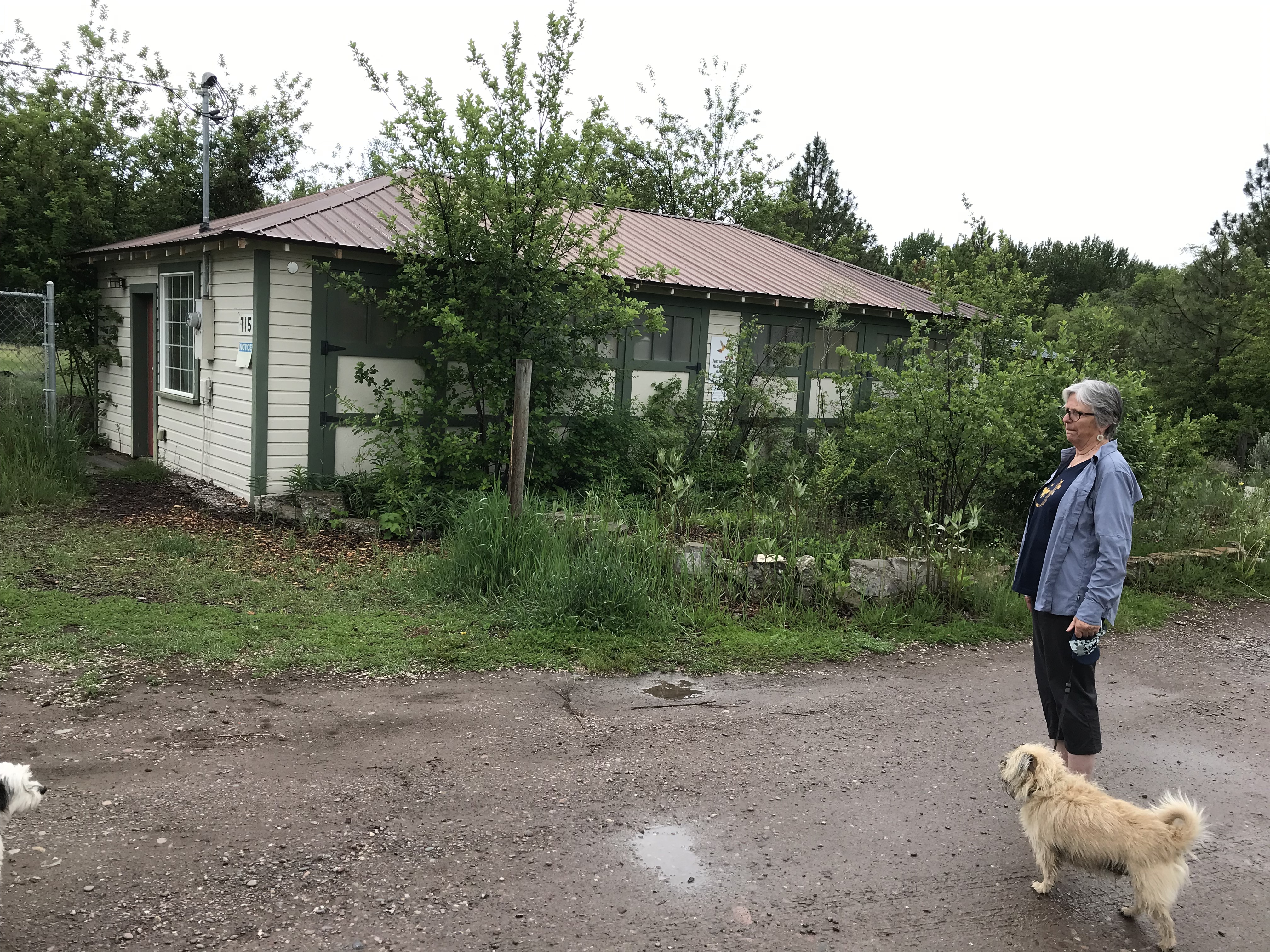
The Fiedler and Struckman families were active in further Missoula theatrical productions. As a five-year-old I had a walk-on part in “My Heart’s in the Highlands” produced by Missoula County High School.
Carol said Margaret Fiedler sometimes kept a sausage hanging from a string in her kitchen that she shared when the children begged.
Fort Missoula was a paradise for children ranging from infants to elementary school age. It had multi-story vacant buildings. Most of the buildings were there yesterday when we visited.
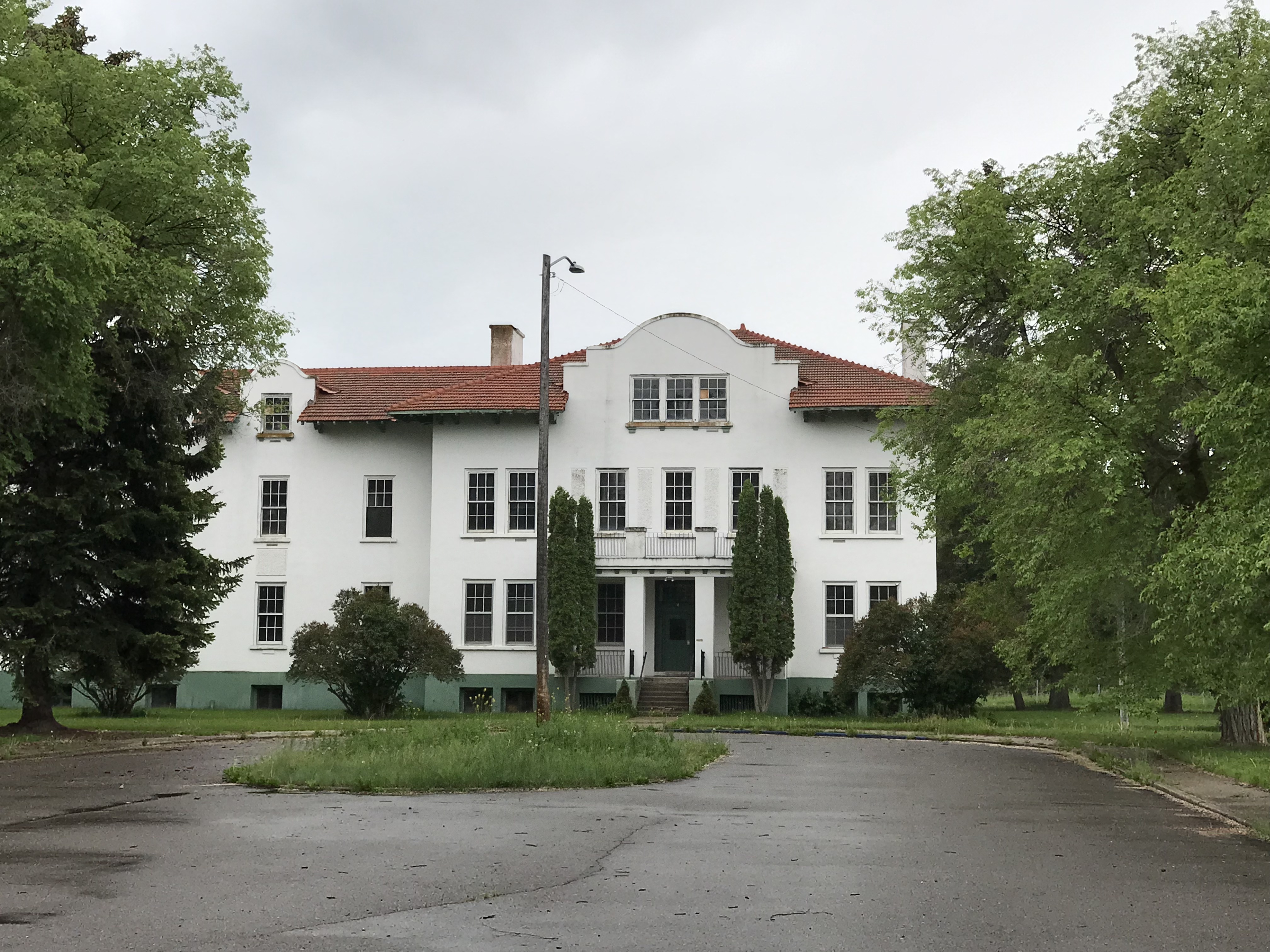
Carol Struckman and Kurt Fiedler, in grade school, were older than the others by four or five years and mostly unsupervised. They spent days entering and exploring and vandalizing buildings, including the hospital. They slid into the hospital basement through a coal chute, then found their way upstairs. She and Kurt hoped to find medical paraphernalia or corpses, but they didn’t. They systematically entered every unoccupied building except the explosive powder magazine near the Bitterroot River, although they tried and tried. They got into the abandoned internees quarters through a trapdoor from a crawl space. Again, no corpses. Below, the hospital as it appears now.
Instead, they found three mystery novels: The Mirrors of Castle Doon, and Who Hid the Key? and Who Locked the Door? When I was older I read these weathered and water-stained books that Carol kept in her bedroom. I read them more than once. The “mirrors” book was Scottish and referred to flashlights as “torches.” All three featured youthful detectives. The last two featured “Perry Pierce,” set in mysterious warehouses.
The fort’s officers club was a log building with a swimming pool of icy river water. The kids swam there, also in the river, but they weren’t supposed to.
The adults didn’t find out the kids broke into the gym by smashing a window in a door and reaching inside to unlatch the door. Once inside, they walked around on beams high above the floor.
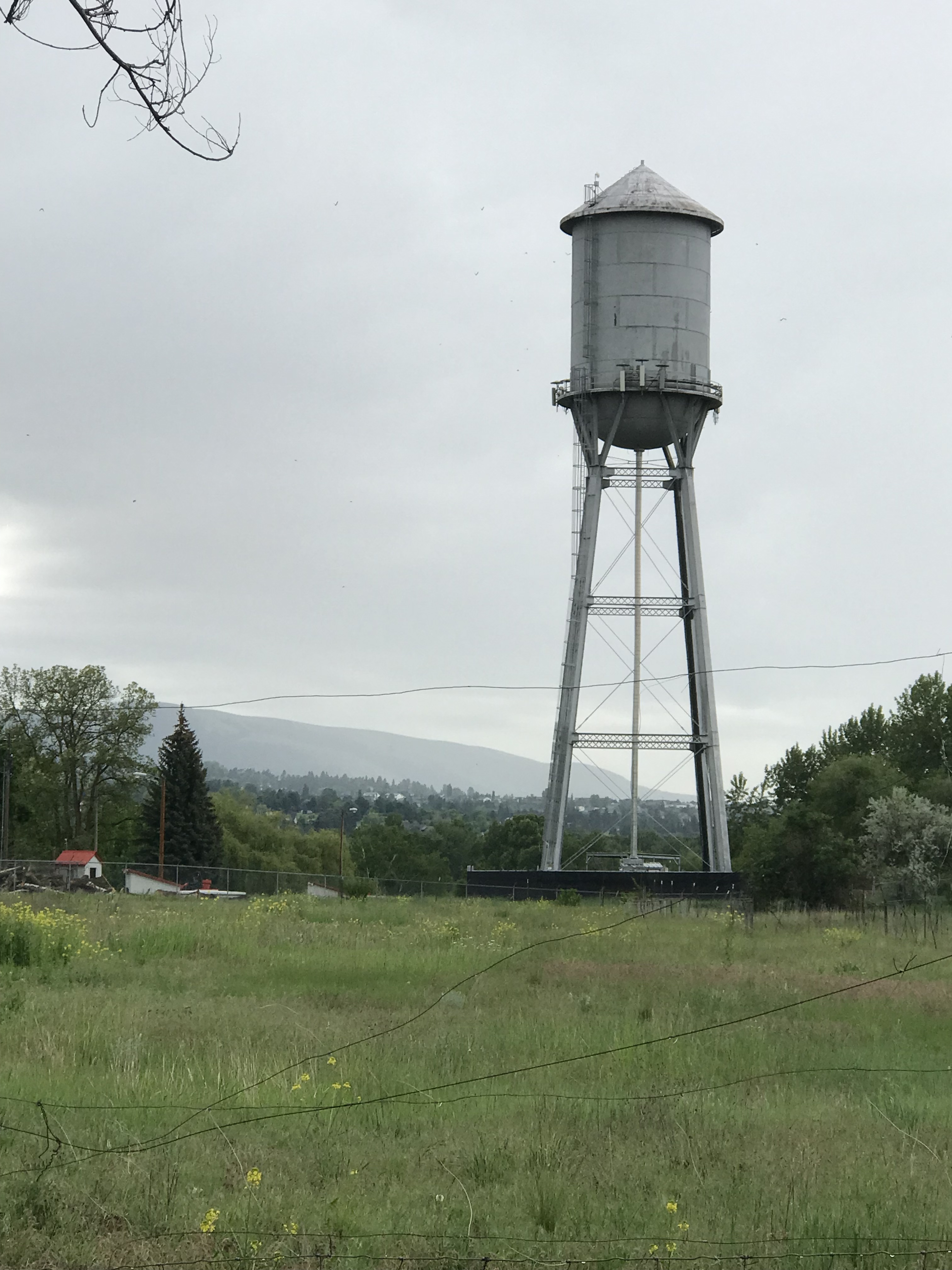
The kids climbed the fort’s water tower and the 16-foot high guard towers. Eric Fiedler fell through the floor of one tower and broke his arm. Here’s the water tower.
One day, Carol and Kurt broke windows in the hospital with rocks they threw from a parking lot. Eventually, a county commissioner came to the Struckman apartment to question our father about who caused the damage. Robert declared that Carol would never do such a thing. Carol lied and said of course she didn’t. Adults generally wanted the kids to go play somewhere.
When I came on the scene I remember Kurt had a scar on his forehead. Eric had a broken tooth. As teenagers, Eric and Tom wanted to be beatnik Bohemian types. When Kurt eventually went to medical school Margaret was angry. Said he sold out for conformity.
Leslie Fiedler insisted the children leave him alone so he could write, so he threatened to “dust their backsides.” Mike Fiedler told me his dad sometimes shouted that they should go for “vigorous outdoor play!” Carol said she once timidly knocked on Leslie’s door and in reply a foot crashed through. She said she was afraid of him. I wasn’t, though. He visited our house after our father died and he was kind to me.
Fiedler had become a famous Jewish scholar, author, and literary critic. He wrote Love and Death in the American Novel at the fort. After the war came the so-called “red scare,” and he and his children were targeted by Right Wing antisemites. My brother Tom once told me that his friend Eric Fiedler was hassled on the Higgins Avenue Bridge by toughs who threatened to throw him in the river. Leslie’s enemies made much of an essay he published, “Montana Face.”
When he left Missoula in the late 1960s Fiedler took the Samuel Clemens endowed chair at SUNY Buffalo, New York. He and Margaret had three more children: Debbie, Jennie, and Miriam.
Alfredo Cipolato, later well known in Missoula as a tenor and owner of the Broadway Market, had been one of the Italian internees at the fort during the war. The Italians called it Bella Vista. Alfredo met his wife in Missoula during the early years of World War II when he sang in the choir at St. Francis Xavier Church. According to her obituary, she said “che bella voce” when she heard his beautiful voice. Alfredo and our father were charter members of the Missoula Mendelssohn Club choir in 1950. Alfredo and I sang in the Mendelssohn Club with in the 1970s. Michael Fiedler and I sang in the club in the Spring of 1981. Our son Todd continued the Mendelssohn Club tradition in the 1990s.
Carol said the fort and surrounding country was beautiful and natural in the 1940s. The kids hiked to a nearby knoll, taking along snacks. She said the knoll had a cave. In grade school my friends and I climbed the same knoll. I remember the cave.
When I suggested it was a miracle the Struckman and Fiedler families survived their free-wheeling childhoods. She said all the kids at the fort survived, except one. A horrifying story!
Carol said she was playing with a neighbor boy named Dickie and his dog. He accidentally tossed a cylindrical tooled leather dog toy into a creek. He fell in the water trying to retrieve it. He said he was afraid his dad would be mad. Dickie couldn’t swim and sank. Carol, nine years old, ran for help, and the adults searched until they found him, but Dickie was drowned.
Climbing the water tower, swimming in the Bitterroot River, entering nearly all the buildings—none of that got them in much trouble. However, playing in the “primal ugguch” (their word for mud near the river) got them in trouble because they spoiled their clothes.
At the end of the era of adventures, I was born at Community Hospital March 28, 1949, spending my first year at the fort. Carol said the day I was born she ran to the Dugan house, the place with the only telephone, to call our father at the university to tell him to come quickly because I was about to be born. Carol said I slept in the larger of the two bedrooms upstairs in a crib with my parents and brother Tom. She said she got the other bedroom. She said I was a real live doll for her to play with. When she had bad dreams she’d put me in bed with her.
Michael Fiedler, age three, came to my first birthday party. Michael had an unusually low voice as a kid. Carol said Margaret used to put peanut butter sandwiches near the cat food dish to distract him from eating the cat food. Mike and I saw each other many times throughout my life. He died a couple years ago, my oldest friend on the planet.


 insearchofbud
Dan, nice story about faculty and kids at Fort Missoula. My folks and I also lived at the Fort at that time (1947 – when I was born).
Thanks, Douglas
I should have known! Of course that’s how our parents became such good friends. Great to hear from you!
Danny
Dan, thank you for this splendid piece on Fort Missoula! I too have many memories from that time there .