I learned this from his daughter that same day. She left a comment on Facebook.
I first became aware of SSGT Walter Brown when I watched the History Channel program reporting the government coverup of the sinking of the SS Leopoldville on Christmas Eve, 1944. Walter had a voice different from most of the soldiers who had been interviewed for this production more than 60 years later. Many seemed sad and resigned. Not Walter.
Walter said something like, “maybe it’s just me, but it seems like they could have towed the ship over to France and beached it.” I know that’s not an exact quote, but I listened to Walter (and the others) multiple times, taking notes, trying to remember their names.
Walter’s name, his person, was easy to remember. He had attitude. He was a lot like the other GIs I met in Sarasota, Florida, in 2006 when Company E of the 266th Regiment had a reunion. The old guys had the right and the freedom to express themselves with total honesty. Several confided that they were glad they didn’t have to fire their M-1 rifles much. They hated war. None of them would agree on everything, but they truly loved each other with an affection stronger than ordinary friendship. They had been to war together. Some had made an heroic leap from the SS Leopoldville to the HMS Brilliant alongside, a jump of 20 feet. Walter was in the same regiment, Company F. In 2005 the author Allan Andrade had phoned Walter to ask about my uncle. Allan always got permission before handing out phone numbers to people like me.
Walter did not remember my uncle Carl R. Bonde Jr. Not surprising, considering the immense number of men in the 66th Division. They are all heroes to me. I found most of them to be far finer than I could have imagined.
 January 10, 2013
Today Bertrand Sciboz posted on Facebook pictures of Penny and me near Cherbourg, France, when we went to sprinkle soil from Carl Bonde’s home in Kalispell into the English Channel where Carl’s troopship is laying on its side 150 feet under the surface. This was just five years ago. We couldn’t have done it without our French friend who had dived the wreck and could show us a sonic image screen that depicted when we were directly over the wreck of the SS Leopoldville.
I had gotten an email from Bertrand, so Christmas Eve 2007 I walked out onto a long stone pier jutting into the bay at Cherbourg and watched as a tiny speck–the Ceres–came into sight. Exactly two pm. The boat’s skipper was Bertrand, who tied up to a stone stairway on the side of the pier. His daughter disembarked to use the facility in the hotel at the other end of the pier. After Penny and I boarded we waited as a friend of Bertrand arrived to trade for a Christmas lobster. Bertrand’s daughter returned to the Ceres we roared out on the Channel to visit the wreck and place the soil. Carl was one of 763 who died Christmas Eve 1944, so to pay respect to them, Bertrand played a recording of a young Black woman singing the national anthem and I tossed a large wreath into the water. “Slap,” it went, and Bertrand snapped a photograph.
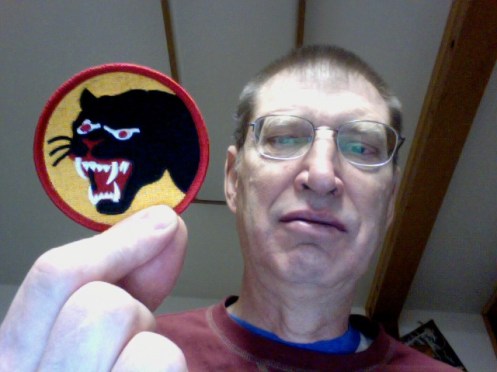
Bought two days ago in the Army Navy Store in Billings, Montana for $4.95. On the back of the patch is a slip: Made in China.
I bought a camera similar to one Brian had, an Olympus point and shoot with powerful optical and digital zoom. Penny and I had tickets to France in 2007 for Christmas. I got the camera specifically to document our pilgrimage from Montana to the watery expanse out on the English Channel as close as possible to where Carl R. Bonde Jr. died. Our aim was to dump a few ounces of Montana soil into the water over the wreckage of the SS Leopoldville, his doomed troopship. He died just 5 miles from France and his body is still there, as far as anyone knows. Some of his buddies were on deck where they could see the lights of Cherbourg when the torpedo struck.
Oh, I thought about it a lot. We both did, Penny and I. We prepared and rehearsed several years for our ritual on the Channel Christmas Eve, 2007. (Carl died Christmas Eve, 1944, about 6 pm. The exact time has been stated to be 5:55) My wife Penny and I ordered passports, of course, but we also had to get the dirt. That was Penny’s idea, putting a bit of Carl’s home into the English Channel.
Not just get it, but get it in the right way from near a house in Kalispell, Montana, Carl’s home. I think I already told about scooping up the dirt from a driveway on the edge of town. Did I mention that I tore the hell out of my fingernail? Well, I just had a torn nail. Did I tell how we were in town decorating graves and our visit to Bud’s home to get dirt was our second try? The first time no one was home to ask permission. People do this sort of thing all the time, don’t they? My impulse was to just get out of the car, get dirt, and leave. But no, I had to actually ask permission.
May was warm in 2007 when we visited Kalispell. Once we got the baggie with probably 4 ounces of dirt, gravel, pine needles and my fingernail—well I remembered to take along a plastic bag for the dirt, but it did not occur to me that I might also need a tool of some sort to gather up the soil.
The question was: how does someone transport a bag of soil to France? I had asked that question of Bud’s Army buddies at the reunion the year before. Army mortar man Maurice O’Donnell recommended putting it into a woman’s face powder container, or the like.
Instead, I practiced taking a dummy bag of dirt with me on the airplane when we flew to visit our son Todd and his family in Seattle. Well, I even took the dirt from our yard, and it was very clay-ey and even heavier. You know, a quart-sized zip-lock bag maybe one quarter filled with dirt, labeled and rolled up. I managed to get the baggie to Seattle and back: once in our checked luggage; another time as a carry on.
Turns out taking the dirt to France were no big deal at all. I just put it in my carryon suitcase. My guess is people do that sort of thing a lot.
Allan Andrade, an author and expert on the SS Leopoldville disaster, helped me connect via email with Bertrand Sciboz, a French treasure hunter. I did attempt to phone Sciboz, but got an answering message in French that sounded like French jibberish. By email, Bertrand told me to bring a thousand euros in cash for the trip. Cash, to avoid paying a value added tax. I got euros from the bank across the street from where I worked. Of course I had to order them in, pay the exchange rate, plus a percentage fee. I got five 200 euro notes, big, maybe 4 x 6 inches, colorful, and crisp. I folded them and put them in my money pouch with the passport. Later I got another couple hundred euros to pay for a wreath that I sort of got talked into getting because my Uncle’s body was among about 300 others that were not recovered from the wreckage.
With our computer, I studied maps and photographs of Cherbourg. It sits on this prominent two-lobed peninsula on the Northwest corner of France, the Normandy coast, looking a little like a snail’s head with two eyeballs. It is situated a little west of Utah and Omaha Beaches.
I learned about Cherbourg from Jacquin Sanders’ book, A Night Before Christmas. The US Army and Navy established forts and headquarters there after liberating France from the Germans. The Google Earth pictures showed the huge breakwater and the port of Cherbourg. Also, you could see the giant pier where ferries take people to England. A hotel is located near the north end of the jutting land, the Hotel Mercure. Our AAA travel agent arranged for our stay Christmas Eve and the night before. She also arranged for a round trip train ride from Paris to Cherbourg. She arranged a hotel in Paris, a place near Gare d’l’Est for the days before and after our Christmas eve expedition.
December 22, when we arrived at the Charles De Gaul Airport, were marched through customs, and herded into a small shuttle, an middle-aged drunk menaced us with his fly wide open as if welcoming us to Paris.
“Get away from him,” Penny said to me. Soon we bought tickets for the RER train into Paris, a cold, breezy place with confounding streets running in all directions. One cannot see far because the buildings are the vertical kind and set right up next to the sidewalks. Many of the streets are only 20-30 feet wide with 5-10-story buildings making dark canyons. This made the December darkness even darker. Other places had many wide boulevards converge on acres of openness with wild traffic surging constantly. Such places were difficult to cross, especially lugging and pulling luggage. Again, the wind was blowing and even with hat, gloves, and a warm jacket, the cold pinched the ears and nose.
Our trouble was that we didn’t know where to go for our hotel. Sure, we had the name and address. I had no sense of direction. I asked a lady at our station, Gare du Nord. She gave us a map of Paris with the word Printemps. We knew the address of our hotel. It was the Villa St-Martin on Rue de Recollets. Therefore, we boldly set out to find it by walking aimlessly and reading the bright blue and white street signs fastened to the buildings at every street corner. Many of the streets had military references, such as the Rue du 8 Mai 1945 and another for Dunkirk. If we were anywhere near the Rue de Recollets, we couldn’t tell. An intersection in our home town usually has two streets. One in Paris often has 3, 4, or even 7 or 8 streets. Of course, we eventually had to ask directions, so we went into a restaurant and asked a man. He didn’t speak English and didn’t know where our street was. He told us anyway, but I couldn’t understand him, so we were even. Penny and I wandered from one street to another until noon.
The second restaurateur gave us the usual indecipherable shrugs and instructions, so we wandered for another 20 minutes until we found a hotel with a man who helped us find our hotel. Just as well, too, because our hotel, the Villa St-Martin, didn’t allow anyone to check in until 2 pm. The clerk put us on the third floor. This translates to the fourth floor. In France the first floor is what we consider to be the second floor. We rode the elevator with purple lighting inside and mirrored walls. The elevator was 2 feet deep and perhaps 4 feet wide, but the mirrors made it look larger.
We were dead tired. Afternoon, Paris time, was about the same as the wee hours of the morning back in the Montana. Somehow we missed a lot of sleep, but we were determined to venture out into Paris to explore the neighborhood of our hotel. It’s just that we felt sort of—gamey or maybe just exhausted. Nonetheless, half sick, we walked about.
Our street, Rue de Recollets, was only three blocks long, quite narrow. To the East was the Canal St-Martin with several gracefully arched pedestrian bridges with wrought iron railings. Once when I crossed I was holding the rail and it had what seemed to be an infant’s poop on it. Another time a man in front of us stepped off the last step at the bottom, turned to his right, and unzipping his fly (this time) and started urinating. Peeing in public was evidently okay in Paris.
To the west of our hotel was a corner where many streets met. One could see a very old cathedral out to the left and to the right, perhaps 200 yards away was the very stately and ornate Gare Du l’Est train station. This was one of the rare places where one could see very far at all, that is, where buildings did not obstruct the view.
On the corner before the intersection, on the same block as our hotel, was our landmark: a store that sold guns, knives, ammunition, brass knuckles, switchblades, spray paint, and sported a sign that read in English, “Bomb Your City.”
I was grateful for the guns and ammo store. It served as a landmark. Funny how the landmarks were the really annoying establishments, such as the crappy tourist trap restaurant with the “American Indian” theme. I’ll bet they did not pay royalties on their “generic Indian” photographs. I bought French toast there for, like, 10 euros, and it turned out to be dry, unbuttered toasted white Wonderbread. Served by—you get the point, and I don’t want this to turn into a catalogue of bitching. You can see how grateful I am, because the “Indian” restaurant turned out to be an easily identified landmark, just like the guns and ammo store.
Paris was cold but not snowy. Likewise the shops and businesses also tended to be unheated but not so cold as to freeze your fingers. We both wanted to make the most out of the short time we would be there, so our routine would be to make quick visits to our hotel room, do our business, put on our coats, head back out. We decided to visit the Louvre.
“Ou es le Louvre?” I asked our hotel clerk, who replied in perfect English, “Why don’t you ride the Metro?”
“We want to walk, if it is not too far,” I replied. She grabbed a tourist map that said “Spring time” on it. In French, of course. She showed us the streets to walk, so we bravely marched out. I started taking photographs willy-nilly. [I wonder if I will ever find any trace of those photographs? The computer they were on was eventually stolen on a Paris train about 3 years later.]
Penny and I started walking in a roughly southward bearing through a street filled with shops of interest to Blacks and their hair. Of course, this is big business, and we were fascinated. Block after block in the gathering darkness of evening, one fancy hair place after another. We only had to walk about 8 or 9 blocks and we soon reached cross streets that would likely take us near the Louvre Museum. We hiked around in one of these, that had numerous restaurants, brightly lit, with people dining on what looked like Chinese chicken dishes, or other brightly orange-colored food. Seems to me we ate something at one of them. Then we were back. Now walking westward, then we turned the corner and went south again for a couple of blocks. No sign of the Louvre, but we did see a large greenish fancy building to the west, that looked like a palace.
At one opportunity, we saw a sign that said “Louvre” something something and an arrow pointed down some stairs or an escalator. It was not a train station, so we walked down. The day after Christmas, the place turned out to be a huge underground shopping mall, simply packed with shoppers of all races and descriptions. We turned around, found an up escalator, got back to the street. After another block, we found a cylindrical old roman style building and a sign nearby that said Louvre. Penny said that such a small building couldn’t possible be the Louvre. I said, “why would it have a sign on it that said “Louvre?”
We walked around the cylinder in about 30 seconds. Then we asked someone. The same old song: “Ou es le Louvre?” I asked. The person answered this time in French and gestured down the street. We went on and on this way in one building and out the next. Ultimately we found the Louvre. Ultimately we found out how to get out of the Louvre. Ultimately we made our way back through the Hair District and back to the Munitions shop, around the corner, back to our hotel, back to bed.
I can still hear Bill Moomey’s wife’s voice when she called her husband to the phone. I thought she sounded like someone on a farm. Friendly, relaxed. Bill’s voice was soft and gentle.
“Hello, this is Bill,” he said.
“I’m Carl Bonde’s nephew, Dan Struckman. Allan Andrade said that you would remember Carl.”
He confirmed that he did. He was a good friend with him, and I felt really happy to speak with Bill. I wanted to make the most of the precious time. Bill never referred to Carl as “Bud.”
“Bill, I have to ask you: How did you escape alive from the SS Leopoldville after it was torpedoed?”
I had read so many tales of the men from Company E, 262nd Regiment that said they escaped because they somehow began walking about the ship singing Christmas carols. I asked Bill if that were true.
“Wait a minute,” Bill said. “It was different. Before I tell you that I want to say that I have wanted to get ahold of someone from Carl’s family for years.” Bill said he even wrote to the postmaster in Kalispell to locate anyone named Bonde, but he had no success.
“That’s because Carl was the only boy in his family. His sisters all married. His dad died in 1957 or 1958 and his mother moved to Missoula to live with us,” I said. “No other Bondes lived in Kalispell.”
“Carl was special to me,” Bill said. “We trained together for a long time, and he had a great sense of humor. He and I were in the same machine gun section. In fact, Carl was my ammo bearer. When someone asked Carl where he was from he would launch into a lengthy description of Kalispell like you’d hear from the Chamber of Commerce. Also Carl was one of the guys who always had a bridge hand in his back pocket. Whenever we were on maneuvers and took a break, Carl would pull out his bridge hand and he and three friends would resume their game.”
I could hear my Uncle’s voice in my head. “How in the world did you get off the Leopoldville alive, Bill?” I would have used the word “hell” but I didn’t want to offend this old gentleman.
“I’ll tell you. I was down in our compartment with everyone else in our group when a couple of guys near me started to vomit. The meal we had just finished was – well – slop. The Channel was rough and the ship was rocking. Well, my friends know that I never did get seasick and I didn’t want that to be the first time, so I went up to the open deck for fresh air. I met up with others from our weapons platoon. We found a place that was protected from the wind and that’s when the torpedo hit. We made our way to the rail and eventually most of us jumped to a destroyer that pulled alongside. It was about a 20-foot jump. I made it and I thank God. My faith in God has been strong ever since.”
Bill said that he and his buddies from Company E sometimes held reunions. He also invited me to visit him in Kearney Nebraska sometime. I told him I wanted to visit him soon.
I told my sister Carol about Bill and she wanted to go. I drove to pick her up about a week later.
Bill and his wife Doris greeted us like we were family. Bill took a look at me and said, “Nope!” Then he looked at my sister Carol and he said, “Yep. Carl was more your height.” Doris fed us like we were farm hands with pot roast, mashed potatoes, vegetables, fresh bread, iced tea, lemon squares for dessert, and coffee. I had a couple helpings of everything because this was back in 2005 when I could still pack it away. I did not take a second helping of lemon squares and Doris acted very disappointed, perhaps even hurt. She tossed the pan onto the counter and said, “all right, then.”
Doris quickly took Carol shopping in Kearney. Bill took me down to his basement to show me his WW II shrine. He had his ribbons and badges and a bookcase full of information about all of that. He had binders full of information. I had brought along some photographs of Bud, some in formation with a unit. Bill did not recognize anyone other than Sergeant “Junior” Weaver who posed with Bud. They looked kind of drunk, I thought, but I didn’t say so.
Bill had me watch the History Channel Video about the SS Leopoldville. He said he disagreed with a statement by one of the soldiers who said he pushed some crewmembers over the side of the ship. Otherwise, he said it was pretty accurate. That’s when he and I started to cry. Not just a little, either. We both broke down and wept. Then we composed ourselves.
Bill gave me lots of materials and told me information that I also have transcribed and will include in this book. I remember that he told me about a gay sailor he encountered on the USS George Washington when the 66th Division was en route to England in November of 1944.
I asked Bill what he thought about Ray Roberts and his books about the SS Leopoldville. I asked Bill twice and he did not reply either time.
At last Carol and Doris had returned. They brought back a gift for Penny, my wife: a bowl made from the horn of some sort of African beast.
We posed for pictures and Carol and I returned to Mitchell, a town near Scotts Bluff.
Bill and I kept in touch by email and the following October the Company E buddies scheduled a reunion in Sarasota Florida. I flew down to stay at the same motel as the others and we were to stay four days.
I had just registered at the motel and I hopped into the rental car to park it when I saw Bill and Doris walking. I jammed the car into park and jumped out and ran over to them to greet them. They were really glad to see me. I parked the car. I walked into this small, noisy room. It echoed, the iron patio furniture scraped noisily on the concrete floor. The talking stopped. I knew I had to talk fast. There were about a dozen older men and women present. I had not even thought much about what I would say, but I did the best I could, letting them know that Carl Bonde was my Uncle and I had been looking for him my whole life.
Bill Moomey came to my aid: “Don’t you remember Carl? He was the one who used to give a fancy description of where he was from that sounded like the chamber of commerce.
Then a tall, gangly, man stood up. I found out later that he was Hank Anderson, a mortar man from the weapons platoon.
“Oh, I remember Carl,” he said.

The house on the hill with long garage. When I was 12 I fell into icy Ashley Creek, crawled out of the water onto a bridge, then slogged up this hill to my mother and her sisters. They hadn’t realized I had been playing near the creek.
April 9, 2012
Vis-a-vis my PFC Carl Bonde book, I liked Timequakes by Kurt Vonnegut, Jr. I liked his notion that history is like a distant mountain range. You can see all of the times from afar and even visit different times forward and backward, as though selecting and climbing one of the mountains in the range. My problem is that I am writing a biography and simultaneously writing about my own efforts to uncover the facts of Uncle Bud’s life. I know why I am writing a story that I would love to read myself. I am telling good news.
The good news is that although the iron doors of history seemed to have closed forever, sealing up my Uncle Bud—lost at sea so long ago—they were not airtight. Turns out that the facts are much more powerful than years, distance, even death.
During the same time I was pushing into the sea of information on the Internet, unseen others were pushing toward me. For example, my uncle Bud’s Army friend Bill Moomey had, for many years, wanted to reach someone from his late friend’s family. My eventual phone call to him in 2005 was a fulfillment of lasting desire.
262nd Regiment
66th Black Panther
US Army Division
Sarasota, Florida November 2-5, 2006
[I made notes at the reunion onto a yellow paper pad; I copied them verbatim with notations and with subsequent corrections by William Moomey, added July 29, 2010.]
Nov. 2, 2006, Sarasota, Florida: I met veteran survivors of Company E, 262nd Regiment, 66th Division (Panthers), US Army. This was Carl R. Bonde, Jr’s [Bud’s company, so these people were his intimates during the last year of his life! Bud was in the machine gun section within the weapons platoon of Company E. [NB: They did not refer to their company as “easy company” (As in Band of Brothers, by Stephen Ambrose.)]
*Hank Anderson was a buck sergeant in the mortar squad, a Leopoldille survivor, and said he remembers Bud. Hank’s wife is Mary Esther.
*Al Salata played baseball for the Army and he was the mortar section sergeant [and the oldest of the group. He died about 2 years later. He was a Leopoldville survivor]. Bill Moomey was there with Doris, his wife. Wally Merza was there with his wife, Martha. They live in Chicago. Bob Carroll and his wife, Colleen, set up the reunion. Portly gentleman [Maurice O’Donnell] drove from Flint, Michigan, to Sarasota. Southern gentleman [Randall Bradham] came from South Carolina. He wrote a book about this unit. He went to army basic training in Missouri. They call him Randy.
The women seem to know the histories verbalized by the soldiers of Company E, 66th Div., every bit as well as the men. Mary Esther, particularly, knows the details of Hank Anderson’s stories as well as or better than he does. I would guess Hank is a minister, retired. He wore his old Army uniform jacket when we went to the Bone Fish restaurant that first evening. He and Mary Esther shared a glass of pink wine. Several of the men were non drinkers, and one or two had a whiskey or similar strong drink. When we returned I went to a nearby grocery, bought a phone card, some cough syrup, and a bottle of Barefoot Merlot. Oh yes, and a cork screw.
Maurice O’Donnell The Great Generation Tom Brokaw. Flags Lt Donald MackWilliams, Lt. Good, from West Point. Allan Andrade – Detective, New York writer.
11/4/2006 6 am, Sarasota, Florida.
Yesterday morning I slept in till 8:40 am. (The night before I had watched TV — Boxing, mostly. I watched a guy named Gonzales from Boise (Caldwell, actually) beat a guy from the midwest. Both Hispanics. 3 knockdowns. Both very tough fighters. So — Friday at 0900 we gathered at the meeting room. This room was little. The motel is being painted and the big room is closed. Therefore, the gave us an itty bitty room with very small tables ~ 24″ across and noisy metal patio chairs that scrape on concrete floor. A guy named Roger, also a military veteran, runs the place. He has a little shrine with war mementos and relics. A letter signed by Colin Powell. Roger is not part of the group, kind of like me, in a way, but still interacts.
The group is very civil and polite, with the mildest of humorous jabs, one with the other. Great conversation. I feel I know these guys better, now.
Briefly, we ate the continental breakfast, although the coffee was gone by 9 and there were just a few pastries.
I ended up speaking with Maurice O’Donnell and Bill Moomey and Randy. Bill had brought a photo album and I got a little acquainted with the story of a member of their company, Cuny, a Sioux from South Dakota, still living, who could not make the reunion. Mary Esther seemed to know Cuny, as she seemed to know many of the absent ones, and fondly.
These guys have been back to France several times. When the war ended each man was assigned duty, mostly involving taking care of POWS, Germans in various parts of France.
Al Salata played 2nd Base in a division baseball team.
Hank Anderson, a tall man (wears size 16 shoe) was in the Elite Constabulary and they were supposed to impress the German civilians. Hank said his uniform was well padded about the upper body to make him look bigger and stronger. The idea was that the Elite C. would convince the Germans that they had lost to a superior army.
Bob Carroll took eight of us to lunch — the 5 women went shopping and to an Estee Lauder party. This was evidently in preparation for the supper club party hosted by Wally Merza and his wife Martha. I’m better at the men’s names now. They are Henry Anderson, presbyterian minister, Maurice O’Donnell, fireman, Bill Moomey, farmer; Randy Bradham, cardiovascular surgeon and blueberry farmer and writer, Al Salata occupation? from New York, Walter Merza, wholesale carpet salesman; Bob Carroll, and me. Women: Al’s wife Mary, Bob’s wife Colleen, Mary Esther, Martha, and Doris Moomey. Of the men, three were survivors of the Leopoldville. Bill, Hank, and Al. Al climbed down a net on the side of the sinking ship to safety. [The other two jumped to the deck of a ship that pulled up alongside.] Hank said jumping to the other ship was the single bravest thing he ever did, although not the best thing. Hank was a squad leader for mortars and he felt it was his duty to set the example for his men. Bill Moomey said the distance from the Leopoldville to the deck of the Brilliant was 20 feet. When Hank jumped, he was not even sure it was the right thing to do or if it was possible to jump without serious injury or death. Remember that some of the men had been told by loudspeaker that the ship was in no danger of sinking. In fact it was sinking and would eventually take hundreds of men to their deaths.
All the veteran 66’ers have trouble getting into and out of cars.
We spoke of many things from ipods and cell phones to WW II war stories. Lots of war stories. The veterans who shot mortars were deaf and had big serious hearing aids. The machine gunners did not suffer from hearing impairments. Three of the men had to have coronary artery bypass surgeries, although when I asked the group about the surgeries, Hank Anderson raised his hand along with Maurice, Bob and Bill. Turns out Hank was deaf and thought I was asking to find out who wanted some ice cream.
Walter and Martha Merza. Wally and his wife live 6 months in Sarasota, 6 months in Chicago in a condominium both places. He was a sergeant in Company E, 262nd Regiment. Martha is ill with myasthenia gravis, but at the reunion she seemed totally well.
Wally looks fit, maybe a little overweight, or maybe not. Hard to tell. He is certainly not a couch potato. I think I overheard him say that he and Martha visit the Y every day for exercise.
He had been a wholesale carpet salesman, so he had charisma. In other words, you just wanted to hang around with him and listen to him talk, tell him stories, because Wally loved to hear stories too. Naturally I told the guys my experiences of my 7 years in the Marines. They were interested in my military stories about delivering newspapers, getting into trouble with the officers, fixing volkswagens, having children, going overseas.
Wally bought an antique Lionell electric train set “O” Gauge (stands for “original”) for Martha from a relative of his for $800. He showed me the locomotive, still in its original box. It was beautiful green and black and quite heavy and large. Perhaps 14″ long unless you include the coal tender, and then it would be 24″ long.
He had a squad member in his machine gun unit, Jimmy Roselli, who went on to become a professional singer. Wally said Jimmy sounded like Tony Bennett or Frank Sinatra, only Wally said Jimmy had a greater vocal range than either of the others. Wally had a book about Roselli, Titled He made the Wise Guys Cry. Because his singing could do that to the mobsters. Wally said the book was going to be made into a movie, starring John Travolta, but Travolta wanted to sing, and Roselli disagreed with that, so the project never went forward.
Wally had had a computer, but it was bought used, and it froze up the first time he turned it on. He figures he broke it and is still looking for a new replacement when he figures out the best kind to buy.
Wally and Martha (a professional dancer and stage producer) bought us a prime rib supper at a Sarasota night club. Then they took us to their Sarasota condo afterward. What a great pair.
Randy Bradford, the smallest physically of the group, is a retired cardiovascular surgeon. He got his medical degree from the University of Michigan after the war. During the war he was a machine gunner and rifleman. When embarking from Southampton, he was in the part that got separated from the other Company E men and went across the channel on the HMS Cheshire. So did Maurice O’Donnell, Wally Merza, and Bob Carroll. Randy said he heard the explosion on the Leopoldville and even saw the torpedo trail on the water. Maurice said after the explosions the men of the Cheshire went to general quarters and he was stationed on the far side of his ship and could not see the Leo.
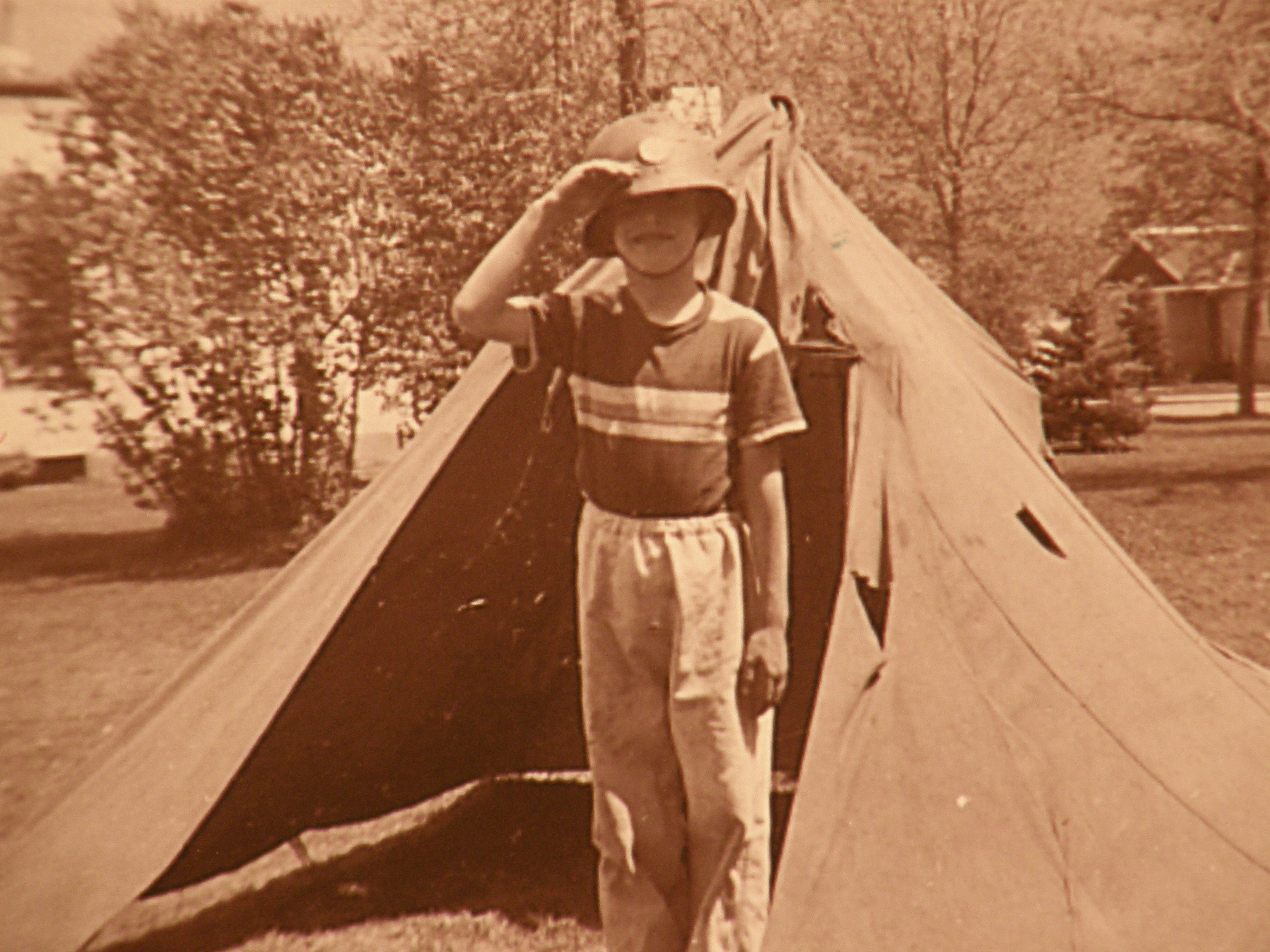
The background has Mount Sentinel. My brother Tom Struckman and I thought dressing up like soldiers was pretty neat. Tom probably took this photograph of me at our house. He had been eight months old Christmas eve, 1944, when Bud was killed.


 insearchofbud