The Volkswagen, or “Hitler’s Revenge,” plays a large part in the story of my late uncle, Carl Ralph Bonde, and me.
As you know, my uncle Bud was killed by a Nazi U-boat torpedo Christmas Eve, 1944.
This was a Christmas present from the Fuhrer, himself, via his Uberleutenant, Gerhard Meyer, and crew of U-486, a type VIIc submarine lurking on the bottom of the shallow English Channel just outside the port of Cherbourg, France. I spoke to my uncle’s army buddies who lived to tell about how their troopship, the SS Leopoldville, was sunk. They and I shared about 4 days together in 2006. All but two of them are now dead. Like that.
I ended up enlisting in 1969 in the Marines during Vietnam because I feared being drafted and killed like my uncle.
In the Marines I was a piss poor soldier because I was there for the wrong reasons. I was afraid of the Marines. I told my commanding officer I hated the Marines in Memphis, so he suggested that I should hit him. So I did, and went to jail. On the third day I…wait, Easter isn’t until tomorrow.
I was eventually exonerated for the crime of punching my officer. The Marines sent me to Southern California to get married to my beautiful Montana wife and raise three absolutely wonderful children. They grew more wonderful with each grandchild they made. After that they have grown even more wonderful to this moment.
Also, when I got to Southern California, I was a private in the Marine Corps as a supply man in a helicopter squadron. There, oddly, I learned to repair volkswagens. In fact, when I wasn’t delivering newspapers, I repaired volkswagens and ran. I ran for the thrill of running long distances. I did have to spend about $10 on a pair of Onitsuga Tiger shoes but I could barely afford them!
My supply officer at the helicopter squadron was a warrant officer, CWO2 John Robertson. He bought old VWs, fixed them up and sold them. He taught me to do the same. He also smoked cigars, drank beer, but when he saw me talking to a chaplain, he looked at me, rolled his eyes at the chaplain, then rolled them back at me.
I believe the Gunner thought I was “feisty.” (I wasn’t.) John had helped get the Corsairs flying in the Marines during WW II. I believe he liked me for my notoriety in Memphis, but he wouldn’t let me talk about it.
The punch line: I eventually, in 2002, 03, or -04 took my daughter and her husband, a US former Navy Officer, to supper with Mr. Robertson and his wife at a restaurant in Southern California. He remembered when he helped me name our oldest son, Todd. He wanted to name him Clifford. “I meant to say, Todd,” he said.
Gunner said the best VW bug made was the 1966 1300cc. The alloy was good, he said. I bought a red one, eventually selling it to my brother’s ex-wife Dana. Someone ran into her car, denting a fender. Dana gave them her insurance information, then away they went, never to be heard from again. Like that.
I bought a blue and white 1967 VW van up the Bitterroot a short way. It was a good one and I rebuilt an engine, a 1500cc, for it. We used it to go camping. I was trying to get it working and Todd noted that it had a piece of gravel in the flywheel. That was my first inkling that Todd was actually brilliant, although I admit to patronizing him. He and I confided a lot. I sold the ’67 to a crazy red haired woman who had a daughter. She called me every time it broke down. I tried to explain to her that every volkswagen breaks down at every opportunity so she just needs to fix it.
Later I bought a blue-green volks bug up on Farviews for $65 that I rebuilt the engine for. Unfortunately the machinist gave me the wrong size crankshaft bearings. The car ran, but it sounded like the low notes on a pipe organ. The hippie woman who bought it from me told me later that she simply replaced the bearings with the right size and it ran perfectly after that. That particular hippie got herself a job on a US Forest Service lookout tower near Missoula with her daughter and identified pentstemon. Funny how those memories stick.
April 3, 2015
She was a beautiful woman, long black hair like Joan Baez, walk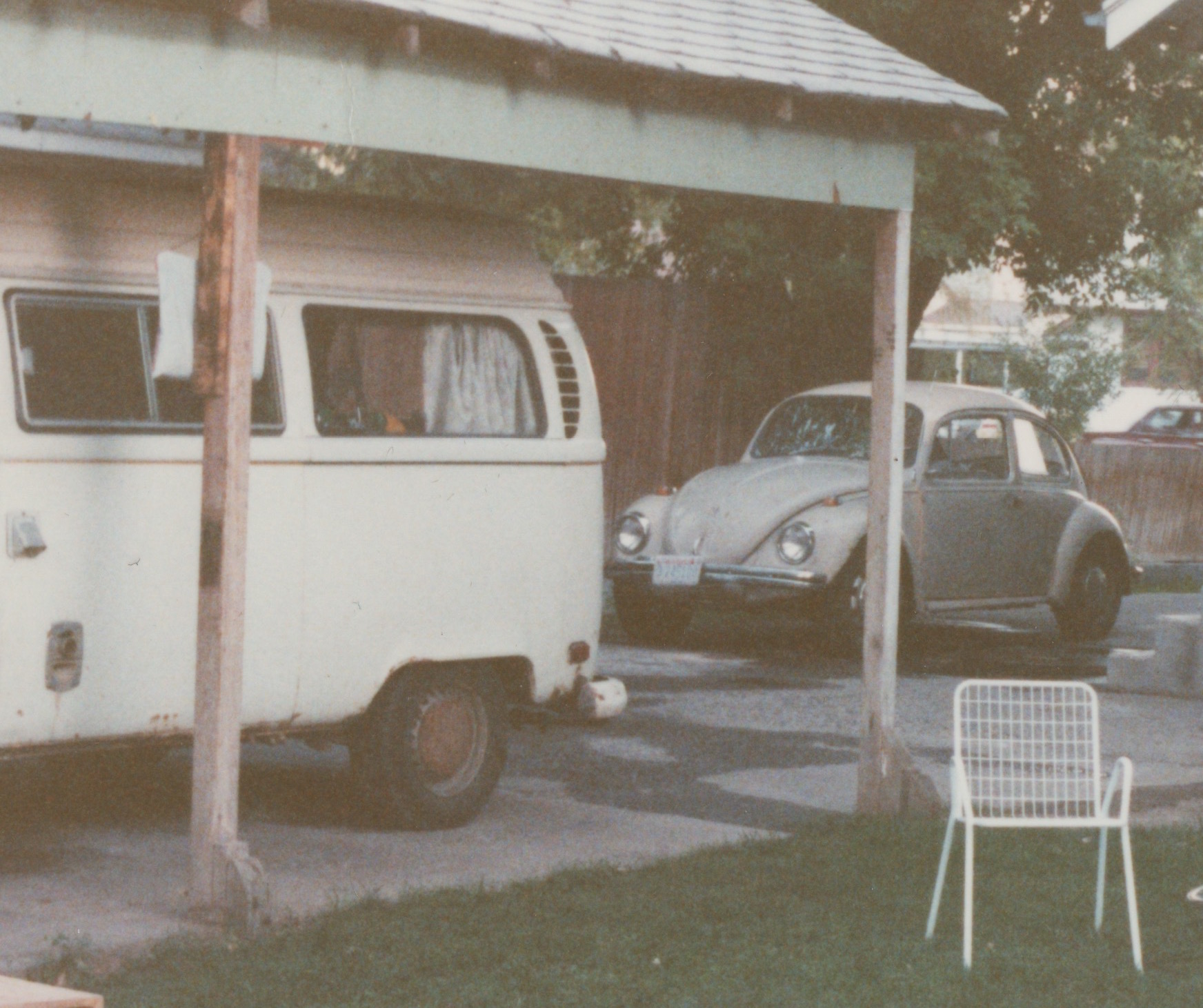
The first time I saw P. she was with Dana Graham. P. was this beautiful woman with straight long black hair walking into Peter Koch’s house through the kitchen. Both were obviously hip 20-year-olds. Somehow I remember they were in town from Billings or maybe Great Falls. Tom was playing drum on the back of his Gibson. I was sitting on Peter’s bed jamming on an old arch top I got from Bill Reynolds in Seattle. Peter was playing guitar, chanting. Nowadays, that would be called rapping. P. said, “Sounds like some good music in here!” or perhaps words to that effect. Made me feel pretty glad they had strolled in. She soon rolled me a cigaret from a Zig Zag and some sort of tobacco that came in a round tin, maybe Balkan Sobranie. I was pretty full of myself. We did sound good. It was blues. We played into the night.
Life was looking good because my brother Tom and I had just gotten jobs with the Northern Pacific on a steel gang. My friend John Herman quit after one day. Our friend Peter was happy because we were moving out of his tiny house. Jerry Printz was happy because we were going to be working with him. David Puveur and his wife were happy because they could pay rent with his decent check. They had a VW camper van and would soon be living in a place of their own.
Everyone crashed at Peter’s house that night. At least I think they did. Tom and I had been living in the back bedroom of Peter’s house, a room completely lined with books, floor to ceiling. One small section of wall had a map of Paris where Peter had lived when he was 20 and had a letter of credit from a wealthy relative that allowed him to live like a bum in those days. Dana slept back there with us, but I don’t know where anyone else stayed. We went horseback riding the next day after someone fixed us some eggs.
We went in David and his wife’s camper van. On the way through Missoula to Mount Jumbo, where we could rent horses, I remember riding in the back with P. That was when she and I looked into each others’ eyes. I thought something special was happening, but I didn’t know for sure. Actually, something special was happening.
After we had spent a week working for the Northern Pacific Tom and his girlfriend Christine rented a house on Missoula’s north side, near the roundhouse. They invited P. and me to stay there too. Actually we had no other place to go. By then we were for all intents and purposes, a pair.
My problem was that I was so afraid of going to Vietnam that thoughts of it kept me awake at night. I felt that the stones in the railroad track bed were somehow speaking to me about death. I was so afraid.
I was proud to walk around town with P. We visited the Double Front Cafe. We visited lots of other soup kitchens on Higgins Avenue. Once this guy in a greasy apron responded to my request for “a light” by grabbing this huge foot-tall cigaret lighter and ceremoniously flicking it for me. He had only one thing on his menu, a soup.
Jerry, David, Tom and I were all railroad men, earning really good money. I don’t know how much. I used to just hand the whole bundle of cash to P. and ask her to pay the bills and buy groceries. Made me proud. For my part, I made a collection of oddball railroad spikes: some had 2 points, some 2 heads. Like that.
Ultimately I voiced the unthinkable: I needed to join the military service to face my greatest fear. I remember P. reacted by saying she felt lost and alone. I felt that I likely would not return, so I needed to make myself as unsavory as possible. Made me crazy.
The customs agent let us into Canada with no hassle, hippie van, my beard notwithstanding. I worried that a smart-ass teenager would say—anything about anything—but nobody did. We drove north through Canada, stopping for oil more than for gas until, like I said, the 1200 cc engine made a racket complete with stinky hot smoke and loose fan belt. Rain. Todd slept in the borrow pit and in the morning he and I hiked out from under the overpass to look around.
Walking toward a fence, he picked up an oval Canadian license plate from Northwest Territories Province sporting an image of a polar bear. In the distance, perhaps 500 meters away, we made out a sign. I thought it said, “Husky.” “Look,” I said to Todd, “Husky! Gas station!”
It said “Nisku” instead. “Nisku Inn.” A hotel. We walked in past an idling airport shuttle. The lady at the desk said the shuttle was leaving, like, now, so Todd and I got on. At the airport we rented a car. First one in my life!
Ten minutes later we pulled up triumphantly to our family and our 1964 crappy piece of junk. The VW van was stopped fairly close to the bottom of the on ramp, so T and I just backed up once we got to the freeway. We had noticed a parking lot across the highway from the hotel, and got permission from the owner to tow and “park” our VW van there for a few days.
Long story short, we bought a rebuilt motor in Edmonton. Well, it wasn’t a complete engine. We had to take off all of the tin, the intake and exhaust manifolds, and the oil cooler from the blown-up engine. Also spark plugs, flywheel, clutch, and fan pulley. I did that in the parking lot on the gravel. We all slept in the van each night. We bought food in Edmonton at a huge store where clerks roller skated up the aisles.
The kids walked over to the Nisku each morning to swim in the hotel pool.
In two days I had the engine back in the van, everything loaded up, we bid farewell to our friends at the parking lot, and P. followed me to the airport to return the rental.
On the way into the airport P. honked at me and flashed her lights. I stopped. Beneath the engine: a spreading pool of oil.
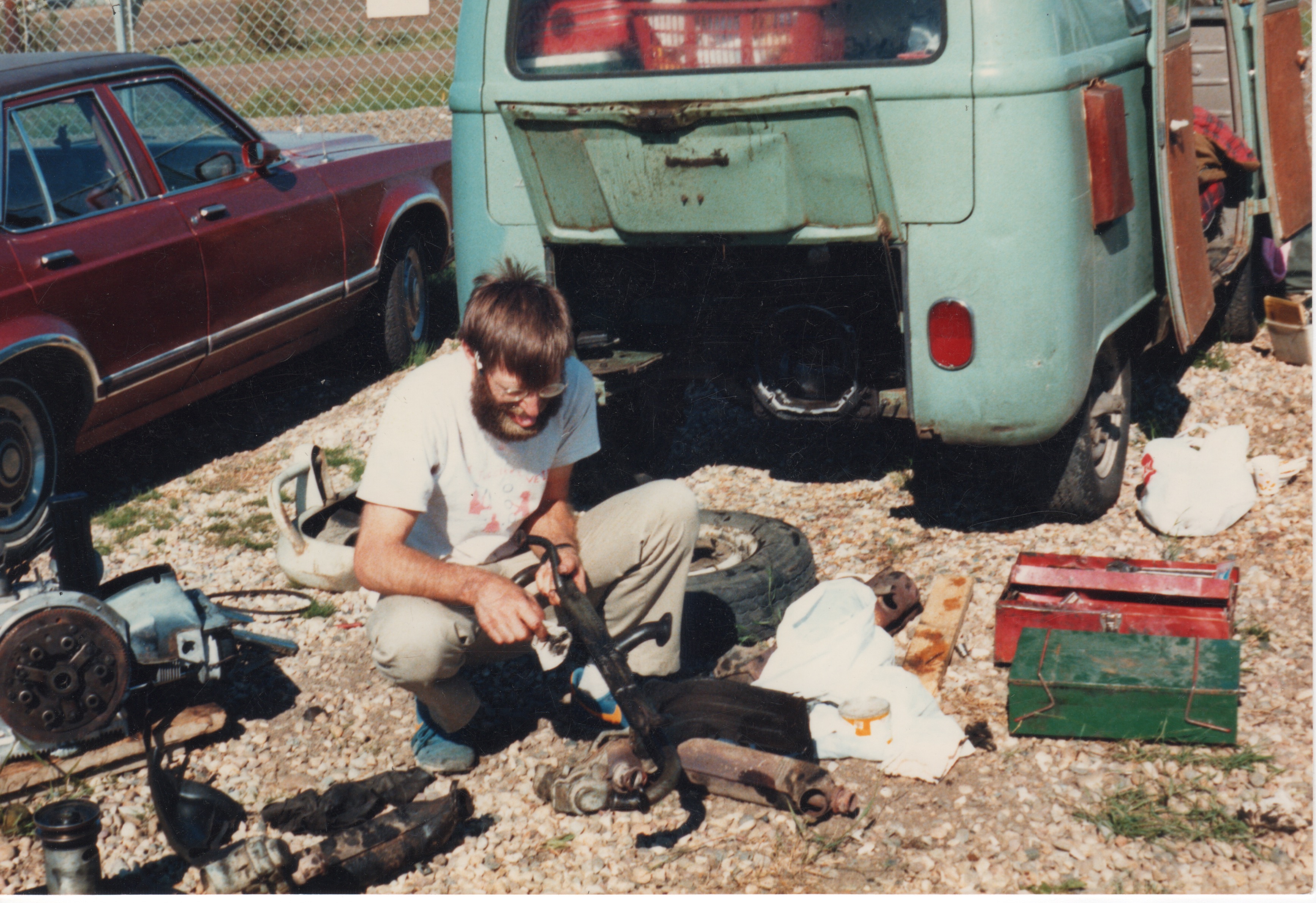
P. photographed me repairing the engine of the 1964 VW van as we attempted to reach Alaska.
At one point in the summer of 1969 I returned to Missoula, Montana, from Seattle on a freight train to unexpectedly find a real job with a Northern Pacific Railroad steel gang. In those days, before railroads were able to grind worn rails with a special machine the size of a diesel train engine, worn rails had to be removed and replaced by a group of men under the supervision of a very tough boss. Our boss’s name was Jim Wiedehoe. My brother called him “the Weeda.” Other laborers worked on “tie gangs,” but not us.
We steel gang folks called ourselves Gandy dancers, a traditional name. There were 2 kinds of workers on our crew. Spoiled white liberal arts major college students like John Herman, my brother and 5 or 6 friends, and me; and grimy old railroad guys, whom we adored and treated with much deference. Us laborers operated hand tools. The old guys operated power tools and drove the machines.
Here’s where the traditional “Gandy dancer” came from, we were told. Our hand tools, like spike malls, heel claws, wrenches and a 3- or 4-foot bar with numerous notches. (This last looked like a big glass cutter or can opener that could engage the side of a rail numerous ways to lever it over, rolling it.) We were told that the tools had been originally made by the Gandy Tool Company of Chicago.
When I got offered the job my friend John Herman had just returned to Missoula from Seattle with wages he earned on a crabbing boat while it was in port. Our other friends, like Larry Felton and Skip Reising, had shipped out to Alaska for the season.
John spent all of his money to rent an apartment near the University of Montana and bought a 1920s-era rusty panel truck that barely ran.
Getting a job on the railroad was almost too good to be true! After filling out the necessary N.P. paperwork, he and I set out on a Thursday afternoon to catch up with the railroad section crew about 80 miles up the river, in the Little Blackfoot Valley, at Avon. The panel truck quit running numerous times.
We got to Avon about 10 hours later, broke. I found my brother Tom and his friends who also had no money for us. He showed us an outfit car, that looked like a freight car, only it had windows and a floor for workers like us to live in. It had a couple of beds without mattresses, just springs. Luckily John and I had sleeping bags. We had no food. There was a store in Avon, but it was closed after about 6. Tom gave us some breakfast cereal, but he had no milk. Did I mention that we had no money?
John Herman and I were pretty hungry by Friday evening, when one of Tom’s friends gave us a ride back to Missoula. When John got his panel truck back to Missoula a week later he parked it in a residential neighborhood, removed the license plates, and we

John Herman and Skip Reising play guitar on a porch in Seattle in 1969. Bill Yenne photographed them when they had time off from working on the crabbing boat.
 Our teens were obviously out of control in the 80s. One stole real estate signs. Another played Dungeons & Dragons. The oldest got arrested by a police officer in the middle of the night for swimming in a private pool. He and a friend trespassed by walking atop the tallest building in Montana.
Therefore it seemed logical, reasonable, to drive to Alaska in our 1964 VW van. Hell, we had 2 credit cards and several cans of motor oil. Anything seemed better to me than for our children to get gunned down in a bad drug deal or fall off a building. Or swim in a private swimming pool.
I doubt if we spent more than 12 hours getting ready. The kids’ schools were out for the summer and I had time off from work–like 3 weeks–because I worked nights in the hospital pharmacy, so I only had to take off for one stint. Or else I had quit my job by that time. I really hated working nights.
Our daughter had a notebook to keep track of the roadkill she could see through the back window. The whole back of the van was one continuous bed with 2 spare tires on the roof, and boxes of supplies and tools under the bed.
The roadkill: she had two columns: G and DG with tick marks for tally. Whether the gophers were alive.
My sister lived in Anchorage with a couple of her kids who expected us in a week or so.
We added oil to the engine near Great Falls. Then perhaps 50 miles north of that. Then we needed more oil and I was almost out of oil. While someone else drove I calculated how many cases of oil we’d need to buy to keep us going to Alaska, an unknown distance, but a long way.
About midnight the oil light lit up and the engine made a desperate sound so I pulled over in the rain under an overpass 20 km from Edmonton. I checked the fan belt back there and it was loose. “Chunk chunk” obviously the main crankshaft bearing had failed. Any other VW owner of my era would have been able to diagnose the problem the same way, using the good book: John Muir’s, “How to Keep Your Volkswagen Alive a manual of step-by-step procedures for the compleat idiot.”
Our oldest took his sleeping bag to the borrow pit and the rest of us crawled in the back of the van for some sleep.
 P. wished me happy birthday at 0320 today. We up and drove to the Pictograph State Park, hiked on up that canyon to the right. No poison ivy yet. Surprised to be blocked by the sprawling trunk and branches of a massive mature ponderosa that had broken about 10 feet above the base. (Lightning? Strong wind?)
Morning weather clear, we drove Highway 212 toward Busby, then South past the Kirby Saloon to Rosebud Creek Battlefield State Park. The battle started June 17, 1876, when soldiers stopped for coffee by the creek and the Cheyenne and Sioux attacked. The Cheyenne still call it the battle when the sister saved her brother. The young warrior’s horse had been shot out from under him. His sister rode her horse under heavy fire and picked him up.
That day one Cheyenne and three US soldiers died during a battle that lasted about 6 hours. General Crook’s army was beaten and unable to help General Custer at the Little Bighorn.
On the way back to Billings the strong wind raised a brown-out dust storm. Well, visibility was poor for a few minutes. A semi had emergency flashers. Paper coffee cups sailed across the road. Apparently this was the first wind strong enough to launch them. At the Yellowstone Fairgrounds cottonwood leaves plastered a chain link fence almost to the top. This was surprising because the solid pattern of leaves blocked the afternoon light.
I don’t know where my nephew Jon Angel found this declassified report. It does no justice to the nearly 800 Americans killed December 24, 1944.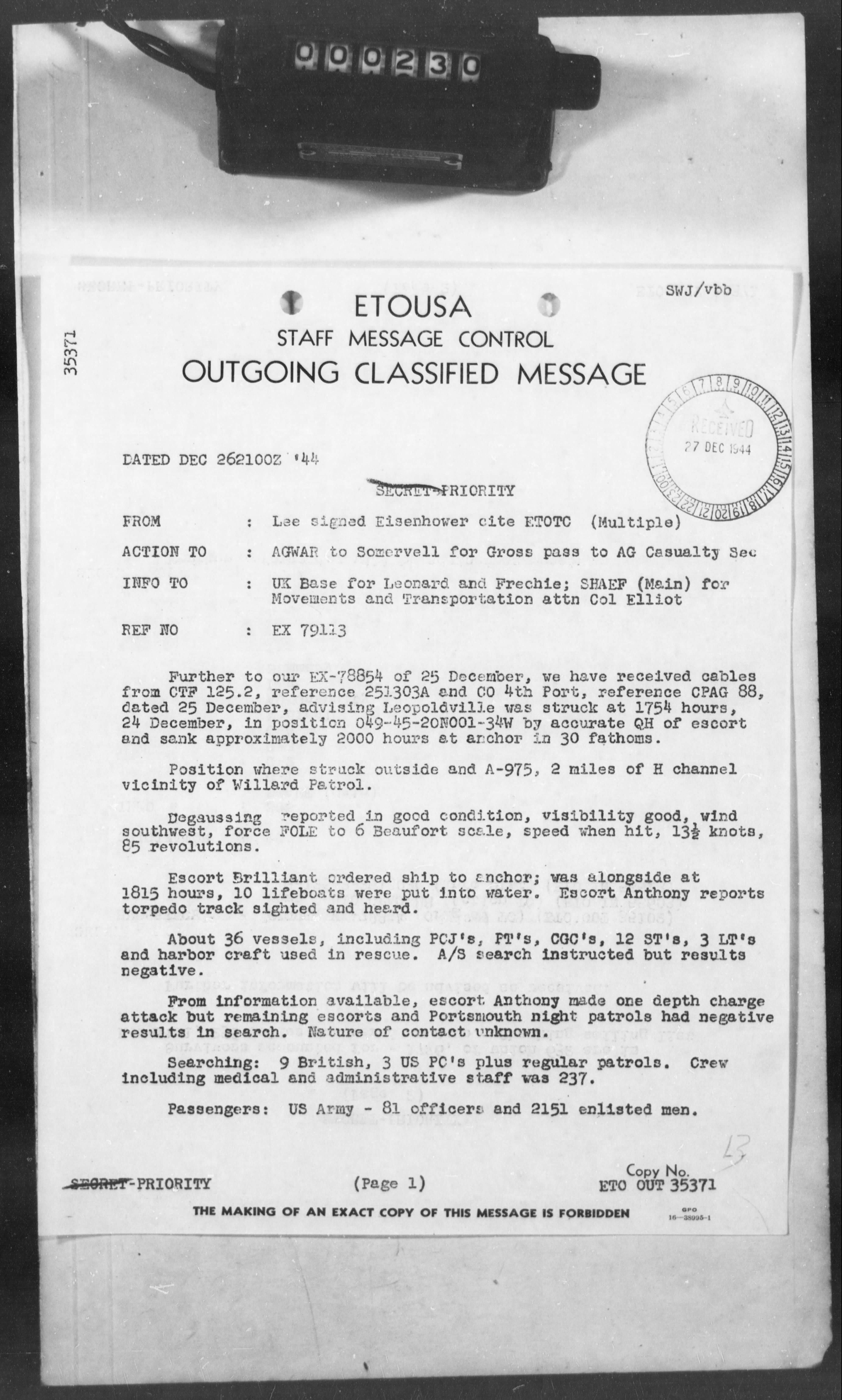
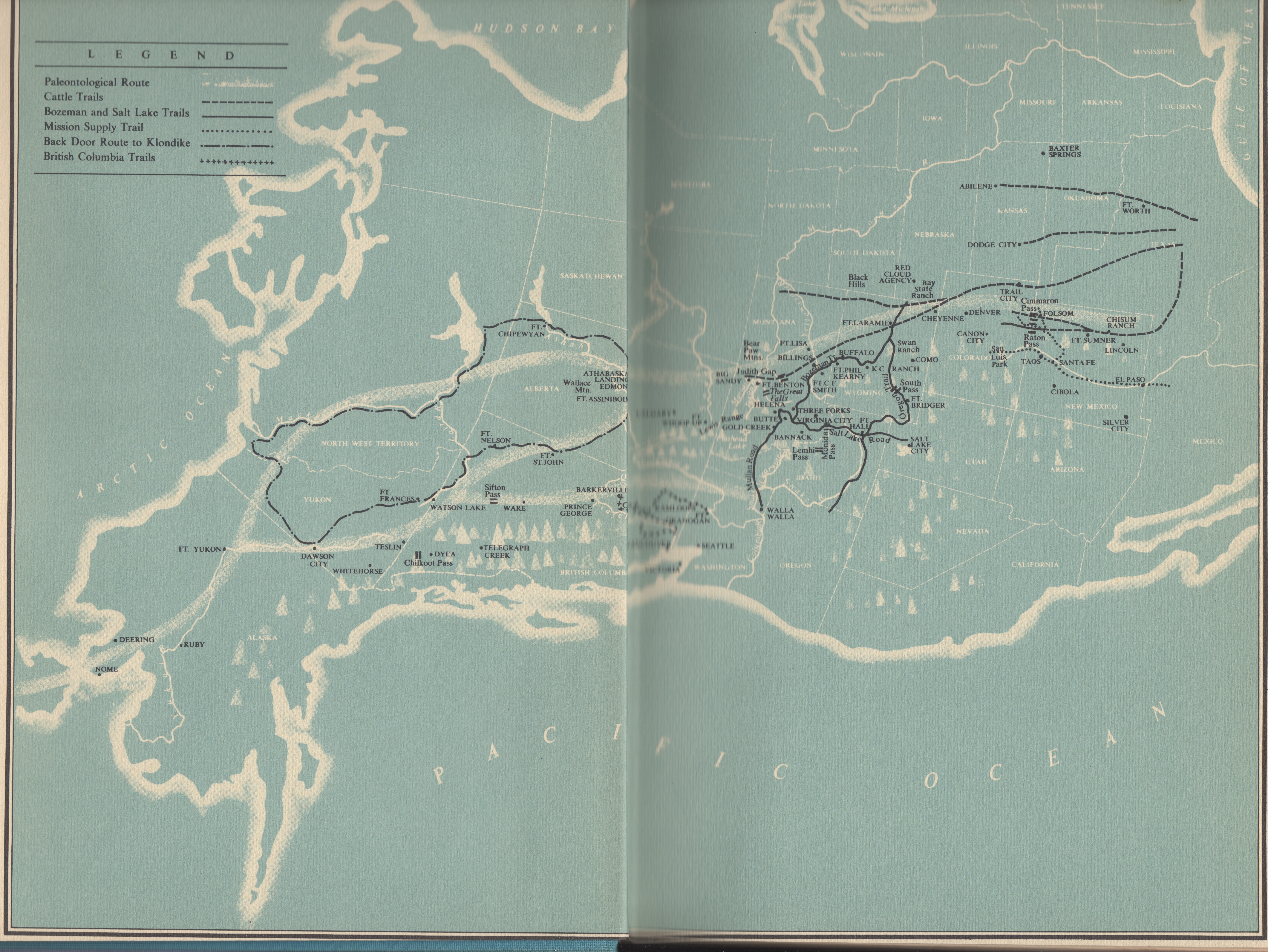
Interesting orientation for this map. Alaskan peninsula is at lower left.
Dan Cushman’s scholarly work, edited by A.B. Guthrie, Jr. , was published by McGraw-Hill in 1966. Good to know that Mr. Cushman, of the town of Big Sandy in Montana, for reasons other than his novel–then Broadway Musical, then movie–“Stay Away, Joe.” I said scholarly because it is indexed and 374 pages long, and the publisher made the textbooks I grew up with.
Monday P. took me to Fairmont resort to a conference for her job. I was forced by my inertia to nap and read for an entire day on a couch upstairs from the lobby. On my way back to the couch after I refilled my coffee I met a man in the hallway with a long gray beard. Oh, maybe 8 or 9 inches from the chin, so I said to him, “Nice beard!” I got the inevitable response, “So is yours!” Then, “Thanks!” and “Getting good!”
Whatever, I thought. In spite of that, I enjoy expressing admiration for large beards.
Turns out this bearded fellow was a presenter at P.’s conference. He was introduced as a marshal from the Department of Justice, who, according to P., had about a $ half-million worth of illicit drugs in his briefcase. Meth, weed, that sort of thing. He used the drugs for show and tell at the conference of, mostly, social workers. P. said she left the conference just before a bunch were headed outdoors to light up some marijuana. Just for demo purposes, she said.
I had been re-reading “Adrian Mole and the Weapons of Mass Destruction” by Sue Townsend. Whenever life gives me any sadness or worry I like to read any of David Sedaris’ newer books. If I can’t find one, I reach for Kurt Vonnegut, Jr., or Sue Townsend. One of these comfort reads always gets me by.

Below I have copied and pasted the decision by the United States Court of Military Appeals that exonerated me from slapping my commanding officer in 1970 while a private in the Marine Corps. Slapping might just be too strong a word. I was so afraid! Perhaps he didn’t even feel my hand upon his face. I remember that he did not appear to have shaved very recently, probably many hours before. He was much shorter than I, certainly chubbier, an officer! A major. My most vivid thought was of my imagination: the countless enlisted, many black, who would have given anything to have had the opportunity to do what this major was asking me to do!
UNITED STATES, Appellee v DANIEL R. STRUCKMAN, Private, U.S. Marine Corps, Appellant
No. 23,837
United States Court of Military Appeals
20 U.S.C.M.A. 493; 1971 CMA LEXIS 688; 43 C.M.R. 333
April 9, 1971
PRIOR HISTORY: [**1] On petition of the accused below. NCM 70-2836, not reported below. Reversed.
COUNSEL: Lieutenant Kenneth N. Beth, JAGC, USNR, was on the pleadings for Appellant, Accused.
Commander Michael F. Fasanaro, Jr., JAGC, USN, was on the pleadings for Appellee, United States.
Opinion of the Court
PER CURIAM:
As a result of rejecting proposed nonjudicial punishment for a sevenday unauthorized absence, the accused was called to the squadron office to confer with the commanding officer. The conference ended when the accused struck the commander in the face. The incident led to a charge against the accused of assault upon a superior commissioned officer in the execution of his office, in violation of Article 90, Uniform Code of Military Justice, 10 USC § 890.
The case was tried before a military judge sitting without court members. After he convicted and sentenced the accused for the assault and the unauthorized absence, he recommended clemency because of the “extremely aggravating circumstances” to which the accused had been subjected. Our reading of the record of trial convinces us there was more than aggravation meriting clemency.
Since the accused [**2] appeared to be smiling “with his face” when he entered the office, the commander asked him “what’s so funny goofy”? The accused reported in a “military manner.” Thereafter, he remained in the position of attention for a time while the commander examined his service record book. At one point, the accused asked permission to speak, but the commander told him he could “speak when I tell you to.” When that time came, the commander advised the accused of his rights under Article 31, Code, supra, 10 USC § 831, and proceeded to question him about his civilian background and his attitude toward the Marine Corps. In the course of questioning, he charged the accused with not being a man, and asserted he was a coward with about a two-foot “streak of yellow” down his back. Finally, he asked the accused to tell him “what . . . [he] would like.” The accused answered that he would “like to see the Marine Corps flat on its back with its heels in the air.” The commander regarded the comment as “an affront,” and he admitted that it made him “mad.”
According to a Government witness, the commander “arose hurriedly,” went around his desk at a “faster than normal walk,” approached the accused, and [**3] said “he represented . . . [the] Marine Corps, let’s see you put me on my back.” The accused testified that he understood the statement “as a challenge from one man to another and if I was sincere in what I said, I should hit him.” Consequently, he turned from his position of attention and struck the commander. Immediately, the squadron first sergeant was “on” the accused and thrust him against the wall. Just then another officer entered the office, and the commander [***335] [*495] directed the first sergeant “to call Security.”
To us, the evidence portrays a situation in which the commander, by words and action, abandoned his position and his rank. In consequence, the accused’s response to the words and conduct “did not, as a matter of law, detract from the authority and the person” of the commander, as a commander or as a commissioned officer. United States v Noriega, 7 USCMA 196, 198, 21 CMR 322 (1956). The findings of guilty, therefore, are not sustainable as a violation of Article 90, Code, supra.
The decision of the United States Navy Court of Military Review is reversed. The nature of the remaining offense and expiration of the period of confinement that was [**4] imposed make it inappropriate to continue the proceedings. United States v Evans, 18 USCMA 3, 39 CMR 3 (1968). We, therefore, set aside the findings of guilty and the sentence and order the charges dismissed.


 insearchofbud