
First, Wikipedia said “George” Ohsawa (note spelling of first name) died of a heart attack, not stomach cancer, as was commonly supposed. Scene: 1968, August, probably, an apartment on Missoula’s northside. Brick. Same one Larry Felton rented at some point when he worked for Northern Produce wheeling potatoes around a warehouse. John’s friend wasn’t the least bit friendly to me. Seemed sort of arrogant about his expensive Martin guitar that he played open tuned with a brass slide. First time I ever saw one of those. I was between girlfriends. My electric Gibson was at my brother’s.
I think I had just gotten back to town by freight train from somewhere west. It was always Seattle or somewhere in the summer of ’68. John’s friend kicked us out of his apartment. Hennessy, a couple years older than us, whom I regarded as a “real hippie,” could see that I had recently taken some sort of psychedelic drug, so he invited us to go camping by the river. John and I went. I must have had my eyes closed because the wheels seemed to rub in the fender wells and a Cream’s “Disraeli Gears” 8-track tape was making fantastic colors in my brain as it blasted full volume.
Neither John nor I had any sleeping bags, so we searched the area along the Clark Fork for bits of wood to put on the campfire as the Cream’s music echoed through my consciousness.
In the morning Hennessey and Captain Bummer wondered how we survived. Bummer said someone had recently drowned there diving for a sandal. A short distance away was a Hudson car with an immense woman sleeping in it. Her name was Mary and was famous for sleeping in a tent at the University of Montana Oval to protest the heavy dorm regulations that applied only to women students. Mary was famous! And friendly! I noticed that she had a “Macrobiotic Diet” cookbook and a copy of “Walden” spilling out of a box of books. She was an authentic hippie like Hennessee and both said they ate Macrobiotic food in accordance with Georges Ohsawa. Note the spelling of his first name with the final “s.”
Here is what Wikipedia said about Mr. Ohsawa:
Later he travelled to Europe, particularly Paris, France where he started to spread his philosophy (it is in this period he supposedly adopted his new pen name “Ohsawa”, after the French “oh, ça va” which means “all right” or “I’m doing fine” as a reply to the question “how are you doing ?”). After several years he returned to Japan to start a foundation, and gather recruits for his now formalized philosophy.
My brother Tom and the other elder hippies agreed that eating brown rice was good, but none was as fanatical about the diet as I. As far as I could tell one should eat only short grain unpolished whole brown rice. In the 1966 edition of “Zen Cookery” that I found in a junk store, that P. almost wouldn’t let me bring into the house, the term “organic” does not appear.
On my own, with the firm belief that Zen Macrobiotic Cooking was the way to peace of mind and goodness, afraid of Vietnam, living nowhere, really, I decided to seek my fortune in Seattle. My friend John Herman was not persuaded by my theories regarding food. I had some hang-ups because all my girlfriends up to that point were unable to fix me anything that didn’t make me vomit. I’m talking rice and beans, undercooked. Poorly cooked. One succeeded with a can of cream of mushroom soup, but she gave me the boot when she sensed my worthlessness. This sense I didn’t share with her.
Ultimately I caught a ride to Seattle with a friend who had a VW bug that 5 or 6 of us crammed into. I stayed at my friend Bill Reynold’s, on his couch. He and his wife ultimately urged me to find my own place, which I did, just 2 doors away, in the University District of the University of Washington in Seattle. I still remember the zip code. You know how Missoula’s was 59801? The one in Seattle was 95801. Or not. I made that up.
Once in my own place, which was the front room of a bungalow that had a bed and a chest of drawers, I needed $40/month for rent. Tom loaned me the money because he and Bill and Mary all worked. The men worked for the parks department and Mary worked in a bookstore closer to the university. Not the famous Id bookstore close to hippie hill, but one on University Avenue a block or two away.
My plan was to sell the hippie newspaper, “The Helix” at 10 cents profit per. Came out once a week, I think. Man, I had a hard time selling them. I got about 30 cents for an hour’s work. I needed to buy brown rice for my Macrobiotic Diet. I had some of that at my place.
On my way to get a supply of the “Helix,” I walked near a sandwich shop that sold forbidden meat, forbidden tomatoes, forbidden potatoes, lots of mayonnaise, the works. I blushed with guilt as I ate up all of my profits.

John Herman and I had recently learned how to smoke cigarets in Missoula in 1967.
I wasn’t homeless in Missoula in the winter of ’67, but my fake hippie university student friends and I had no place to socialize during the freezing winter evenings. At least none that suited us. The Dean of Women, in particular, kept a tight grip on us freshmen. Women directly, of course, but that meant we men were also hobbled. None of us were old enough to go in bars. We didn’t want to go in bars! We wanted to be together, and we were–during meals! The student union building was always locked after meals were over. We wanted a place to go evenings. We required ourselves to be freely together indoors. We were not allowed to live anywhere but in the dorms. I wrote a letter to the editor complaining of the intolerable conditions!!
Oh, we could have watched TV in the dorms with the other men or we could have gone to one of those off-campus religious places with organized activities, such as sitting around in a circle. We had had enough of that. It wasn’t cool. We were into more, uh, Eastern religious experiences. You know, like George Harrison. We were against the war! I was afraid of the war!
Cool in Missoula in 1967 was the “Basement Coffee House,” open to hippie men and women, fake or real, every evening in the University Congregational Church, about 3 blocks from the campus. In those days my friends and I could go there with no fear of being hasseled by religious zealots, and the entrance to the coffee house was in the back of the church, through the playground.
In 1978 I published a magazine, “The Portable Wall.” One of our group of counter-culture types, Jonna Rhein, wrote me a letter with a reminiscence:
Hello All,
Reading over the last “Portable Wall” I found my interest leaning toward the letters, hearing about Larry, Theresa, Kim, Brenda–etc., etc., my eyes closed, candles lit about the room and I found myself in the cellar of a church on University Avenue. A bit of a glazed look to my eyes–drinking apple cider, hot & spiced, sitting around–it being so dark one can hardly see–listening to a young college fella and his guitar. I just flashed on the classic story of John Herman, titled, “Job at the Gas Station”: those were the days when the large red bouncing balls with handles were fashionable–John’s first day on the job–this gas station had a special on those big bouncing balls–John was told to go into the storeroom and practice bouncing–on the balls–to sell them. John was found two hours later in the storeroom with his head in his hands, moaning, “I can’t do it, I can’t do it.”
We went to the Downstairs Coffee House as often as we could. There was music, great-looking chicks who, for a quarter, served up coffee, hot chocolate or cider; it had lots of room and homemade tables from wooden cable spools with checkered tablecloths and like she said, dark except for a chianti bottle with a candle.

Zumba gave me self confidence to dance the tango with a señorita in Salta, Argentina
April 15, 2015
Zumba lesson tonight at 6:30! Last night at rehearsal I spoke to a fellow singer, a tenor. Our chorale practiced at Lincoln Center auditorium, on the other side of the wall from where P. and I had gone to Zumba for years.
He said he went to a Zumba dance lesson once, but quit because he felt uncomfortable being the only man in the class. I told him we’d gone to Zumba for well over a year and I was usually the only man. He suggested that I was secure in my masculinity. Actually, I doubt if anyone really is. But this is not a confession.
My friend Ron said other men might just be jealous of being in a room — a gym, really — with so many women. I wondered aloud what my marine drill instructor would say if he could see me at Zumba.
Ron, a pulmonologist, said the DI might well have died of emphysema or lung cancer by now, or even old age because of being older than I am. I said I was not wanting to think about them further.
April 12, 2015
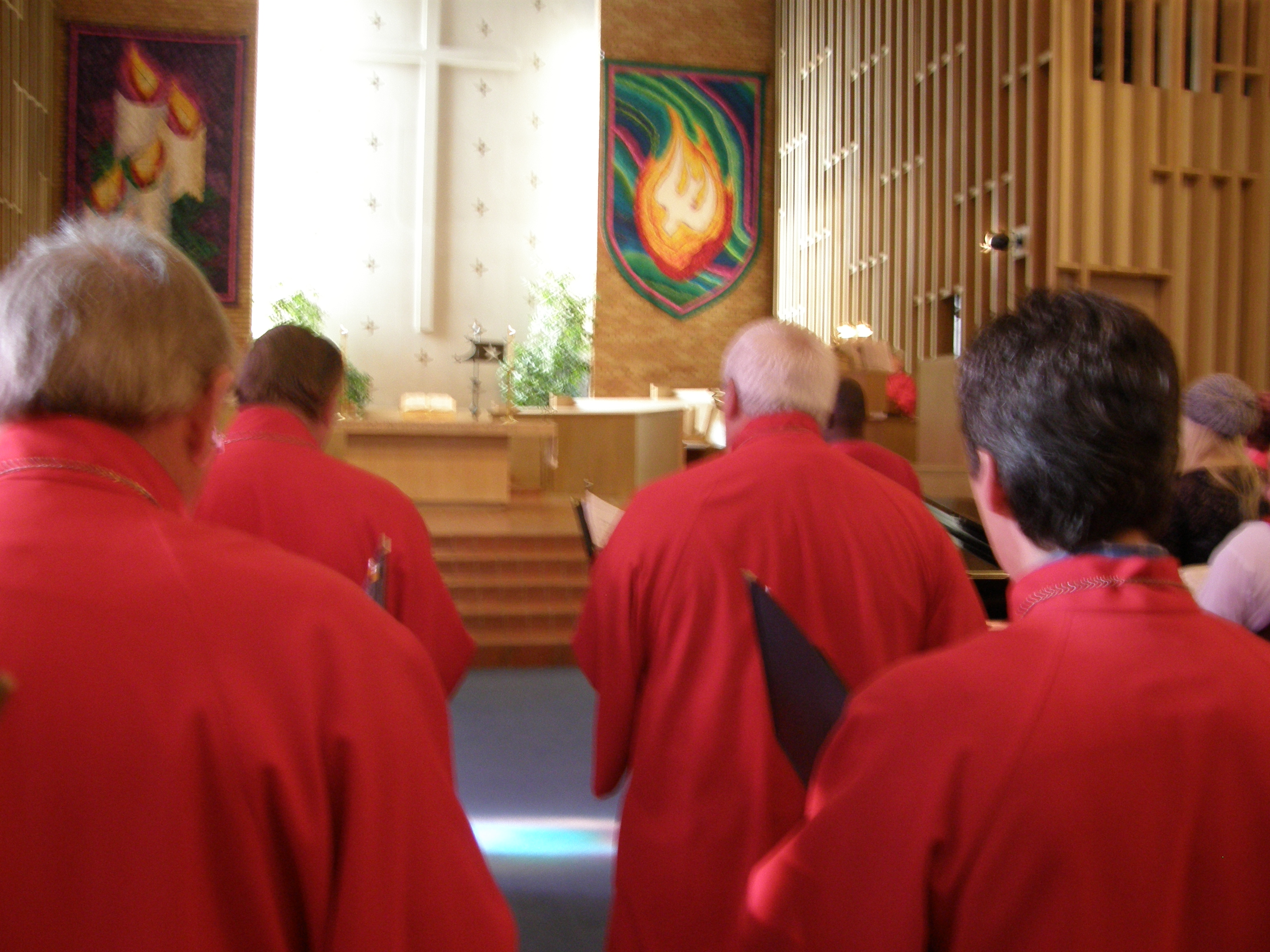
The bright sunshine through the window surprised me. That and I had about 5 minutes to get to church. I had wanted to be on time to make up for missing choir practice Wednesday. Laura ended up asking me how Zumba went. I confessed that I had not gone. Instead, I helped watch Becky’s son.
Prior to the service I had asked the minister, “Father, may I make an impassioned plea during announcements?”
He looked at me with suspicion, I thought.
“About the homeless program.”
He relaxed slightly and nodded.
He opened brightly with his usual greeting and very quickly asked for announcements. I stepped on my choir robe as I strode up the side aisle to the front. Two or perhaps three others were ahead of me to announce a film and discussion, an admonition to sign the attendance registry, and to join the hand bell choir. When my turn came I handled the mic carefully, noting that the mute button had a green light. That means it is live, I thought.
My pulse raced. The church was by no means packed. Off to the right was a pair of 20-something men with nerdy glasses and military high-and-tights holding hands the way a couple would. Otherwise, the church had just a scattering of people to invite to the appreciation dinner on Tuesday—the dinner I had no intention of attending even if I had not already had a conflict that night. But I did.
I started off by stating the facts: the who, where, what, why, when and how. In no particular order. Then the story of how I had gotten coerced into making the announcement and why if I had said I had gotten coerced, I would regret it for years to come, so I had to withdraw the part about being coerced.
I thought I was losing my mind.
“Do you want to go to an appreciation dinner?” I asked. Of course there was no answer. I answered for them. “No.” I felt like I was warming up to the task. I continued.
“No one wants to go to an appreciation dinner. The people in our church like to volunteer as hosts for the homeless, but they don’t like going to volunteer appreciation dinners. I wouldn’t consider going to one myself, either,” I said.
“But here’s the thing. The program just has 2 or 3 paid people and everyone else is a volunteer. There wouldn’t be a homeless program if there were no volunteers. Therefore, the directors need to show their appreciation for volunteers. That’s why you people need to go to the dinner on Tuesday evening so that they can show their appreciation for you. All are welcome, even if you are just thinking of being a volunteer.”
It seemed plausible, though absurd, to employ such twisted logic. I think I can safely say nobody in the room will go to the dinner on Tuesday. I should have asked for a show of hands. Let’s see. Of those who would not be attending.

P. and I. visited the Four Dances area, taken care of by the U.S. Department of the Interior Bureau of Land Management. Apparently, there was a Chief Four Dances, of the Crow Tribe, for whom the area was named. There is no Indian stuff at Four Dances, but it is a natural area with snakes and other wildlife. I saw a caterpillar and lots of grasshoppers. We met a woman who walked a pair of unleashed dogs and a portly man who went to the area apparently to speak on his cell phone. P. calls them “mobiles.”
I had my GPS to test. In fact, the reason I am up at 3 a.m. writing this is because the damn thing has an alarm that went off. I am having trouble understanding how it works. Next time we visit a foreign city, like Paris, I want to take the GPS. If you have been to a place like Paris or Washington DC you will know why I want a device. Sure, cell phones have an app to be downloaded. I don’t have a fancy phone and I bought the GPS for, like, $200.
Four Dances is just across the Yellowstone River from Billings. Close. You head out of town toward Lockwood, then veer off to the right as though to Pictograph Caves. There is a sign and a short gravel road and a parking area. Then you walk a trail, not too steep, up a hill until the trail offers an access to the river to the right or the peregrine falcon nesting areas straight ahead. You’re not allowed too close to the nests, but you get an expansive view. P. and I opted for the river, a long downhill walk that gets steep the last third before it winds up on the flood flats about 100 yards wide to the water’s edge. We saw a pair of Canada geese and distant ducks. The water was low. There are no dams upriver so the level fluctuates with the melting snow and rainfall.
The walk back uphill was excruciating, but as good a workout as an hour at the Y. I was soaked with sweat and it was about 70 degrees with only a light intermittent breeze. Because we had been good we stopped at the Big Dipper for ice cream on the way home. I had chocolate with orange and chocolate chips; P. had — I cannot remember, except it was light-colored and she didn’t offer me any.
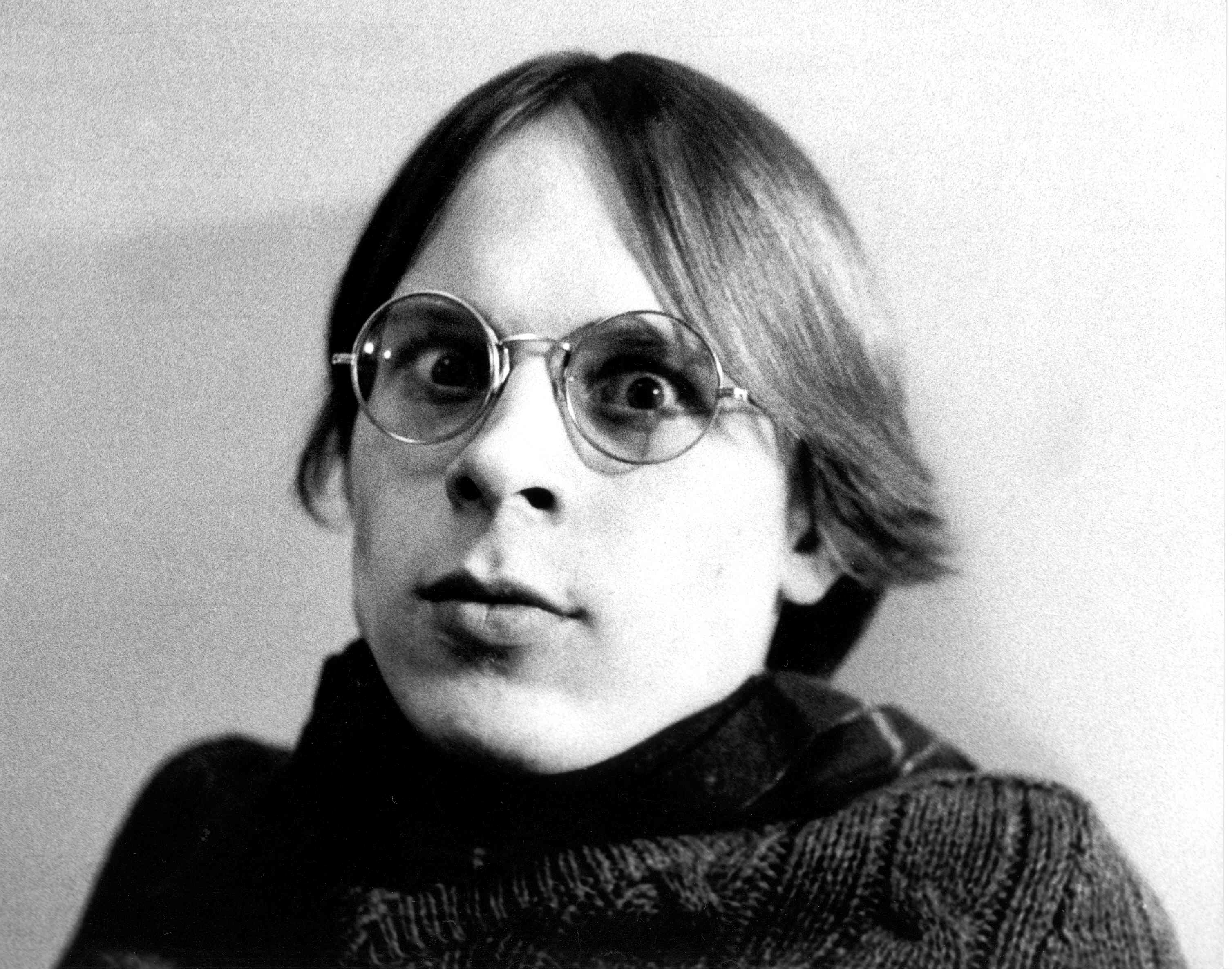
John-John, as Kim Thompson called him, was one of the original cafeteria hippies in 1967. He was a year older than the rest of us because he worked for “a bread factory” with his sister in Boston. John was an artist. A graphic artist, I mean. He took drawing at the University of Montana. Once he even promised he would graduate in 1972. “How about you?” he asked. “Sure,” I replied. Then we shook.
I’m giving myself 5 more minutes to tell about John Herman. He rolled his own cigarets. He always had to roll just one more when he and Larry Felton were roomies at Elrod Hall. He was paranoid. He was paranoid about being paranoid. He knew how to bargain for a bag of weed.
He drove us to a Northern Pacific railroad job in Avon, Montana, in this piece of crap rust bucket of a panel truck that someone swindled him for.
He often commented on women. Complimentary, always. He often told me I was full of shit.
When I showed up one quarter at the university with an electric Gibson John Herman, Gordon Simard, and I were lured in to play in a rock group we called, “Water.” Our detractors called us “heavy water,” but they were being sarcastic. However, we were pretty good. We had a repertoire of about 3 songs, plus one we called “slow blues.” John Herman played drums. Slingerland set, but I’m not sure. He always took off his shirt and he was skinny, ribs poking out. He never seemed to have facial hair. Maybe that’s why he often called me “Dan the bearded giant.”
I ended up joining the Marines the same year Herman and I worked for the railroad. I saw him just once after that, in about 1978, or so. I was a student in Missoula again, collecting veteran’s benefits. He phoned to say he was pulling into town. He worked as a long-haul truck driver for North American Van Lines. In fact, his address was c/o NAVL. He stayed with my brother’s ex-wife who had an apartment at married student housing near us.
Perhaps a month later John phoned me from somewhere. “I’m in the nut house!” he said.
A couple years later Larry Felton wrote to me with the sad news that John’s sister had told him that John had committed suicide.

Evidence that my argument here is bogus!
April 8, 2015
I dreamed I visited an old girlfriend who looked me in the eye. She advised me not to water the lawn because it is wasteful. I told her that I would consider her words carefully. Then I (still dreaming) looked at her house with its weedy, barren yard and dried plants where a flower garden might be. Yeah, I told myself, not too bad. I mean, no actual papers or anything blowing about or stuck to the dried plants. Just dirt and an occasional weed. Good honest weeds. I woke up.
P. was already busy with her morning activities. I asked her what she thought about us not watering our yard. She said she doesn’t water much, but she likes to keep the trees watered (she uses a special deep root device that delivers water through a metal tube about 2 feet below the surface). Otherwise, she is okay with a brown lawn. Our lawn is splotchy, bumpy, and riddled with dandelions and other weeds. She said she doesn’t water the boulevard, but she likes to water our tiny back yard because we like to go back there. She said she thinks because we hardly do anything to our yard it is remarkably drought resistant. It has the same tired old grass as when we moved in 31-1/2 years ago. Except for a few places where we’ve put in some grass seed.
Once when the city was collecting toxic waste I took a coffee can with grass seed, along with the usual motor oil, paint thinner and used batteries. A man handed me back the grass seed through the window of the car. “Not waste,” he said. Apparently I’m not the only one who tried to palm off grass seed as toxic waste.
Over on Lewis Avenue a few years back someone’s lawn turned bright yellow as though someone had poisoned it. I asked P. if she remembered. She supposed it had been over-fertilized and burned up. As I recall the folks on Lewis dug up their dead sod and replaced it with green.
My nephew and his wife have a lush lawn which they feed and water. Of course, without the attention to their lawn the places where the dog goes to the bathroom would cause unsightly dark green spots. With the feeding they have done by Chemlawn(TM) their entire lawn is dark green.
If only they would not use so much water the world would be a better place!
Here, according to a small section, which I cut and pasted from a Wikipedia article, are six advantages that my nephew could accrue if he and his wife used xeriscaping techniques:
• Lowered consumption of water: Xeriscaped landscapes use up to two thirds less water than regular lawn landscapes. [5]
• Makes more water available for other domestic and community uses and the environment.
• Reduce Maintenance: Aside from occasional weeding and mulching Xeriscaping requires far less time and effort to maintain.[6]
• Xeriscape plants in appropriate planting design, and soil grading and mulching, takes full advantage of rainfall retention. [6]
• Less cost to maintain: Xeriscaping requires less fertilisers and equipment, particularly due to the reduced lawn areas. [6]
• Reduced waste and pollution: Lawn clippings can contribute to organic waste in landfills and the use of heavy fertilisers contributes to urban runoff pollution. [5]
I hope you were not startled by capital exes nor by the British spelling of fertilisers. The most important downsides, briefly, are the initial cost, the possibility of getting poked by thorns or thistles, the difficulty of playing volleyball or shuttlecock, and the perception of ugliness by some cynical types.

Springtime growth
It was Spring, 1970, at the Naval Aviation Training Center, Millington, Tennessee. A tall skinny private had recently been sentenced to what the others called “6,6, and a kick.” He had been found guilty that he had struck his Commanding Officer in the face with his fist. The court-martial punishment was 6 months of confinement at hard labor, 6 months forfeiture of 2/3 pay, and a bad-conduct discharge. Ultimately he would spend 5 months confinement but the remainder of the sentence would have been dismissed.
Stork (everyone but his enemies called him Stork) got out of jail in September, 1970.
For some reason unknown to him he was nearly incapable of thinking, speaking or acting independently when he arrived in jail. He had overcome all of that by the time he got out. Here’s what happened.
First, daisies. One early Spring morning on the second floor of the Navy confinement barracks Stork felt this guilty sensation of niceness, as though he were 5 again. He saw little yellow daisies in his mind’s eye when the morning sun streamed in. In the Marine Corps one cannot—should not— have the sensation of niceness, he thought, so he dismissed it. The niceness. Later, he would think that his brain had been thawing out, slowly. Some might say he had been brainwashed by basic training. Stork felt strangely detached from everyone.
The United States war in Vietnam seemed distant, despite the stream of people coming back with wounds and drug addictions and attitude. Like this one black guy—a Lance Corporal—with the full leg cast. He said a guy with an M-16 had been walking behind him as they went single-file through the jungle and the guy accidentally shot him in the calf. The bullet broke the bones in his leg before making a big exit wound in front, so his cast had a window in it, a 4-inch-square cutout for tending the wound on his shin. Stork didn’t ask him why he was being confined because he didn’t think to ask, his head being filled with what felt like wool.
When he was new to the brig medium security area upstairs with its 60+ Sailor and Marine prisoners, he was shocked to see racial segregation. This wasn’t imposed by the command, but was self-imposed. He attempted to sit with a group of blacks at one of the 4 metal picnic tables but one in the group was unfriendly. Then another. He suspected they didn’t like him. They really had no reason to or not to.
In fact, neither did the other inmates. One of Stork’s problems, before he received his nickname, was that he had nothing to say to anyone. It was like his brain was full of cotton. Sometimes, when he tried to engage others in conversation, he just echoed their speech so that he could prove to them—and himself—that, yes, he could speak. His father, who had died when Stork was 4 years old, had sold a short story to Esquire titled “The Night of the Pig,” in which its main character, homeless Otis Penty, had no story at all to tell. For that he got into terrible trouble.
He learned he could move about the great room, too, ‘though frightened of the others. He learned that he didn’t need anywhere specific to go. He could relax, then rouse himself without thinking too much, then just go a bit. Turn right, go a bit. Backtrack. Sit on the floor. No thoughts. If he saw someone new to medium security confinement, he introduced himself, acted friendly. Then left them just as abruptly. He would visit them later.
Stork was beginning to gain some self confidence. The barracks upstairs consisted of a great room with about 60-70 gray Navy single beds in four rows occupying the majority. Then there was the cage, consisting of a floor-to-ceiling heavy mesh enclosure that reached about half-way across the great room with a locking mesh door. It was constructed to protect the stairwell. A desk within for the chaser (guard) had a telephone. A large whiteboard on the wall had the names of all the prisoners. Traditionally the warden, a navy lieutenant commander, had his name next to the number “1.” Stork’s number was 51.
Stork spoke briefly with several other inmates on his way to use the toilet. There was a row of five low fixtures mounted on an—oh, a painted wooden 20-inch high, perhaps 16-inch wide, and 15 feet long box—in the center of the remaining area past the cage. Three or four shower heads were on the far back wall within a tiled curbed water catchment with drain. The great room had no solid interior walls. It did have gray wall lockers on the long wall opposite the cage. Each inmate could have cigarets, deodorant, a change of clothing, a book or two, a pencil, some paper. Shoes.
Whenever the prisoners were allowed to smoke, the chaser would light one prisoner’s cigaret, who would propagate the light. The jailer also dispensed disposable razor blades, brass polish, and shoe polish. There were no news periodicals.
To get past his shyness Stork walked purposefully to a toilet, announced in a conversational tone that he needed to “drop some poop,” made loud grunting noises and contorted his face in mock agony as though constipated. He was gratified with a mild response from the others. Just some approving smiles, then no reaction at all. Stork had stumbled upon something. He was starting to feel human.
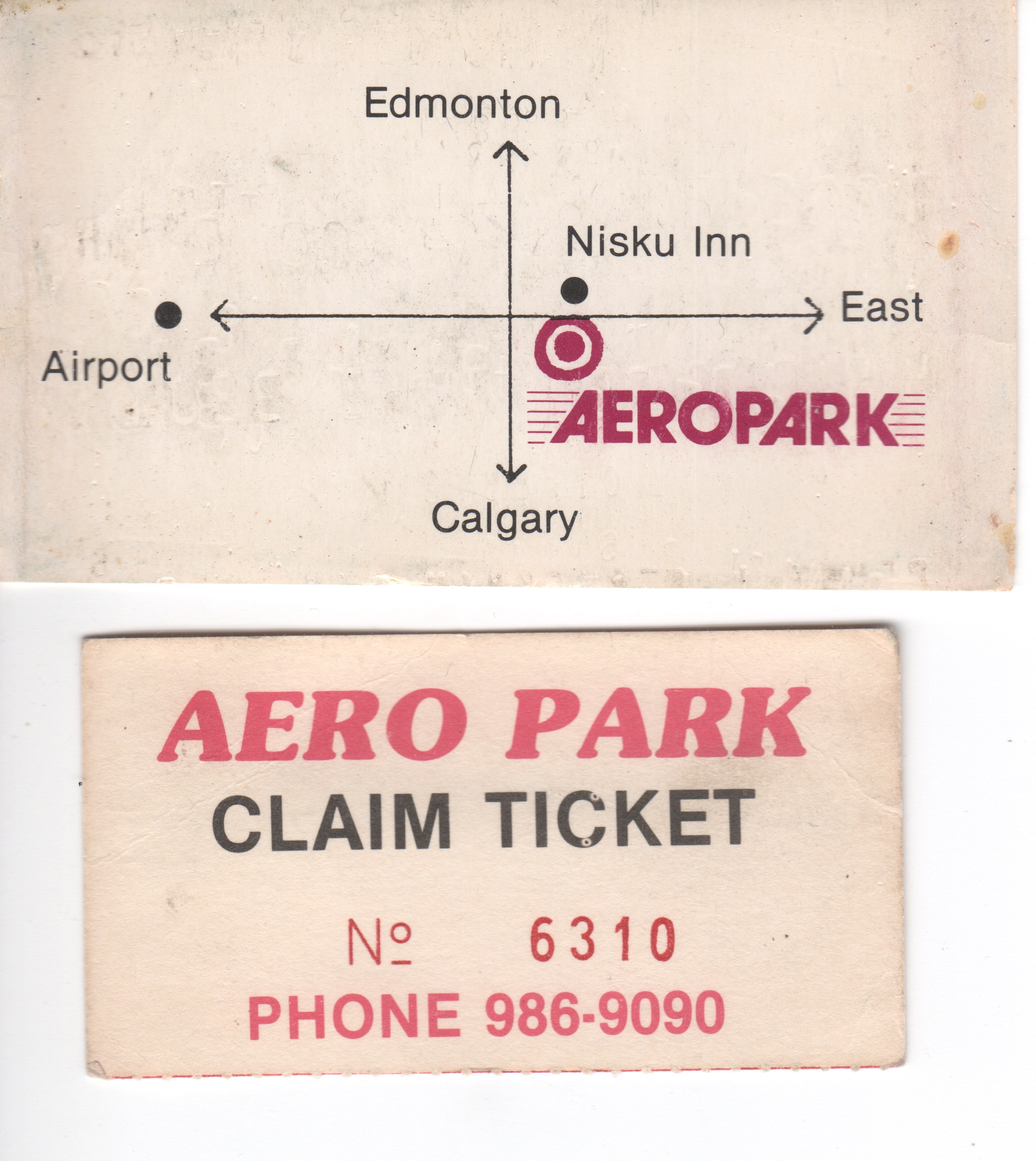
I still have the business card and claim ticket for our green ’64 VW van that broke down 20 km south of Edmonton.
April 6, 2015
Today would have been my brother’s 72nd birthday.
In 1987 we packed up the family suddenly in June and headed to Alaska in our 1964 VW van to protect our teenagers from themselves.
We bought the van in 1980 when Larry Felton came to Missoula driving the station wagon he had inherited and was driving back to Sacramento. Larry helped us because we had to replace a gray 1965 VW van a chemistry student at the University of Montana sold me. (The student was subsequently arrested in California for attempting to shoot a police officer. Just reinforced my relief that the gray van that burned had bad karma.)
This all looks so strange when I type it out. Anyway, the green 64 van we bought in 1980 had been standing in a field up the Bitterroot with hay growing up through its slightly rusty floor and some bailing twine in the back. The ’64 took us on adventures in Northern Idaho to work on a lookout tower with a llama named Andy. Our kids slept in the van with rain dripping on their heads. In the cold in late spring.
This is the ’64 VW we eventually drove to Alaska. Well, part way there. To a place 20 km short of Edmonton, Alberta.
As you recall, our family ended up in a parking lot across the highway from the Nisku Inn. We had purchased a new engine from a dealer in Edmonton, but the engine hemorrhaged oil when we tried to return the rental car we used to rescue ourselves.
Once we did saw the heartbreaking mess of oil we towed the VW, new engine and all, back to the parking lot. Still early in the day, I phoned the dealer who advised me to check a pair of rubber seals at the oil cooler. So I again struggled with the tools, removed the engine, then dismantled the tin. I removed the oil cooler, checked the rubber seals, put the whole works back together and got the engine back in and ready to go before dark that same day. The kids spent another day swimming at the Nisku Inn.
I fired it up again, and as it idled, I made the compulsory check back under the rear. So good. Until came a fat stream of oil pouring down. Again.
I jumped up front and switched off the ignition. This time, after perhaps 15 seconds, I howled with rage and tears as I pounded my fists on the big round steering wheel. “Boo hoo! I quit!” I cried, looking at P., who looked at me like I was an imbicile, but said a comforting word.
The following morning, on the phone from the parking lot office, the dealer in Edmonton supposed I needed a different sort of oil pressure seals, so I drove into town and came back with some robust seals. And more oil. Once I had installed these and mantled and installed the engine, we returned the rental car and drove the van to the dealer to have the mechanics check my work.
The mechanic walked to the van, started the engine, pulled the throttle all the way open so it made a deafening roar. The tin around the cylinders blew outwards like an inflating balloon. “Looks good,” he said. “Don’t baby it, aye.”
The engine was stronger than ever as we sped north. A couple days later we arrived at Dawson Creek. At this point we were ready to start our long journey north to Alaska!

My grandparents lived atop a hill on the outskirts of Kalispell. They had the longest, skinniest garage I have ever seen.
The Bible had colorful maps and black and white photographs in the back: the Rosetta stone, an Egyptian mummy, maps of places that did not include anywhere in Western Montana, although I looked and looked. Every few weeks I’d look again, but no Kalispell; but there was a body of water, but nowhere did it say anything about Flathead Lake. They were left out for some reason.
Again, why had my grandmother made such a big deal out of giving me the Bible when it did not include any of the places that were important to me? Kalispell didn’t look anything like Israel.
“Northern Lights to Fields of Gold,” was the title of another book I grew up with, a book by Stanley Scearce of Ronan. My father ghost wrote it for Mr. Scearce. Later, when I was in my late 20s I tried to read it but the sentences were sometimes pages long, the verbs passive, the subject hidden behind countless adjectives. I liked the title, though and several times in my life I traveled long distances north. My question remained, why didn’t the book tell about the actual places? Why didn’t it tell about Ronan? The title was just about the best part of the book.
I have longed for the Old North Trail all my life. Perhaps others have also. The Chinese Book of Changes, or I Ching, describes the North as a mysterious region where the dead go. The Blackfeet Indian stories tell of people who came north on the Old Trail bearing colorful tropical birds. People who spoke an indigenous language foreign to the Blackfeet. The ancient trail just east of the Rocky Mountain Front. It is still there!
The Old North Trail is a physical place, not too remote from where I live, with mountains that have been important to many thousands of people for many thousands of years. In fact my mother was born near the Old North Trail in Buffalo, Montana, in Judith Gap, a mountain passage.
Both my sons know of the trail. My younger one told me that he once interviewed an old Metis man near Choteau who told of going 40 miles to a New Years Dance. Bob asked him if had gotten a ride? The man said no, he went on foot. He said he started in the morning and stopped only to smoke a cigaret every so often. Bob didn’t believe him, so he got a topographical map of the area and a pencil and asked him to trace his path. The man was pissed that Bob mistrusted him, but he drew out the route anyway.
Later Bob and Todd left a car at one end of the old man’s route and jogged the 40 miles. Here is what Bob said: 1) they could tell when they were on the Old North Trail because the going got significantly easier there than when they lost track of it. 2) the trail stayed close to the bottom of the steep hillside at the edge of the wilderness, so creeks and streams were relatively small and easy to ford. 3) there were a few exceptions to number 2 above, such as one particularly deep canyon. 4) they were in no condition to attend a dance after jogging and walking 40 miles, unlike the old Metis man.


 insearchofbud