
In 1957 Carl and Ellen Bonde celebrated their 50th wedding anniversary at the “Hacienda” in Kalispell. About 40 people stayed at their house for the occasion.
I read some of the family history supplied by Helen Lodmill and this is what I got.
The Bundes or Bondes or Bondys come from a line that included a Norwegian knight and a king “with fair hair” back about 1500 years. I’m thinking, “yeah right!” On the other hand, most of us have some sort of big shot in our family tree we want to claim. Also some little shots we want to forget.
In Vang, Norway, in the early 1800s, first husband Thorstein Bunde and my great-great grandmother Berit Olsdotter Egge married and had 4 children. [One of these, Kari, was Thorstein Veblen’s mother.] In a few years Thorstein got into some sort of financial trouble from “costly litigation” and ended up having to sell his farm, only he provided my g-g-grandma Berit with an annuity and a house on the farm that he sold off for the large sum of $400 specie. Then he left town. Alone.
Thorstein went to Lillehammer to start a new life, but died there at age 35. Five years later Berit married my great-great grandfather Einar Halvorson Groven, a poor farmer, and because they lived on the old Bonde farm, Einer and Berit both took/kept the last name Bonde (she for the 2nd time). (Apparently that was the practice in those days, to take the name of the farm where you lived.) They emigrated to the USA and had five children of which two survived to adulthood, including Tosten, my great-grandfather, who ended up building the stone farm house near Nerstrand. Tosten married my great-grandmother Ingebor Haugen. They had 11 children, born in the stone house, but only 7 survived. The youngest was Alfred, then Carl, my grandfather. The oldest was Oscar, who stayed on the farm. My grandpa Carl married Ellen Wichstrom in North Dakota. They were living in Buffalo, Montana, when my mother was born upstairs from a dry goods store.
My mother married a journalist/teacher named Robert P. Struckman from Big Timber, Montana, and I was born in 1949 in Missoula while he taught at the University of Montana. He died when I was four, so my mother taught elementary school in Missoula, and later at Western Montana College. A poor student, I dropped out of college and I served in the Marine Corps. I finished a degree in pharmacy and served in the Commissioned Corps of the US Public Health Service before retiring in 2005.
I married Penny Meakins when I was still a private in the US Marine Corps and we had three children, Todd Jacob, Robert Joseph, and Clara Ellen. Todd married Susanna Gaunt and they have two sons: Cyrus and Roland. Robert married Heather Corson and they have a son Josiah and a daughter Olivia. Clara married Brian Roberts and they have three children: Henry, Beatrice, and George.

The fancy clothes seem to fit perfectly, although they could be hand-me-downs from their numerous sibs.
My grandpa Carl T. Bonde spoke Norwegian fluently with his Kalispell, Montana, cronies and when he said grace at Thanksgiving and Christmas. He was easy going, and old, when I knew him as a boy. He and I often fantasized about mixing concrete. I wanted to be able to say to my friends, in the same way that old workers warned me so importantly, “Wet cement.” With old workers the conversation ended. Grandpa and I spoke of getting the materials together: cement, sand, and lime. Always lime, because grandpa painted his apple tree trunks with lime to keep ants off the fruit.
We collared the market on lime, but we never seemed to get the cement and sand. I didn’t have a project in mind. I was four years old! I didn’t ask for much, just some wet cement to call mine. To make something permanent. Didn’t matter what.
Grandpa smelled good, like cigars, tobacco, beer, whiskey. He had false teeth that he took out after eating peanuts. He used his pocket knife to clean the bits of nuts from between his teeth. He always shared with me. Grandma was not so much fun. She said a child should be seen and not heard. I liked to talk, still do. Grandpa said when I hung around him and chattered my endless monolog about everything I thought, that I was a “big help.” I loved helping grandpa. Whenever he did something that amounted to much, though, he would tell me that what he was about to do was “ticklish business.” That meant I could only watch.
Grandpa wore a nightshirt, same as grandma. I never saw them act affectionate or touch each other or even murmur any kind of endearment. Well, grandma did call us to lunch when grandpa and I were down at the barn at the bottom of the hill struggling with some kind of work. Typically I yacked away even when I played by myself. She would call in a high musical way, “Yoohoo! Yoohoo!” Grandpa and I would put down our tools and trudge importantly uphill past the root cellar and a sort of rock wall.
During the day grandpa wore old worn-out dress pants, often wool. His profession, his livelihood, was what kids in his day called, “commercial.” He had started out after high school as a store clerk. I’m not sure how he came to meet grandma, who had graduated from the Normal School at Valley City, North Dakota. Grandpa dressed as a professional every day, so he had lots of old shirts and trousers and coats. Grandma made huge hooked wool rugs from his old clothes.
I usually wore jeans or cords. Neither was very easy for me to put on by myself because of the zippers and snaps. I never had a belt, but I did have suspenders. I wore brown leather shoes. Grandpa did also. I never saw him wear boots, although he went hunting in the fall when it often snowed.
I think I met Alfred when I was in the fifth grade in Missoula. Grandpa and grandpa came to Missoula to our house and an old man got out of the car and introduced himself as one of my grandpa’s brothers. He said he wasn’t “any good any more.” I thought that was a strange thing to say. Now that I am less good every year, I think I understand what he was talking about.
Alfred and Grandpa were close enough to go into the grocery business together in Buffalo, Montana, in the Judith Gap pass. Family lore says that Alfred and Carl’s wives quarreled, so the experiment ended. I believe Carl sold his interest to Alfred who subsequently sold his interest to someone else. Today Buffalo Montana has been almost completely abandoned, although it had a post office in 2009.
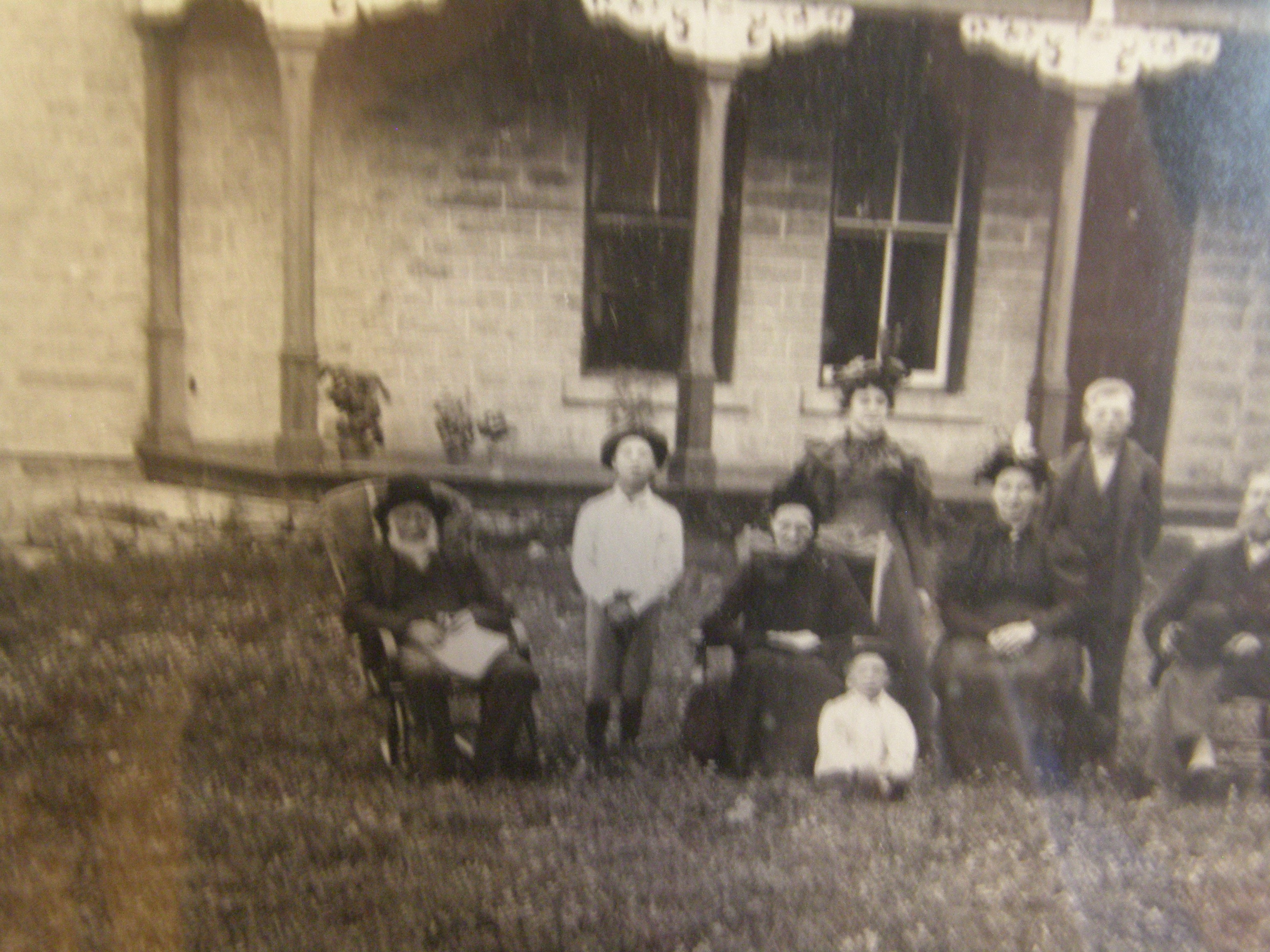
Carl Bonde, Sr. is the boy in the white shirt, standing in front of his childhood home near Nerstrand, Minnesota.
July 30, 2015
Tomorrow I go to Nerstrand, Minnesota, to visit the farm house where my mother’s father was born. At least I think he was born in the house. Nobody ever told me. About 1885, give or take. He had many brothers and sisters, more than 10. Again, I don’t know how many. Another fact worth knowing. Don’t we make fun of redneck families whose family trees look like a broom. Tosten and Ingabor Bonde made their family tree look like that.
The stone house Tosten built has been fixed up, added onto, fortified with an I beam, but is mostly like it was. My 89-year-old cousin Earl Bonde, who died since the last reunion, said he nearly burned the insides of the house when he was a kid. I could tell he still felt shame after so many years, even though things turned out okay. They had candles and lanterns in 1930 and he started a fire. I forget the details, but obviously the house is fine. Sure it is made of stone, but the floors and walls and ceilings were wooden.
My grandfather’s only son, Carl Ralph Bonde, Jr., probably never visited Nerstrand to see the stone house. Other than a few school-sponsored debate trips around Montana, Carl’s travels in the USA were for military service. Alabama, Arkansas, North Dakota, New York. He did visit a relative in New Jersey en route to England during World War II.
World War II was practically over by the time Buddy got sent to England. By then, France, Italy, and Spain had been liberated from the racist Nazis and the remnants of his army seemed about to accept defeat. Probably Carl’s 66th Panther Army Infantry Division was a kind of insurance to make certain that Hitler would lose the war.
I imagine that many of the American GIs looked forward to loving up the British girls and going pub crawling. This was 1944, in the weeks between Thanksgiving and Christmas, when they arrived at Southampton, headed by train to their quarters near Dorchester in the hinterlands of England.
They had celebrated Thanksgiving on the troopship, George Washington, eating their holiday meal in shifts, standing up. The Division had four regiments with support personnel and foot soldiers. Bud was a soldier, a member of a machine gun section. Bud was an ammo bearer. He was also very bright, had a couple years of college, and among many friends who also had been college students prior to being made infantry soldiers, private soldiers, so-called “grunts.”
Anyhow, as World War II was winding down the Nazis were losing ground and no longer had much of an air force. They still had submarines, U-boats. Damned effective. One of those ended up killing almost 800 soldiers, including my uncle Carl Ralph Bonde, Jr. just as his troopship, the SS Leopoldville, came in sight of the French port of Cherbourg.
Hitler, exactly one week earlier, had launched a massive counter-offensive in Luxembourg. In return, Eisenhower was cashing his insurance policy, his cache of troops that he kept in England just in case. My heroic uncle Buddy Bonde.
July 29, 2015
“You want my story?”
I hoisted myself up on the slippery wood of the barstool, making a couple experimental shrugs with my hips to test the swivel mechanism. The bartender, who looked like she might be 12, Asian, wasn’t paying any attention, so I began. I resolved to tell the whole thing in less than five.
“You were trying to wake me, remember? This was 1968 or 1969. Somehow you found me at Peter’s. Only I was faking. I had taken some sort of pill. I think they told me it was psilocybin, or maybe mescaline. Maybe strychnine? I can’t remember. Anyway, you wouldn’t leave me alone, so I got pissed. I told you that I wasn’t asleep, I was crazy and I wanted to stay that way. You told me that was the first time I had spoken to you without filling you full of bullshit for a long, long time. I got no pleasure from the compliment, I mean to tell you.
“Anyhow, I knew we were through. Oh, I still had very strong feelings for you, but we were through. I had been untrue. I had cheated on you with at least one or two other women by that time. It was over and I wanted to try and get some sleep. You left. I jumped up after a few and went out into the yard. I could see you in the distance walking across the bridge. I thought you looked independent and free.
My love affairs were doomed. I played guitar with my friends over in my brother’s basement and my friends Mike Fiedler and Tim Rogers and Peter Koch told me that I was kind of a stupid little shit. At least, that’s the way I interpreted what they said. I talked Tim into hitchhiking west with me so that we could get jobs and make our fortunes in the silver mines of Idaho. We left that same day.”
I ordered a beer from the young-looking Asian bartender.
“Before Tim and I left I found a jug of wine someone had left and I took a swig. ‘Gotta fortify up,’ I said. We made it to Wallace that day and got the police to let us sleep in jail. The next morning the jailer gave us each a sack lunch and let us out.
“We didn’t find work. Had to have safety equipment and join the union. Had to have special safety glasses. Had to fill out papers and hang around town until we could get hired. We hitched south to Boise that second day. Spent the night in a park across from the Rescue Mission because it was too late to go there.
“We tried to get to a town in Idaho called, —uh, I can’t remember. Springfield, maybe. Beautiful sounding place situated in the most god-awful lava beds. Tim and I got dropped off where we could see the town in the distance, so we started walking. Trouble is, the town was really really far. Like 15 miles away. I panicked and flagged down a car that was going the wrong way. Tim explained to the driver that we were okay, we didn’t really need emergency help.”
I sipped my beer. I could see this was going to take a lot longer than 5.
“Tim and I decided getting to the town, which, by the way, was supposed to have our musician friends holed up in an abandoned hotel, to be impossible. I remember shaking hands with him at an intersection of two highways. I went to Eugene Oregon. I don’t know where Tim went.
“I was draft-elligible. I didn’t want to go to Vietnam. I wanted to do drugs and make music and live in some sort of mysterious way as a hobo. I checked the I Ching, but I don’t remember what it said. My friends in Missoula said I was just a boy and I should go out and do something. I decided to go to Canada and live the life of a forester. (And smoke dope and do drugs and make music, too.)
“I’ll wrap up my story. I didn’t like the people in Eugene who were getting ready to renounce their citizenship and move to Canada, so I grabbed a freight and rode to Seattle. From there I hitch-hiked through Canada to Alaska. I threw a hexagram that turned up ‘number 7, the army.’
“After refusing the advances of a gay man who tried to hit on me in Anchorage I went to Fairbanks and worked on a carnival as a grease-monkey. That was the only time I have ever driven a semi tractor.”
I finished my beer. The bartender continued to ignore me, so I just started talking again.
“I can’t keep the events straight. I ended up earning enough dough to fly back to Seattle and staying with my friend Larry Felton. I made several trips back and forth from Seattle to Missoula on the freight trains. I fell in love with P. and got a job with the railroad out of Missoula as a member of a steel gang. I worked with my brother and his friends until Thanksgiving. I was starting to lose my marbles. I broke up with P. and joined the Marines.
“I was a crappy soldier, and I ended up socking my commanding officer. Well, he asked me to do it! They didn’t throw me out because I promised them I would fly straight, and I did. I made friends wherever I went, although I had a scary time in my head for several months when I thought I was truly going mad with fear and grief. All of that resolved, though. I had a nickname, ‘Stork.’”
I ordered a second beer.
“Long story short, I married P. a year later and she moved from Lewistown to Santa Ana, California. We were very poor and very happy. Except for a year in Japan I spent the next 6 years in California until I got out and moved back to Missoula to return to school.
“I finished journalism, but couldn’t write, so I enrolled in pharmacy. Got a job in Billings at a hospital, then worked at Planned Parenthood, then joined the U.S. Public Health Service where I stayed until I retired in 2005. I’ve worked at several pharmacy jobs since then, taught a semester at Rocky Mountain College. Pharmacy turned into a good career.
“Drugs? I left all that back in Missoula when I joined the Marines. Couldn’t afford even beer for a long time. I drink wine these days, act in plays, volunteer to help the homeless and am on the board of a child care. I sing a lot in choirs and the symphony chorale and in theatrical productions.”
Another day for writing about the myriad things I care so much about! It is sort of like piecrust, though. Piecrust can be thick, tough, chewy, and in the way of a great pie experience. And I love pie! Allow me to recall the ways.
In 1976, after I had gotten my discharge from the Marine Corps and had been admitted to the University of Montana, we drove the rented truck and two Volkswagens from Southern California to Missoula. I checked in at the student housing office at Elrod Hall and got a key to 215 B Sisson apartment. I took the five of us and everything we owned to the southernmost “X,” and soon P said to me that she had just met the woman who lived on the first floor and that they were going to be best friends. It was true! Marilyn Seastone had three children, same as we did. The Charles and Marilyn were about the best neighbors anyone could have. They were endlessly funny and fun, completely intellectual, completely poor, completely making do with next to nothing, perfectly elegant in their simplicity. In short, they were outrageous!
All of their friends were the same way. How I gush.
No. The Seastones were not perfect. They had their share of darkness and troubles, same as we did. Ended up we were not speaking to each other, but I did help them move out about five years after we had met in 1976. Doesn’t that happen when you become intimate friends, one family with another?
The next year after we moved to Missoula a few friends and I started a magazine when I took a summer journalism class from Wilbur Wood. The magazine, “The Portable Wall,” was my project and the fulfillment of a desire. Dana Graham, my brother’s ex, got to name the periodical by donating $10 toward its premier issue.
I find it interesting that all of us: Dana, the Seastones, Mark Fryberger, Dirk Lee, were really hippies in whatever manner could be construed to be real at the time. I don’t remember smoking any marijuana when we made the magazine! I do recall working on a Volkswagen when a black student with some friends came by, who saw me smoking a tobacco hand-rolled cigarette, offered to “squeeze” it for me. I think I offered him a hit, but he had little interest in squeezing my tobacco cigarette.
My initial pie-making effort happened the next year in the Fall, and I chronicled it in the third issue of The PW. I tried to make a 7-inch crust fit a 9-inch pie pan. Really didn’t work. I did the calculations later, to find that it takes almost twice as much dough for that extra 2 inches of pan! I also discovered that pie dough sticks to the surface of a table if one is not careful. I scraped the dough off the table several times, that Fall day in 1968. I also discovered that if one works the dough often enough, the gluten comes alive and grabs each other’s molecules in tight embrace, to toughen and strengthen the ball so that tons of force would (theoretically) be required to render the ball into a very thin piecrust.
The theoretically thin crust is only that. Impossible. The result, in reality, was the person (me) suffering humiliation and weeping. This was one of only three times I shed tears as an adult.
I think I lied in my PW article about pies, claiming to make a pumpkin pie that was edible. Well, the custard itself was edible, but the crust had to be thrown out, mostly uneaten. One could eat it, again theoretically, but such eating was not pleasant, nor particularly healthy.
I learned a great deal from my Sisson Apartments pie effort. I learned to respect, but not fear, pie crust. I learned that pie crust is a necessary evil, like the words used when writing. My dear spouse still declines most crust. She rarely fails to tell me her feelings about crust. I usually say, “I know, I know,” when she launches into her speech, asking me to consider making a cobbler instead of a pie.
My pie making made a huge leap when we started working summers at the fire lookout tower in Northwestern Washington at the Priest Lake Ranger District. I could pick a pie’s worth of huckleberries while making my way uphill to the tower from the spring where I collected 4 gallons of water. Sometimes I’d make batches of 7 pies a day. My fate as a pie maker was sealed.
In later years our aunt Corinne brought huckleberries and whiskey to our house at winter holiday time. She taught me to make lefse. She taught me to boil 5 large potatoes, skin them, add cream, butter and flour and salt. She took a ball of dough smaller than an egg and rolled it larger than a manhole cover. What a rare treat. What a treat to be lambasted by my dear aunt. “Go to hell!” she said, if I failed to run for her whiskey. She was my uncle Bud’s sister.
These days I know where to find huckleberries and good apples, even decent pumpkin for pies. As my life forces ebb I know how to concoct pies that are attractive to our three children and our seven grandchildren. Keeps us in touch over the holidays. Pie crust? A necessary evil, just like the words used to write such as this.
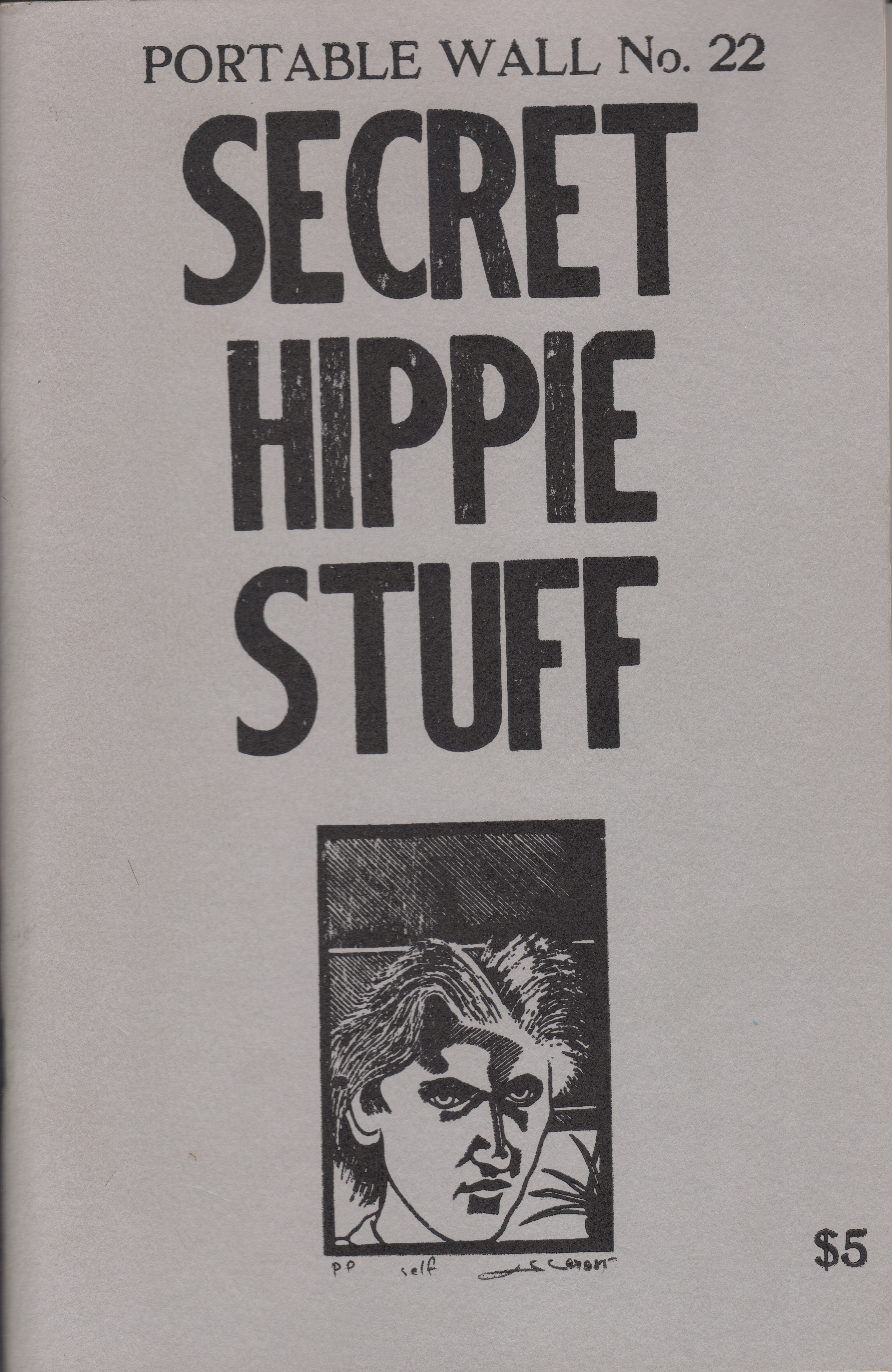
A cover from The Portable Wall. Illustration by Dirk Lee.

TBT: In 1942 an army infantry soldier, my late uncle, demonstrates marching at right shoulder arms for an unknown photographer.
When I was home on leave from basic training in the Marines I recall doing the same thing my uncle Carl R. Bonde, Jr. did about thirty years before: march around with a .22 on my shoulder to show someone how it was done.
This photograph fills my heart with longing to see him face-to-face.
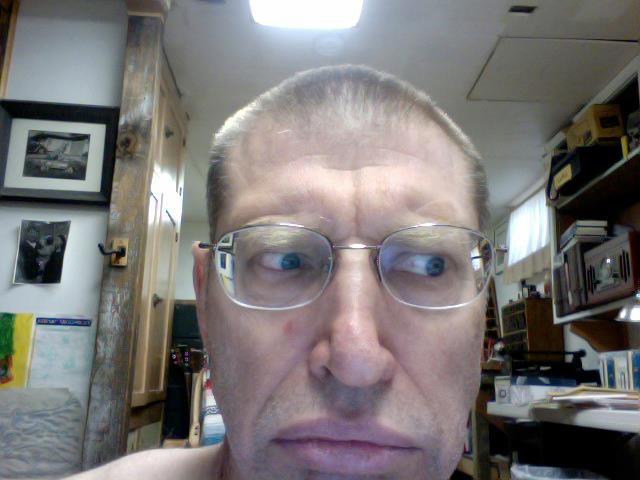
I used to be an actor.
When I went to visit Gerry Roe to audition he was with Janie Rife in a back office looking for a form for me to fill out, telling my contact information and my willingness to play a part in “The Fantasticks.” I filled it, except for the line asking about my audition piece, because I didn’t have one, really. I brought my score for “La Traviata.”
We looked in a variety of back rooms and settled on a dressing room for boys for “Wizard of Oz.” I tried to sing the drinking song from La Traviata from memory but couldn’t remember the words, so I made some up. Then he asked me to sing “Try to Remember” from “Fantasticks,” but I didn’t know the words there either, so I made them up. Then he asked me to read a poetic monolog from the same show. Twice. “Isn’t that wonderful?” Gerry asked.
“Well,” I answered, “I suppose so. Well, it’s not what I would have said.”
“What would you have said?” he asked.
“I would have said, ‘This is about two young lovers who think nobody has ever experienced what they have, walking in the evening sunlight through weedy river banks along the Clark Fork.’” I said.
“And going like this!” he said, sucking through his pinched fingers as if smoking a joint, “Pfffffffffft.” Gerry knew about Missoula. I had the feeling he could see right through me.
“Exactly!” I answered, nervously.
We had a little laugh. “I’ve been there, too,” he said, as I nodded vigorously. I was thinking of my journalism professor, Nathaniel Blumberg, who chided our class in “History and Principles of Journalism,” when he told us we were exactly like every other pair of lovers who thought they were the first to watch a sunset. His news for us was that we were not.
In the end I told Gerry that I wished that he would get about 25 men to audition so that he could pick out some stars. He obviously had to settle for me, instead. However, in my day I have done some excellent work as an actor, so maybe he could tell that I was an old Thespian.
I learned I had been cast as the father of the boy in the story.
The musical play is wonderful, and my favorite line is, “Without a hurt, the heart is hollow.”
I know just about everyone can identify with this.
I have also truly been hurt by love, for I have loved and lost more than only a few dear ones and the hurt burns within my breast. That’s how I know I will contribute greatly to this splendid production.

Don’t try this! John Herman and I light up in Missoula, 1968.
July 21, 2015
One of my alert readers asked about my encounters with dead people.
I will not tell the tale by Jack Handey about the severed head of his friend Don, but those of you who want a real good short story can simply google “Jack Handey severed head” without the quotes. I said short, but I meant, like, three sentences long.
Yes, the corpse fascinates me. You too. I would have you read Mary Roach’s book, “Stiff,” in which she delightfully explores the topic; although she subsequently admitted that she wished she had included “Operation Mincemeat” by Ben MacIntyre, the telling of how the allies tricked Hitler with false intelligence chained to the wrist of a planted and doctored corpse.
Roach observed that human bodies are funny, as long as you have no relationship to the persons the bodies belonged to.
Okay. I’m stalling.
Here are my encounters: my grandpa Carl T. Bonde in his open casket in 1958. I couldn’t believe it was him! He looked funny, somehow. Not funny. Odd. His head looked more rounded and perhaps his false teeth were out. I was only slightly less interested in the great number of old, bald, red-faced men who attended: old Norwegian and German men I had never seen before. My brother remarked on it.
Some of my encounters, as you will see, were false, or demi-encounters. In high school I read a lot of stories about ghosts, necromancy, spiritualists, like that.
One winter night in Dillon, Montana in 1964 I heard the squealing of metal-on-metal out my bedroom window on Atlantic Avenue. In those days wreckers towed with a hook, and although the driver had used some sort of dolly for the mangled car, it made a lot of racket. I watched, fascinated, as it passed. My friend Philip Davis and I delivered newspapers the next morning, just a few hours later, so he and I hiked out west of town to see if we could find any human body parts that had been left behind. Dillon is high-altitude, not so far from the continental divide and damned spooky in the winter, at night. Philip and I got the newspapers at the town police station where the dispatcher worked. The Butte-Anaconda Montana Standard, a union paper in those days, would be dropped off by a Greyhound bus at about 5:30. Philip and I folded the papers indoors there, where the other carriers sat around the periphery of the room. Philip’s route took us to the windy, cold highway where it entered town near Barrett Memorial Hospital and Western Montana College of Education. Of course it was still very dark because it was winter.
Two years later, a bunch of us clustered around to stare at the car Johnny Quick crashed into a bridge abutment that killed him and Joe Bramsman. Their blood was all over the interior of the crunched up Chevy Bel-Aire. One of their shoes was in the back seat. This was the same car Johnny took me and Allen Lenhart to work in a previous summer. We had to help pay for gas for that souped-up engine. Johnny had modified the steering wheel. He had a so-called “suicide knob” and he had cut out a portion of the wheel so that it resembled the aileron control on an airplane. He put crutch tips on the raw ends of the “wheel.” Once on Atlantic Avenue when Johnny was taking me to my house one of the crutch tips caught Johnny’s rubber irrigation boot and we almost hit the front of a semi before he got it loose.
In 1967, my grandma Ellen Bonde died in Dillon at 80. I don’t remember what she looked like afterward, but she looked ill before she died. We all went to Kalispell for her funeral and I remember seeing my aunts and abundance of cousins on my mother’s side. I think that was the last time I saw all four Judd boys together.
Other than a severed leg that I’ve told about before, one in a box at the University of Montana, I didn’t see any bodies until 1969 when I worked on the crabbing boat in Seattle. I was painting a bulkhead when Larry Felton poked his head around a corner and wrinkled his nose. “What a disgusting sight,” he said.
“What is?” I asked, dropping the wet brush into the bucket.
There, just a few feet from our boat we saw a police boat that had officers fishing a body out of the lake. At first I thought they were picking up some styrofoam, but then I saw clothes and realized the corpse’s flesh had turned white from being submerged. “A stiff!” someone said.
Came a long dry spell, dead person-wise. Especially when I hitch-hiked and rode freights. Time seemed so slow that it almost stopped.
I physically encountered no bodies while I was in the Marines! One in my squadron took pills and drank and died in the night; so, being a supply man, I inventoried his belongings, packed them into boxes, and mailed them to his mother.
Another died while I was in supply in California. A staff sergeant with a particularly foul mouth crashed his Corvette so I packed up his things too. In each case I followed protocol and common sense. I removed all of the pornographic magazines and any condoms and any flammables, like aftershave or cologne, or other stuff that would be messy, like laundry soap, or any liquor. Any illegal stuff would have been already confiscated by the police. Someone from our squadron escorted the bodies back to the Marines’ homes for burial with military honors.
No stiffs for me until we moved to Billings and I began working in a hospital. I’d help doctors and nurses and emergency medical people try to revive a body perhaps every 2 weeks. At first I had nightmares and I was jumpy whenever I heard a siren in the distance. The sight of a perfectly good body—fine in every way, except for being dead—made me feel quite sad. In fact it still does.
I worked five years at the hospital and of the more than 100 resuscitation attempts I witnessed, exactly two succeeded so that the revived person could return home. The scene typically, for a patient brought in by rescuers, would be that the patient was expertly taped with towels and white tape to a wooden board. Someone would have oxygen flowing through a mask that they would be squeezing to mimic breathing. Another person would be compressing the victim’s chest. The doctor would admire the taping and towels, say a few encouragements to those with the mask and compressions, then get an intravenous line placed. Then he would give just about every adrenergic drug in the crash cart, many syringes of sodium bicarbonate, then do it all again a few more times before calling it quits. I would dutifully write the time on a form.
Now that I am retired I have encountered dead people mostly at funerals, frequently enough that I hardly bother to look at bodies in caskets any more. Oh, I look to make sure the person is really dead, but then I strike up a conversation somewhere.
I guess I should finish the story of how Philip and I visited the site of a terrible automobile accident just west of Dillon before dawn in the winter. Remember, we were looking for any left over body parts.
You are leaning forward, attentive. “The severed head,” I begin.

Everything is out of my comfort zone.
Here I am, only 66 years old and feeling sort of constipated. Mentally. I feel I must write, even though I couldn’t say why. Here’s a few ideas: I’ll write a really long book and pay someone to read it. I did this once with my book about my uncle Carl Ralph Bonde, Jr., only I gave copies of my writing to my son Robert and my nephew Jon. I got the same response from both of them. Did they rave about it? Love it? Hate it? Tell me it was a piece of crap? No. I heard nothing from either of them because, I’m confident, neither could read past a few pages. Also, they love me. Yes, even Jon does, although he might not admit it. Bob tells me all the time.
My second idea, since I doubt I could afford to pay anyone to read my words, would be to use it for some self-improvement. That way I’d glean some good without involving anyone else, really.
Not really my second idea, but my second and third.
I’d write all of my regrets, from my earliest sins, crimes, slights, omissions, unkindnesses, mistakes, and downright evil deeds. You know how they sometimes ask condemned prisoners or people on their deathbeds? Any regrets? No, they would say. My answer would be that yes I have regrets. Here they are. Thousands of pages, if you have time to read them. If you are willing to read them, here’s several hundred dollars to make it worth your while. I’m sorry! Sorry!!
Third: I’d write down all of the braveries. Last night when I was contemplating this I resolved to write about my own, but even though I think I could list hundreds I thought the ones I witnessed could be written as well. Writing about brave deeds is tricky. In my opinion, the deed doesn’t constitute the bravery, but the fear one had prior to doing it. As a fearful, shy person, I have done many. And I have witnessed many, also.
Now I’ve got a fourth. I’ll write about everyone I’ve loved! Many of these people are still living. I’d start with the ones I loved most. Come to think, some of those I loved greatly never knew I loved them. I must let them know!
Now the fifth. I’d go through each issue of The Portable Wall, my popular paper-and-ink literary journal, and write about the contributors, wonderful to me, people who greatly contributed to my life. I’ll have to get back issues from my nephew who took them home.
Sixth, how I learned to identify plants. Wild flowers, particularly. Also trees. And shrubs.
Seventh, my experience with crappy volkswagen bugs, vans, Fords, Nissans, Hondas, BMWs, Tatankas, and Subarus. All of them wear out, break down, and pollute the environment. I liked them, loved them, hated them, forsook them.
Eighth, the horror of living in an “efficiency apartment.”
Ninth, my encounters with dead people.
Tenth, I don’t have a tenth yet. I did not memorize any multiplication tables until I was about 23 years old.
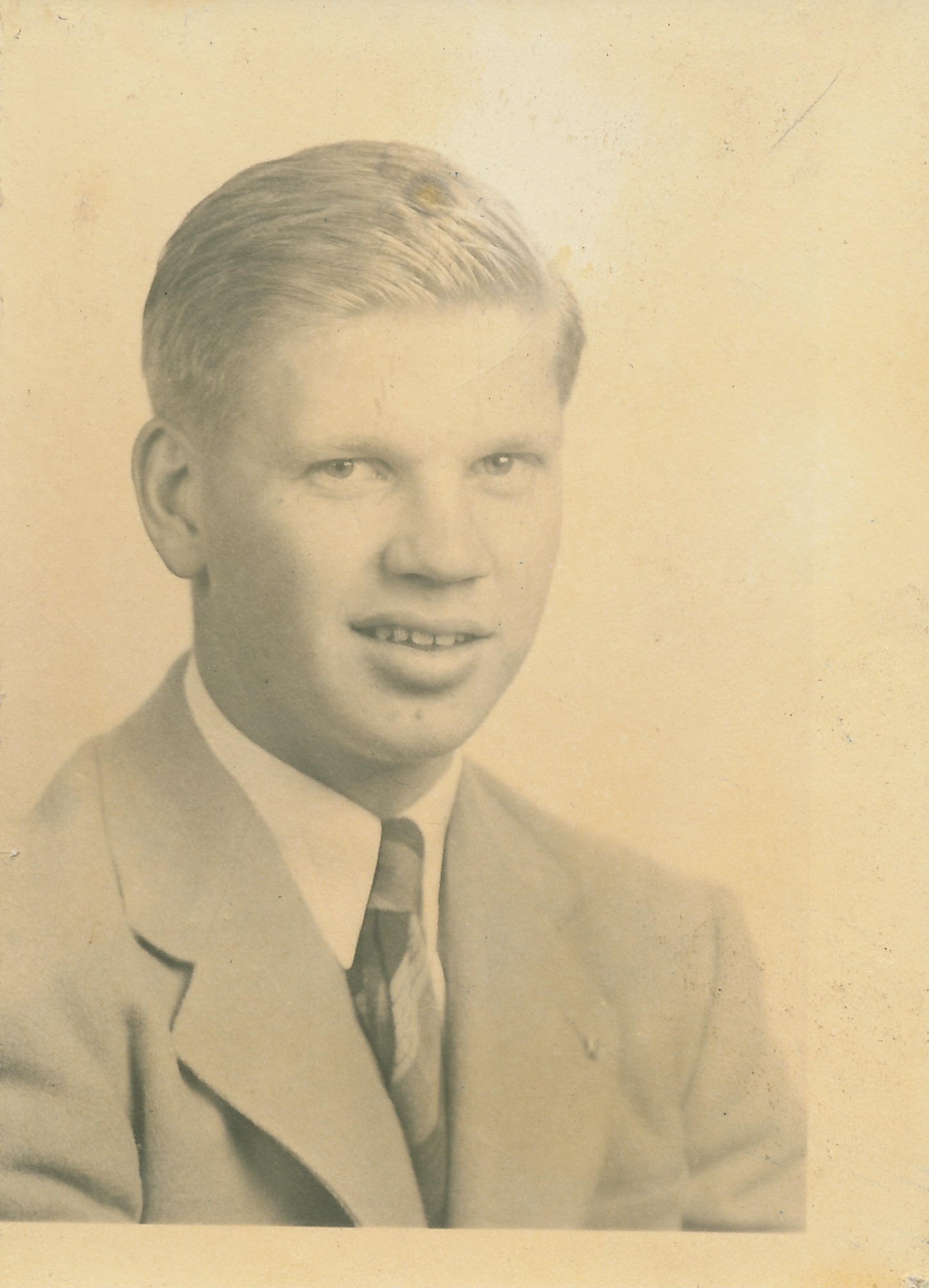
Carl Bonde’s high school graduation picture, 1941.
July 20, 2015
Writer’s block. I had an idea of writing about my uncle Carl’s childhood, substituting details of mine. The problem has always been that I don’t know much about his childhood back in the 1920s and 1930s. (I was born in 1949.) Sure, one can look at old newspapers from the period for background, but I find that to be a cheap fix. Instead, I think about my own experiences. Although Carl and I never met we both knew the same family members, but at different times. I think my uncle was a war hero. He was also an acknowledged goofball by those who remembered him.
I had a happy childhood. Oh, my father died when I was four, but my siblings, my mother and her sisters, and her friends looked out for me. in grade school I mostly played cowboy and soldier with my best friends on the block. That kept me busy. Looming large, also, was trouble with encopresis. This is defined in Wikipedia as “involuntary defecation, associated with emotional or psychiatric illness.” If that weren’t enough, I had trouble with enuresis, or difficulty controlling urination. Both of these pathological conditions were associated, ironically, with my happy childhood. I was simply too busy and happy to stop and pee. I was too happy to stop and poop, too. I also, incidentally, had a thing about refrigerators. I think that sums up a lot.
None of my concerns matched those of my uncle Carl, my absent uncle, the one killed in the English Channel by racist Nazis in World War II, while fighting for the interests of these United States, ironically, segregated by race. I want to explore that subject much more. Remind me, please.
I don’t know if uncle Carl had a thing about refrigerators as I did, so I can speak only for myself here. Permit me to digress, please.
My earliest memory (at all!) was of our refrigerator when I wasn’t even a year old yet. I know my memory was accurate because I asked my sister, ten years older, if the appliance had been to the left of the entrance of the kitchen, and it was. Of course, to a child who could not yet walk, a refrigerator looked like a skyscraper, and so it did. Adults looked like giants with nostrils full of reddish hair. They did not step on me as I gazed with wonder at the refrigerator. My memory, here, is out of kilter. It is haywire. Nonetheless, I am sure I was not a year old because we moved before my first birthday.
The fridge in the house we moved into in 1950 was smaller, but modern for its day. Our house at 334 North Avenue West in Missoula cost $5,000 and my paternal grandfather Emil loaned my father the money to buy it. Emil was not wealthy, but he was intelligent and frugal. I inherited stock from him that I had to sell in 1982 when we got our start in Billings. There, in Billings, the fridge came with the house we rented a couple blocks up Burlington Avenue. This has some importance, because when we bought our present house the former owner, a gentleman named John Frasco, took the fridge with him to his new home at Cannon Beach, Oregon. The good news was it was January 1, 1984, winter. The bad news? The temperature was about 20 below zero, too cold for milk or anything else we might plan to eat. We had to buy a fridge with our meager funds to keep things from freezing and to keep them from spoiling.
Turned out the fridge was a lemon. It was worse than that. It was a total fraudulent — thing! The guy who delivered the monstrosity said “they don’t build them like this any more!” It was made in, maybe, 1940. We literally had to use a coat hanger to open the door. My calls of complaint the next day were not answered, and when P. went to the bank Monday morning to stop payment on our check, she got there too late, and she said she saw the crooked appliance salesman pulling out of the bank parking lot, having just cashed our check. We were bitter. We told everyone.
Our real estate lady gave us a damned nice fridge that next day. End of digression.
Back to my uncle Carl’s childhood, growing up in the 1920s and 1930s in Kalispell, Montana. I still know too little. Grandpa had abandoned the agricultural economy by then, in favor of money. When I came on the scene in the 1950s they had a big Fridgedaire, with modern, rounded corners, heavy insulated door, inches of wall insulation, and a powerful spring latch to hold the rubber seal on the door to the smooth surface of the body. One had to grab the handle and pull out and down to disengage the latch and swing the heavy door. I had to be about 8 years old before I weighed enough.
Back in Missoula our fridge was relatively puny, with cheap, thin door and walls. This was fortunate for me because I didn’t have to wait for third grade to get some milk out. Pop? I can’t remember that we ever had pop. Pop came in huge glass bottles and was prohibitively expensive. Cans of pop were rare. If my brother Tom or someone got such a can of pop they drank it in front of the store. Probably three of his friends helped him.
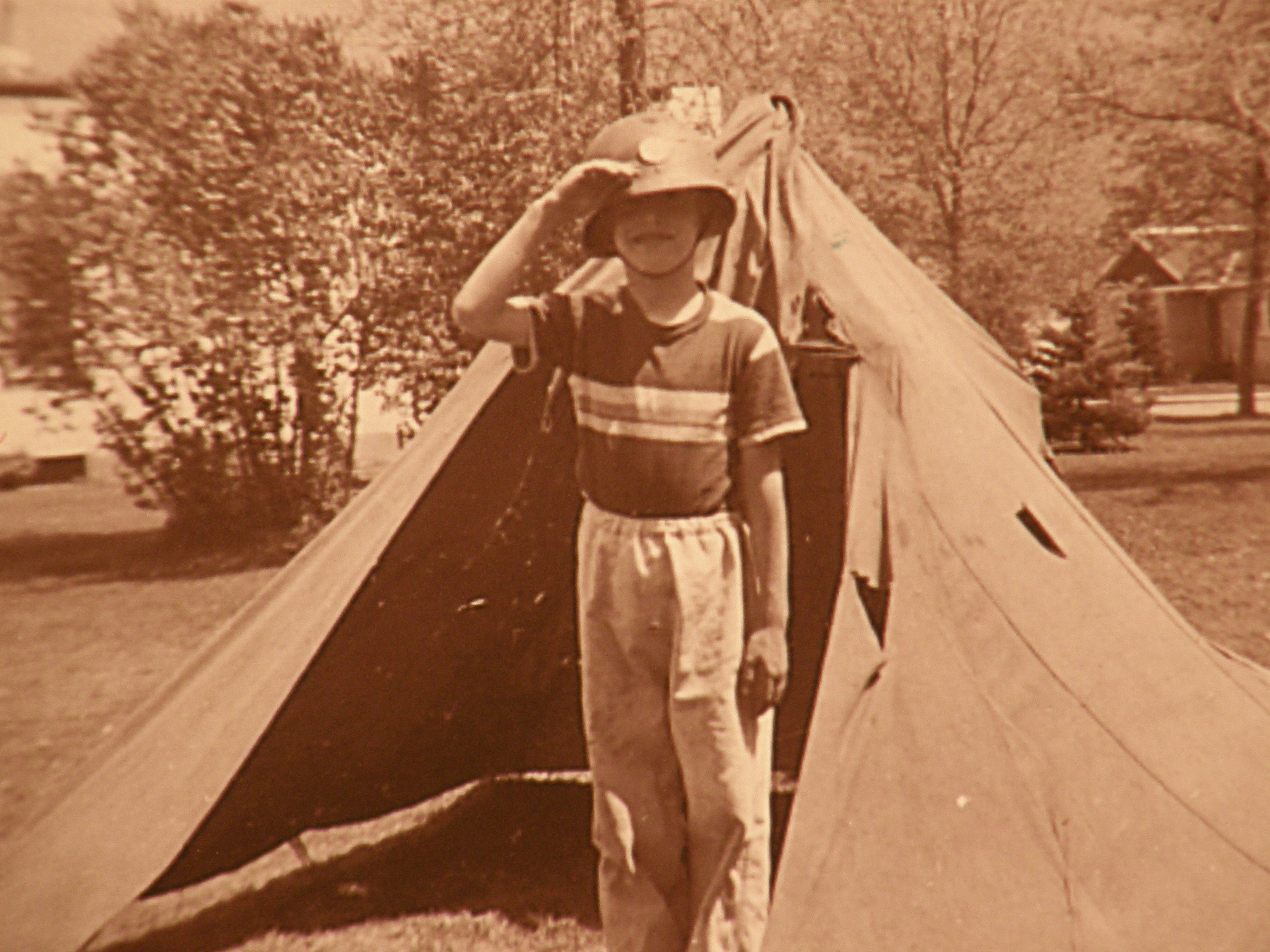
We played army, growing up in the shadow of WW II.
I get sleepy thinking about refrigerators and other nonsense of that ilk. Refrigerators have always been a fascination for me, but not as much as the bathroom and my failed attempts at “number one and number two.” I’m again talking about encopresis and enuresis. These subjects are not pretty, but they were important for me. My brother mercilessly teased me, sang songs about my troubles. “Danny is a grunt!” he would gleefully sing. This was just the first line of a long song. “…a very fine gru-unt! He’s a grunt.” Eventually, he got the desired result from me. I burst into tears and I threw a nail clipper at him, striking the television screen instead.
Fortunately the tube was behind a thick pane of glass, so the glass had a nice star fracture on it that interfered later with my sister’s boyfriend’s attempts to watch hockey. In trying to retaliate I ended up breaking lots of things around the house, especially things that belonged to my brother. I broke them whenever I stayed home from school with a stomach ache because I had trouble pooping.
Once when I went into his room, as usual, to break his things, play his french horn, and listen to his phonograph records, I found a note written to me telling me to get out of his room. I simply ignored the note. I tried to play his french horn like a hunting horn and got a swallow of old spit out the mouthpiece.
I had so much trouble with my bowel movements that I didn’t go to the toilet for days and days at a time. When I did go, it was painful and large and apt to plug up the toilet. I also soiled my underwear and I think the last time my mother ever spanked me was for that. She used a hairbrush and it hurt like hell. What was a boy of maybe 11 to do? The need to defecate is powerful strong!
I used a secret place outdoors, next to the garage, in a dense lilac hedge. This was a safe place. I used it whenever I couldn’t get over to the university to use one of their toilets.
I played a sort of game, in those days. My goal was to visit (and use) every men’s bathroom in every building. There I didn’t have to worry whether my poop would plug the toilet. I simply went and didn’t flush. “The stealth pooper strikes again,” I murmured as I slipped out of the stall and out of the men’s room and down the hall to the elevator.
I played in the elevator. The door opens and closes, the car stops and starts with the toggle switch for emergency stop, and one can even ring the alarm bell by pushing a button. One can push the button to send the car to the 4th floor, then race up the stairs to try to beat it. That was too easy!
Daytime urine leakage was easy to master and stop by the time I attended school, but nightly bedwetting was a bigger problem, and I never figured out that the two quarts of Kool-Aid I drank just before bed could be a factor. Seems obvious now, I know.
Suffice it to say that I never really minded wetting the bed, but my mother got damned tired of it. One evening she told me to practice a couple of times waking up before I fell asleep. I did this like a drill for several nights in a row and I never wet the bed again.
I still don’t know much about my uncle Carl’s childhood. Somehow, because I observed our three children growing through high school without any of them suffering from obvious signs of either encopresis or enuresis, I tend to doubt that Carl suffered from either malady. For one thing the bed that he used wasn’t pee stained like mine was.


 insearchofbud