 Tom Struckman took this photograph of his mother in the early 1970s.
My mother, Helen Margaret Bonde, was born at home October 22, 1912. Her parents, and her uncle Alfred and his wife, owned a general store in Buffalo, Montana. Both families lived in an apartment above the store. My mother was born there. Her parents, Carl Tosten and Ellen Margaret Bonde, already had a daughter, Corinne Elsinore, born in Fairbault, Minnesota, in 1910.
Carl and Alfred’s wives couldn’t get along, so they sold the store. Alfred and his wife moved to Minnesota, I think, and Carl took his family to Kalispell where they lived until his death in 1958. He died of emphysema after years of cigarette smoking.
Helen Bonde went to teacher’s college at Valley City, North Dakota, after graduating from Flathead County High School. I don’t know a lot about Helen’s high school years, but she had many friends, including plenty of faculty, who signed her annuals. Helen played the flute in the school orchestra. She told me that she got very light-headed at first.
Once in grade school my mom told a lie, she said. I don’t remember what the crime was — petty theft, perhaps — but she told me that the teacher asked each child if they had done it. My mom had, but she lied and said she hadn’t. This made such an impression on her that she told me about it. I thought, eh. I’ve told plenty of lies like that.
When I was perhaps five years old Helen showed me a photo album with many portraits of her Valley City classmates. She went through page after page, telling me all of their names. Several of them were dead, she said.
By then my mother was a widow. Her husband, who smoked most of his life, died of a brain tumor in 1953.
After graduating from Valley City Teacher’s College, the same college her mother Ellen had graduated from, Helen got her first teaching job at Niarada, Montana, in a one-room school. In those days many teachers went to summer school in Missoula and she met my father, Robert Powers Struckman, who had decided he would never earn a living writing short stories, and was pursuing a teaching certificate instead.
My Aunt Corinne told me, with obvious relish, that Robert met Helen and told her that first time, that she was going to bear his children. Corinne loved to shock us. She’s the one who told us one thanksgiving that she was going to “baste that bastard” of a turkey.
After Robert and Helen married they moved to the castle apartments in White Sulphur Springs, Montana, where they both taught school. The next year Robert got a job teaching high school in Great Falls. Helen was a house wife. They had their first child in February, 1939. Carol Ellen. Robert didn’t like teaching, and he got a job as associate editor of the Montana Farmer, published by the Great Falls Tribune. Mother said marrying Robert was the most important thing in her life.
While writing and editing the monthly Farmer, Robert helped a large group of journalists and printers create a union, the Montana Newspaper Guild. My sister Carol remembers some of its members, especially Joseph Kinsey Howard and Chick Guthrie, two of the early presidents of the Guild and both prominent Montana authors. One of the editors of the Tribune, Bob Bosley, was my god-father.
April 6, 1944, Helen’s second child was born, Thomas Tod. The next year Helen’s husband got a position with the faculty of the School of Journalism in Missoula at the university. In those days it was Montana State University. Bozeman had Montana State College.
The four Struckmans lived at first in the strip houses, married student housing in Missoula. Because of the huge influx of ex-GIs from the end of World War II, and the large number of college faculty newly hired, housing was in short supply.
The Struckmans, the Browders, the Dugans, and the Fiedlers all moved out to the officers’ quarters at Fort Missoula, west of town. These families became quite close, as did their children, who played in the buildings of the abandoned fort. Their third child, Daniel Robert was born March 28, 1949.
Ultimately the four families moved back into Missoula. The Struckmans bought the house at 334 N. Ave. West for $5,000 in 1950. Robert’s father, Emil, loaned them the money to buy the house. Their fourth child, Steven Carl, was born in 1951, but had a lethal birth defect, so he lived less than a month.
In September 1953, Helen’s husband Robert died of the brain tumor. Two weeks later she took a job teaching second grade at Jefferson School in Missoula. Helen raised her three children by herself. Carol got married in 1958. Helen’s mother became a widow that same year, in the fall, and she moved in with her and the two boys on North Avenue. In 1961 Helen sold the house for $11,200, and bought another at 640 E. Kent for $17,000. All the while teaching, Helen received a grant to teach French to her second grade students. She took Daniel and Ellen to Ann Arbor, Michigan to the University of Michigan for the summer to take classes in French. They drove an Oldsmobile both ways. Took about a week to cross the country in those days.
Helen also took graduate courses in education, earning a master’s degree from Missoula. In 1962 she took Daniel and Ellen to Dillon, where she was an assistant professor of education at Western Montana College.
Helen’s mother died in 1967 in Dillon, age 80. Daniel graduated from high school the same year and moved to Missoula. Tom had worked on a master’s of English at the University of Oregon, but quit. Tom moved to Seattle to live with his Aunt Corinne.
Helen lived alone in Dillon from 1967 until 1976. She spent holidays with her daughter Carol, who lived in nearby Bozeman with husband and six children. Helen learned to make pottery and was an ardent duplicate bridge player. Helen also smoked cigarettes most of her life.
In 1976 Helen moved to Lakeside, Montana, on Flathead Lake’s west shore, with her sister Corinne. Helen became sick with non-Hodgkins lymphoma and died that summer in Salt Lake City, age 64.
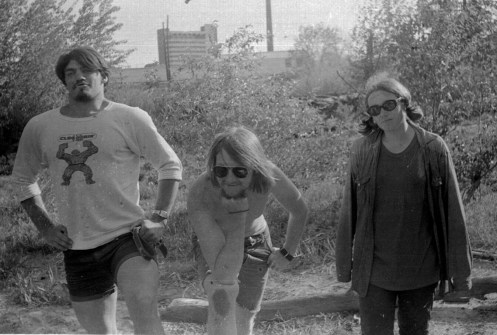
Becky Cuffe, at right, in front the Milwaukee Road tracks. University buildings in the background. The other two guys are Allen Lenhart and Steve Franklin.
January 13, 2016
Three of us in Missoula in the middle of fall, 1968, walked down to the Milwaukee Road tracks. To smoke marijuana? Maybe, but I doubt that we would have had any. I think we were just sort of wandering around in the light snowfall, probably skipping a morning class. If I remember right, it was Becky, Virginia, and me.
The railroad tracks held a fascination because in those days hobos traveled through, sometimes setting up camp along the south bank of the Clark Fork River. At most, a few hundred yards north of the University where we were students.
These days the tracks are gone and people run and bike there.
That chilly day, I’m thinking Becky led the way. In fact, the whole adventure was probably her idea. Depends on what she had been reading.
The Madison Street Bridge, where the tracks ran under, offered some protection from the snow, but not the cold breeze from Hell Gate Canyon.
An old man sat by a campfire there. We headed his way. Finally, Becky walked up to him.
“Hi,” she said, “do you mind if we visit?”
The man looked up at us. I doubt if we — two women and one man — looked threatening. Especially because Becky smiled broadly. She had a round, freckled, face and bright red hair. Like ‘Wendy,’ in ads these days.
The man said simply, “Okay.” He had a stubble of whiskers. He wore denim coveralls and a fleece-lined leather coat. His hat had earflaps. He looked like he needed a bath. He had no luggage. I figured he was a wino. Becky took him for more than that.
I wished I had brought my camera, the Argus C-3 I got from my late grandma.
 My mother snapped this photo of me the previous summer, 1968.
After exchanging some pleasantries, Becky told the man she thought he looked very wise. He smiled and didn’t disagree. We were all into Eastern religious stories with holy mendicants. Wise people and kings who posed as poor wanderers.
Memories are not clear, but he urged us to visit the university library to seek important secrets within books. “They have the secrets, but you have to look carefully because they won’t tell you where they are,” he said. He didn’t tell us more than that.
It was snowing, so Becky invited him to eat at the student dining facility. She thought she could sneak him in. “I’ll pretend you’re my dad,” she said.
He declined her offer. He sat by his fire as we three students hunkered around it. Then we stood and returned to the campus.
Oh yes, I don’t remember when he said it, but at one point he got a wild, far-off look, rolling his eyes toward the eastern sky.
He told us that sometimes he could “hear the music.” He repeated this but did not elaborate.


January 12, 2016
Even though the temp has been freezing, some of the snow and ice on the pavement is heated by the sun. Makes for a certain humid feeling, walking on the sidewalk, sporadic wetness here, ice and snow there. I can smell the wet leaves on the lawns and in the gutters. Dog shit here, yellow snow there. Yellow Gazette bag on driveway.
Three blocks to the YMCA. Often a rabbit crouches out in plain view on a lawn, but absolutely still. I’ll bet he thinks I can’t see him, poor little bastard. I think.
This morning P. and I were talking about supper. Wait. No, she was talking about the terrific troubles of 16-year-old mothers she sees at Young Families Early Head Start. Then, noticing something through the window, she cursed at a squirrel she saw on our carport roof. She made clawing motions with her hands, like a squirrel climbing. I don’t remember her exact words, but she said she believes the little critters can get into our house, although I built the carport to specifically keep out everything as small as yellow jackets. She does not believe it is squirrel proof, so she promised to crawl up on the roof when the weather permits. Just to check and take action as needed.
Her rant reminded me of our angry neighbor across the street, the one who hates mourning doves. I wondered if such hatred of squirrels and doves could be the basis of one of my popular fables?
I turned the topic over in my imagination, with my eyes closed. Nothing came to mind.
Rabbits, squirrels, mourning doves. Each hated by a person. I don’t hate rabbits, but I’m groping for a fable.
Fair to say that each of us has a scornful word. No. Two of us have actual malevolence for her own animal. What if we could each eliminate the one we believe to be a pestilence?
Per our wishes, all the rabbits, squirrels, and mourning doves magically — gone.
So: Mocking the foolish rabbit, I’d feel terrible if we no longer had the squirrels and doves.
At last achieving victory over squirrels, P. might feel saddened without the doves and rabbits. Well, she said the rabbits carry filthy disease. I’m just trying to create a symmetrical situation here. Also, I’ve never heard her say anything about the doves, one way or the other.
Finally, how would our angry flute playing neighbor having experienced final victory over doves, feel without the rabbits and squirrels to frolic, fight, and mate?
Terrible, that’s what!
Plus, I would no longer have little cute animals as inspiration for popular fables.

January 11, 2016
Yesterday I did manage to work out at the YMCA. Because she had gone earlier, P. told me she saw that firefighters were there to do physical exercise with civilians while the firefighters wore their fire fighting gear. I assumed that meant special boots, pants, coats, hats.
Thinking it was to raise money I tucked a $20 into a pocket of my exercise pants and headed over there. Worse luck! They had gone by the time I arrived. I ended up pedaling an exercise bike, listening to a woman’s basketball game with a broken headphone. I used the springy headgear to hold the broken earpiece to my ear. Southern Florida trailed University of Connecticut by 15 when I went back home.
That evening Becky took P. and me to a restaurant as a gift. Not quite, because the restaurant was closed. Instead we took Becky to Walker’s Grill and, over drinks, she told us all about her life.
I thought I was going to work this morning but lucky for me, while eating cereal, I glanced at my datebook. No work today. So I went to the basement and looked through old photographs. I’ve been taking pictures most of my life, since the fifth grade. Then I found a rather recent photo.
A blurry photograph of an older man wearing a sweater and beret took me back four years. In Paris. End of January, when P. and I had our 40th wedding anniversary. I remember the triumphant feeling I had when I snapped his picture. Then I remember the lousy feeling I had when I found no pocket money when they passed the collection plate. I’ve gotten ahead of myself.
This was our third trip to Paris and man! I thought I knew my way around. My daughter and I had even taken a night French language class a few years before and I knew how to tell the sad fate of our calico cat.
Weather was freezing cold that mid-January, early in the morning when our huge AirFrance plane touched down. Doesn’t take nearly as long to get into France as it does to leave, so we were soon on a train bound for mid-Paris. P. and I sat near the back of one of the cars when someone tried to sell us something or other. I simply gave whatever it was back. I took a photo of the inside of the car.
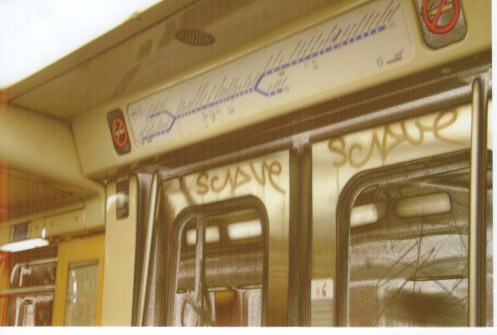
A couple minutes later, just before the train left the station, a man entered behind me, fell against me in a shower of coins, then sprinted out the door with the graffiti that looks like it said “scpve.” On each half of the door.
“What the hell was that guy doing?” I asked.
“He threw money at you,” P. answered. When we arrived at the Gare du Nord in Paris at the 10th arrondissement, we collected our luggage, but not the bag with the laptop. It had disappeared. Amazing how one’s day can change from light-hearted confidence to paranoid gloom. We couldn’t get into the hotel for hours, so we walked through the maze of Parisian streets.
Back to the story about the priest with the Beret. We had a few days to kick around Paris before our anniversary supper, so we visited as many art museums as we could. At one point during the week I woke in the night, afraid that my identity had been stolen. P. assured me that I was the same person I had been, so I went back to sleep.
The evening of that first day in Paris, to stay awake, we hiked around our neighborhood, freezing cold. We stopped at an ancient church near our hotel, black with the dust and dirt of centuries. Some young people exited. One small fellow told P. and me in English about a talent show that would take place in a couple days at the church.
Well, we went back to the church, found seats at the back of a makeshift theater, and all kinds of people performed, including an old man, the one wearing the beret. He came in carrying a suitcase and an umbrella, reciting a poem– in French, of course — into a microphone. Despite all of my evening French lessons, I understood nothing, but the audience came erupted now and again with laughter. Well, his verses rhymed. He looked a bit distressed, but I think that was part of his act.
The other acts were as you might guess: guitar and singer, small groups reciting, three men brought in dishes, dishpans, soap and towels and washed a load of dishes. One of the men was never satisfied with the work of the others and they had to rewash and rinse. That was good for maybe 10 minutes or so. We had no place to go, so we enjoyed ourselves.
Something about the January cold, the late night, the melancholy feeling left over from being victimized by a thief, and the contrast of the good will of the crowd toward the home-grown performers made us feel pretty good.
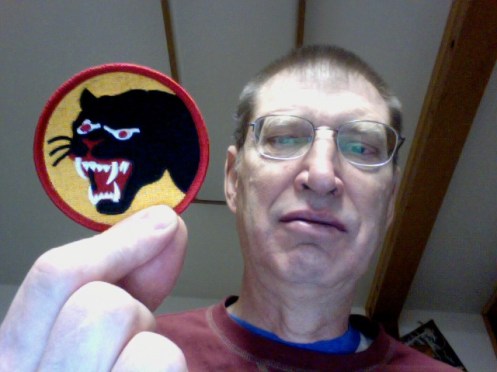
The patch of the 66th Army Panther Division.
I was happily surprised to receive a Christmas card from Roger Baker, a survivor of the SS Leopoldville sinking that killed my uncle Bud Bonde in 1944. Roger must be getting close to a hundred years old! Roger Baker has been secretary of the Leopoldville Memorial Association for the 11 years that I have been a member, and he was an old man when I joined.
Roger wrote:
Like our honored veterans age is slowly taking away my vitality. I have laughed, cried, and grieved with you over the years as we remembered and honored our heros of the Leopoldville.
The pains and weaknesses of age have begun to attack me. I am not seriously ill but slowing down rapidly.
So it is with a great deal of sadness that I inform you that I am not sure how much longer I will be able to carry on the duty of secretary, as small as it has become. I will continue as long as I feel comfortable and able to keep up with what is required. When you no longer hear from me you will know that my time is done.
The information for the LMA will then fall to our homepage on the world wide web. Please use it and support it. For more information contact Donald Nigbor, 9 harvest Way, Angleton, Texas 77515-3385.
This year I received word that Donald Gentler, from St. Louis, Missouri, Staff Sgt. of Co. K, 262nd past away. My brother was his assistant.
Thank you all for being friends and confidants for the past few years. I love all of you for the service you have rendered and the support you have given.
Roger Baker, Secretary LMA
(Signed, Roger Baker)
Always in memory of the men of the 262nd and 264th Regt., 66th Division, United States Army …….December 24, 1944.

John Herman in 1969.
“I don’t remember the first time I saw her, but I remember the last,” I told our children. “Just think. If we had made different choices over the course of 1968 and 1969 she could have been your mother.”
I got some puzzled looks, but I knew I had them hooked. Our three looked at me, then, perhaps confused or troubled, glanced away. Even so, I had their attention and they weren’t going anywhere soon.
“In 1967, in the fall, just a couple months after starting at the university in Missoula, this one college kid, eyes darting, with neatly combed long black hair sidled up to me.” He murmured, “’Do you know where I could get some pot?’”
“I felt both pride and hope. Proud that my old army field jacket and scruffy beard made me look like a hippie. And hopeful that I would find some pot smoking friends. And, of course, some pot.
“No,” I had replied, ‘But I’d like to. I’m still looking.’ We were both headed down into the Student Union. For lunch.
“Meals at the University of Montana Student Union always went on for hours, and my new friend Larry Felton and I sort of stuck together as we walked down the reddish stairs to get food. Larry looked a bit like Bob Dylan, only without the wild hair. Larry had a brown leather jacket, blue jeans, tan work shirt with a bag of Bugler tobacco in the breast pocket, and old army boots. The kind of old fashioned boots with stitching across the instep over the top.
“When Larry introduced me to a bunch of college freshmen men and women sitting at four tables that had been pushed together to form one long one, that’s when I first noticed her, sitting between two other women at the far end.
“In those days smoking was permitted just about everywhere. I didn’t smoke, but most of the others did. We drank coffee. Several of the freshman women smoked Tarryton brand, the men rolled their own. I can see them now. There was John Herman, Skip Reising, Steve Franklin, Jonna Rhein, Linda Sheble, Virginia Baker, Becky Cuffe, Kim Thompson, Scott Hendryx, Gary from New York, Mark Fryberger, Bill Yenne, Steve Spoja, Bob Verduin, Brenda Fleming, Jerry Berner, and me. Oh, they weren’t all there, every time, but this was most of our group. Some of us, like me, felt like a social misfit, even outcast. I wanted to be an intellectual, which was better than being drafted into the army to go kill people in Vietnam.”
Here I looked at our children, a bit surprised that I still held their attention.
“Where was mom?” asked our middle child.
“I didn’t meet your mother for a year,” I replied. “A couple of straight kids—we called any who didn’t look hip straight—joined up with us later, such as Dana Graham, and your mother.
“We were the ‘in crowd,’ the main group of hip students, although we sometimes found a few other strays like Mike Crowley, and Anna and Steve who didn’t bond with us. The rest of the students ignored us and left us alone. Parents and peer pressure to remain straight was strong in those days.
“At first, our group was distinguished by our clothes and hair. Boys grew their hair long, sometimes beards. Girls almost always parted their hair in the middle and wore it straight. Like Joan Baez. None of us smoked any marijuana for a long time, although we had heard that it was available. Well, you had to have a connection. We talked about drugs, because that’s what was happening in 1967. Larry Felton said he had tried smoking belladonna. He had tried inhaling freon. Said he almost saw God before the effect wore off. For some reason, I don’t think anyone else tried the freon. Some of us later tried belladonna but that stuff made for an unpleasant experience. I mean, ultimately we smoked about as much weed as we wanted, but it took a long time, months”.
At this point I looked at the kids who looked back expectantly.
I continued. “I was attracted to a woman at the end of the table. She had long, straight, blond hair that she parted down the center. I was taken with her wide distinctive smile. She seemed shy and she we were in a journalism class together. At first she seemed indifferent toward me. She often seemed to hurry away. When I asked her if she smoked pot she replied, ‘Herbs are not for me.’ Only she pronounced ‘herbs’ with a hard ‘H’ like the name ‘Herb.” I thought her face looked sort of lamb-like. I think I told her so, and she wasn’t offended.”
About then I remembered that things didn’t really go as I described to the kids.
I confessed, “I didn’t immediately take up with the hippies at the Student Union that fall. No. Even though Missoula was my home town, I didn’t know anyone there when I returned after my years living in Dillon. You know, I looked up an old girlfriend from fourth grade, Virginia Stewart. We met off campus at a religious place where she boasted about her fiancee, a soldier. You can guess how I felt.
“Ended up feeling even more lonesome. I hung out with some old high school Dillon friends, but none aspired to be hippies.
“I was sort of torn between worrying about my hair being neatly combed and worrying about my hair being long and wild looking. It really did boil down to hair style.
“My friend Dave Duncan let me use his hair conditioner and although he had sometimes liked to drink, we were not 21. We had been able to get beer in Dillon — Whitehall, actually, but we didn’t know how in Missoula.
“By the time cold weather hit, I had my first few encounters with Larry and the hippies of the Student Union. I had a hard time figuring out what I was about. I knew I didn’t want to go into the army but I wanted to smoke pot, perhaps drop some acid. I also wanted to remain in college and be an intellectual. A writer, perhaps. My goals shifted around. I found it easier to be against things than to aim for something.
“Also, once I did become part of the hippie group in the Student Union, we did a lot more talking than anything. And cigarette smoking. By Christmas I had learned to smoke. I also got good at playing my cheap guitar. Mostly ‘Desolation Row’ by Bob Dylan.”
I wondered how long I could hold the kids’ attention. I sensed they wanted me to tell them the good stuff.
“I don’t remember the first time we smoked marijuana,” I said. “I mean I do remember the first time I ever smoked. With my brother and his friends in Eugene Oregon in the summer of ’67. I just don’t remember the first time in Missoula. By Christmas our freshman year many of us had smoked marijuana, but it was expensive, even then.
“I haven’t smoked any since 1978, but I understand that marijuana is many times more potent than it was in the ‘60s. We almost always walked up Mount Sentinel a short ways to smoke grass. Just us college hippies. We didn’t mingle much with others. Sometimes Larry or somebody would bring a cousin or someone to town from Billings.
I could see that my kids expected more from me than the story of my college drug use.
“What about mom?” our daughter insisted.
“She could easily have been another woman,” I said. “The hippie women did have their eyes on us, and we had ours on them. This was seldom obvious to me, but I remember a snippet of conversation I overheard between Becky Cuffe and her friend Jonna Rhein as we hurried somewhere through the cold weather. ‘Which one of will get Dan?’ Becky said, with a laugh. I knew that was just a joke, because Becky really liked John Herman, although I don’t remember ever seeing them doing any of the things lovers do, like walking hand-in-hand or cuddling or kissing. People in our group just didn’t seem to do that. Well, me and one of the women did, finally. It was me and this woman. Actually, she picked me and had to question me and tease me to confess that I really liked her.”
“I suppose that happens more often than not,” I said to the kids.
“Was she the one who would have been our mother?” asked our oldest son.
I pretended I didn’t hear him.

Carl Bonde’s high school graduation picture, 1941.

Carl after Army basic training.
Who was Oswald Veblen? Carl Ralph Bonde, Jr.’s mother thought highly of him because he was a mathematics professor at Princeton. Oswald specialized in geometric theorems. Carl visited Oswald at his home while on his way to England in the late Fall, 1944. Interested readers can check Oswald Veblen out at Wikipedia.
Carl died Christmas Eve when a U-boat torpedo sunk his ship, the SS Leopoldville. The Leo was properly designated “SS” because it was a Belgian troopship that had been requisitioned to transport thousands of Americans to France across the English Channel.
Of possible interest:
*U-486, the German submarine that sunk the Leo, was just one of many that had sat on the bottom of the shallow English Channel waiting for Allied ships.
*Submarines, like U-486, were of type VIIC. They spent only four hours a day, at most, below the surface. Mostly they sailed like any other ship because, even though they had snorkels, they required air from the surface to run.
*The U-boats had to be continuously modified and upgraded in response to the allies’ ability to track and kill them. Many of the upgrades were not satisfactory, such as conversion to electric engines. The electric engines were slower than the allied ships.
 Thorstein Veblen was Oswald’s uncle.
For a long time I thought my maternal family’s boasts about Veblen were hollow. I believe I know the connection now.
Thorstein was my grandfather’s half-cousin. Grandpa was about 30 years younger, and they probably never met. Also, Thorstein got away with a hell of a lot more mischief than grandpa ever did.
However, grandpa Carl Bonde had the advantage of a laid-back life. That, and being retired and able to retreat to his barn several hundred feet away from grandma and the house, to speak Norwegian with his friends.
Thorstein was smart. He went to college in Northfield at 17. In a few years he could confuse and intimidate anyone who got in his face. Any pedagog who did not understand Thorstein’s murky satire was sunk. The ones who did understand mistrusted him because he was a socialist. In the end, Thorstein couldn’t prevail against the wagging tongues of others in academia.
Worse, he was a professed agnostic despite his Norwegian and Lutheran world of Nerstrand, Minnesota. How could he fit in? Being godless not only didn’t win him many friends, it kept him from gaining a foothold as a sociology professor, where being Christian was required.
Read more in Wikipedia, if you are interested.
Thorstein had numerous extramarital affairs with students and faculty at a list of universities. He had lower and lower academic ranks at lesser and lesser institutions. He stayed with his parents at their farm east of Nerstrand for seven years.
Did I mention that Thorstein Veblen was a widely known economist, known for his books, especially his Theory of the Leisure Class? No? Well, I forgot. The book was satire, but taken seriously as an economic treatise. Now days, its value as an economic work is minimal. It’s value is literary, as I said, as satire.
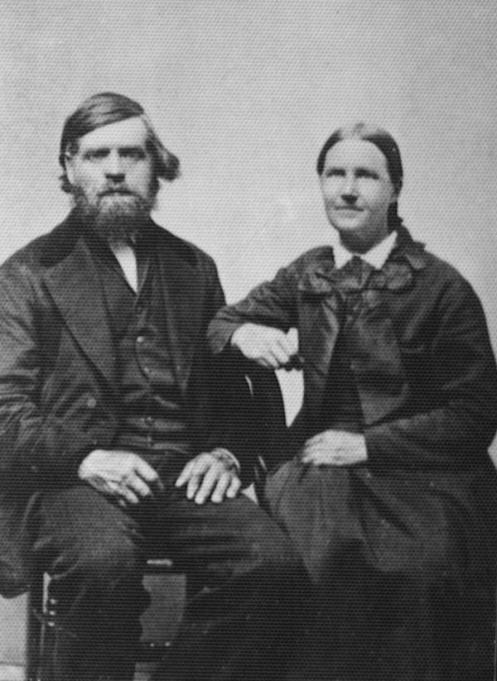
Thomas and Kari Veblen were Thorstein’s parents, who immigrated from Norway ahead of Kari’s mother Berit, who remarried after Kari’s father’s death in Lillihamer, Norway. Kari was Tosten Bonde’s half-sister.

My grandpa Carl Bonde, Sr. is the boy in the white shirt, standing in front of his parents’ stone house near Nerstrand, Minnesota.
You remember Tosten? Tosten built the big stone Bonde house, also close to Nerstrand.

My daughter and her family took P. and me to visit the National Eagle Center in Wabasha, Minnesota. Turns out this center is national in name only, being a private enterprise. Clara suggested that its “national” designation was on a par with the National Wood Carving Center, also in Minnesota, I think. Nonetheless, we piled into the Toyota Sienna Minivan: Clara and her husband, our three grandchildren, ages 6, 8, and 10, P. and me. Clara forbids me from using the children’s names on Facebook or on my popular blog, with its tens of readers.
You know what you’ve heard about Minnesota winters? They are all true.
En route we made the usual jokes, small talk, sang the usual songs. Additionally we told new jokes and sang new songs, such as this one that I learned from Clara’s brother Robert:
Twinkle twinkle chocolate bar
Your dad drives a rusty car.
Pull the lever, push the choke,
Drive away in a trail of smoke.
Twinkle twinkle chocolate bar
Your dad drives a rusty car.
After 40 minutes or so, two of the kids complained of nausea. Clara’s husband handed back a stocking cap for someone to vomit into. I opened up two plastic Walmart bags. Clara drove slower. We eventually reached the National Eagle Center. No one had gotten sick.
The highlight of the Center experience: a lecture by a small woman with broad smile who spoke with confidence of the eagle’s ability to eject its poop six feet, clear of its nest.
We were some of the first into the lecture room so I sat in the second row next to a large old hairy, bearded man in coveralls. He began asking me questions, such as where we were from and how long we planned to stay. I asked him if he was an old pot-smoking hippie. He hesitated. Too long, I thought.
“Come on!” I demanded.
“Not since they made it legal to smoke,” he said. Of course I didn’t believe him.
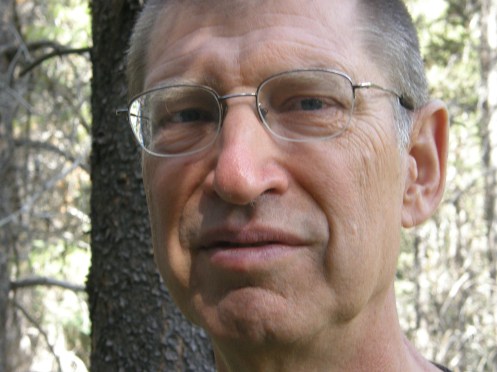
One thing follows another.
January 1, 2016
There has to be a word, a single expression for this longing I feel for ones long gone. Grief, certainly. A young lovely woman, and my father. My uncle, my mother, and my brother.
Shit.
Too often my sadness is misperceived by P. as anger. I have been angry before, but I don’t feel that way.
So last evening P. and I hiked several miles across Rochester, Minnesota, from our daughter’s to a nursing home. P. and our daughter’s three children had decided to go spend their Christmas money on toys, but also on gifts to donate to those who live in a nearby nursing home. Nearby if one drives, of course, but a substantial hike in cold weather in Minnesota. I had to pee on the way, so I peed on a fence in an empty field. Well, it was about 6 p.m. and almost dark. Maybe 5 p.m. and not dark, but getting dark. Probably closer to 4 p.m. I still had jet lag from visiting our son in Bethesda, Maryland. And his family. I don’t think anyone saw me pee in the field. But then, they might have. So what?
Anyway we hiked on a plowed trail along the Zumbro River without the faintest idea of what the nursing home looked like, or even where it was, exactly. Soon we saw a woman who walked two dogs. I asked P. to inquire about the nursing home. She declined and we said, “Hi.” She returned the greeting. Long story short, we hiked another 15 minutes, got cold, turned around, and encountered the same woman coming back.
This time I said, “Excuse me, is there a nursing home near here?”
“Yes,” she said, “my mother lives in that one over there. Do you have someone in there too?”
P. explained about gifts for the ones living in the facility. She asked the woman to recommend some gifts. She recommended blankets or throws.
When we walked back home along the Zumbro we saw hundreds, if not thousands of geese in the water near our side of the riverbank


 insearchofbud