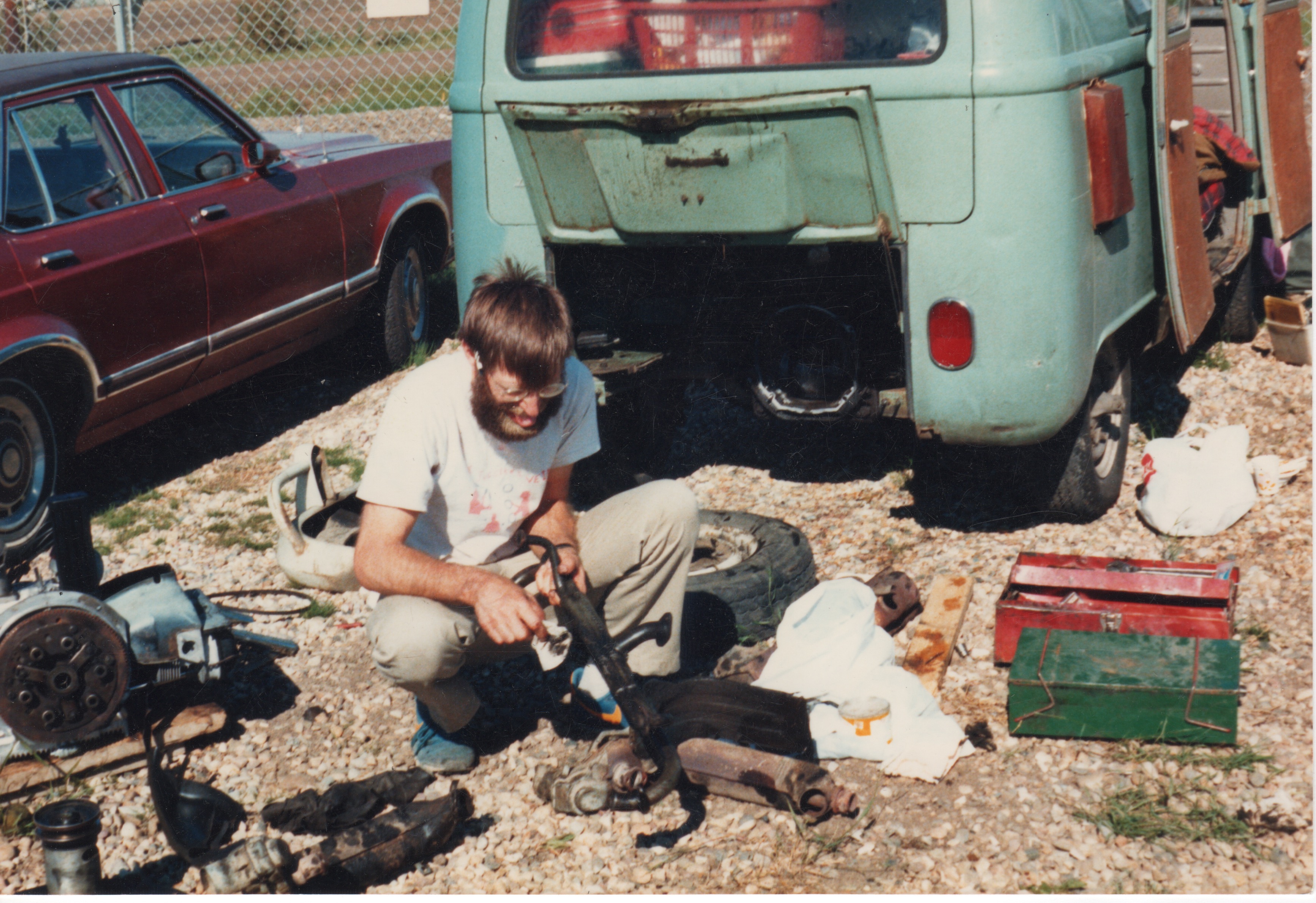
I worked on the van in the parking lot across from the Nisku Inn
Buddy’s high school years
His sisters dominated the Bonde household during the turbulent years leading up to World War II. Corinne was a singer, a diva; she had a singing part in a high school production of Gilbert and Sullivan’s H.M.S. Pinafore. Helen was a serious student and played the flute in the school orchestra. Carol was much quieter than either of her sisters, and all of them loved Buddy dearly.
I inherited Buddy’s high school annual for 1940. Nowhere was his name printed, but many of his friends signed it. Buddy was a Boy Scout; he liked to camp, hunt, and fish. He enjoyed chess and bridge. He was damned intelligent. In many ways, Bud’s high school years paralleled those of our three children as they negotiated the sorrows, hazards, and pleasures of their teenage years.
Chapter seven
Penny and I discovered the house while walking the Billings neighborhood. Our quest that fall day: walk to Clark Avenue and admire the castles, including the Moss Mansion.
We returned to Burlington Avenue, headed home toward the place we rented on the 400 block. In front of a green house on the 200 block shined a pickup’s tail lights. I walked to the door and notified a young man who thanked me, saying a faulty brake pedal spring made the lights go on. He trotted out to the truck while Penny and I walked two blocks home.
More than a year later, I got a job working the night shift at the hospital and a raise to $10.20 an hour. Penny and I looked to buy a house, but they were scarce in 1983. The only suitable house for sale was the one where we asked about the truck tail lights.
We thought we could afford a $500 a month payment, so we asked a real estate lady to offer the owner, John Frasco, a suitable amount. Of course, he turned us down, but ultimately accepted. We moved in during a blizzard, January 1, 1984.
To our sorrow, Burton the cat ran out the back door never again to be seen and admired. The temperature was at least twenty below. The next day, we drove up and down the streets and alleys, but no luck.
The house we bought—a 1925 bungalow—may have had some mixed karma. The family who lived there before us had suffered a tragedy: they lost their mom to a heart attack, apparently. They had a couple of kids, at least, past high school age.
Originally it had two official bedrooms, a vast unfinished attic, a full basement that had been mostly finished, but flooded years before. The washing machine and dryer were parked in the unfinished part of the basement. I sat on the washer. I looked up at the floor joists.
I loved the floor joists, the pipes, the wires. The concrete floor, the furnace. The furnace had been a coal burner, then an oil, then a natural gas. A squirrel cage fan forced air through the steel ducts. I loved what I saw.
The steep stairs to the attic led from a door in the back bedroom, making two left-hand turns. A bare bulb illuminated the huge wood-floored space. Marks from countless roller skates.
The house was painted a sort of brownish green throughout. It had filthy, greenish carpet.
I wanted to make the place mine. We ripped up the carpet and painted a bunch of boards chocolate brown for baseboards. I aimed to fix up the attic.
It took me a day to break a hole in the dining room wall, move the door from the bedroom, and cobble a straight stairway up. Nephew Chuck Angel helped me insulate and frame and sheetrock the attic. By then it was spring and our two sons moved upstairs.
It has since been floored and carpeted, windowed and re-windowed. A great place to freeze in the winter and swelter other times. Look how tough it made our kids. Todd is a man, now, sleeping in an old house in Duluth—upstairs without heat—with his wife and two sons of his own. Bob lives in Billings. Clara used to brave the Minnesota winters, but now lives with her family near San Diego.
The door that used to lead to the attic has been removed and the stairs replaced by a real carpenter. A couple months ago I took the door to the NOVA theater to install as part of the set for A Christmas Carol. The door was successfully opened and slammed shut (after suitable reinforcing) numerous times. Then the door appeared in the play No Exit. And Free Birdie. Now it has increased its repertoire to include Shakespeare’s Macbeth.
“Knock, knock! Who’s there?”
Most of the years our kids were in school remain a blur for me because I worked the overnight shift at the hospital pharmacy. I’d come home tired and sleep as much as I could until the kids got home after school. Penny was a Head Start teacher.
I begged the people in the pharmacy at Deaconess to let me work a share of days like everybody else, but they wouldn’t. I quit abruptly after five years.
I worked at the other hospital up the street, Saint Vincent’s, to cover the shifts of two women who took maternity leave. We had to be sneaky about dispensing birth control pills in a Catholic hospital. We kept the pills on an out-of-the-way shelf.
Once my term at Saint Vincent’s ended, Clinic Director Joan McCracken hired me at Planned Parenthood to dispense birth control pills, creams, jellies, devices, and antibiotics for sexually transmitted infections. I also conducted mother-son and father-son sexuality classes. The folks at Planned Parenthood were kind, professional, and competent.
I got good at explaining how to take birth control pills. After months of this, I had an epiphany. I realized I didn’t have to make the long spiel to those who already knew how to take them. My task was to determine who needed the spiel?
Here’s what I learned. If they could answer two questions correctly, I could be fairly sure their knowledge was sufficient. My questions: 1) (handing the pack of pills to the woman) What’s the first pill to take? And 2) When will you take it?
Depending upon their answers, I had a feel for how much time I needed to spend going over the instructions.
This style of pharmacist-patient interaction helped me throughout the next thirty years.
I was afraid only once during my thirty years as a pharmacist. A social worker at Planned Parenthood told me she would offer dietary counseling to anyone who wanted it. She suggested that I could make referrals.
“Great,” I said. That morning a large woman came in for a refill of her birth control pills. As I prepared them for her, I mentioned the new dietary counseling we offered.
Her expression looked a little like an approaching thunderstorm.
“Are you saying I’m FAT?” she demanded, placing her hands on my desk and leaning toward me. (Silence.)
I lied. “Oh no, no. Nothing like that…”
Another time, a teenage patient told me she knew my sons, and said the one was “wild.” I knew it was time to find a new job. I didn’t want to compromise anyone’s privacy.
Penny suggested I check with the Public Health Service for employment, and that’s how I became friends with Captain Bob Ashmore, the Billings Area Pharmacy Officer. He helped me in more ways than I can say.
I applied to be a commissioned officer with the US Public Health Service. I aimed to work in the IHS (Indian Health Service) at one of the nearby reservations. Best of all, my seven years of service in the Marines would count toward my eventual retirement.
Even better, I would soon outrank the Marine major who as much as asked me to hit him when I was a private. Funny how things change.
Joan McCracken said to me, “Don’t leave Planned Parenthood. Do you want a tribe? I’ll get you a tribe.” Her husband, Dr. Clayton McCracken, the clinic medical director, was a retired commissioned officer with IHS. Joan was funny! Clayton was always quiet, but kind and firm.
North to Alaska in a hippie van
My application for a commission in the USPHS took about a year. For a time I was between jobs. I worked as a relief pharmacist in Red Lodge, Hardin, Colstrip, and Roundup. Job security wasn’t great, but it was daytime work, and usually fun.
In June, 1987, the day after school let out for the summer, we packed up the family and headed to Alaska in our 1964 green VW van.
My unspoken aim was to protect our teenagers from themselves. The green VW van had an old engine that used a lot of oil. What the hell, I thought. We didn’t have much money, but I had two credit cards with credit limits of about a thousand dollars available on their accounts.
The van always had trouble with overheating. I fastened a cake pan to one side and a broiler pan on the other, near the back of the van, to serve as air scoops to force more air into the engine compartment vents. This gave it a distinctive, homemade look.
We bought the van in 1980 when Larry Felton helped us pull it out of a field up the Bitterroot Valley. It had hay growing up through its rusty floor and some bailing twine in the back. The ’64 took us on adventures in northern Idaho to work on a lookout tower with Andy, our llama. Our kids slept in the van with rain dripping on their heads at Priest Lake. In the cold, in late spring.
This is the ’64 VW we eventually drove to Alaska. Well, part way there. To a place twenty kilometers short of Edmonton, Alberta.
As we headed into Canada, we needed to add oil every hour or so. As I drove, I mentally calculated how many cases of oil I’d need to reach Alaska. I contemplated buying several dozen.
That night it rained and the wind blew. Then the engine emitted a kind of loud howl and we lost power. The “check oil” light shined bright yellow. I stopped beneath an overpass. A green sign in the headlights said Edmonton was twenty kilometers distant. I opened up the engine compartment that smelt of burnt oil. I checked the tension in the fan belt. There was none. It was loose. We decided to get some sleep. Todd took his sleeping bag to the borrow pit.
The next morning was sunny. Todd and I walked to the top of the overpass and spied a distant sign. Looked like it said, “Husky Inn.” As we walked closer, we saw we had misread the sign. We also found a license plate in the shape of a polar bear.
The Nisku, not “Husky,” Inn was a hotel. Todd and I walked into the lobby as some people were boarding an airport shuttle. Without a word, we filed aboard the shuttle with the others. At the airport, we rented a small car, then drove triumphantly to our disabled green van. Using a tow strap, we towed our van backward, up the on-ramp, toward the Nisku. We were glad to see a parking facility near the Nisku. I jumped out to talk to the owners of the lot. They were kind and generous.
We ended up staying several days in the parking lot across the highway from the Nisku Inn. The owners allowed us to use their phone and to repair our van on their lot. They even fastened some “get well” balloons to our dead engine.
We bought a new engine from a dealer in Edmonton, but the engine hemorrhaged oil when we tried to return the rental car.
Once we saw the heartbreaking mess of oil, we towed the VW, new engine and all, back to the parking lot. Still early in the day, I phoned the guy who sold the engine, who advised me to check a pair of rubber seals at the oil cooler. So I again struggled with the tools, removed the engine, then dismantled the tin. I removed the oil cooler, checked the rubber seals, put the whole works back together and got the engine back in and ready to go before dark that same day. The kids spent another day swimming in the hotel pool at the Nisku Inn.
I fired up the engine again, and as it idled, I made the compulsory check back under the rear. So far, so good. Until came a fat stream of oil pouring down. Again.
I jumped up front and switched off the ignition. This time, after perhaps fifteen seconds, I howled with rage and tears as I pounded my fists on the big round steering wheel. “Boo hoo! I quit!” I cried, looking at Penny, who looked at me like I was an imbecile, but said a comforting word.
The following morning, on the phone from the parking lot office, the dealer in Edmonton supposed I needed a different sort of rubber oil cooler seal, so I drove to town in the rental car and came back with some robust seals. And more oil. Once I had installed these, and mantled and installed the engine, we returned the rental and drove the van to the dealer to have the mechanics check my work.
The mechanic walked to the van, started the engine, pulled the throttle all the way open so it made a deafening roar. The tin around the cylinders blew outwards like an inflating balloon. “Looks good,” he said. “Don’t baby it, aye.”
The engine was stronger than ever as we sped north. A couple days later we arrived at Dawson Creek. At this point we were ready to start our long journey north to Alaska!
The Alaska Highway seemed endless. We took turns driving, and when tired, we slept in the back with various teenage children. Clara kept a tally of gophers and of dead gophers. “G” and “DG” in her notebook.
We often had to push our van to start the engine. Early one morning when I was driving, I had Todd push the van while I popped the clutch. He pushed us up the hill, then back down. Then I thought to turn on the ignition switch, which was a household light switch fastened to the dashboard with screws.
I wish you could have been there for the adventure of traveling north for almost a week, sleeping in the back of the van. Not just riding and sleeping, but changing a flat with a spare that was in a box bolted to the roof. In a box, along with a spare can of gas and most of the camping equipment.
Our van was loaded with extras: extra carburetor, extra generator/fan combo, extra distributor and coil. All of the things one might need, plus the tool chest and container of hand cleaner. Once we left Edmonton with our new rebuilt engine, we had a much better vehicle than the one we started out with.
We soon learned that the best places to pull off the Alaska Highway for roadside adventures were any of the bridges. That’s where we found Edith Creek, a paradise without anyone else’s tracks. You could drink the water, go swimming and come out bright red and blue, or make a fire and hunker. A great place to go for a break.
Things were good, except our son Bob suffered episodes of vomiting, which we treated with prescription suppositories. Only we ran out of them. Somewhere in Canada we stopped at a public clinic. The doctor told us the vomiting was a symptom of the severe kidney pain Bob suffered. This was news to me!
Bob had colicky pain in his kidney, and we could do nothing for it but treat the symptoms. Once we got back to Billings, many weeks later, he went in for surgery to correct a blocked ureter. Many years later, he needed the surgery to be revised. That’s when he helped me start my blog, In Search of Bud.
Once we crossed from Canada into Alaska, we drove all day to get to Anchorage, to my sister Carol’s house. We ended up staying several days, going salmon fishing at the Russian River on the Kenai Peninsula.
Everything in Alaska seemed to cost a $20 bill. We called the twenties “frogskins.” We all got three-day fishing permits for a frogskin apiece, bought some brightly colored flies for another frogskin, then proceeded to the river to a parking lot. Cost a frog to park. We arrived at 11 p.m. It never got dark, so we waded into the icy river. Turns out the dark shapes we saw were salmon. We weren’t allowed to snag them, so we cast our lure, reeled it in. If a fish came in sideways or tail first, we unhooked it. If it came back headfirst, we kept it. As the morning became brighter, I could see the river bottom was littered with brightly colored flies like the ones we bought.
A moose calf loped along the riverbank while we fished. I think we were all allowed to keep three fish apiece. They each weighed about ten pounds.
We froze all our salmon in Carol’s freezer, then wrapped them in newspaper and added dry ice. On our way back to the lower forty-eight states, we found some more dry ice for sale at White Horse. Cost another frogskin. My nephew Chuck and one or two of his brothers accompanied us back to Montana, via Glacier National Park. Chuck had a red VW van with a rusty gas tank that often choked his gas line filter. We swapped out his gas tank in Billings.
In August of 1988, I got commissioned as an officer with the US Public Health Service, along with orders to go to Lame Deer, Montana. The clinic was exactly 106 miles from my house. Commuting distance for the next seventeen years until I retired.

London, England, December 23, 1944
Carl — his family called him Buddy — was in England, in the army, an hour by train from London. He was sitting on the step to the brick barracks at Camp Piddlehinton.
Things sure looked different now that the US had practically won the war. After D-Day, the allied forces pushed the Germans out of France. The rumor was that Hitler was on the verge of quitting and accepting whatever peace terms were thrust upon him.
Buddy didn’t know what to do with himself, so he stood and returned to his bunk with the straw mattress inside the barracks. He collapsed on it. About that time, Hank showed up, a tall lanky guy from the mortar section, with enormous feet. “Let’s go into town, Carl,” he said. “Let’s go see the sights!”
“You know there’s more to life than ‘sights,’” Carl replied. [Pause.] “There’s great big bouncy babes, too.” They laughed.
Carl grabbed his tie from the foot of his bed, inexpertly tying it as they walked over to the command tent where they could get 24-hour passes to town. With the Germans on the run, passes were easy to get.
Inside the tent, Carl and Hank had to stand for a few minutes behind five or six other GIs who were waiting to speak to the clerk who worked for the First Sergeant. The men called him the “First Shirt.”
Sure enough, the clerk filled out passes for them. They didn’t need to be back until the next morning at 11am. Christmas Eve was Sunday and the men had high hopes of spending some of their pay on presents for their sweethearts and for their families back home. Carl was hoping to do a little bar-hopping with his friends, maybe get drunk, then “va va voooom,” he thought, smacking his lips. He hoped to kiss beautiful British women. Hell, he heard there were plenty of women in London who would do it in a doorway for a pair of black market silk stockings or a carton of Lucky Strikes.
The train station was about six miles away in Dorchester, so the men stood by the road with their thumbs out. Soon a soldier they recognized as a general’s aide stopped his jeep for them. He was able to give them a ride the whole way. The clerk had to meet someone from the train station, top secret, he boasted.
The train car was wooden–wooden seats covered with plush cushions–wooden walls, varnished and shiny. The locomotive spewed huge clouds of black coal smoke. Luckily the wind was blowing from the land out to the channel that morning, because the cloud didn’t gag the men in the train as they headed for London. The group had the above-mentioned Hank and Carl, but also Bill Loughborough, Bill Moomey, Al Salata, Maurice O’Donnell, and Randy Bradham. Enough to start a game of bridge, even though they’d have to stop playing in just over an hour.
The train took them to Piccadilly Circus in London and they all piled out. Some of the men went to find something to eat. You could get fish and chips almost anywhere for a shilling. A couple of shillings and you could get a warm English beer, too. Only the beer in England was a true pint, way bigger than American beers.
Carl managed to slip away from his friends, saying he wanted to go browse a store for a chess set. He did this after all his friends committed to going to a show. A burlesque show with honest-to-goodness women with big, bouncy breasts.
Here’s where the story gets murky. Bill Moomey and Hank Anderson swore that Carl returned to the camp with them, but Bill Loughborough said he wasn’t quite so sure. In any case, subsequent events didn’t permit any easy answer to this question.
Chapter five
Standard Street apartments in Santa Ana, California
Penny and I married in Lewistown, Montana, January 30, 1971. She and I had a brief honeymoon: we went by train from Bozeman to Missoula where we stayed a couple days in the Palace Hotel, in a room with a noisy radiator that had been painted silver. I don’t know how we got around after that. I think we walked. Somehow, we got to my mother’s in Dillon, perhaps by bus.
Penny lived with my mother in Dillon for several months while I returned to Santa Ana to the helicopter squadron.
For those months, I continued to save nearly all of my military pay–about $100/month– at the base credit union. I lived in the barracks and ate in the mess hall. I needed several dollars a month to buy razor blades and laundry detergent, two items I couldn’t live without.
Each evening after work, I changed into civilian clothes and I bicycled around Santa Ana looking for an apartment to rent. I gravitated toward the majestic old bungalows with rooms to rent and shiftless looking people hanging out. I was a hippie at heart.
Then I got serious. I checked out the places other Marines rented. I found a modern-looking, if cheap, apartment on Standard Street in Santa Ana for $115/month. It looked something like a two-story motel with an inner courtyard. Other, similarly designed places, had swimming pools, but ours didn’t. The place I rented was on the second floor. An avionics guy from Texas in my squadron lived with his wife a few doors down from ours. He had a Volkswagen Bug and offered to give me rides. I had a bike, though, so I didn’t take him up on his offer unless necessary. He gave Penny and me a ride to Saint Joseph Hospital when Todd was born.
I asked around the helicopter squadron if anyone knew how I could earn some money. A gruff sergeant, who ran the group mail room, helped me get a job cleaning a Xerox regional office a few miles away. I had a bike to get me there.
Penny joined me in Santa Ana, California, in April, with a suitcase full of sheets and blankets and towels. Sergeant Bobby Haines drove me into Los Angeles to LAX to pick her up and drive us to our Standard Street apartment.
We had a dining room table, chairs, and a bed. Our books, most of them given to me by Corporal Jim Harrington, were lined up on the floor. Penny’s radio didn’t work. I kept my bike in the living room. As soon as I could, I bought a $50 radio with our savings.
A Stater Brothers grocery was on the next block, and Penny bought some rice, cheese, and cauliflower. I bargained with a produce man for a wooden orange crate to make a small bookcase. Cost me a dime. I bought a square iron skillet for a dollar, or so. I don’t know. Round ones looked so ordinary. I found a piece of weathered driftwood about a foot long and put it in our living room as an art object. Everything looked so plastic in the city. I needed something earthy, like a piece of driftwood. I’ll bet it’s around here somewhere, even fifty years later, like the square skillet.
The only recreation we had was reading to each other. Penny read aloud Monkey, a Chinese Folk Story, translated by Arthur Waley. When she finished, I read her Don Quixote, translated by Putnam. I was still reading Don Quixote when Penny was in labor with Todd.
Each morning, I cycled through the Santa Ana orange groves to the helicopter base where I worked until 4:30. Then I pedaled home to eat the cauliflower, cheese, and rice that Penny cooked. We couldn’t afford meat. We kept a notebook to record our expenses.
After supper, I bicycled to my evening job cleaning the Xerox building. I got shit from my boss for talking to the other cleaners. My supervisor was the same sergeant who worked in our squadron mail room, a depressed-looking guy who didn’t like me to lean on my broad dust mop and talk. I quoted to him from the I Ching that said words to the effect that a little recreation makes the work lighter and improves morale. The sergeant scowled, but I didn’t care.
I studied the Xerox corporate amenities that got more elaborate as I proceeded down the hallway and upward in the chain of command. Here’s what I noticed: The pipe tobacco of the vice president was Balkan Sobranie; in the president’s office, it was Black Mallory. I remembered Peter Koch telling me, back in 1969, about Black Mallory. Finest tobacco anywhere, he said.
The regional president had his own shower and dressing room. Vice president had a large waiting room, but none of the other stuff. Down the chain, the offices got smaller.
As we workers cleaned our way down the hallway from the apex of power, I noted a curious phenomenon: the number of staples in the rugs increased exponentially. We picked them out of the carpet with needle-nose pliers.
In those days (1970s), computer work meant punching eighty-column key cards. I never found out what all those staples were used for.
I’d get home to Standard Street about nine each night, ready for more reading.
Todd was born on April 29. I was in the maternity waiting room when Dr. Wing came in. “Mr. Struckman, Mr. Struckman, what do you want?” he asked.
I stood up, puzzled by the question. I replied, “A cup of coffee?”
“It’s a boy, Mr. Struckman!”

August 14, 2023
At last I’m back in the groove, telling my all to my blog post readers. The subject I want to broach is “Pharmacy Counseling.”
Do you want the pharmacist to counsel you? hmmmmm?
Neither do I.
End of subject?
Not quite.
Actually, I suspect you did want the pharmacist to counsel you.
You’ve got a prescription for some sort of new medication.
Of course you want to learn how it will affect you, IF you don’t already know.
Perhaps you’ll tell the pharmacist you already know. Great! Goodbye! It’s not a knowledge contest!
On the other hand, maybe the medicine is new for you?
Your doctor probably told you a bunch of stuff when she gave you the instructions to visit the pharmacy to pick up the medicine.
Here’s my distilled wisdom from my long career as a pharmacist.
Try to put yourself into my huge shoes. They are size 15. I have a grandson who would likely tell me he couldn’t possibly squeeze his feet into them.
A patient comes to me with a prescription. I count out, pour out, measure out the appropriate medicine, put it in a bottle, affix an appropriate label with the prescribed instructions. I let you know it’s ready. I’m standing there, half-smiling.
Now what?
I could, you know, simply hand you the medicine in a bag, staple it shut. Ask you something that would hurry you out the door. What would I ask you to hurry you out the door? I would ask you if you have any questions? I know the answer to that one. It is always, “no.”
As a pharmacist, if I’m at my wits end, exhausted, I want to get rid of a patient! I ask them, “Do you have any questions?” (no)
Then I say, “good bye!
What I mean is, “goodbye, get out! Go away! Now!”
However,
If I were a professional person, who cared about you, I would counsel you. Of course I would. I am a professional person, and I DO care about you!
Here’s what I would most likely say: “Hello! Thanks for letting me fill your prescription! What did the doctor say she was going to give you?”
You can say whatever you want at this point. Maybe the doctor gave you some medicine for your back pain? You might say back to me: “She said she was going to give me a muscle relaxer.” I don’t know, “a blood pressure pill.” Whatever.
I’d then say, “Right! This is a … muscle relaxer (or whatever). When did she say to take it?”
…and so on. The kind of counseling I learned to employ, is to verify that the patient knows what the medicine is for, how and when to take it, and what to expect from the medicine. Depending upon the type of medicine, other questions would be appropriate.
I learned the “verification technique” while working as a pharmacist with the US Public Health Service.
It’s been years since I was an actual pharmacist. Do I (ME?) want to be counseled? Yes, of course.
It’s all about a highly trained professional adding information to the patient’s knowledge base.
At least it was for me.
1969 Missoula
When I was eight years old a big kid chased me toward the corner of the school playground. Cornered, I ran at him as hard as I could. I threw myself at his legs, knocked him down, then ran to safety.
During the Vietnam war, our government was drafting young men to go to war. We had been told, in 1967, in a high school assembly by a recruiter, that every man owed the United States six years of military service. Generally, that would mean two in active duty, four in reserves.
Vietnam was killing thousands, according to the horrifying images on TV news. At the University of Montana in Missoula, I made friends with those who preferred smoking marijuana and taking a variety of hallucinogenic substances to being drafted. I pretty much lost interest in my student deferment. I thought it unjust that us white middle-class kids with the means to go to college should avoid danger, even though I didn’t want—was afraid—to go into the army.
I ended up doing something like I did when I was eight when I ran toward the pursuing bully. In 1969, I enlisted in the Marines. Because I was afraid.
Always in my mind was the thought of my uncle, Carl R. Bonde, Jr., Private First Class, 66th Army Division, who had been sent to specialized training to the University of North Dakota under the Army Specialized Training Program (ASTP). Uncle Carl was killed on Christmas Eve, 1944. Uncle Carl had been drafted. I didn’t want to be drafted. He had been enticed with high-tech training in a program that was abruptly discontinued. He and thousands of others in the ASTP ended up in the infantry as army privates.
I enlisted in Missoula November 23, 1969, on Penny’s twentieth birthday, a sad occasion, because we agreed to break up then.
I said “goodbye forever.” I was off to Vietnam, of course. Everyone knew that’s what happened if you joined the Marines in those days. Didn’t they? I had my faith. I had been reading a bunch of Eastern religion stuff: Taoism, Hinduism, Buddhism. All of them extolled mortifying the flesh and entering reality. The Vietnam war was my reality, naive as I was about the particulars. I knew I was a hippie, but I also knew I couldn’t stick my head in the sand or be a coward. Real hippies were brave and true. Or so I thought. I was also under the influence of Don Quixote.
I’m re-reading Don Quixote as I write this. In 1969 I read the Putnam translation, but now I’m reading the Ormsby translation. Mr. Ormsby used Putnam in his scholarly re-writing in English. Nonetheless, it was written by Miguel de Cervantes Saavedra.
Under the influence of Sr. Cervantes Saavedra, even joining the Marine Corps during Vietnam makes perfect sense.
My friends shouted at me to not go! Many of them joined anti-war demonstrations.
Whereas people on the street had enjoined me to “get a haircut!”, my hip friends urged me to remain a “happy hippie.” However, life has its serious aspects. I knew I had to face front. I had to face the reality that seemed most real to me.
One Monday morning, I strode into the Marine Corps recruiter’s office on West Broadway in Missoula. “I want to join the Marines.”
A gunnery sergeant looked up from his desk with mild interest. “What are you running from?”
“Nothing.”
“Ever been arrested?”
“Drunk and disorderly in Dillon in 1967,” I replied (omitting the part about indecent exposure). (I pissed on the window of Skeet’s Cafe after a racist cook threw me out because I threw a rag at him.)
“Come back tomorrow,” said the sergeant.
The gunnery sergeant smiled and welcomed me when I returned. He had me take a test and answer a bunch of questions. What I remember about the test:
I had to identify parts of a car motor, including the ignition coil. Since I didn’t know the parts of a motor then, I don’t know if I got that one right.
Lots of other questions. I’m pretty good at taking tests, so I believe I answered most of them correctly.
I had to answer if I’d been a member of a list of organizations, none of which I’d ever heard of. I think the gist was “young communist league,” and “communist party of America.” I’m making these up, but that’s the impression I got. I wasn’t able to say I was a member of any of them.
I had to list all of my addresses. I didn’t know it at the time, but it was the basis of my gaining a secret security clearance through something called an ENT NAC (This is a National Agency Check (NAC) on enlistees. I listed all my addresses. I was too naive to know if any of them were incriminating. Anyway, my address tended to change every week in those days. Depended upon the whim and generosity of friends like Bill Reynolds and Peter Koch and my brother Tom.
My friends who saw me off at the bus station in Missoula remembered that I flashed them the peace sign. Then the finger. Then the peace sign. Shows how mixed up I was. Brave/sad/hopeless/scared.
Platoon 3213, Marine Corps Recruit Depot, San Diego
My Marine Corps experience was exhausting, at times beautiful. I disliked the drill instructor because he was sadistic, but he could sing when he called cadence. I did enjoy the company of the other recruits, however. At least most of them. Not that we had much time to socialize.
We entered the Marine Corps in November 1969 during Vietnam. Some of us ended up getting the 0310 military occupational specialty (MOS), infantry rifleman. Others, like me, got an MOS for aviation technology. That’s another story. Every Marine was a basic rifleman, we were told.
I didn’t know anything about the Marine Corps when we filed through AFEES (Armed Forces Examination and Entrance Station) Butte for our physicals and tests. We got on a school bus in downtown Butte and they took us to the airport for a direct flight to San Diego. The pilot announced our presence. He said we would be flying over Camp Pendleton where we could look down to see night operations under flares that lit up the mock battlefield like day. Before we went home on leave months later, we had our turn with the night flares. I thought I’d freeze that February.
Minutes after we arrived at basic training, we stood on the yellow footprints and were made to read yellow words on a red billboard about the UCMJ: the Uniform Code of Military Justice, the law under which we had to live. Then we filed into a room with individually numbered tables, and were made to strip and pack up all our civilian clothes to send home by mail. We each received a service number. Haircuts. Showers and shaving. I nicked myself. Shaving cream in a tube. Barber missed one long hair near my ear during my half minute haircut. We got some dark green clothing and sneakers and a big green nylon sea bag to carry everything. If we accidentally touched any furniture while we filed through the supply depot, someone would curse at us. I got called a “hippie,” but I don’t know how they knew.
Eventually we ended up with our seabag of military stuff in the room with the numbered tables. My number was 43. Or perhaps 47. I was starting to go schizophrenic and decided the number was important and indicative of my place in eternal madness.
I also decided (1) I didn’t like the Marine Corps, and (2) I would do my best work. A voice commanded us all to “sit at attention with our hands on our knees and our butts on the floor.” I obeyed as carefully as I could.
We sat for a long time. Hours. Some of the others eventually quit sitting at attention and stretched out their legs or lay down on their sides. After another couple of hours just about everyone but me was kicking back.
I decided that, as much as it sucked, I would stay at attention, hands on knees. Perhaps I would be the last of my family members ever to endure this (by then) painful position. I felt I was in an alien place and I didn’t want to get used to it.
Months later, I spoke with a fellow recruit later whose way of coping was to adopt a “soft look.” He explained he would make a wrinkle or some other purposeful imperfection in his uniform in order to thumb his nose at the Marine Corps. I sort of liked his idea, but by the time I learned of it, I was finished with training.
Without warning, while sitting on the floor, we heard the loud voice of one of our drill instructors, Staff Sergeant Feyerchak. He hollered and swore at us because we got him up in the middle of the night to babysit us. I thought it ironic that he blamed us. Perhaps he was trying to be funny? No. He acted like he despised us. And, moreover, turns out he was the nice one.
Took me weeks and weeks to realize that the drill instructor didn’t hate us, although he acted like he did. He acted cold hearted, but good at teaching us how to march, make up our beds, and clean things up.
Our first senior drill instructor, whose name I can’t remember, except he was a gunnery sergeant, disappeared for no apparent reason, replaced by SSgt Feyerchak, who became a couple degrees warmer once promoted. He’s the one who told us he wanted things done “neat.”
We started calling him “the grand old man of the corps” when he wasn’t listening. Most evenings, if he was on duty, he’d give us a “daddy talk.” He allowed us to ask him questions and he’d swear at us and throw things. Like our mail. Or packages, if one of us got one. I think those evenings were called “commander’s time.”
Of course I was a lousy soldier. Although I tried to develop enthusiasm for killing people and I professed wanting to go to Vietnam, I was afraid. I figured my salvation would always be asking to be sent to the infantry to Vietnam, like Brer Rabbit and the briar patch..
A dilemma I had in 1969 in boot camp: Each of us was issued a “cover block,” consisting of a 24” by 6” piece of 1/8” plastic with a screw and wing nut to fasten it into a hat-size cylinder. This device came flat, so we had to bend it into shape to hold our hats so we could brush on much starch. A starched cover looked much sharper than the flaccid cotton we started with.
My cover block had a screw without threads. No. The wing nut had no interior threads, but the screw was fine. No matter how I tried, I couldn’t block my cover to starch it. I needed a replacement wing nut-screw assembly.
That evening, I walked to the hut where our instructors had their office.
I reported correctly to my senior drill instructor in his office. “Sir, the private requests permission to speak, sir!
“Go ahead.”
“Sir, the private’s wing nut ain’t got no threads, sir.” (I thought I was being funny!)
I’ll leave it to the reader’s imagination for what happened next. I mean, I knew it would provoke derision from the instructors. I wasn’t worried, and I can honestly say it wasn’t terribly painful, but I got no satisfaction, hardware product-wise.
In the end, I think I rigged up a clothes pin to starch my cover.
Those are not my fondest memories.
Eventually, our platoon graduated from boot camp. My brother Tom, Penny, and Dana hitched rides from Montana to San Diego for the graduation ceremony.
After graduation, we newly minted Marines went to train at Camp Pendleton Infantry Training Regiment for weeks of practice with explosives and various weapons. We learned about booby traps and guerilla jungle warfare. Then we all went home for thirty days of annual leave before we were to report to our next duty station.
My next duty station was aviation electronics training at a Naval Air Station near Memphis, Tennessee.
Thirty Days Leave in Montana
I hung out in Dillon for a few days before returning to Missoula where I went to Peter Koch’s house. Soon I was hanging out with Tom and with Penny again. I sold my Gibson electric guitar for $200 so I could afford a ticket to Memphis, Tennessee.
The Vietnam war years (1955-75) had two important aspects as I recall. On the one hand: unspeakable stupidity, pain, death, and cruelty amid guns, helicopters, rice paddies, red gritty dirt, and jungles in Southeast Asia. And, on the other: glorious psychedelic drugs; striped bell-bottom pants; and bearded, long-haired drug- and sex-crazed hippies stateside. I forgot to mention the arts. Rock groups. Big amplifiers, electric guitars, bands in every town. Also underground comics, newspapers, vinyl records, and head shops. Did I mention civil rights? Black Panthers, women’s liberation. Heroes, martyrs.
Freaking out in Millington, Tennessee
The $200 I got for my Gibson hollowbody paid my airfare to Memphis, where I got a shuttle to the training station in Millington. Once I was assigned a training squadron my impression was that we had no leaders. The sergeant in charge of us was asleep in the middle of the afternoon.
I rejected the idea of learning about aviation electronics. The idea of bombing people made me ill. My aim was survival.
Therefore, choosing a path different from my uncle’s, I was uncooperative with going to classes and soon went AWOL for a week in Memphis, spending days riding city buses and enduring mosquito-infested nights sleeping in a park restroom. I remember feeling comforted by the foliage and hedges that seemed to thrive without anyone helping them. Finally, confused, exhausted, I returned to the base.
I turned myself in to the officer of the day. I was arrested and, the next day, sent to the Commanding Officer for non-judicial punishment.
I knew I could refuse non-judicial punishment, so I requested a court martial. I wanted to ensure that I would have an opportunity to explain myself and to get kicked out of school. Nonetheless, I was told I had to see the Commanding Officer.
Nattily dressed in my best uniform, I entered the training squadron headquarters. The first sergeant had me wait outside the Commander’s office.
After an interminable wait in the hall at parade rest, at last I was told to report to my Commander.
He greeted me with “What’s so funny, goofy?” I appeared to him to be smiling with my face, he later said.
I said, “Sir, Private Struckman reporting as ordered, sir.”
He said nothing for what seemed like five or ten minutes. I stood at attention. I wanted to tell him why I wanted a court martial instead of non-judicial punishment. At last, I asked for permission to speak.
“You can speak when I tell you,” he said gruffly.
Major Waddell had my school record in hand. He probably saw that I was non-compliant with my training, refusing to take notes, purposely failing exams, and going AWOL.
He accused me of not being a man. He said I had a yellow streak. He said the Marine Corps had done about all it could for me. His profane mouth mentioned my mother, but I don’t remember what he said. Nobody gets away with talking about my mother.
Finally, he asked me what I wanted from the Marine Corps. I remained at attention.
“I’d like to see the Marine Corps flat on its back with its heels in the air, sir,” I replied. I felt angry and worn out from not getting much sleep in the Memphis park for seven nights in a row. I didn’t like being called a coward, even if it was true that I was fearful. Not the least of it, he mentioned my mother.
The major got up from his chair, walked around his desk, got about a foot away from me at my side, and said, “I represent that Marine Corps! Let’s see you put me on my back!”
I was afraid. At first I told myself I was a coward, I wanted to back down.
I suppose these thoughts took mere seconds. His words echoed in my head.
Did he just ask me to hit him? His exact words were, “Let’s see you put me on my back?”
Yes. The message was clear. He asked me to hit him!
I had a mental image of my fellow Marines, many of them black, standing out in formation. Wouldn’t any of them jump at such an opportunity? Of course they would. Clearly, I had no choice. I had to do something I was afraid to do.
So I turned toward him. I made a fist, and hit him in the jaw, although my arms felt heavy from many minutes of standing at attention.
I confess I felt sorry for the major. I think I surprised him.
I was in a heap of trouble. The first sergeant, of whom I was previously unaware, had been standing behind me. At the major’s order, he pushed me toward a wall and called the military police (MP) to come arrest me. I stood up against the air conditioner, listening to the hum, waiting.
An MP escorted me, handcuffed, through the squadron administration section to the exit. I started to say something and someone in the office yelled at me to shut up! I wondered if it would be appropriate to snarl. The MP walked me about a block to the brig, where a sailor put me into a holding cell.
Perhaps two months later, after several visits with a Navy lawyer, I got a summary court martial before a Navy Captain. After a day-long trial, he found me guilty of assault of a superior commissioned officer and sentenced me to four months confinement at hard labor, four months of forfeiture of $75 a month, and a BCD (Bad Conduct Discharge). I fully expected to celebrate Christmas in the brig before becoming a civilian. I was told an appeal of the verdict would be automatic.
Life in the Navy brig
We all had nicknames in the brig in Memphis. Mine was “Buzzard,” given to me by a guy in a nearby cell who seemed to hate me. I guess the most surprising thing in the hard cell were the peace signs scratched into the stainless steel walls. I guess I never did know what the anonymous folks did the scratching with. They had no coins, no keys. Perhaps they used the eraser end of a pencil, the metal band holding the rubber.
Sure, the usual curse words also graced the walls, also messages boasting about how long they endured being locked up. Also, the home towns. I can’t remember many specifics, except one guy was from Tupelo, Mississippi. I played checkers with him. I beat him, so I joyfully leaped up and down on the metal bed frame and a guard thought I was killing my cellmate. That was after I slowly thawed.
I was surprised, at first, by the peace signs because I believed that the marines and sailors were largely killers. Even the ones in the brig, I thought. Oh, intellectually I knew I would encounter other anti-military people more like me, and I was really staking my life on that being true. One guy—a marine I met in the brig—was from North Dakota and he had an entire community giving him emotional support for his being noncooperative with the war in Vietnam. I know because he showed me a letter from his hometown. I envied him.
I was against the war, but not for any noble reason. I joined the Marines because I was “running toward the bully,” afraid for my life, and I didn’t feel like I even had much of a home in Montana anymore because I joined the service in opposition to my hippie, anti-war friends.
At first my lawyer suggested that my motive for going AWOL was for honest, political, moral reasons like the guy from North Dakota had, but it wasn’t.
My thing was that I didn’t want to follow in my Uncle Bud’s footsteps and get killed. As far as hitting the Major, well, he asked me to do it. I was merely doing what I thought anyone else would have done in those circumstances. I was depressed, I felt disgraced. And stupid.
In the brig I was the “buzzard,” and I hated my nickname. It embarrassed me. Therefore, that first night of confinement, I turned my face to the wall and wished Skutch would shut up. That wasn’t really his name, but that was sort of like it. I just can’t remember.
He was damned bright, Skutch, and boasted about his gift for talking. That made him sort of scary, because I felt I had terrible secrets. I hallucinated mean voices. It was hard to know if Skutch was mean or friendly. He was certainly persistent. I believe he spent most of my first night in the brig regaling me with insults and mocking me because I was silent. I felt confused, profoundly alone, sad unto death. I didn’t know why Skutch wouldn’t just leave me alone. I didn’t know why he repeatedly called me “Buzz, Buzz Buzz. Buzzard, the Bizzzzzerk Buzzard.” I eventually met him. He was a rather tall, pudgy, bland-looking 19-year-old with a charismatic, animated, talkative manner. My trouble was that I didn’t have anything to say. That was monstrous for me. I was very tall and skinny, very quiet, and very stupid.
I wanted to just close my eyes and sleep. I was in the cell farthest from the end of the hall. The fourth one. I wasn’t sure if Skutch was in the third one, but I thought he was. The voices that tormented me sounded through the bars at the front of our cages and down the thirty-foot hall in front of them. Most of the cells had windows that could open across the hallway, but not mine, because it was the last one at the end of the hall. Summer in Memphis smelled good, like mowed lawn and clean sheets. The grassy yard surrounded our wooden, converted WWII barracks on three sides. A chain link fence with concertina wire further reminded us how unwelcome we were anywhere else. A double gate down a short sidewalk led to the front entrance. You get the idea. The building was white two-story with heavy screens bolted to all the windows.
Toward the left rear of the building first floor was the receiving area and an elaborate gray panel with levers and a hand crank with the mechanics for opening the four cell doors in the hard cell area. That’s where I was at first. We slept on the smooth concrete floor every night but one. While I was there, I wrote a letter complaining about conditions, so an inspector visited us. Just prior to the visit, for one night, we all got mattresses that were too wide for our narrow steel bunks, so we put them on the floor. We also all got an additional wool blanket. We never got pillows. Instead we used the Bibles or the rolls of toilet paper for our heads. The guards always removed the heavy paper cylinder from the toilet paper, but I never found out why. They also took our boots and belts.
Skutch never again played much of a role for me after the first couple of days. I desperately wanted to be able to thaw out and speak, but like I said, I couldn’t think of anything to say. I had voices in my head in addition to those I heard from Skutch and whoever else was there that first night. Someone else always chimed in with “There it is!” when Skutch said I was a “Buzzard.” I thought I heard other voices too, but I never did know about them.
The longer I was unable to speak, the worse my situation was, I thought. I felt myself disintegrating into smaller and smaller life forms. I started as a human, then to smaller and smaller animals. A cat, a mouse, a cockroach, an ant, then smaller and smaller plants. I fell asleep after being certain that I had split into an infinite number of barley plants. A year before I joined the service, I had moved irrigation pipes in high school and college in barley fields. Even my brother helped me one summer. Another summer a girlfriend helped me for a while until I started smoking lots of cannabis. Then I got too lazy for work and quit.
Because of the seriousness of the offense I was charged with, the command required that I be evaluated for mental health. I took a multi-page multiple-question examination. It was difficult because my short-term memory was terrible and the questions were ambiguous. The questions repeated every few pages, just worded differently, and I couldn’t remember how I had answered before, so I had to guess. I wanted to be insane, sort of. Or I didn’t want to be insane, because being so was terrifying!
In Memphis, in the brig, I no longer wanted to be insane. Therefore, I was glad to visit a clinical psychologist soon after I had taken the written test. He looked bored as he wrote in a notebook. He asked me a probing open-ended question. I told him about the voices in my head. I told him about feeling fragmented into smaller and smaller creatures, even barley plants. He was scribbling on his notepad, so I slowed so that he could keep up.
“So you just want to get out of the Marines?” he said. Wow, he really knew how to get to the point. I knew I was confused and miserable. I couldn’t relate to people in a friendly way.
“I want to be able to talk to people again,” I answered truthfully.
By that time I really didn’t care where I was. I didn’t even care if I went back to Montana because I no longer had a sweetheart. I didn’t care if I stayed in the brig forever. Even the thought of staying in the Marines didn’t seem so bad. I sort of blamed the Marines for the fix I was in, and I thought they could jolly well keep me until I was in better health.
“You are a schizophrenic 240,” the psychologist said.
“What does that mean?” I asked.
“It’s just a diagnostic code,” he said. But I didn’t believe him.
Strangely, I felt much, much better after telling the bored psychologist my most heartfelt thoughts and fears. And I started to thaw. Back in the brig, I tried speaking to the other prisoners briefly. I told this one and that one about the I Ching. It was the best I could do. I didn’t insult their intelligence. I told them it was ancient common sense–wisdom–in a book, not a religious text, like the Bible.
Within a week or so, I was assigned to go with a group to work unloading trucks at the commissary. Hard, sweaty, physical work with a bunch of good people.
About then, someone gave me the nickname, “Stork.” I liked it.
Stork Man
In the main part of the brig, upstairs, each of us had a small locker along the sidewall of the great room that was our collective home. The room was about forty feet by 150 feet long, with many windows covered with steel mesh. The front half of the room had our bunks, the back half had picnic tables, toilets, showers, and the cage. During the summer, when our prisoner count was low, the beds were simply lined up side by side with no spaces between. You got in bed by climbing over the foot or the head of the bed. They were standard steel gray Navy bunks with sheets but no blankets. Millington, Tennessee, was damned hot in the summer. In the winter when the prisoner count was higher we made them into bunk beds by fastening one atop the other.
In the summer there was a fan, but it was in the cage with the chaser. Guards were called chasers.
The cage. Near the back end of the great room along one wall was the cage with a locked door. The cage always had a guard inside at a desk. The cage surrounded the one stairway. The cage had a firehose. I heard a rumor of a riot when the prisoners got a hold of the firehose. I didn’t like the idea of riots.
The cage was nearer to the showers and toilets. No privacy in the big room. Toilets were in a line at the center of the room near the picnic tables. The showers were on the wall and had no enclosures. Just a large concrete area on the floor caught the shower water and allowed it to drain.
The stairway in the cage was the one exit, leading down to the brig offices for the warden and the dining room. The minimum security prisoners, about a dozen in all, lived and worked the laundry at the far back end of the building downstairs. The chow for our meals came in carts three times a day and the dirty trays and empty food containers were taken out on the same carts. The dining area had a television up near the ceiling in one corner. Each evening those of us with recreation privileges got to play cards in the dining area after supper.
If the place ever caught fire I don’t know how we would have gotten out.
I nearly forgot to mention four maximum security “hard cells” were also on the first floor.
The Navy supplied us with towels and took away our dirty laundry every day. We marked our own clothes with permanent markers and when they came back from the laundry on the first floor, everything was jumbled together in one big cloth basket. We picked our own things out. For a while there were some disputes and the chasers handed out the laundry the way they handed out the mail, one piece at a time when they called our names.
Our mail was censored. I said the word “fuck” in a letter to one of my friends and I got it back unsent. I was allowed to write to my mother and one girlfriend only. I actually wrote to more than one girlfriend, but the jailers didn’t seem to notice. I had several friends who were girls. We got note paper and pencils for writing letters and we were allowed to write a letter each day. They opened and inspected our incoming mail before we got it.
My introduction to the brig some five months earlier had been being escorted to the “hard cell.” That was the place where prisoners torment each other by taunting and hollering. Prisoners who have discipline problems in the hard cell can be put on diminished rations: no dairy, no meat. Just water, starches, and vegetables. Oh yes, I almost forgot. No smoking if you are on diminished rations.
I was on diminished rations for Mother’s Day and the chaser brought me a giant serving of turkey dressing. Best meal I ever ate.
At first I didn’t know what to do with myself in medium security. Seemed like the prisoners had already formed themselves into groups with no room for me. I solved that problem and got to know the other prisoners by meeting and greeting the new ones, the vulnerable newbies. I was always welcome to speak with them, and I learned how to help them get adjusted to the brig. Often they were scared. I made it a point to find out about them without asking them why they were in the brig in the first place. I didn’t tell them that I was in for assaulting my commanding officer. Most of the inmates were prisoners because they had left the service to avoid going to Vietnam. In fact, almost all of them were in for that reason. After several months I learned just about everyone’s names and their stories.
I got a copy of the I Ching because my hippie friends in Missoula mailed it to me, disguised. It had a book cover from Sam Jones’ Latest Sermons. I shared the wisdom of this miraculous and ancient work with anyone who would listen. I found most of the men receptive to the idea that the universe is organized around the creative (sky) and the receptive (earth). I showed them how to ask the book a question, then throw coins for the answer. Only we had no coins. I used three buttons from one of my shirts.
Getting to know the black and indigenous inmates was more difficult, but again, some were open to a white guy like me getting to know them. I didn’t press too hard on anyone. I liked to sort of skip around from person to person. After a while we were singing made-up songs and playing games. By the time I was released from the brig, I was enjoying myself. I made lots of pretty good friends. I wrote to some of them after I got out, but I received no replies.
I was so successful at being in medium security that I was promoted to minimum, but I didn’t stay long because I didn’t like being away from my friends upstairs.
The guys in minimum security got to drink coffee and did the laundry. Also, they worked at the base commissary in the butcher shop. Butchers talk. All. The. Time. All that meat made me feel a bit ill, so I told the warden I wanted to be back in medium security.
I found out later that my older sister Carol may have gotten me sprung from the Navy brig a month early. Carol once babysat in Missoula for a law student who would later become a Navy JAG lawyer.
Or it may have been the letter I wrote to the Commanding Officer asking to be released from confinement and to get orders back to regular duty. I promised I’d behave myself.
One morning, one of the Navy chasers spoke over the intercom, “Struckman, report to the quarterdeck with your personal effects.” The quarterdeck was a sort of anteroom at the entrance of the brig. Everyone had to enter and depart through the quarterdeck.
When I was called to the quarterdeck that last day, I emptied my locker. All I had was a pack of cigarettes, my I Ching, shaving stuff, soap, a couple pairs of pants and shirts, socks and underwear.
I was surprised that a Marine captain escorted me from the brig to a storage facility to get my sea bag of uniforms. He made sure I would be in a freshly laundered dress uniform when I departed the base, shoes and brass polished appropriately.
Then he escorted me to squadron headquarters, the same building where I hit Major Waddell five months earlier. That’s where I got orders to Southern California. I was surprised to learn that Major Waddell had been relieved of command.
After receiving my orders, the captain ushered me out of the administration section. Someone started clapping and others joined him. I felt happy, even if I was a convict.
That day I remember thinking that Memphis, Tennessee, wasn’t so bad after all.
1970 MCAS(H) Santa Ana, California
The cosmos, the stars were beginning to align again after I was transferred to a helicopter squadron on a small base near Los Angeles. This was MCAS(H) Santa Ana, California. Marine Corps Air Station (Helicopter). I didn’t know how fortunate I was.
I was assigned to a helicopter squadron supply section. Two immense blimp hangars housed all of the helicopter squadrons on the base. The doors at each end of the Quonset hut-shaped building were six-stories high. Someone told me a jet flew in one end and out the other at an airshow. Or not, I thought.
To my surprise, the others treated me with kindness. Sergeant Bobby Haines didn’t make me stand duty. Said I had been through enough already. This, from a guy back from Vietnam. SSgt Crossland advised me to tell anybody who asked that I had been in “legal trouble” in Memphis.
The officer in charge of our section, Warrant Officer John “Gunner” Robertson, told me he didn’t care what trouble I had been in; I could start fresh. He fixed me up with a tiny office under the stairs in the aircraft hanger, under the stairs leading up to the administration offices. The tiny room formerly held the armory, but now it held Marine Corps property: field jackets, canteens, bayonets, haversacks, stuff like that. My job was to take care of these things and check them out to the guys in our squadron who wanted them. I kept a card file the way a library would.
I got a guitar from somewhere and played blues in my tiny room. The commanding officer heard me and admired my playing. Said I had an educated little finger.
I inventoried and kept track of a list of equipment. Almost nobody hassled me, but no one ignored me either. Soon, I had a variety of friends throughout the squadron. My friends called me Stork. Even Gunner Robertson called me Stork.
One stocky aircraft mechanic got in my face once, while I was in the base exchange looking to buy shaving supplies, but I faced him down then and there. He didn’t bother me again.
Here’s my story: I was starting my second year as a Private E-1, having never gotten promoted because of my altercation with the Marine major. Just because you get your sentence shortened for assaulting one of them, doesn’t mean you’ll get a promotion any time soon.
Hydraulics technician Corporal Ed Bonk advised me to get promoted. “You’ll never make any money, Stork,” he said. He also advised me to quit smoking if I wanted to live to see my grandkids.
On base, I lived in a big concrete barracks with the rest of Marine Medium Helicopter Squadron 161. Many of the members of my squadron had recently returned from Vietnam, from Bien Hua. One of these was a fellow named Sergeant Sergeant.
The guy with this unfortunate name was officious, punctual, neat, and personable, even charming.
Nobody could stand him.
“He’s a real dipshit,” said Sergeant Haines.
Sergeant Sergeant was on duty at the barracks the day one of my fellow squadron members, a kind of sleazy guy named Jerry, offered me some marijuana to smoke.
I gladly accepted his offer. Because of a forfeiture of pay for my crimes in Tennessee, I couldn’t afford the $0.25 per pack of store bought smokes, so I usually rolled my own with Prince Albert and Top papers. I mixed some of Jerry’s pot in with the tobacco for a mellow smoke and a welcome high. I figured the tobacco would mask the smell of pot.
After I lit up and took a couple of hits off my cigarette, into my cubicle charged Sergeant Sergeant!
“Private STRUCKMAN!” he yelled. “Report to the quarterdeck!” His desk was at one end of the squad bay and was technically known as the “quarterdeck.”
I figured I’d be busted and kicked out of the Marines.
Nothing to lose, I hollered at him, “Sergeant Asshole! You are one dumb motherfucker!! I’m smoking a tobacco cigarette, SEE STUPID? (I held up the can of Prince Albert.) It’s nothing but P A! IN A CAN, STUPID!”
Poor Sergeant Sergeant got apologetic, mumbled something, and slouched away.
In retrospect, I think he was glad not to bust me, a guy who was notorious for assaulting his commanding officer, a major. Whatever the reason, I was glad to escape prosecution!
I, of course, quickly took the evidence to the toilet and flushed it!
Tobacco will not mask the smell of weed.
Corporal Jim Harrington worked in squadron supply with me. He got orders overseas, so he gave me his ten-speed bike, a Peugeot, and a stack of interesting books. After work each day, I explored Costa Mesa, Huntington Beach, Laguna Beach, and UC Irvine, all places within easy biking distance.
A lascivious old man in Laguna Beach propositioned me once when I stopped somewhere for water. I guess I looked skinny and vulnerable. I managed to escape.
The bike was my free entertainment, but I had to avoid storm drain covers on the coast highway.
I spoke by phone with Penny once a week, or so, until her mother refused my collect calls. So I also communicated with Penny by mail. She told me she was pregnant and I was sympathetic, as a friend would be.
However, I couldn’t bear the thought of her facing her troubles alone. I wanted to rekindle our relationship.
Then I suggested we marry. I had almost no money. I told Penny I thought marriage might be impossible, but I wanted to establish if it really was. So in my off time, I investigated the feasibility of getting married.
I started by making an appointment with the base chaplain, who suggested that, as a private, I wasn’t entitled to a wife. Perhaps when I became corporal, he said.
However, when I pressed him, he refused to say marriage for me was impossible; he sent me to Navy Relief, where volunteers counseled young married couples. I took notes, learned about budgeting, learned what the resources were. I recall visiting the volunteers at Navy Relief several times. They liked me! Getting married wasn’t impossible, in fact I proposed to Penny and we set a date for January, 1971. We decided to keep the wedding low-key and quiet. I applied for annual leave and arranged to spend the night at Malmstrom Air Force Base before catching a bus to Lewistown.
I started saving as much of my approximately $100 per month as I could. The reason my pay was only $100, was because I was still forfeiting two-thirds of my pay for being found guilty of assaulting an officer. I opened an account at the credit union on base. Soon, I told my squadron friends that I planned to get married. Gunner Robertson told me not to call my fellow Marines friends.
“Call them military acquaintances, Stork,” he said, puffing on a cigar.
I don’t remember how I got to Los Angeles to fly to Great Falls to get a bus to Malmstrom, then get another bus to Great Falls, then another bus to Lewistown. I walked from the Lewistown bus station to Penny’s mother’s house and knocked at the door. It was early in the day. Penny answered. She acted surprised I was there! I had to do some fast talking. I begged Penny’s mother for permission to marry her daughter.
Over the next week, Penny and I visited Father Boyer at the nearby Episcopal Church for premarital counseling and planning. We got blood tests and a marriage license at the Fergus County Courthouse. We bought wedding rings downtown in Lewistown. We are still wearing them, fifty-two years later.
I didn’t know word would get out about our plans. To my surprise Tom, Dana, Peter Koch and Peter’s girlfriend drove over from Missoula. My mother drove from Dillon. My sister Carol and three of her kids came from Bozeman.
Penny’s nephew Waylan was toddling around her house at the reception where her mother, Lillian, served an immense flat cake, complete with plastic bride and groom.
It was January 30 and a blizzard swept through Lewistown. I recall driving my mother’s car into a snow berm in the center of Main Street.
1962-1969
Junior High
I entered 8th grade at Parkview Junior High School in Dillon. Our science teacher acted like he was demented. He’d tell us a fact, then immediately ask us what he just said. Repeatedly. As if he were a robot. At first I’d raise my hand, but after a few of these I gave up. Most of the class also sat like zombies.
I think the science teacher was explaining geology. Or mineralogy. Could have been interesting. After all, in Missoula I often prowled the geology building and questioned the geology students, even looking through their microscopes when they made thin sections of minerals.
I wanted to escape Dillon, even mentally. We weren’t allowed to close our eyes, rock back and forth, and hum, the way I wanted. The other 8th grade teachers were less crazy, sometimes entertaining, even if heavy handed.
An 8th grader named Monte Proulx got me to go with him on his afternoon paper route delivering the Dillon Daily Tribune. I was shocked when he lit up and smoked a cigarette. He even inhaled. None of my 8th grade friends ever did that, except as an experiment.
When I got home I breathlessly told my mother that Monte was bad. I was experiencing culture shock. A few years later, in high school, Monte told me he wanted to be a paleontologist. Later that year I saw someone hitting him in the face and he cried. Last I heard, Monte committed suicide. One moving experience of Dillon, Montana.
I felt I was isolated in Dillon, but gradually I became friends with Jim Feathers, Allen Lenhart, and Kirk Bergeson, because they got tired of hassling me.
Dillon, population about 4,000, is the county seat of Beaverhead County, the largest county in Montana. It is east of the continental divide, despite its location in the extreme southwestern part of the state. The divide makes a wide curve to the north, west, and south, carving out the area of Beaverhead County. The closest big city is Butte, a tough mining town on the continental divide with a proud history of union activism.
My new friends in Dillon told me of the vigilantes of the ghost town of Bannack who, in the early days, hanged Sheriff Henry Plummer and his gang of road agents. They didn’t teach me this lore in school; I learned it from my three classmates as we trudged across the park each day after school.
Jim, Allen, and Kirk, collectively, were bigger/stronger/smarter than I was, but at least they were townspeople. Many of the other students lived in the smaller towns, or on farms and ranches elsewhere in the county. These three didn’t smoke or drink and they played on the school sports teams. I think they wanted to haze me.
That year I got a spanking with a wooden paddle when the principal caught me hiding beneath the librarian’s desk. Made me cry it hurt so much.
I thought Dillon was brutal. I was skinny and tall and used to my Missoula friends and the university. Dillon had Western Montana College, with its spindly buildings, which I explored evenings, much as I did in Missoula at the university. Trouble was, the buildings were old and securely locked and the college library had mostly obsolete books without much of any history in them. Same was true of the Dillon city Carnegie library. The books were old and toothless.
The era of Civil Rights got almost no notice in Dillon Montana in the mid-1960s.
To quote Wikipedia: “Dillon is known statewide for its decades of success in high school sports. The boys’ basketball team won the Class A State Championship in 1990, the school’s first state title since 1946. Since 2000 the high school football team has played in 11 Class A State Championships, winning eight. The boys’ basketball team has played in eight Class A State Championships since 2007, winning five.”
High school
Most of us participated in sports. We were co-champions in Class A football with Columbia Falls in 1967. We did well in other sports too.
My friend David Duncan and I played with his walkie talkies and did some drinking together. He did a little bowling, but didn’t go out for sports. He died of AIDS. I looked up his obituary and I was surprised when I saw that he was gay. Nobody talked about being gay or lesbian in high school.
Although Stevensville, Montana, continues to be a major host of the John Birch Society, an anti-democratic, top-down, right-wing organization, originally created to oppose the “conspiracy to promote communism” in the US, I think Dillon was not far behind.
I made a photograph of Tom Struckman, about 1964, with nephews Chris and Chuck Angel in Dillon, Montana. I used my grandmother’s Argus C-3 viewfinder 35mm camera. I wanted to get a picture published in the highschool newspaper, The Beaver, but the great action shots of high school football games were not clear enough to satisfy editor Tim Pilgrim. Eventually I succeeded at making clearer pictures.
In 1969 I traded the Argus C-3 to Larry Felton for some pot. He returned the camera to me years later in Tustin, California, but I don’t remember what happened to it. I think I gave it to my brother.
By the time my sister brought my nephews from Bozeman to Dillon to visit I was getting better at taking pictures. Of course I developed and printed my own.
My darkroom was a closet in my upstairs bedroom. Very handy for me, large enough. At one point I developed B&W 8mm movie film and ended up splashing great quantities of chemicals all over the floor.
Tom lived with us because he was expelled from the University of Montana when he stopped going to classes. He had to retake some basic courses at Western Montana College. He didn’t much respect the faculty. He said they had an English professor who hadn’t heard of Leslie Fiedler. Tom said Western was a glorified high school. Our mother taught there until her retirement in 1975.
I enjoyed high school, although I did poorly my first year because I needed glasses and I was too vain to wear them. During algebra class we learned that President Kennedy was assassinated when Principal Bun Lodge announced it over the intercom.
I went out for every sport I could, except skiing and wrestling. Our first football game took place in Butte in a Butte High parking lot that had dirt and sawdust. The Butte kids were chubby and wore old fashioned helmets without face masks. They tossed dirt in our faces and when they tackled one of us three or four would pile on. We won 6-0.
Basketball didn’t work for me because I never developed good ball handling skills. My sophomore year I was on the second junior varsity team of mismatched jerseys and misfits. We lost a game to Lima, Montana, when our team made fewer than 15 points–but man! We could pass! We were dazzling passers. Eventually our coach quit; Lost interest, I think, because none of us tried to make a basket.
Track was my favorite sport. I was a slow runner, so my event was the mile. Two of our freshmen, Les Gordon and Miles Ramsay, could run a mile fast enough to win races; Les ran his in 4:47, respectable for a 14- or 15-year-old, even today.
Took me much longer than all the others, about 6 minutes, but I didn’t quit, even though some of the officials wanted me to, because they had to stand around waiting for me to finish in order to set up the low hurdles. Teammate Steve Ferris asked me if my strategy was to start last and get slower.
My senior year I switched to the half mile. I developed a new way of running where I sort of stuttered my feet up and down instead of trying to stride. Mr. Bridenstein advised me against that, but my coaches told me not to listen to him.
Ultimately, I ran fast enough to earn a third place ribbon, finishing in about 2:20. This amazed coach Jim Corr, who said, “Wow! You were really running!”
I did my best work in theater and in journalism. I auditioned for plays and got big parts. You can do that in a small high school that emphasizes sports.
My brother told me about Marvel Comics, especially Spiderman. My friends and I tried to invent our own comic book, but we lacked the technology. We created a few pages we planned to print with an A.B.Dick stencil printer, but we didn’t get far enough on the project. I wrote a letter that was published in Spiderman #39.
I often went to Methodist Youth Fellowship meetings in Dillon. Jim Feathers and I became best friends, inseparable. Of course, when we went to Methodist summer camp at Flathead Lake the counselor separated us when we told her we were inseparable.
I had one of the best weeks of my life at camp. They were liberal with sex education and one of the female camp counselors had me and the rest of a coed group leaf through a Playboy magazine! She complained the women didn’t look good to her, but to me they were big and bouncy and thoroughly delightful. I don’t know if they did that with Jim’s group.
During high school I had a summer job moving irrigation pipes for Joe Helle, a major rancher in the Dillon area. Joe ran cattle and sheep all the way from Yellowstone Park to Dillon, but he had to keep his barley crops watered with sprinklers. That’s where I and a couple others came in. The job meant getting up at dawn, driving five miles to the barley, shutting off the line of fifty 40-foot aluminum pipes, then moving them sixty feet. We moved about three or four lines apiece, I and a couple other irrigators. Then it was back home until about 4 p.m. when we’d move the pipe lines again. We kept the lines straight by aiming them at a distant mountain. Sometimes there’d be a fish or a snake in the pipeline. At the beginning of the summer we watered dirt. By the end of the season the barley was so tall it was hard to walk through. The mosquitoes were fierce and we used many cans of Off! spray. We were dirty, tired, and stinky.
The summer before our senior high school year Feathers got a job with me moving the pipes. We got about $10/day, quite a lot in 1966. Trouble was, Joe Helle paid me a bonus for being in charge of teaching Jim the ropes. Joe let me drive the truck and tractor when needed. When Jim found out I got paid more than him, he was pissed since we both did the same amount of work.
Because he lived five miles out of town, Jim slept in our basement and every morning I’d wake him at 4 a.m. and we’d eat cereal in silence. The wet, strenuous work, the getting up in the dark, the cold cereal, and the fact that I got paid more than he did, put our friendship on the rocks. We didn’t speak, until at one point we were practically punching each other out. Jim was so mad he threatened to burn down Joe Helle’s by-then golden fields of barley.
Jim and I didn’t speak until late in our senior year when he stuck out his hand to me and suggested we mend our friendship. I took it and promised to be his friend once more. That was more than 50 years ago and we’re still friends.
At my 50th high school class reunion my first impression was to encounter fellow student Wade Hansen. Well, not exactly. Two anonymous looking old women leafed through their pre-printed name tags for my name, but couldn’t find it. I didn’t tell them my name because I wanted to know if they recognized me. Wade was talking to another ancient woman and hadn’t noticed me. To my surprise the aged women were the same age as I. Classmates.
Hard to find enough superlatives when talking about Wade. At the ten-year reunion he had the most children. Wade and I enthusiastically shook hands. His hand seemed about three sizes larger than mine and made of steel coated with … with whatever fingers are coated with. Finger material, I guess.
You see, in 1966, Wade and I set a speed record for climbing Mount Torrey (11,147 feet, second highest mountain in the Pioneer Range), about thirty miles, or so, from Dillon. I told Wade it was my only real claim to fame. We were about seventeen when we — Wade, actually—got a wild hair to race to the top of the mountain from Moose Meadow, and he invited me along. I remember that we scrambled directly up the boulders. Wade reached the top a little before I did. When I joined him, he held his hand up and counted, “One, two,” …and we both touched the top at the same time, on three. We filled out the paper in the register, leaving some coins as souvenirs for the next climbers.
“Do you remember how long it took us?” he asked me. I replied I thought it took us two hours. “One hour, forty minutes,” he said. Then he added that he and his kids were going to climb two mountains that weekend. He invited me along. Scared the hell out of me. I told him I had to work (I did). Later, I got an idea for an excuse that would sound plausible. “No thanks, I can’t climb the mountain. I’ve got to get a colonoscopy,” I would lie.
Grandmother Ellen Bonde
Grandmother moved with us to Dillon. During those years she journeyed to Norway and France with Aunt Corinne. Her eyesight was poor from cataracts. She said she was afraid a doctor’s knife would slip, so she refused surgery.
She got sick my senior year in high school.
In 1967, I overheard the doctor, who spoke loudly like he was talking to a deaf person: “Ellen, do you want to die? Is that—is that it?”
She always suffered in silence, a Norwegian. Like I said, grandma didn’t trust doctors and I knew she especially didn’t trust this German bully, the one who prescribed great maroon mercury tablets for her kidneys.
Doctors still made house calls in those days. Mercurials were once considered legitimate medications for inducing diuresis.
Our house stunk. Mother gave Grandma soft-boiled eggs she then vomited.
We talked about fixing a hospital bed in our front room because Grandma was too weak to make it upstairs.
You know, I could have carried her in my arms, but she disliked me. She didn’t trust me. Said I stole her kitchen utensils. Well, I did. Also, I used to pawn her projector screen and camping stove for beer money. Either one of her things would net me $5 from Gracie’s Second Hand Store, the price of a case of Lucky Lager.
Nonetheless, I carried her up the stairs to her room that Sunday.
When I got home from school the next day I learned that Mother sent Grandma to Barrett’s Hospital by ambulance.
Our house was two and a half blocks away, so I walked over to see her. The building was old, granite, and easy to get around in. Smelled like carbolic acid antiseptic.
Grandma and I often fought. She called me a “little piece” and a “puke.” In turn, I had called her a “nasty old bitch.” The abuse was always verbal and mutual. I don’t know who started it. She had strong right-wing political views. My views were merely oppositional to hers.
However, at the hospital after a few pleasantries, she thanked me for visiting her. She told me, “You are a good boy. Your Grandma said so.” She asked me to get her purse for her. She gave me a five dollar bill, too. Sort of hurt my feelings because I didn’t visit her to get money. I was her grandson, after all. I wanted to cry. Even so, I soon bought a case of beer.
The next time I saw her, that next Sunday, Grandma was in Park View Nursing Home, across town. When Mother and I visited her the skin on her eyelids looked swollen and greasy. Her breathing was labored. Her half-closed eyes were jaundiced and had a kind of wild look as she surveyed us. Even so, I’m not sure she knew who we were. If either one of us spoke to Grandma, I’m not sure what we said.
My sister, Carol, drove from Bozeman to Dillon that day, to be with our mother.
Ellen died that night. She had reached her goal: She lived to be 80, and like, nine days.
However, she died without ever learning what happened to either her son or her cat. Both disappeared, entrusted to others for their well-being. Neither returned. No bodies were recovered.
The last years of her life, Ellen looked to me to be bitter and depressed. She held her head in her hand. Looked like she might cry.
Her remarkable son Buddy, whom she lost in WWII, went into the army, destined for the European war. She saw him once again when he came home on leave, but that was it.
Her beloved Siamese cat? It disappeared in Missoula when I was in the seventh grade.
One day her son was in England, writing letters, telling her about “limeys,” then . . . nothing. He was gone. Missing in action. A month later she got a telegram from the War Department stating he had been killed in action.
Ellen died without learning details of what happened.
Her cat? Early in 1962, I took it for a walk in a makeshift rope harness. A block away from our Missoula home, I tied it to a tree so I could visit my friend Chuck Mann who often peed in his basement drain. An hour later, I noticed a loose dog running away from where the cat was tied up. Only the rope remained. Grandma didn’t believe me when I told her.
“I think you did away with my cat,” she said.
The summer after I graduated high school I spent a week with the forest service planting trees near Sheridan, Montana. I quit that job, broke up with my highschool girlfriend. Well, she broke up with me. Devastated, I drove the red 1960 Studebaker VI three of my friends and I bought for $60, to Eugene, Oregon, to visit Tom. I should have asked permission from Les Gordon because the title was in his name.
Tom and his friends got me stoned on pot at the ocean beach, so I thought I was ready for a life of higher learning at the University of Montana. Tom told me about hippies and showed me some copies of the Berkeley Barb.
Craig Hall
The first day at the University of Montana Mother insisted on helping me make my bed to get me settled. I was mortified that my mother was there helping me move into Craig Hall. Then it was a freshman men’s dormitory. She continued tucking in the sheets and blanket.
“Please mother, don’t,” I begged her. “Just leave me here! Go! Please!”
For background, I must note that there are grand old dormitories at the university. But Craig Hall doesn’t come close. It is ugly, plain and square, like it has a military crewcut. It stunk like a locker room. Sweat, only mingled with the odors of shoe polish and Brasso. The R.O.T.C. guys were always shining their brass belt buckles. Lots of guys didn’t change their underwear very often.
I was familiar with all of the dormitories because, as an adolescent growing up in Missoula, I used to explore the university buildings every night after school. I did so for at least two years, hundreds of forays into the unknown. I knew secrets about the buildings. I had crawled through tunnels connecting the buildings. I pooped in many bathrooms. In the early 1960s when “Batman” was a popular television show, the “H” on the word “BATHROOM” had been rubbed out.
I was only mildly amused then; I am less amused now.
But God! In 1967, as a freshman, I was lonely! I had lived in Dillon since the eighth grade and I didn’t know anyone in Missoula except one or two of my friends from high school who attended UM. I looked for some hip people around campus, but I couldn’t find any. Dave Duncan lived in Craig and I could usually borrow money from him. I had a scruffy beard, but my hair was still short. I was worried about my hair so I borrowed hair conditioner from Dave. I was geeky and out of place. Les Gordon and Kirk Bergeson were somewhere, but I didn’t encounter them. Turns out Penny was a freshman the same time I was. Her roommate was Judy Seidensticker, an excellent student from Dillon. I didn’t learn about that connection until much later. Judy eventually died of cancer in Colstrip, Montana.
My dorm room had a grimy ground-level picture window, a marvel of architecture. Marvelous because it had been designed as if to eliminate any possible grace or beauty.
It was closest to the north outside door of the building, where countless feet tramped past my door to class every morning. The sound of anxious feet made me feel anxious too, like I had to join in the rush.
Fellow journalism student Jim Grady, from Shelby, lived upstairs on the second floor of Craig. He said his passion was to write fiction. He wrote Six Days of the Condor, a novel that more than repaid him for his effort. Jim and I lived parallel lives and we knew of each other, but I believe he was a much more serious student than I, and he has gained immense stature as an investigative journalist and author. He is also a decent human being.
My accommodations: Unsatisfactory. Just like my roommate, I can’t remember his name, the super straight college freshman. Not artistic. Not cool. Not rebellious. Totally beat down by the establishment.
He had bad habits: he kept his hair short, he shaved, he didn’t like me, he talked in a loud voice, like someone from New Jersey. He had learned these habits at a military academy where his parents sent him.
He said he had been a teenage criminal. Like me, he majored in journalism, the principal thing we had in common, although he said he didn’t care about journalism.
We treated each other politely, at first. He suggested I sleep on the bottom bunk, so I did. After all, my covers were neatly tucked by my mother.
I laid down on the bottom bunk and he climbed up to the top. I pushed my feet up against the springs overhead to jog him up and down. He responded by threatening me with a shocking surprise that would be quite painful if I did that again, so I didn’t.
He told me that he didn’t like me. He said he rejected all of my values. Hippie values. Peace, love, drugs, rock and roll, sexual adventures, and nonconformity.
One day, entering the room, he told me, “You are a nihilist! That’s right, a nihilist.”
He laughed. I had no idea what he meant. He told me that we had practically nothing in common. He didn’t like illegal drugs. He said he lost a good friend from a heroin overdose. Of course he was lying. Wasn’t he? I told him that hippies don’t take heroin. Just psychedelic drugs. For recreation and introspection. For educational, spiritual, and scientific purposes. Like getting high.
(As far as I know, nobody in Dillon used drugs of any kind during our high school years. There weren’t even rumors. It was unheard of. Underage drinking was widespread, though, and several of my friends used chewing tobacco.)
Even more disgusting, each morning my roomie brushed his head briskly for about 15 seconds with a pair of brushes he kept on his well-organized dresser. In turn, I snubbed him and typically rolled out of bed chanting some secret hippie stuff. I often put on yesterday’s clothes, and headed to breakfast. Or else I rolled over and skipped my 8 o’clock class. Or both.
After the first quarter I saw the military man roommate maybe once more, between classes. He was friendly. Said he got just one B, the rest A’s. Hell, I did just as good as he did. Well, not quite. But pretty good anyway. Good enough for the Dean’s list.
Hunting for hip
Missoula always had counterculture types like bohemians and beatniks; now it had hippies. Trouble is, I didn’t know any. At least not in Missoula. My only credentials were my old army field jacket and my experience getting high with my brother and his friends in Eugene.
I wanted to find some hippies. Some dope-smokers who would be willing to share with me. Intellectuals. Hipsters. Counter-culture folk.
How to define hip? I’ll tell you how I viewed it at the time. A hip person wasn’t straight. Straight people caved into the pressure from the town folk, their high school teachers, their adult relatives, their jock friends. They joined fraternities and sororities. These people made them get a short haircut and wear regular straight clothes and abstain from pot and drink alcoholic beverages and smoke tobacco cigarettes. Also watch TV. In short, straights were not rebels.
As I said, straight people were well-groomed and cared about television and sports and didn’t question the United States’ involvement in Vietnam. Straight people were mean. Straight people were knee-jerk patriotic and were allied with the old guys who belonged to the Elks or Masons or some other organization. They were the problem. Hippies were part of the solution, the revolution for peace and justice and harmony.
When I got up each day I did my best to act naturally. I stopped borrowing hair conditioner from Dave Duncan. My hair was growing long, same with my beard. In that way, I hoped to attract persons of like interests, especially girls. Interest in being a part of the counterculture. You see, the counterculture women dressed in flowing dresses in glorious colors, exercised the freedom to seek self-gratification. Men sought the freedom to shun the military and war. In those days all young men had to register for the draft in their hometown.
One day before lunch, near the door to the Lodge, this guy with a brown leather jacket, army boots, and long hair sidled up to me and asked me in a hushed tone, “Do you know where I can buy some pot?”
“No,” I said. “But I hope I can find some.” The person was Larry Felton, destined to become a close friend for the next sixty years.
Cafeteria Hippies
I usually found Larry Felton, a charming guy with leadership skills, among the hippies at the UM food service where we always shoved a bunch of tables together and feasted as a group of bearded and long-haired men, and equally long-haired women. Our meetings on weekdays often lasted until the food service personnel ushered us out. The group was impossible to miss. At first I was intimidated. Brenda Fleming told me “the look” was the thing. People who wouldn’t belong were those who clung to the strict rules of conformity. The stakes were high. Straight society had Vietnam to hang over the heads of men, like the sword of Damocles.
Kim Thompson scooped ice cream for the students at the dining hall. She said she developed a powerfully muscular arm. One scoop for most, two if she liked them, three if she loved them.
John Herman
John-John Herman, as Kim Thompson called him, was one of the original cafeteria hippies in 1967. He was a couple years older than the rest of us because he earned money as he drove a truck for a bread factory in North Carolina. John was an artist. A graphic artist, I mean. He took drawing classes at the University of Montana. Once he even promised he would graduate in 1972. “How about you?” he asked. “Sure,” I replied. Then we shook. Neither of us graduated in 1972.
There were perhaps a dozen of the cafeteria hippies, a loose-knit group. Larry Felton said he thought he was invited by Brenda Fleming who noticed the peace symbol pinned to his coat.
Feeling ignored by the straight college freshmen and women, I gravitated toward the hipper, geekier, looser, pot-smoking types who frequented the food service dining room. Frank Sonnenberg served us food and washed our dishes. This was the beginning of his profound influence. Brenda said she remembers him.
I remember seeing Frank at the outdoor anti-war rallies that fall. He had a charismatic, intense, but friendly look. When the time was right for demonstrating solidarity, Frank was a leader. This wasn’t new for him. He started attending international relations functions in Missoula sponsored by UM political science instructor Barclay Kuhn before Frank got out of high school.
Frank was easy to get to know, easy to talk with. He was friendly, like you’d expect a rural kid from Chinook to be. He wasn’t a huge person, physically, in fact it was common knowledge that he’d been ill. But he was genuinely kind.
We cafeteria types were not locked into having to ask for dates to get together for university-sanctioned social events. Like in sororities and fraternities. Frat boys were not cool. They reeked of sexism, alcoholism, and underarm deodorant and aftershave cologne. My friends shunned all that. We looked and smelled naturally. Of sweat, of tobacco and incense. Sometimes–rarely, really–of marijuana.
Larry Felton noted recently that his father’s family lived in Chinook, Montana, and that was his first home, although he was born in Havre, because that’s where the hospital was located. He moved away within a couple years, but returned often to visit. Chinook always seemed to him to be a Norman Rockwellian kind of place.
Looking back, I find it remarkable how most of the prominent Missoula hippies hailed from the Montana highline.
Those days were the nascent time of hard rock and blues music. I know that’s hard to believe now, but it was.
The folk music scene was drawing to a close in 1967. It had been reviled by the anti-communist John Birch Society that spread propaganda lies like, “buying a Bob Dylan album puts money in the hands of communists; even buys the bullets that kill our soldiers in Vietnam.”
The Beatles and the Rolling Stones and Bob Dylan were some of the pioneer musicians prior to 1967, followed closely by the “summer of love” psychedelic San Francisco bands: The Jefferson Airplane, Grateful Dead, Country Joe and the Fish, Quicksilver Messenger Service, Janis Joplin, Jimi Hendrix. I almost forgot Procol Harum, which also started out in 1967. From the east coast came Velvet Underground. Frank Zappa came in that first wave. Creedence Clearwater Revival came in later. Also about a year later was Cream and a list of newer bands. Raw energy, message of freedom, anti-war, anti-establishment.
The straights in Missoula, on the other hand, listened to top 40 hits: A few big stars making music highly processed with violins and horns. Pabulum.
We didn’t shun all responsibility, although the straights often tried to portray us that way.
Like Brenda said, it often boiled down to hairstyle, to our looks.
We hippies bravely fought the pressure to conform to “straight values.” Someone yelled at me from a car to “Get a haircut!” My mother told me to get a haircut. My high school track coach threatened to pull my beard out with a pair of pliers. My sister’s adult friend told me in a forceful way that my long hair was unacceptable. There was a song on the radio with the lyrics” “…are you a boy or are you a girl? With your long brown hair you look like a girl?” Anti-hip songs with messages opposing marijuana, other psychedelic drugs, mocking the anti-war movement. We had to stand up tall for our values.
That’s what we were about. Freedom to explore new ideas, to have hip friends, to be members of an underground culture that could fulfill the American dream of self-determination.
Recently, Larry Felton had this to say about the “us and themness” dichotomy of the times….It sheds some serious light on the deep roots of our current partisanship and culture wars, right up to the “Woke Libtards” and “MAGA Deplorables” of today.
I liked to sing folk songs, then Beatle and Bob Dylan songs. Didn’t everyone sing? I bought and discarded one cheap guitar after another.
Women had strict curfews at their residence halls. Men didn’t, so we’d follow the women home, planting ourselves inside the parlor in front of the blaring televisions. We’d claim to be waiting for specific individuals. I got kicked out because I insisted on entertaining one of the women by letting her sit on my lap.
We dressed like clowns because our government was turning us into soldiers, shipping us off to Vietnam to be traumatized or killed. Or both. We’d rather get stoned and get thrown out of the women’s dormitory.
Cold, snowy, evenings, we walked down to the University Congregational Church to the downstairs coffee house, The Melting Pot, for a few hours, then we’d be back to the dorm rooms to listen to heavy acid rock: Rolling Stones, Beatles, Country Joe and the Fish, Jefferson Airplane, Jimi Hendrix, Blue Cheer. We sat on the edge of beds, toked weed, and smoked regular tobacco cigarettes.
I first saw Jerry Printz in 1967 at the Melting Pot coffeehouse filled with smoking, coffee-drinking hippies and college kids. He was a member of Einstein Intersection, a rock band that performed a song with the lyric “girl you’re . . . out of sight.” Printz was the lead singer. Mike Fiedler was there. Charles Lubrecht was another and I don’t remember the names of any others, but the group was tight. Jerry owned his own PA system, a big deal in those days. He later let me plug my guitar into it when I lived with my brother across the river on Hartman street. Mike Fiedler made fun of my loud playing, telling me he was “equally impressed by my amplifiers.”
I don’t remember when I became close friends with Jerry Printz. He was a year older than I. He wasn’t a college student. We did have lots of friends in common, though, including Fiedler. Jerry and I argued about Mike. He said Mike used a ton of drugs and as a result, was crazy. I said Mike didn’t act crazy at all. Well, Mike simply rolled his eyes back into his head and murmured, “Jacks and no jacks back,” and “I’ll have what the boys in the backroom will have,” and “No fibbling or bibbling out.” Our arguments always ended when Jerry asserted that he knew Mike better than I did. True. Perhaps.
But I was sure Mike spoke the truth: i.e., no fibbling or bibbling out, even though I later argued that point with my mother who assured me that “of course there is fibbling and bibbling out.” “No there isn’t!” I insisted.
Dana Graham was just another pea-coat clad hippie girl in our universe at the University of Montana back in 1968-69. Once when we guys were hanging around the steps of Brantley Hall, she sang “Danny boy” to me. Hell, she sang to everyone in those days, not just me.
Because she was a year ahead of us in school, I remember that she once showed a girlfriend and me some work she did when she worked for someone in the botany department. She would look into a microscope and draw what she saw, then color it with watercolors. This impressed one of my girlfriends so much she mentioned it to me later.
We were all becoming freakish hippies in those days. Our folks mostly paid for school and we took classes and smoked a lot of cigarettes.
Funny how a person can insinuate herself into the consciousness over time. Dana was one who gradually came into focus. There was the time she sang. There was the time she showed us the drawings colored meticulously with watercolors. There was the time she tied a scarf around her head and we smuggled her into the dormitory. I remember we smoked pot with her and the rest of our friends in a dorm room.
We all smoked pot until a while back when we found it interacted with our heart medications. Recreational pot is legal where I live. I think it mimics dementia with its short-term memory loss. Now, more than fifty years later, none of us use it very often. I don’t use it at all.
The Hobo by the river
Three of us in Missoula in the middle of fall, 1968, walked down to the Milwaukee Road tracks. To smoke marijuana? Maybe, but I doubt that we had any. I think we were just wandering around in the light snowfall, probably skipping morning classes. If I remember right, it was Becky Cuffe, Virginia Baker, and me.
The railroad tracks held a fascination for us because in those days hobos traveled through, sometimes setting up camp along the tracks on the south bank of the Clark Fork River. At most, a few hundred yards north of the University where we were students.
These days the tracks are gone and people run and bike there. Hoboes are simply “homeless” people these days, without the classier moniker.
That chilly day, I’m thinking Becky led the way. In fact, the whole adventure was probably her idea. Depends on what she had been reading.
The Madison Street Bridge, where the tracks ran under, offered some protection from the snow, but not the cold breeze from Hell Gate Canyon.
An old man sat by a campfire there. We headed his way. Finally, Becky walked up to him.
“Hi,” she said, “do you mind if we visit?”
The man looked up at us. I doubt if we — two women and one man — looked threatening. Especially because Becky smiled broadly. She had a round, freckled face and dark red hair.
The man said simply, “Okay.” He had a stubble of whiskers. He wore denim coveralls and a fleece-lined denim coat. His hat had earflaps. He looked like he needed a bath. He had no luggage. I figured he was a wino. Becky took him for more than that.
I wished I had brought my camera, the Argus C-3 I got from my late grandma.
After saying hello, Becky told the man she thought he looked very wise. He smiled and didn’t disagree. We were all into Eastern religious stories with holy mendicants. Wise people and kings who posed as poor wanderers.
Memories are not clear, but he urged us to visit the university library to seek important secrets within books. “They have the secrets, but you have to look carefully because they won’t tell you where they are,” he said. He didn’t tell us more than that.
It started snowing, just a few flakes, so Becky invited him to eat at the student dining facility. She said she thought she could sneak him in. “I’ll pretend you’re my dad,” she said.
He declined her offer. He sat by his fire as we three students hunkered around it. Then we stood and returned to the campus.
Oh yes, I don’t remember when he said it, but at one point he got a wild, far-off look, rolling his eyes toward the eastern sky.
He told us that sometimes he could “hear the music.” He repeated this but did not elaborate.
Elrod Hall
More about John Herman. He rolled his own cigarettes. He always had to roll just one more when he and Larry Felton were roommates at Elrod Hall. He was paranoid. He was paranoid about being paranoid. He knew how to bargain for a bag of weed, but I remember only the times he declined the purchase because it cost too much, or had too many stems and seeds.
Looking back, the worst drug experiences I had were with legal drugs: tobacco cigarettes and alcohol. Alcohol wouldn’t have been much of a problem, because none of us bought it very often. We were too young. But a friend of ours from Billings, a Hispanic youth named Ramon, got caught with a six-pack of beer and was expelled from the university. I always believed the real motive for his being expelled was racism.
The rest of us smoked marijuana so that the smell reached the resident assistants, and we got no punishment. Gary, a bearded hippie from New York, called our RA a tyrant.
I got in trouble with my RA for typing late into the night. I wrote some of my most enlightened pieces at night in those days of youth, of innocence, of freakishness.
I hung a carpet up on the wall and put the typewriter on a stack of towels to deaden the noise, but the clacking typewriter was too loud. The following quarter I was moved into a corner room on the first floor of Elrod Hall, over the laundry facility. That facility proved to be a meeting place when I didn’t return home for Thanksgiving holiday my sophomore year. There I spent time with the guys from the East Coast, such as Steve Franklin from Philadelphia. I didn’t wash my clothes often, but during the holidays when the residence hall was empty there wasn’t much else to do. I don’t remember how I ate, but I did have a sausage or two hanging out my dorm room window.
Smoking weed and taking LSD made it impossible for me to write my assignments for journalism school, so I applied to change my major to English, despite my utter lack of knowledge about what a degree in English would take, as far as academic work.
Water
My second year at UM I thought I was a rock and roll star because of a brief stint with a band we named “Water.” It was Gordon Simard on vocals, me on my electric Gibson hollow body, John Herman on drums, I don’t remember our bass guitarist, but he was our manager and got busted for selling weed to highschool kids. His lawyer was expensive, so he had to move to Idaho and work in the silver mines of Kellogg to get out of debt.
“Water” played perhaps three or four gigs before our bass guitarist got busted. We did one or two Missoula sessions at a roller rink, another in the UM Copper Commons ballroom, and one in Helena at a dance in the Civic Center. “Water” had a repertoire of three songs: “Keep on Chooglin,’” by Creedence Clearwater, and “Slow blues.” The third song was “I ain’t Superstitious,” after a cover by Jeff Beck. We played these songs for extended sets to satisfy the time requirement to play for a high school shindig.
We had just the one paying gig, the one in Helena. After expenses for fuel, trailer and equipment rental, each of us musicians got a few dollars, enough to buy a hamburger to tide us over until we returned to Missoula. We were tired and hungry from lugging the heavy equipment up and down the stairs to the Helena Civic Center.
Now, 50 years later, I spent maybe 40 minutes on the phone with my old pal Duck Lenhart, who gave me credit for wearing a big felt hat and for helping him decide to be a conscientious objector during Vietnam. I just remember trying to get him to smoke weed the summer of 1967, but he was resistant to the idea.
First move to Seattle, early spring of 1969
As I said before, by the end of my fall quarter at Missoula, I was ready to quit the university. That in itself was a thrill because I wrote my final exam in world literature as a personal attack and critique of the professor who taught us. I let him have it, his sniveling ways, his apologetic demeanor. I ended up with a B, much to my surprise.
I was recently devastated when my blonde hippie girlfriend telephoned me at Christmas when I was in Dillon to break up with me. She said she was engaged to marry her old high school sweetheart. I thought she loved me!
The sickening shock turned to intense sadness. Soon, I took the bus to Missoula, then a train to Seattle to move in with my brother near the University of Washington. Tom was living in the back of Bill and Mary Reynold’s house. Bill and Mary let me sleep on their couch in the front room until I could find a place of my own. They had an ample supply of Lebanese hashish, which I smoked. They also had a fine stack of R. Crumb comix, which I read. Also a fine stack of blank paper, on which I drew. I fixed many peanut butter and honey sandwiches, which I ate.
I tried earning money selling the underground newspaper, the Helix. I had limited success. Eventually Larry Felton and several others–Scott Hendryx, Skip Reising, John Herman among them– also quit school and arrived in Seattle. Bill Yenne and others also came to Seattle for the summer. A bunch of them rented a huge house on Thomas Street on a hill near Lake Union.
Larry, John, Skip and I got jobs on the MV Theresa Lee, a king crab processing ship docked in Lake Union getting fixed up for the next season in Alaska. I refused to cut my hair and beard, so the captain wouldn’t let me go to Alaska with the boat.
I didn’t stay in Seattle long. I couldn’t earn much money and Tom and I missed Missoula. I talked him into moving back to Montana. We left early one summer morning in his 1953 Chevy. We had clothes and some mattresses and blankets.
Back to Missoula, summer of 1969
Once we crossed from Idaho into Montana, Tom stopped by some ponderosa pine trees. We hugged the trees and kissed them. Then we drove on to Missoula.
We drove up and down several Missoula streets. We stopped at some attractive brick places with “for rent” signs, but nobody would rent to a couple of scroungy-looking types like us. Tom drove over to Hartman Street to see Peter Koch.
Peter rented a long, low-slung, brown shingled house, on the edge of Kiwanis Park on the Clark Fork River.
Tom was in front of me, asking Peter if we could stay with him in his back room. “You are welcome to stay, Tom,” Peter said, and I pushed in right behind Tom into the back room, floor to ceiling with every imaginable esoteric book about Eastern religions and scholarly works by all of the great thinkers of the world. We were soon sound asleep.
Peter knew we liked to take mind-expanding drugs, that we enjoyed making music for hours on end, and we enjoyed the summer Missoula weather. We didn’t worry too much about food to eat or clothes to wear. If things got bad enough we figured we could find jobs doing something to earn some money.
I heard Peter say once that so-and-so “owed him a job,” if he ever got short of money. That was my idea of work. You did some to get some money. The rest of the time you made music and art.
Peter’s back room connected to his kitchen by a hallway with access to a bathroom. The kitchen accommodated one butt at a time, and Peter’s living room, which he had converted to a generous bed. had some chairs around it. Peter slept on the bed. The rest of us sat on the edge of the bed and played our guitars. I’d drum or play blues chords, Tom used to turn his Gibson classical guitar over and drum on the wooden back. Peter supplied the dope and papers and we toked freely.
Days passed, Peter, Tom and I went fishing up Gold Creek, then cooked the trout in Peter’s kitchen, serving brown rice along with.
Michael Lynn Fiedler
I told about Mike Fiedler. He attended my first birthday party in Missoula in 1950. We were childhood friends, went to Kalispell, saw a movie or two during our grade school years, but mostly we didn’t see each other often.
I saw Michael play with “Einstein Intersection” a year or so before I went to Seattle.
In the late 60s in Missoula, we had some magical summers with Michael. I think Mike had the mental illness that makes you shout obscenities at strangers. Only Mike shouted random things he heard in conversation. I’m thinking of Tourette’s syndrome, although none of us had a name for the behavior then. Jerry Printz said Mike was permanently spaced out from taking speed. I disputed that then, and I still do.
Look! I’m at Kiwanis park near the Clark Fork River on a June morning in Missoula in 1969. A figure on a 1950s women’s bicycle is peddling this way, a blue bike with tractor seat and basket on front handlebars. It’s Michael Fiedler. He is smiling, rolling his head, clucking. He has some flowers from someone’s garden. That’s how he appears.
Several times I’ve been tripping along on an idyllic Missoula scene: green lawns and a creek, a bridge, wildflowers and birds. An elfin figure wearing a sailors watch cap appears, grabs me by my arms, hugs me. His smile is huge, his teeth are uneven, one or two missing. My childhood friend! Always shaggy long black curly hair and a dense beard. Looked like a pirate!
He’s wearing sandals, black pants, colorful shirt, colorful scarf. Does he have any dope? No, but it’s early yet. He pulls up and we greet and we hug! We barge into Peter Koch’s little house, people still asleep in there. The air is cool. Hungry? Peter is the ultimate host.
We put on some rice to cook. Brown rice, whole grain, unpolished. Peter spent most of his money on marmalade and expensive coffee from Broadway Market. You know the place, Cipolato’s grocery. Peter smoked expensive Balkan Sobranie tobacco or Gauloise cigarettes when he could get them.
Michael could come up with some amazing street drugs to share later in the day. First we had to navigate the crowd of hippies that were wandering around Peter’s house. They are Peter’s age, about 5 years older than us. Probably from Eugene or Seattle. I thought they were probably bringing in some psychedelic drugs to sell. Of course I had no money to buy them.
An outspoken woman in a long hippie dress teases Michael. She is evidently put off by Michael’s tics and vocal outbursts. She says she understands him, she says she knows why he blurts out “Fuuuuuuuck!!” and rolls his eyes. She follows him across the yard as he tries to avoid her. “I’m alright, Frank,” he blurts breathlessly, in a bass tone somewhat higher than a distant jetliner.
Yet she persistantly teases him. He finally turns to her and angrily demands she stop. Mike looks like he could get physical. She is taken aback, relents. Yet, Mike does seem to be a bit incapacitated by his Tourette’s, and for some reason, the woman is dissatisfied about its authenticity, his inability to stop the grunts, the tics, the “Jacks and no jacks back!”
Someone said Michael once fell off a bar stool at the Missoula Club. That episode with Frank Dugan was the source of another tic and repetitive outburst, “I’m alright, Frank!”
Last I heard Mike and some friends went to Texas to establish some sort of commune. Word from his sister, Debbie Apraku, and from Gary Stiles via Colleen Kane was that Mike died of a heart attack in the wilderness there. Mike was close friends with many, especially Charles Lubrecht, Swain Wolfe, and too many others for me to list because he lived in Missoula and I’ve lived 40 years in Billings.
Back to Seattle again, later in 1969
I was sweet on Dana Graham for a week or so in Missoula when I still lived in the back of Peter Koch’s house. Dana and I traveled with three or four others to Seattle in Bill Yenne’s orange Volkswagen bug, she on my lap. We fell out of love as quickly as we fell in. Once we got to Seattle she dumped me. She fell madly in love with a cute, curly-haired fellow who happened to be there. I was sad for, like, a day. Sadness is great for singing blues and I remember rocking it at Larry Felton’s place in Seattle.
I ran into Frank Sonnenberg again on a street in Seattle, and he said we could crash at a friend’s house across the bridge from the university. I don’t remember who the generous soul was, but his floor was large enough to accommodate me for a few days. Frank got me a job selling circus tickets by phone for a few bucks an hour. Frank knew how to survive.
Frank was politically active in the Seattle scene, so I went with him to several protests.
He and I were walking across town one sunny day and he stopped. “Isn’t that mary jane?” Frank pointed at a spindly plant growing from a flower bed.
“Sure enough!” I said, snatching it up. “Let’s smoke it!” It wasn’t fully mature, but it had some fine leaves. We were rewarded with a buzz.
It wasn’t bad weed at all. I still smoked tobacco in those days and I always had some papers and matches handy. As Frank and I made our way to “hippie hill” at the University of Washington, he told me that he used to broadcast marijuana seeds in the vacant lots around Missoula. That’s when I first learned he knew about agriculture.
Frank was the kind of friend you could have a conversation with that might last five or ten years, picking up the thread the next time one of you was in town. His generosity in planting the seeds went right along with his generous personality. Frank and I got separated at an anti-war protest amid clouds of teargas and I didn’t see him again until years later.
However, I heard about Frank’s whereabouts because he and some others from his hometown of Chinook formed a psychedelic band, called “The Golden Floaters.” I think they operated on an astral plane that included more than guitars and drums.
A couple of my girl friends crashed at the home of the Floaters. In talking to them I later learned that Frank was ill, and had to poop out of colostomy.
When I was in Missoula I visited Dave Thomas and some of the Floaters. That’s when I learned a little about poetry, about alchemy. About the Cosmos of the Floaters.
I forgot to mention the “Golden Floaters” was a term descriptive of the turds of those who followed the zen way of macrobiotics.
Back in Missoula again, summer of 1969.
I rode a freight by myself back to Missoula. By then Tom had moved from Peter’s house to a tiny house across the road. Tom let me sleep in his living room on a mattress. I was at a loss. My life had no direction.
Once when I asked Peter Koch to share some of life’s secrets with me he said “the more places you’ve been, the better off you are.” Did I think he was trying to get me to leave? Didn’t matter if he was. I knew I needed to get moving.
I resolved to seek my fortune.
Here’s some background: My old high school friend, Duck, had a stack of Marvel comics more than fourteen inches high, and this wasn’t counting the comic book-size plywood they rested on. This stack stood beside his pallet in the basement apartment that was on the far west side of Missoula.
Less than two years later Duck would abandon his Marvels in the farming community of Richfield, Idaho, where he and the three members of a hippie blues band lived in an abandoned hotel in the tiny Idaho town. They hoped to live in psychedelic freedom to make music.
I hoped to visit them.
Tim Rogers and I were at Tom’s Hartman Street house in Missoula when we decided to head to Idaho to get jobs in the silver mines. I suggested we “fortify up” with a swig of wine. We did, and we hitched in the rain to Wallace Idaho, where we asked the local police to let us sleep in a jail cell for the night.
We slept on cots in jail. I remember Tim and I discussed military service. Tim said he wasn’t opposed to serving and that he thought I acted like I was too good for it. I disagreed, but we fell asleep. In the morning we each got a sack lunch from the jailer.
We inquired at a couple of silver mines in Wallace. You had to join the union and have proper safety equipment, like boots and eyewear. We didn’t have any money to get those. Discouraged, we caught rides south through Idaho the next day with a guy in a small truck.
Tim and I spent the next night in a city park in Boise, roughly across the street from the Rescue Mission. We arrived too late to check in for a bed, so we unrolled our bags under some bushes. The next day we panhandled for breakfast, faking a British accent. Hell anything would have brought results better than my plain Montana way of speaking. Tim said buckwheat pancakes filled you up better, but you had to have at least a couple dollars for breakfast. Didn’t take long when we were desperate and faking an accent.
The rain stopped and I still had one tab of LSD and a small amount of Prince Albert tobacco, so we hitched out of town. I took the acid. Didn’t occur to me that we were not likely to find a ride to the remote village of Richfield, a town of about 400, but a car dropped Tim and me close enough to see the water tower and grain elevator in the distance, across the smooth-looking grassy lava bed. The roadmap called it the “great Idaho lava bed.” It didn’t seem so close once we tried walking across, cutting the distance to less than twenty miles. The buildings looked near enough to almost touch them. It was afternoon and the weather was warm.
Turns out we just needed to walk down into a ravine and up the other side in order to once again see the water tower and grain elevator of Richfield. I marveled at how like the ocean during a storm the land seemed, undulating where you couldn’t see anything but the side of the next swell until you crested the top. We struggled this way for several hours before I began to fatigue, the distant water tower and grain elevator not seeming to get any closer.
We stopped for a smoke. We had used up all of the good tobacco and now smoked the Prince Albert, chunks of coarse tobacco, like sawdust, poking holes in the Zigzag papers. I suggested that we were on a fool’s errand. Twenty miles wasn’t an abstraction anymore. More like an impossibility. I was wearing some spaced-out hippie boots that were blistering a hole in my ankle where the leather buckled with each step on the rocky lava surface.
Years later, in studying human anatomy, I would see the resemblance between the lining of the small bowel, with its several degrees of folding of villi and microvilli, to the surface of the great Idaho lava bed with its undulations. Not more than a hands-breadth underfoot, but developing to degrees of undulations as large as houses. This freaked me out.
Scared, I ran five or six hundred meters to a road that ran parallel to our trek toward Richfield, a name that now inspired horror. I was especially horrified by the extreme visage of two women in cars that flashed past headed back toward Boise. In my drug-induced state I clearly saw they were zombies with open faces and mouths contorted into the grins of death. The next car that came along I flapped my arms like a great bird to flag it down.
The car stopped the way one does when one flags it down. I was too terrified to speak, out of my mind on acid, but Tim calmly told the woman that I had made a mistake. She was headed away from Richfield, our destination. Tim and I turned back toward Boise, catching a ride with another.
Richfield turned into the impossible destination in a comic, drawn with a rapidograph pen.
You should know that hippies were not in fashion in 1968. In fact, one had to stick together with others for safety and for having fun! I have a photo of Duck, Steve Star and Becky. You know how it is fashionable these days to talk of hippies with “hippie names” like “Flower Girl” or the like? That’s a lot of bullshit.
Here’s what the real names were. There was Duck. There was Giant, Little John, John-John, Becky, Virginia, Bin, Larry, Steve Star, Captain Bummer, Peter, Hennessey. I could go on and on.
Tim and I went our separate ways when we returned to Boise. I decided I’d flee the draft by going to Canada. I don’t remember where Tim was headed. I thought my best bet would be to go to the University of Oregon, then join those who wanted to head north.
Once in Eugene I found the hippie area, where I asked around for information about Canada. I made a discovery. I didn’t like the people who were headed north. I didn’t want to associate myself with them. Instead I hitched to Seattle.
Alaska via the Alcan Highway
At the University of Washington I found a notice on a bulletin board: “Going to Alaska. Riders needed to help pay for gas.”
I phoned my cousin Blaine Ackley in Seattle. He said he would lend me $10. Afterward, I phoned the number on the notice. I asked the fellow if $10 was enough to pay for gas? He said it was, so I met up with him and his Volkswagen van. I had my rucksack and sleeping bag and $10.
That’s how I went north to work in Fairbanks, Alaska, for a carnival. I thought I was lucky to get a job with the Golden Wheel Amusements. Huh. More like greasy wheel amusements. The pay was $1.25/hour, so I and this other kid had to move heavy steel carnival ride parts from the back of a truck three hours to earn enough money to buy a sandwich from a concession. Steel parts, painted silver, caked with lots of old grease. The owner of the carnival company was from the deep south, and so were his permanent staff. The ones I met were vocally racist. They talked about murdering blacks if any tried to break into the carnival compound at night. As far as I know, none did, but the carnival people bragged about carrying weapons.
The other young kid and I did unskilled labor, like I said, lugging steel carnival ride parts from the backs of trailers, then helping set up the rides for the midway. I don’t remember the kid’s name, but he had braces on his teeth and was from California. We both worked for a 5-foot skinny southern guy, an ex-Marine, named Benny. In Fairbanks during July, the sky never quite goes dark, so we worked until Benny was too tired to stay awake. Once there was a rainstorm and Benny and the kid and I sat in the cab of the truck to wait for it to quit. We had been working a couple days without sleep, so Benny nodded off. You can bet the two of us quietly caught some sleep too.
I had a rucksack with two pairs of underpants, an extra pair of jeans and a few shirts. That’s when I discovered you didn’t have to launder your clothes to feel cleaner. You wore a set until you couldn’t stand them, then changed into the other clothes that were once too filthy to wear, but now seemed a whole lot better than the ones you had on. I did that day after day, sleeping in the cab of another carnival semi, washing up in a strangely deluxe public men’s room. We both wore raggedy greasy coveralls we found in a pile in the back of one of the semi trailers. Like the clothes in my rucksack, it seemed there was always one set cleaner than the rest.
The California kid and I quit the carnival after about a week. I had maybe $50 when we hitched rides south to Anchorage with some GIs from a nearby base. I remember getting an earful of curses from the carnival owner when he paid us. The guy had gotten into a dispute with the owner of the amusement park so he was packing up the rides and concessions and leaving early. We wanted no part of that heavy work. I suppose if they had offered to clean our filthy clothes. . . .
In Anchorage I smoked some pot with my cousin Mike, hitched south to Palmer, where I worked a couple days on a dairy farm, then returned to Anchorage to buy a ticket to Seattle.
I flew back to Seattle, stayed a night with Larry Felton. I remember he asked about everyone in Missoula, including Penny. I said I didn’t know her very well.
Then I rode a freight to Missoula, checked in with my friends Dana, Penny, Peter, and Tom. I found John Herman living across the street from the university in an apartment where Food for Thought now operates a coffee shop.
Missoula in the late summer and fall of 1969
While I was in Alaska my friend Mike Fiedler got in trouble for swimming in the Rattlesnake Creek. The judge ordered him to Warm Springs State Hospital for a mental evaluation. Mike famously said, “Thanks, Judge.”
I tried some LSD at Tom’s the night before we were to take Mike to Warm Springs.
It made me nauseated. I remember Tom gave me a couple aspirin tablets to help my symptoms. I said I hoped the acid would make me crazy so I could go to Warm Springs and be with Mike. Penny, whom I barely knew then, suggested that maybe I could homestead. I think I nodded my head.
Railroad Worker
When I got offered the job on the Northern Pacific railroad my friend John Herman had just returned to Missoula from Seattle with wages he earned on the MV Theresa Lee when he made a trip to Alaska. Our other friends, like Larry Felton and Skip Reising, had shipped out to Alaska for the season. Larry was a wiper, a union designation for a helper in the engine room. Skip was a career union laborer.
In the late summer of 1969 a bunch of us got jobs on a railroad steel gang. Jerry Printz was one of the more experienced workers on the crew that included John Herman and me. John and I were the youngest guys, and we got the worst jobs, setting spikes for a pneumatic hammer operator. We’d take a spike and tap it into the railroad tie with a 2 pound hammer. I forget what Jerry’s job was, but we always had time to socialize after the day’s work.
Getting a job on the railroad was almost too good to be true! After filling out the necessary Northern Pacific paperwork, John and I set out on a Thursday afternoon to catch up with the railroad section crew about 80 miles up the river, in the Little Blackfoot Valley, at Avon. The panel truck quit running numerous times, but we got it going again.
We got to Avon about 10 hours later, broke. I found my brother Tom and his friends who also had no money for us.
Like I said, Tom showed us our outfit car that looked like a freight car, only it had windows and a floor for workers like us to live in. It had a couple of beds without mattresses, just springs. Luckily John and I had sleeping bags. We had no food. There was a store in Avon, but it was closed after 6. Tom gave us some breakfast cereal, but he had no milk. Did I mention that we had no money?
John Herman and I were pretty hungry by Friday evening, when one of Tom’s friends gave us a ride back to Missoula. When John got his panel truck back to Missoula a week later he parked it in a residential neighborhood, removed the license plates, and we walked away from it.
At work we lived in the “outfit cars,” old wooden railroad boxcars with windows. They had a couple of little beds at one end and a table and coal stove and icebox at the other end. Our car had beds for us with springs and no mattresses.
All the outfit cars, coal car, ice car, and equipment cars were on a siding. We walked to the coal and ice cars and fetched fuel for our stove and ice for the icebox. This all seems so quaint now, but it wasn’t then. Sometimes we made music in the evening. Guitar, blues harp, drumming.
The train’s outfit cars were on a siding in Arlee when Jerry and I walked to a bar and bought some Thunderbird wine. I remember buying it, well, someone bought it for us, probably Jerry, but I sure don’t remember drinking it. I don’t think any of us drank alcohol much in those days. We would have preferred to smoke weed, but it was kind of hard to get. I think it was more of trying to fit into what I thought the image of a railroad gandy dancer was. Gritty, creosote-smelling, wine guzzling. I wanted to wear stinky coveralls and live the part, without actually drinking the T-bird wine.
If I remember right, Jerry and his roommate — maybe it was my brother Tom — lived in a really nice outfit car, with a rug on the floor and mattresses on the beds, and a kerosene lamp or two for light. John Herman and I had no lamps, no rug, no mattresses. We had sleeping bags for our bare springs beds. Also a nice hot coal fire in the stove. We’d started the fire in the stove with kindling and kerosene, then added coal. Amazing how a coal stove can make life seem better and brighter.
In those days, before railroads were able to grind worn rails with a special machine the size of a diesel train engine, worn rails had to be removed and replaced by a group of men under the supervision of a very tough boss. Our boss’s name was Jim Wiedehoe. My brother called him “the Weeda.” Other laborers worked on “tie gangs,” but not us.
We steel gang folks called ourselves Gandy dancers, a traditional name. There were two kinds of workers on our crew. Spoiled white liberal arts major college students like John Herman, my brother and 5 or 6 friends, and me; and old grimy railroad guys, whom we treated with much deference. We laborers swung spike mauls and used other hand tools. The old guys operated power tools and drove the machines.
Here’s where the traditional term “Gandy dancer” came from, we were told. Our hand tools, like spike mauls, heel claws, long wrenches and a 3- or 4-foot bar with numerous notches. (This last looked like a six-foot glass cutter that could engage the side of a rail numerous ways to lever it over, rolling it.) We were told that the tools had been originally made by the Gandy Tool Company of Chicago.
One time a bunch of us, including Jerry, loaded Printz’ PA system into my brother Tom’s 1953 Chevy and went to Peter Koch’s relative’s cabin at Seeley Lake to noodle out some music. Jerry said he admired Jerry Lee Lewis. We all admired Jerry Printz, but he was always in pain. I mean emotional anguish. He hurt from his heart because a girlfriend dumped him. Yet he always had a good sense of humor, a ready smile. He was a true outdoorsman, he had experience in the Montana wilderness way before many people ever went there. He knew how to live in a mummy bag before you could even find a mummy bag in a store.
Jerry loved to camp and he knew how to do it with style. I remember another trip when we stopped in Bonner at a store to buy some fishing lures and pickled peppers. Jerry called the peppers, simply, “pickles.” Tom and I rented a tent and four or six of us hiked about a half mile in the rain to a little lake in the Seeley Swan valley. Jerry caught some cutthroat trout right away. He showed me the fish so I could know about that kind of trout. I remember he opened the fish’s gut to see what it had been eating. I was wide-eyed.
Whenever I saw Jerry I’d ask him how he was doing. His answer was “the best I can. The more you do, the more you do.” Not earthshaking, but true. Jerry spoke truth.
Penny Lou Meakins
The first time I saw Penny Meakins she was with Dana Graham, entering Peter Koch’s tiny house in Missoula, on the edge of Kiwanis Park near the river.
Penny was a beautiful woman with straight long black hair walking into Peter Koch’s house through the kitchen. Both she and Dana were obviously hip 20-year-olds. Somehow I remember they were in town from Billings or maybe Great Falls. Tom was drumming on the back of his Gibson classical guitar. I was sitting on Peter’s bed jamming on an old arch top I got from Bill Reynolds in Seattle. Peter was playing guitar, chanting. Nowadays, that would be called rapping.
Penny said, “Sounds like some good music in here!” or perhaps words to that effect. Made me feel glad they had strolled in. She soon rolled me a cigarette from a Zig Zag and some sort of tobacco that came in a round tin, maybe Balkan Sobranie. I was pretty full of myself. We did sound good. It was blues. We played into the night.
Life was looking good because my brother Tom and I had recently gotten jobs with the Northern Pacific railroad on a steel gang. Our friend Peter was happy because we were moving out of his tiny house where Tom and I had been staying for a month or more.
Jerry Printz was happy because we were going to be working with him. David Pevear and his wife were happy because they could pay rent with his decent paycheck. They had a VW camper van and would soon be living in a place of their own.
Everyone crashed at Peter’s house that night. At least I think they did. Tom and I had been living in the back bedroom of Peter’s house, a room completely lined with books, floor to ceiling.
One small section of wall had a map of Paris where Peter lived when he was 20 and he had a letter of credit from a wealthy relative that allowed him to live freely in those days. Dana slept back there with us, but I don’t know where anyone else stayed. We went horseback riding the next day after someone fixed us some eggs for breakfast.
We went in David and his wife’s camper van. On the way through Missoula to Mount Jumbo, where we could rent horses, I remember riding in the back of the VW van with Penny. That was when she and I looked into each others’ eyes. I thought something special was happening, but I didn’t know for sure.
After several of us guys spent a week working for the Northern Pacific, Tom and his girlfriend rented a house on Missoula’s north side, near the roundhouse. They invited Penny and me to stay there too. Actually, we had no other place to go.
By then we were for all intents and purposes, an item.
My problem was that I was so afraid of going to Vietnam that thoughts of it kept me awake at night. I knew that the stones in the railroad track bed were somehow speaking to me about death. I was terrified. I remarked on it.
I was proud to walk around downtown Missoula with Penny. We visited the Double Front Cafe. We visited lots of soup kitchens on Higgins Avenue. Once this guy in a greasy apron responded to my request for “a light” by grabbing this huge foot-tall cigarette lighter and ceremoniously flicking it for me. He had only one thing on his menu, a soup. Penny and I had soup.
Jerry, David, John, Tom and I were all proud railroad men, earning good money. I don’t know how much. I used to just hand the whole bundle of cash to Penny and ask her to pay the bills and buy groceries. Made me glad. For my part, I made a collection of oddball railroad spikes: some had 2 points, some 2 heads. Like that. Penny stayed in this house on the northside with Pig, the dog, and Jessicahan, the cat.
I was damned happy! The summer was turning to fall, and we had good friends.
Ultimately I voiced the unthinkable: I needed to join the military service to face my greatest fear. I remember Penny reacted by saying she felt lost and alone. I believed that I likely would not return, so I needed to make myself as unsavory as possible. I acted crudely without saying anything mean to anyone else.
Made me crazy. I specifically said our relationship was through, though it broke both of our hearts.
Some of my friends begged me not to join, making promises of hippie communes. Peter Koch tried to scare me, telling me I’d have to crawl on the ground while someone held a machine gun to my butt. He said I’d be told what to do. How to wipe my glasses.
My sister applauded my decision, as did Captain Bummer. “My uncle liked the Marine Corps,” he said. “He stayed for six years.”
I know I visited Larry Felton in Seattle about this time, but I can’t remember exactly how things went. Larry had a cheap apartment that I stayed at, and I cut my hair short with a kind of razor comb he had. One reason it’s hard to keep track is that it took just a day to get from Missoula to Seattle, and another day to get back by hopping freight trains.
I felt strangely liberated. Nothing in the great books we read in Henry Bugbee’s course, “Oriental Thought” prohibited my joining the Marines, certainly not the Bhagavad Gita. Peter said I was turning into a religious nut.
I consulted the I Ching. “First the oblation, then the sacrifice,” was the cryptic answer. Despite my desire to run away to Canada, I knew my fear of the Vietnam war was too powerful. I wanted to change my mind, but I had experienced waffling on such decisions before and I knew what hell that was.
Peter told me that if I went to Vietnam and killed little brown people not to come back!
My parents, Robert and Helen, married in Kalispell in 1936, in Helen’s parents’ house. I found a newspaper clipping from the Kalispell Daily Interlake. Her two sisters and brother were in attendance. I forget who poured the coffee, but that used to be an important item in a wedding story.
Robert Powers Struckman, after years of pounding out tales and garnering rejection slips, had begun selling his short stories, most often to the editor of Household magazine. Importantly, he hit one over the fence! He sold a short story, “The Night of the Pig,” to Esquire magazine for $150 and he bought Helen a diamond wedding ring with the money. Our daughter Clara wears it these days.
At first the couple lived in Missoula, where Robert earned a teaching certificate at the university; then they moved to White Sulphur Springs, Montana, Meagher County. Each of them got jobs teaching. She taught elementary, he taught in high school.
The county was named for Thomas Francis Meagher, a Montana territorial governor who had been a general in the Irish Brigade, a Union army unit during the American Civil War. Before that, according to Wikipedia, he had been convicted of high treason in Britain, sentenced to be hanged, drawn and quartered. Luckily for him, his sentence was commuted to deportation to Australia.
Governor Meagher disappeared on the Missouri River near Fort Benton, Montana; some say he was murdered. Today, a statue of Meagher on a horse stands proudly in front of the Montana capitol. A few years ago, Penny, my cousin Blaine, and his wife Fran, and I visited a bed and breakfast in San Juan, Costa Rica. The owner was a historian who had studied extensively about Meagher, who was instrumental in opening up transportation in Costa Rica for giant fruit companies. I stole a paperback he had about German U-boats. I still have it.
Wait. I started out in 1936 or 1937 in White Sulphur Springs and ended up in Costa Rica. Back to White Sulphur Springs.The Struckman couple lived in a rooming house everyone in town called the Castle. They still call it the Castle, only now it is a museum. A few years ago, several of us, including our grandson Josiah, visited the Castle. On a table there, I found a copy of an old Frontier and Midland magazine, with another short story Robert wrote, “The Train.” H.G. Merriam published and edited Frontier and Midland. Mark Royden Winchell, who wrote a definitive biography of Leslie Fiedler, Too Good to be True, praised H.G. Merriam and his magazine. When Dr. Merriam died in March, 1980, Nathaniel Blumberg and I were among many who attended the funeral in the music recital hall at University of Montana.

Friday, September 9
Now, let’s see. No fable, nothing about Gunther, no chapter about Bud, no time traveling, no lovesick moping around after any girls, nothing about the mysterious and ancient Great North Trail. What are some of the other themes? Oh yes, hippie days, days of my youth, chemistry, photography, getting my finger chopped by the lawn mower. Then there’s always writing itself. Unfortunately, all of the themes are dry holes. Nothing about cowboys or Indians. Man! If a person is only as good as their next piece, I don’t know what to expect.
We purchased a countertop and sink for our bathroom. Goody. Now I’ll have somewhere to keep my dental floss, etcetera.
The future: I think the world will look congested, like Iwakuni, Japan; or Istanbul or Paris or any other old populated place. Streets will be narrow and buildings will occupy every extra square inch of land. People will learn how to become excruciatingly polite because the rude people will have become extinct long ago. People will communicate through all avenues: writing, speaking, physical actions, like dancing; electronic texting, and real-time video communication. Yellow post-it notes will survive the next several millennia before something like the etch-a-sketch takes their place.
The word extincted will refer to persons killed by mobs of torch-bearing persons.
Men and women will be impossible to tell apart at first glance. People will naturally gravitate toward those in the opposite “camp.”
People will be vegetarians because meat will be too costly for anyone. Cows will be kept for milk, chickens kept to lay eggs, but most of the people will eat rice and beans and other grains, vegetables, and legumes. Kale will be a delicacy. Same for various kinds of mushrooms and seaweed. Berries will sell for many astrobucks.
Oil as we now get from oil wells will be used exclusively for manufacturing medicines and for lubricating machinery. All electricity will be from renewables, such as plants, wind, solar, hydro. Nuclear will have been deemed too dangerous and old reactors will be strictly quarantined. (See “extincted.”)
A typical household will consume very little electricity to light its LCD bulbs and to heat water for cooking. Wealthy people will have central heating with geothermal systems, but most people will dress warmly and sit within warm modules in their otherwise-cold houses.
Transportation will be by foot, bicycle, velocicycle, public transportation or electronic teleportation. Private cars will be obsolete because there will be no fuel to run them, not even electricity. Sure, important political figures will have private transportation, but mostly by air, not by road. Air transport will be via balloon, not propeller, not by jet.
Language will become ever more concentrated. English will sound different than it does now. You know how a teenage girl talks these days? Everyone will talk that way in the future. Fast and high and with lots of new words that will take the place of entire sentences and paragraphs. A person from our era would not be able to understand a future English speaker.
Prisons will be larger than ever. In fact, every normal person will be in some sort of prison, depending upon their trustworthiness. There will be twenty grades of prison, from minimal minimum (M&M) to heavy duty locked away (HDLA). In every case, the sentences will be just six months before one can be released to the next lower level of security. It would take about ten years for someone in HDLA to earn total freedom, but before then someone would likely have bludgeoned him to death.
Weapons? Everyone who isn’t in prison can have all of the firearms they want. Trouble is, hardly anyone will not be in some sort of prison. Paranoia will be deemed a crime. Since the paranoid tend to purchase weapons, many will have their weapons confiscated before they are locked away.
Drugs? All drugs will have been decriminalized and prohibition repealed for everything. See the remarks about weapons above.
Lucky people will actually work and have jobs. Most people will simply exist.
What will people do? People who work will make things. All working people will create art of one kind or another when they are not tending crops, collecting eggs or milking cows. Many people will spray paint public transportation with graffiti. Some buses and trains will have so much spray paint they will weigh too much to move.

The left side of our duplex at Fort Missoula, as it was yesterday.
1947 Fort Missoula
I gleaned some of the following facts from a Wikipedia article and most of the rest from my sister, Carol Hotchkiss Struckman. She is 84 years old and lives in Nebraska. I was too young to remember anything about Fort Missoula but the location of the refrigerator. I know that sounds unlikely.
After World War II, the state university in Missoula swelled with ex-GIs who survived the war and were entitled to government education benefits under the GI Bill. My father, Robert P. Struckman, who had been too old for the military, was one of several who got college teaching jobs. Housing was in high demand after the war. In 1946, the new faculty, including our family, lived in tarpaper strip houses at the end of Arthur Avenue in Missoula, walking distance from the university. The strips were better suited to students who had families, so in 1947 the teachers moved to some housing the university rented from the army at nearby Fort Missoula.
Fort Missoula, a group of buildings a couple miles west of town, was built in 1877 for the 7th Infantry as an army outpost to protect settlers from indigenous tribes. This unit, along with other soldiers and civilians, fought, and lost, a battle with the non-treaty Nez Perce at the battle of the Big Hole. The Nez Perce were led by Chief Joseph and Chief Looking Glass. Later, the fort was home to the 3rd Infantry, and in 1888, the 25th Infantry, composed of Blacks who tested the feasibility of riding bicycles instead of horses. Fort Missoula had no walls; it was an open fort amidst miles of open spaces. In the 1930s, the fort housed New Deal Civilian Conservation Corps workers.
A mile-long straight road connected what is now Reserve Street to the fort. That road is no longer in use, although I rode my bicycle on it in grade school.
During World War II the US Department of Justice housed at Fort Missoula 1200 Italian Americans and, for a short time after Pearl Harbor, about 400 Japanese Americans deemed a security risk. The Japanese were soon relocated to other internment camps, such as the one at Heart Butte in Wyoming.
Today Missoula has grown to surround the fort, with its historic buildings, a U.S. Forest Service fire lookout tower, a museum, and other attractions, like a streetcar.
Wikipedia’s article about Fort Missoula doesn’t say a word about the university faculty having lived there. I found no photos of the building that was my first home.
By 1947, Fort Missoula no longer kept Italian Americans interned there, and the fort had some unused officer and enlisted quarters available for faculty housing. One of the those faculty, long-time family friend, Gordon Browder, told me in 1978 that my father Robert was good with a hammer. Robert helped refurbish the fort’s NCO quarters that, last time I was there a couple years ago, stood boarded up. I saw two duplexes. Gordon told me Robert divided the upstairs room of his apartment into two bedrooms. The university responded by increasing his rent.
One side of the street had the Struckman and Browder families sharing one duplex; and next door, the Snodgrass and another family that my sister Carol didn’t remember the name of because they had no children. The Fiedler family lived across the street.
Journalism professors Ed Dugan, Olaf Bue, and their familes lived a block or two away. Carol said our daddy lowered the Dugan’s 12-foot ceilings to make the rooms easier to heat.
Our neighbor and family friend, Leslie Fiedler, in his 30s, earned his PhD in 1947 and taught English at the university. He served with the US Navy in the Pacific as an interpreter. By 1947, he and Margaret had three children: Kurt, Eric, and Michael. Their house at the fort was across the street from our Struckman/Dugan duplex and had a big garage. Margaret Fiedler helped the children fix it into a theater with curtains you could open and shut with a rope. They put on the play, “Peter Pan” without the help of adults. They charged a penny for admission. Here’s what’s left of the garage, overgrown.
The Fiedler and Struckman families were active in further Missoula theatrical productions. As a five-year-old I had a walk-on part in “My Heart’s in the Highlands” produced by Missoula County High School.
Carol said Margaret Fiedler sometimes kept a sausage hanging from a string in her kitchen that she shared when the children begged.
Fort Missoula was a paradise for children ranging from infants to elementary school age. It had multi-story vacant buildings. Most of the buildings were there yesterday when we visited.
Carol Struckman and Kurt Fiedler, in grade school, were older than the others by four or five years and mostly unsupervised. They spent days entering and exploring and vandalizing buildings, including the hospital. They slid into the hospital basement through a coal chute, then found their way upstairs. She and Kurt hoped to find medical paraphernalia or corpses, but they didn’t. They systematically entered every unoccupied building except the explosive powder magazine near the Bitterroot River, although they tried and tried. They got into the abandoned internees quarters through a trapdoor from a crawl space. Again, no corpses. Below, the hospital as it appears now.
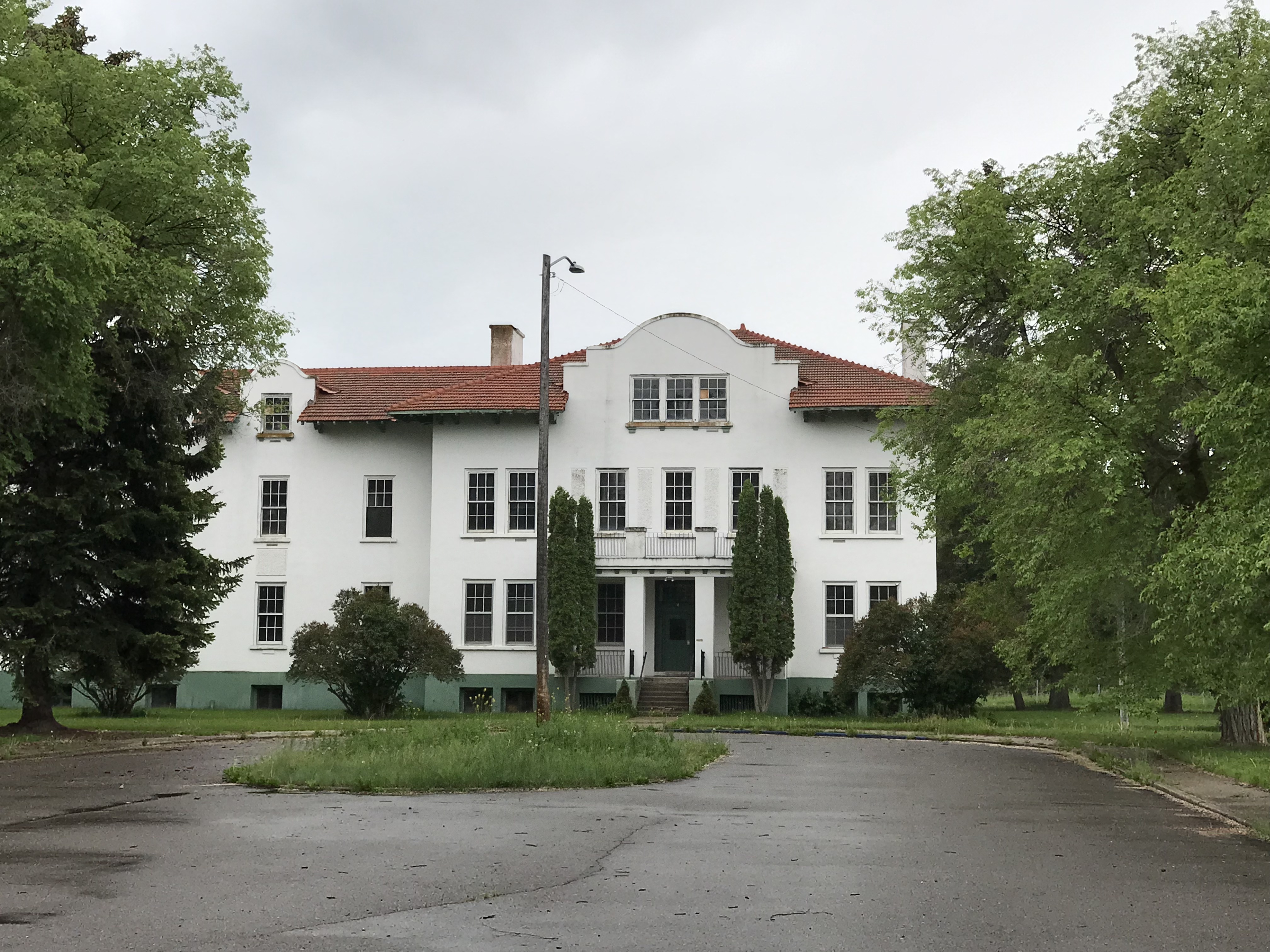
Instead, they found three mystery novels: The Mirrors of Castle Doon, and Who Hid the Key? and Who Locked the Door? When I was older I read these weathered and water-stained books that Carol kept in her bedroom. I read them more than once. The “mirrors” book was Scottish and referred to flashlights as “torches.” All three featured youthful detectives. The last two featured “Perry Pierce,” set in mysterious warehouses.
The fort’s officers club was a log building with a swimming pool of icy river water. The kids swam there, also in the river, but they weren’t supposed to.
The adults didn’t find out the kids broke into the gym by smashing a window in a door and reaching inside to unlatch the door. Once inside, they walked around on beams high above the floor.
The kids climbed the fort’s water tower and the 16-foot high guard towers. Eric Fiedler fell through the floor of one tower and broke his arm. Here’s the water tower.
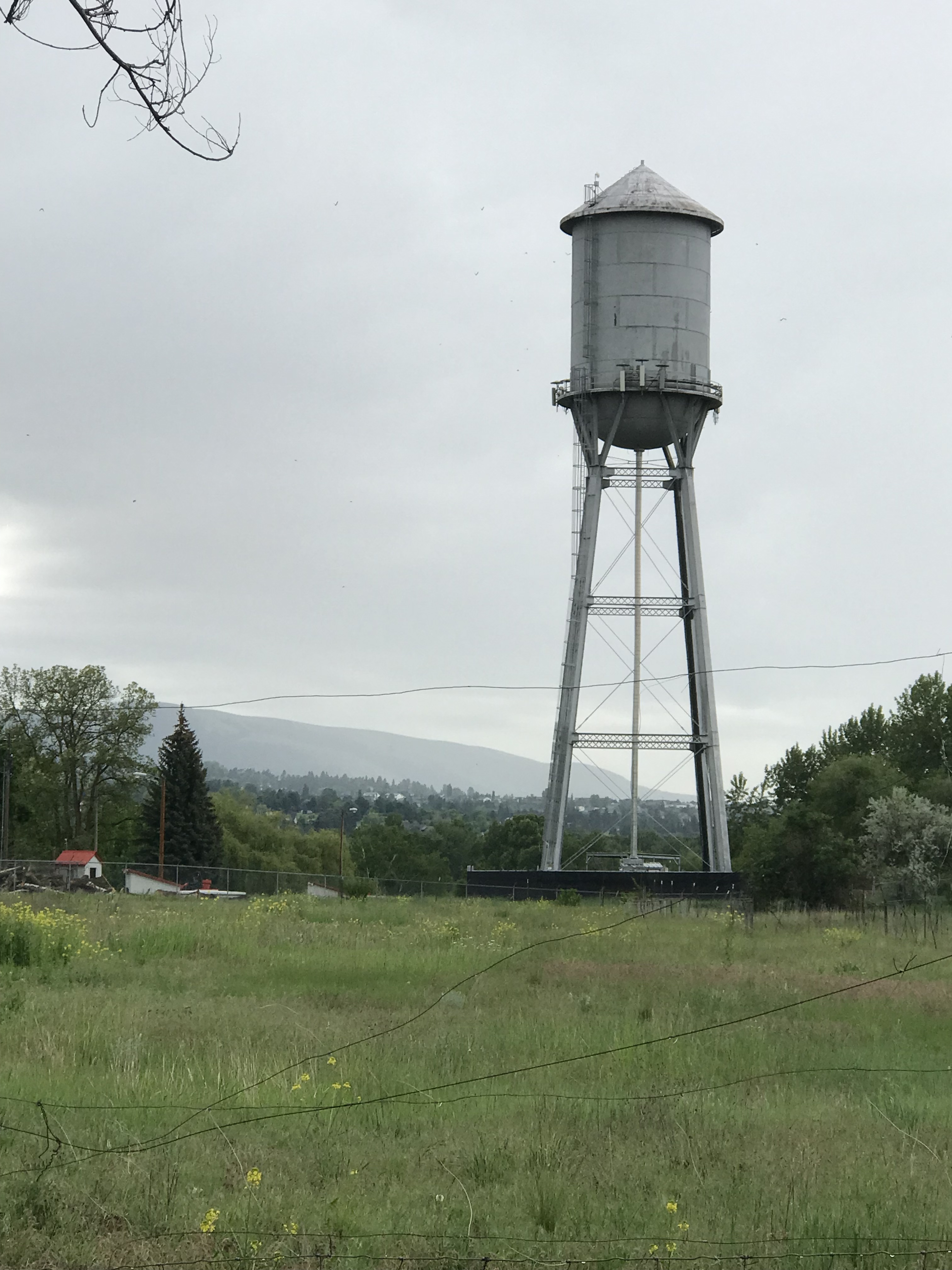
One day, Carol and Kurt broke windows in the hospital with rocks they threw from a parking lot. Eventually, a county commissioner came to the Struckman apartment to question our father about who caused the damage. Robert declared that Carol would never do such a thing. Carol lied and said of course she didn’t. Adults generally wanted the kids to go play somewhere.
When I came on the scene I remember Kurt had a scar on his forehead. Eric had a broken tooth. As teenagers, Eric and Tom wanted to be beatnik Bohemian types. When Kurt eventually went to medical school Margaret was angry. Said he sold out for conformity.
Leslie Fiedler insisted the children leave him alone so he could write, so he threatened to “dust their backsides.” Mike Fiedler told me his dad sometimes shouted that they should go for “vigorous outdoor play!” Carol said she once timidly knocked on Leslie’s door and in reply a foot crashed through. She said she was afraid of him. I wasn’t, though. He visited our house after our father died and he was kind to me.
Fiedler had become a famous Jewish scholar, author, and literary critic. He wrote Love and Death in the American Novel at the fort. After the war came the so-called “red scare,” and he and his children were targeted by Right Wing antisemites. My brother Tom once told me that his friend Eric Fiedler was hassled on the Higgins Avenue Bridge by toughs who threatened to throw him in the river. Leslie’s enemies made much of an essay he published, “Montana Face.”
When he left Missoula in the late 1960s Fiedler took the Samuel Clemens endowed chair at SUNY Buffalo, New York. He and Margaret had three more children: Debbie, Jennie, and Miriam.
Alfredo Cipolato, later well known in Missoula as a tenor and owner of the Broadway Market, had been one of the Italian internees at the fort during the war. The Italians called it Bella Vista. Alfredo met his wife in Missoula during the early years of World War II when he sang in the choir at St. Francis Xavier Church. According to her obituary, she said “che bella voce” when she heard his beautiful voice. Alfredo and our father were charter members of the Missoula Mendelssohn Club choir in 1950. Alfredo and I sang in the Mendelssohn Club with in the 1970s. Michael Fiedler and I sang in the club in the Spring of 1981. Our son Todd continued the Mendelssohn Club tradition in the 1990s.
Carol said the fort and surrounding country was beautiful and natural in the 1940s. The kids hiked to a nearby knoll, taking along snacks. She said the knoll had a cave. In grade school my friends and I climbed the same knoll. I remember the cave.
When I suggested it was a miracle the Struckman and Fiedler families survived their free-wheeling childhoods. She said all the kids at the fort survived, except one. A horrifying story!
Carol said she was playing with a neighbor boy named Dickie and his dog. He accidentally tossed a cylindrical tooled leather dog toy into a creek. He fell in the water trying to retrieve it. He said he was afraid his dad would be mad. Dickie couldn’t swim and sank. Carol, nine years old, ran for help, and the adults searched until they found him, but Dickie was drowned.
Climbing the water tower, swimming in the Bitterroot River, entering nearly all the buildings—none of that got them in much trouble. However, playing in the “primal ugguch” (their word for mud near the river) got them in trouble because they spoiled their clothes.
At the end of the era of adventures, I was born at Community Hospital March 28, 1949, spending my first year at the fort. Carol said the day I was born she ran to the Dugan house, the place with the only telephone, to call our father at the university to tell him to come quickly because I was about to be born. Carol said I slept in the larger of the two bedrooms upstairs in a crib with my parents and brother Tom. She said she got the other bedroom. She said I was a real live doll for her to play with. When she had bad dreams she’d put me in bed with her.
Michael Fiedler, age three, came to my first birthday party. Michael had an unusually low voice as a kid. Carol said Margaret used to put peanut butter sandwiches near the cat food dish to distract him from eating the cat food. Mike and I saw each other many times throughout my life. He died a couple years ago, my oldest friend on the planet.
January 7, 2019
I am told I spend too much time on Facebook, mostly agreeing with politically charged posts. Trouble is, despite the venom and passion I see expressed by the left and right ends of the political spectrum, I found, mostly from canvassing voters last Summer and Fall, people generally agree on the kind of world they’d like to see.
Spent the time it takes to walk around two city blocks listening and repeating Welsh for a tiny part of the opera Blodwen. This was the first Welsh opera, composed by Joseph Parry with libretto by Richard Davies. They did this in the late 1800s.
I’ll be in the chorus of Blodwen when it opens May 19 this year. Our director sent us all Drop Box recordings for the 13 opera songs with chorus parts, so I can listen from my iPhone through ear buds. He carefully pronounced each phrase, then set it to music, then sang it slowly so we can get it right.
This morning I listened to the 11th song. Then I studied the score at home. Did I mention we have until May 19?
Turns out those morning walks with Gunther are good for more than just one or two things. Thanks to the example set by that genius author, David Sedaris, I now pick up the random bits of trash I encounter on my short walks. An empty water bottle. Marlboro package. Things like that. I make my walks two or three times a day, so I have given myself permission to pass up stuff if I’m not in the mood to stoop down. I can get them later.
Organic matter like sticks or even frozen dog turds from someone else’s dog get a carefully aimed kick to get them off the sidewalk, of course. This morning I did that to a chunk of ice that turned out frozen fast to the sidewalk. Pain in toe. A couple soccer-style kicks did the trick.
I’m thinking of further trimming low-hanging branches over the sidewalk on our block where I have to duck. I have a pruning shear in the garage I’ve employed before. Mrs. Johnson on the far corner or our block has a beautiful tree that hangs too low that I’m reluctant to attack because it is symmetrical. I avoid its branches by walking near the edge of the walk. I don’t know what kind of tree it is.
I was amazed at perhaps a dozen low-flying geese, in formation. They always seem to be in formation.
Blodwen. After I get more familiar with the sounds of the Welsh words I’ll write them out on note cards to memorize, standard practice for opera singers.

April 23, 2023
Stories from our homeless shelter. Some 30-40 people would queue at the front door of the church each afternoon; although some, like Robert, sat at the nearby bus stop bench, bearing the cold weather. Seating space was scarce near the church.
Five days ago our church’s homeless shelter closed until next Fall. This, I was told, by order of the Billings Fire Marshal.
I spoke with a fellow, Robert, several times over the past four months when First Congregational in downtown Billings hosted 31 or fewer people nightly. Lisa Harmon, pastor, said this amounted to a bit more than 3,000 person-nights.
Robert was a regular at the shelter. Quiet, middle-aged, dressed for the weather.
He often wore a fur cap pulled over his ears, wheeled his belongings in a metal carry-all. I saw clean clothes stuffed between the wires. He wore tan overalls, several coats, boots, cloth gloves.
Today I stopped to visit with Robert at his usual bus stop near the church. I was early, to sing in the choir.
He wore a wide-brim camo hat this time. He had several days of stubble on his chin.
After I greeted him, he asked me how my day was going, as he usually does.
I handed him a banknote that had been a gift to me from Mrs. Johnson, my neighbor who said she wanted me to take my wife out to eat. She was thanking me for clearing her walk a couple of times last winter. I told Robert the provenance of the money and he promised to repay me. I suggested he could pass it along if he felt the need. He folded the bill, inserting it in his glove. I said I hoped it would buy him something to give him comfort. He said he planned to get some macaroni and cheese. He smacked his lips.
I asked him how his night had been; he had a pained expression and said he spent the night at the Montana Rescue Mission, but he vowed never to return. He said people “yelled and screamed” and acted mean there.
He said he planned to visit the local Crisis Center after this. I didn’t ask him why he was homeless.
Our conversations usually focused on high school sports, especially for class C schools like his home town Stanford, Montana, a roadside town between Lewistown and Great Falls.
Robert played basketball for Stanford years ago at a tournament in Havre. He said they were pretty good, but after he graduated high school the team went downhill. He played football, too.
He told me of Stanford’s famous albino wolf in the museum, mounted and displayed in a case.
Several other denizens of the shelter attended church today, including Lavita, a pretty Native who sometimes instigated singing at the shelter with what I called her “sisterly sisters.”
These folks sometimes sat around the central table in the church narthex, talking, giggling, teasing one another.
Today she gave me a hug. She reminded me that as I walked past their table I danced a bit to their tune. Hard not to. I loved the sense of ease she and the others displayed, despite the fragile nature of their existence. (All of our existences?) Another woman, Brenda, always had a kind word for us volunteer helpers.
Another woman, Amanda, said she was Crow, born in Bozeman when her parents attended Montana State University. For her, English was a second language. I only encountered her a couple of evenings at the shelter.
Jim was a volunteer whom I met about once a week. Sometimes he brought his grandson. Jim’s daughter supplied a dozen pizzas one evening. Jim came from Hardin, Montana, but he grew up in Billings, rode his motorcycle to the shelter.
The volunteers were only slightly less interesting than those who came for shelter. Until you lingered with the group it was hard to tell the volunteers from the homeless guests.
Impressions:
—one woman looked like a middle-aged housewife experiencing life on the street for the first time. Did she have a fight with her family?
—Jack, an older man with long white hair, looked like an academic. He was one of several with a notebook sticking from his pack.
—a young man, Johnny, had only the clothes on his back. He looked barely out of his teens. When I mentioned that he reminded me of a television actor on “Portlandia,” he replied that he hears that often.
—Randy carried a pack in back and a quilt in front. The last time I saw him he was nearly incoherent and played with a dental bridge with his tongue.
—Timothy was an ex-Marine from a tribe in central or northern Montana. He grabbed my hand and wouldn’t let go until I promised to pray for him. I pulled my hand back. “Right now,” he said, so I did, silently.
—Dean always wore a sports jersey and seemed too chipper for the occasion.
—Tim (different guy than Timothy, above) got around slowly with a walker. He spoke softly and his clothes were invariably soiled so he daily needed a new set: socks, trousers, shirt. He had a supply of candy that he enjoyed on the sly. We stocked up a supply of size 32 waist pants for him. He seemed well-known and well-liked by volunteers, mental health workers and the other street folks.
—another 10-15 persons each evening perched about the narthex on various chairs. Some new people, some familiar faces whom I didn’t meet. Some I met only once and I don’t recall their names.
After the shelter closed for the season a bunch of us volunteers cleaned the sleeping rooms. It was a “low barrier” shelter, so we often admitted people who were high or drunk, as long as they weren’t too disruptive.
But we did find a methamphetamine pipe, a syringe, some goldfish crackers complete with mouse droppings. These things didn’t trouble me, much. Like I said, we had more than 3,000 person-night stays and mostly trouble-free.


 insearchofbud