
Thomas Tod Struckman 1944-1997.
My brother Tom said he didn’t believe in God, but that he was responsible for himself. “Isn’t that noble of me?” We talked about God in 1964 when I was in high school, he was in college. In Dillon, Montana, at Western Montana College. He called it a glorified high school. The English professor didn’t know who Leslie Fiedler was, he said. Tom went to Western because he had been expelled from Missoula for not attending classes. He had flunked out.
If he ever changed his mind about God, I can’t ask him now. I don’t think he feared death, because of his attitude and I’d say he had a premonition when I last spoke to him. That was weeks before, when he was just 53. The conversation itself was a near miracle. I’ll tell you later.
My nephew Jon and I had driven to Missoula’s north side to visit Tom in his small house for perhaps a half an hour in 1997, mid-August, two or three weeks before his death. He had just been released from Community Hospital after a massive heart attack.
We found him dressed in his usual gray t-shirt and old jeans, sitting on his gas heater with his hospital name band still on his arm like a badge of pride. The heater, brown enamel with a stovepipe, was cold, of course, just a convenient place to sit. It was August. The house had four rooms, counting the bathroom. It always had a good smell. The smell of old stuff: blankets, books, table, chairs, wood. Jon and I sat on the floor, on a threadbare Persian rug passed down from our father.
Tom said he was almost too weak to walk the 100 feet to his garden. He said the doctor told him that the heart attack destroyed 70 percent of his heart. He had told Jon of the question of losing part of one’s heart, the seat of emotion, of love.
His attitude? With the characteristic flip of his head and a sniff, he told us that “they gave me nitroglycerin, but it doesn’t matter because I won’t take it.” I didn’t ask him why. I was just glad to see him. I was afraid. Afraid he would take offense and throw me out as he had done several times before.
You see Tom and I hadn’t spoken for eleven years, since the day in 1986 when he yelled at our family, “Fuck you!” and we trooped out of his house.
He had no telephone. I missed him and wrote him letters that he didn’t answer. I had gone to his door and he shouted at me to leave him alone. I sent him candy at Christmas. Then in the summer of 1997 my nephew Geoff called to say that Tom had bad chest pain. In short, I asked him to tell Tom that he should go to the hospital because they had a drug that could help. Tom respected my pharmacy training and Geoff called me back. Tom got up and told him: “A drug? Let’s go!” Tom was admitted right then.
My other nephew, Jon, told me that Tom had a phone in his hospital room. After hesitating, I telephoned him.
[Phone rings.]
“Hello?”
“Tom, it’s me. Your brother. Dan!”
[Click].
Despite my sorrow, I agreed to drive to Missoula with Jon to attempt a visit. That’s when I saw Tom. He said he remembered answering the hospital bedside phone, but he fumbled it and never knew who called. We reminisced about old times working on the railroad together. I told Tom I still hated this guy named Rod who disparaged some beans I cooked. I was surprised that Tom said that I was too harsh in my memory of him. We shook hands and Tom gave me a military style hand salute. I offered him some chewing tobacco. He said, “Okay. No. That stuff will give you a heart attack.” Jon and I left, elated. I was near tears I was so glad.
Tom entered our world April 6, 1944, left it in 1997. No one knows the date because, like I said, our friend Mark found Tom’s body on his kitchen floor, rotten, covered with maggots. The corpse had been there for weeks, but nobody knows how many.
He had visited Tom to ask him if he was “between cats,” you see. Mark had been adopted by a stray. He said he knocked on the door a few times. Tom was nearly always home. Mark looked through the window on Tom’s kitchen door and saw what looked like a scarecrow on the floor. Mark opened the door and saw what it was, then called the cops. Then Mark phoned me. He said, “Tom died.”
I questioned Mark, who was in shock. That’s when he told me about looking in on Tom. I thanked him. We didn’t have much of a conversation. I looked at our daughter Clara after I hung up. Then I cried. Felt good to cry and cry. I was so grateful to Jon for practically forcing me to go to Missoula to visit.
I called our son Todd who went to Tom’s. Todd phoned us later and told us that he had helped clean up Tom’s remains. He said a couple of men were trying to put Tom’s swollen body into a metal coffin with a rubber gasket. They told him to go away. Todd said he started to leave, then returned. He realized he didn’t have to take orders from them, he told me. He said he was good with all of us in Billings going to Missoula the next day.
Then Todd called us again about eight or nine o’clock unable to sleep. He was alone in his house. He asked us to come to Missoula right away.
When we arrived five or six hours later, Tom’s little house was dark, except for the glow of perhaps a dozen scented candles. No one was there. The candles, mostly on the kitchen stove, added perfume to the penetrating, sweet, putrid smell. I noticed a used white latex glove on the gravel walk leading to the back steps. I picked it up and took it indoors. We noticed an image like a snow angel on Tom’s kitchen floor where Todd had scrubbed away the remnants of the body.
The next day I photographed every room in Tom’s house. Tom practiced what he called “voluntary simplicity.” This meant living gracefully in a non-materialistic way. Tom’s house was a kind of work of art and I wanted to make a record of it.
That’s when I noticed a pattern of pink comma-shaped specks on his kitchen walls, ceiling, even into his bathroom through the open door. I even found the pink commas on a prescription bottle of amlodipine, a blood pressure med, on an open shelf above his kitchen sink.
I could scarcely believe the droplets could travel so far—all the way to the far side of his bathroom. I don’t know, maybe 12 feet. Gray water was still standing in his bathtub. A saucepan for rinsing his hair was on the edge of the tub.
According to a Stiff, a book about death by Mary Roach, after a certain amount of time a cadaver inflates with gas produced by bacteria in the gut. The body swells until it eventually bursts–splits open–spraying its liquefied contents like an aerosol. At a research cadaver farm in Tennessee a man told Roach that he had never witnessed a body explode, but he had heard it happen twice. Hence, the many light pink comma-shaped marks on the walls and ceiling. The little tails of each speck pointed to the place Tom’s body had laid when it popped.
Right. I can describe Tom’s appearance in death better than how he looked in life. See? I never saw Tom’s cadaver just his imprint on his kitchen linoleum. The imprint came of our son’s scrubbing the linoleum with chlorinated cleanser.
Tom was hip. I mean, actually hip. He was fun. Even for me, once we reached adulthood. He did it all, he did it first, and he did it better. I’ll try to give you a better picture of him. He described himself as handsome, easy-going, comfortable.
I spent my early childhood running toward, then from, Tom. Our father died early on. I admired Tom and wanted to play with him. He had neat stuff. He chased me away from him. He usually punched me with his fists. Usually in the arms and stomach, not my face. He didn’t like me. I was sloppy. He was a perfectionist and he regarded me with disdain because my facial features were large and plain. You see, I was destined to become considerably taller than he was.
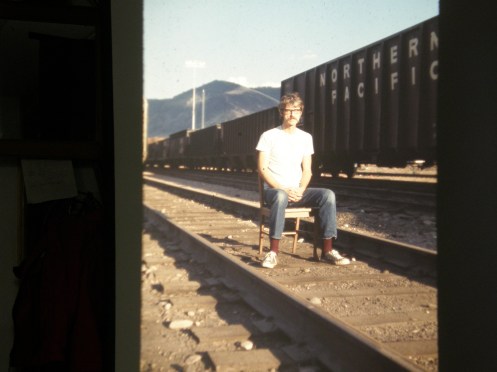
Tom poses behind his house in Missoula in 1976.
Therefore I started out looking and acting clumsy and ungainly. My eventual tall stature was not evident during our childhood and Tom was, frankly, ashamed to be seen with me, so he punched me and ridiculed me so that I wouldn’t follow him around like a mongrel when his friends were there.
I am here simply telling the truth, not so that you will pity me. If he were alive, Tom would tell you that nobody needs to pity me. Or him either. I just want to tell about Tom here.
He studied Zen Buddhism when he was perhaps 25 years old. The rest of his life he faithfully meditated several times a day, sitting erect in the lotus position, often facing a wall.
I think I forgot to mention that Tom was schizophrenic, but he took no medicine. The U.S. government agreed with the evaluation by the psychiatrist. Tom received a small social security disability pension that he had to supplement with food stamps and several hundred dollars a month our sister and I sent him from our share of our mother’s state teacher’s retirement.
Over the years I have known several schizophrenic patients in my career as a pharmacist and none of them acted like Tom. He was not delusional, suffered no apparent discomfort, was not paranoid. However, the last 10 years of his life he wanted nothing to do with me. He was fairly socially isolated by that time. He disliked me, and that was that. Was he schizophrenic? Beats me. In 1966 our mother had him evaluated at the State Mental Hospital in Warm Springs. Tom wrote me a letter: “…Being crazy is not fun. Life in the zoo is gray and bleak. They have a library with a bust of Shakespeare on the outside, but nothing by him inside.”
Tom was scholarly. He studied English literature in Missoula, getting A’s from even the most demanding professors, then got into the graduate program in Eugene, Oregon. In 1967 he dropped out of school. He became a hippie and moved in with his friends in Seattle.
Our uncle in Seattle bought Tom a light green1953 Chevy sedan and had Tom visit a doctor who prescribed Triavil. No longer available, Triavil was a combined antipsychotic/antidepressant pill and Tom did well. Tom and his friends got jobs with the Seattle Parks Department. It was a sweet job that was undemanding, but paid well. It was the perfect job for him and his friends. They all smoked hashish. Really good hashish from Lebanon. They played music on guitars and drums and drew pictures with colored pens. Life was good. I joined them the next winter and smoked their hash and ate countless peanut butter and honey sandwiches and drank their milk. And smoked their cigarettes. I talked Tom into moving back from Seattle to Montana. I hoped we could make a living as musicians.
The spring of 1969 Tom and I got into the old Chevy, bound for Missoula. A car that age in Montana would be in far better condition than one in Seattle, with its rust-producing fog and rain. You could feel the car body flex and twist as we drove.
Tom and I were dissimilar in temperament. I am describing him here.
From the outset we knew Tom was unusually gifted, although I’m not sure what his gift was. It was being cool. He had huge pride in himself.
I guess I was first aware when I watched Tom make a soap carving with Ivory soap. I remember that he copied an image of “Sir Edmund Hillary climbing a mountain” in our encyclopedia, the 1950 edition of “The Book of Knowledge.” The figure was perhaps three inches tall, perfectly proportioned, without any broken limbs, a mountain climber wielding an ice axe, carrying a huge pack and coil of rope. The space between his legs was empty of soap, same as the areas around his arms. The detail was perfect, right down to the expression on his face. It did not look like the work of a 7th- or 8th-grader. Of course, I tried my hand at soap carving also, and I tried to make a duck or a fish or a cat. Didn’t matter. They all looked about the same. Tom’s derision when he saw my lame attempt was heartless and merciless.
You know how kids like to draw? Tom’s drawings looked like the illustrations in books. He was so into mountain climbing that he typed up his own book, titled “The Conquest of Everest,” with full-page illustrations of climbers and Sherpas, maps, drawings of the mountain, with all of the climbing routes labeled. That’s when I learned the word “col” means mountain saddle.
Tom picked and chose at what he would excel. The French horn in high school, then the classical guitar in college. (He traded his horn for a Gibson guitar.) Folk ballads. (He could play and sing all of the verses to many Joan Baez songs.) Marvel Comics. He was into Marvels the first year they came out. He wrote a play when he went to the University of Oregon, titled “It.” (He gave it to our mother for her birthday.) He could play marbles. (He had a canvas bank bag fat with marbles.) He collected baseball cards, he built model airplanes, he made a telegraph set, he built a wooden castle complete with moat and drawbridge. He carefully painted every knight and every knight’s horse. The list goes on.
Even as an adult he learned to swim by reading a book. He became even better at drawing from life by reading another book. He built a harpsichord. And a clavichord and years before, a banjo.
You get the idea. He read books. Hundreds and hundreds. The last book he read before he died was Adam Smith’s “Wealth of Nations.” His nephew Geoff bought it for him. No. Geoff bought him the book but Tom had him return it because it had been abridged.
Although Tom’s life had been cut short, it was not abridged. In other words, like his friend Peter Koch said, there was no transistor missing.
Tom Struckman had immense pride.
Tom Struckman was a mysterious one. At the Bon department store in Missoula, Tom was parked at the East end parking lot. Remember? There used to be an incinerator there that had long since been removed, but you could see the image of where it had been: the incinerator, the flu, the chimney. All of it emblazoned on the brick that faced the parking area. Tom had parked his car there. A guy was trying to get out of the lot and thought Tom’s car was blocking the way. I was there. I thought Tom would move his car, but no.
“You’ve got plenty of room,” Tom screamed. I was awed by Tom’s forcefulness with a stranger. I use the term, “screamed,” because that is how he expressed himself then. The driver got out of the lot and drove away. Yes, he had enough room.
Yet in other matters, Tom was timid. He often said something, like: “Other people can do that, but we cannot.”
He and I moved back to Montana from Seattle in 1969. I remember we left Seattle early in June, before light, in the morning. We stopped on the road, once we entered Montana and literally hugged a tree. Do you know how a Ponderosa Pine smells? The tree has a sweet odor, like sugar. Tom and I were happy to be back and we hugged and kissed the tree. Then we got back into his 1953 Chevy sedan and continued to Missoula. Of course, we had no place to stay. We drove up and down 4th and 5th streets, looking at the brick apartment buildings between Higgins and Orange streets. We saw a “for rent” sign, so we knocked. I remember that the landlord wouldn’t rent to us because he said he “didn’t know our habits.” I think that meant we looked pretty disreputable with our long hair and long beards. Tom and I laughed about it. As we walked downtown someone yelled at us from a passing car: “get a haircut!” Again, we laughed. Again, we became less and less sure of ourselves. I can say this now because Tom died in 1997. He cannot contradict me.
I had pretty much given up hope but Tom knew where Peter Koch lived, on Hartman Street, so he drove us there, and he knocked at Peter’s door. The front door to Peter’s house had a homemade sign that read, “This door doesn’t exist.”
Peter answered the door that did exist: the kitchen door. I remember Peter said to Tom, “Sure, you can stay here.” I was right behind Tom, so I pushed in afterward. I was aware that Peter had not included me, but I was with Tom, and desperate. I was his younger brother. Tom could stay in Peter’s back room, with all of his books. Peter had many books. His bookshelves reached from floor to ceiling on three sides of the room. I cannot begin to tell you the titles, but some of the authors’ names began with “W”: Watts, Wilhelm, and on and on. Many of the books had to do with Eastern religious thought. Spiritual matters. Poetic matters. Important spiritual poetic matters that were wreathed in mystery. The books remain in my mind. I just cannot list them here.
Tom and I slept in Peter’s back room on a mattress he had. We had our sleeping bags and blankets.
The next day Peter took us fishing at Gold Creek. We didn’t have licenses. Who needed anything that cost anything? I remember cleaning fish and eating them that night, with the brown rice Peter had. He had a large bag of rice. Simple insurance against hunger, he said.
Peter called one of his neighbors a “damn thief.” Then we went shopping for a hose and sprinkler by walking around the university district until we found the hardware. Peter put them under his coat. We would have taken Tom’s car back but it had a flat tire. I remember pointing out that the tire was only 1/3 flat. Just the bottom part. However, we still had to change the tire. Tom benefitted Peter in that Peter only had a bicycle for transportation, but Tom had a car. And the car could take us to distant fishing sites.

Gunther is justly proud. He pooped and peed as we made our compulsory lap around the block just now at 11:fucking 30 p.m. And now he is chewing his favorite rag doll puppy toy. I love him. Don’t get me wrong. Whoops! Now he is finally eating his evening meal, so I’ll need to take him on another lap around the block in about a half hour. Because I adore this handsome young feller. He adores me, too.

Our cat Annabelle seems to watch over a collection of our daughter’s pottery. An old cat, she reigned serene until she made a fatal error. The couch? Still in use. The lamp? Broke it accidentally. The table? Belonged to Pat Zuelke. The mirror? From my childhood home in Missoula. The photograph? Wife’s father, a Montana ranch hand.
Diary
Monday, February 22, 2016
Today was rough! Worked from eight a.m. until nearly six p.m. at the pharmacy with my friends. We probably filled and checked 700 prescriptions, but working was the best part of my day. I had to go straight to rehearsal afterward. Okay, I did stop briefly at home for some beans and rice.
Then, after three and one-half hours of opera rehearsal I felt tired, hopeless and sad. I think the rehearsal went well, over all, for the others, but I doubted the value of my own contribution because I made lots of mistakes. I came in too soon, I missed coming in later. I forgot the lyrics, I wasn’t loud enough. Except when I came in too soon.
I had noticed an actor, one of my fellow singers that I had argued with the day before, looking isolated, in the back of the theater before rehearsal. At least I think it was he; the light was dim, so I might have been mistaken.
Oh, it was a pointless argument. I had stepped on his toes and, when he got angry, I elbowed him in the stomach. I apologized for stepping on his foot, but he was angry about getting elbowed, so he refused my apology.
After rehearsal I got an email inviting me to a day care meeting. The manager of the childcare wants to move the business out of the church and into a pair of two-bedroom houses. How can that be a good thing?
Tuesday, February 23, 2016
No work today, but I went to a meeting of three of the other childcare directors, the manager, a real estate saleswoman and a banker. Everyone but me seemed to think moving out of the church into a pair of residences was just fine. They wanted me to okay a deal, but I didn’t want to be pressured. I met with the other board members privately. I gave in to allowing the deal if the board approves, which it had not. Now I feel like a slut.
Later P. and I drove over to the houses. The builder happened to be there and he let us into one to look. They are much smaller than the church space with no room for much of a playground.
At opera practice I apologized again to the actor for elbowing him and for stepping on his foot. I promised never to do it again. I meant it. He thanked me for apologizing. He seemed much more animated and I noticed that he didn’t sit apart from the others in the cast. Of course, I had also sat apart. Now I sat with my mouth shut. At least for a while.
Our conductor aided me by assigning three strong principal singers to belt out my choral part from offstage. At first they were way in the back and I could barely hear them. I thanked them, and asked them if they could move closer to the front. One of them said they were told to sing back there. Oh yeah, I forgot, I thought.
Later the director said he could barely hear them and asked the three to move closer to the front. I felt nearly happy, despite the length of the rehearsal going to nearly eleven p.m.! Must be more than a dozen elementary-age kids in the opera and they didn’t get to leave until ten! I can’t imagine how tired they will be tomorrow.
Wednesday, February 24, 2016
I practiced the lyrics and music at home along with a Youtube recording. The work doesn’t seem to stick well in my memory, even with repetition. We are starting opera practice an hour earlier tonight, so I hope we aren’t out much past ten.
At noon I found a photograph of our old cat, Annabelle, a calico with polydactyl paws. She died at age 15 in 1999 by the hand of a veterinarian wielding a syringe of poison.
Annabelle had lived a good, meek and gentle life, but she made a fatal error. She used P.’s mother’s suitcase for a kitty litter box. Of course I felt sad for a while, but I recovered. Anyway several members of our family have developed allergies to cats.
Ten years ago, or so, I started visiting an old man. Old! He was 92, with poor heart function so that he was too weak to get up from his easy chair. Soon we were pretty good friends. He was on hospice.
A WW II veteran, he told me some of his experiences, but he was never in combat. The closest he came to shooting was Northern Africa when he helped pack up a field hospital and move out to avoid an enemy onslaught.
Gordon was great company. I visited him for two hours, twice a week, for almost exactly a year until he died. We both enjoyed the visits immensely. We told each other stories. I exhausted my supply, though, after about a hundred visits, give or take ten or twenty.
I told Gordon my fishing stories. He was an avid fisherman and birder. He never owned a car or had a drivers license. He got rides with friends or took the bus. He was on first name basis with the bus drivers who took him when he went fishing. He had fewer fishing stories than I did, for some reason, although I did get a story every time I asked. I think fishing had lost its novelty, for all that he loved it.
He had donated his fishing gear a few years back when he still could get around his house near Eastern Montana College, where he lived with his wife. He said he hauled his waders, net, tackle, flies, many rods and reels, creels–all of it–to his driveway. He called the Boys and Girls Club. They took it, a big pickup load. I could sense his grief, but also great courage. I remember thinking that the folks with the truck wouldn’t likely have known the value of that stuff. But what the hey!
We conversed. All subjects were up for grabs. He was refreshingly honest. What did he have to lose? Nothing! He had given all of his possessions away. He was on hospice and he said he would have died months ago if we hadn’t become friends. He loved to tell dirty jokes and he loved mine. One subject he didn’t like: anything that had to do with guns or explosives.
We talked about many things: politics, birds, local artists, clothing, sewing machines, music, trees, money, his childhood in North Dakota, his family, calves liver, hunting rabbits, swimming, socks, bicycles, raising his daughter. He was not big on religion, but he and his wife had been church members for most of their lives.
He was a retired banker. He said he hated his job.
He liked Hilary Clinton. He watched sports on television, especially football and tennis.
His wife and he hadn’t talked much in years. She had severe dementia and they slept in separate rooms. They always informed each other when leaving their apartment, he said. He blamed her involvement with the local Audubon Society for their lack of communication. She had spent many hours each month working on the Audubon newsletter.
The second year of my twice weekly visits he and I found it harder and harder to find new things to talk about. We started watching television. I felt like the wellspring of conversation was dwindling. Finally, he told me that he wanted to die. I advised him to stop drinking fluids. He protested that the nurse told him to drink lots of water! I told him to “suit yourself, then.” In six days he died.
What do you do when you run out of things to talk about? Did boredom kill Gordon?
I hoped for a new friend. A few months later  I was assigned another hospice patient, a guy named William. When I visited him I found out that he was also a WW II veteran. He spent a career selling a popular soft drink product.
After perhaps an hour of getting to know each other William told me as I was leaving his apartment that we had little in common. “Don’t bother coming back,” he said.


Today I took down the tree house in our back yard. For one thing, it was unsafe. For another, I think my neighbor will like it better. Months ago when I went up the ladder to make some repairs I looked over the fence into her back yard where she was sitting in a hot tub. “Hi neighbor,” she said.
I didn’t look. Well, okay, of course I looked. She was wearing a bathing suit. “Hi,” I replied. An awkward moment. She and I never did talk much, and we haven’t talked at all in the years since.
Anyhow, nearly all of our grandkids and grand nephews and nieces have outgrown the tree house. We used to sweat when the kids, almost two short to climb the rungs, risked their lives going up there. By the time it was safe for them they were in school. They had no interest.
The tree it was fastened to had outgrown the tree house also. Maybe 10-15 years ago we copied one that used to be just east of Pioneer Park. P. and I walked over there and I took a picture. Then we built. Complete with a roof for shade. In the last couple of years the tree’s girth had increased so that some of the floor boards no longer rested on the joists, a hazard, so I removed the ladders to discourage the neighbor kids. It had two because one of our grandkids said the tree house needed a fire escape. The roof blew off last year in a storm. Today I attacked with screwdriver and saw and hammer. I was gratified at the difficulty. I picked up the pieces, saying in my mind, seven, eight, lay them straight.
George Elkshoulder and I got the job of teaching a sexual awareness class to the 5th and 6th grade boys at Lame Deer School. There were several adult men with the same name. The George Elkshoulder I knew best was a Northern Cheyenne Tribal Community Health Representative. Or “CHR.”
Of course, you remember 1989, don’t you? Everett C. Koop was still the Surgeon General who promoted educating children and condom use to help counter the spreading AIDS epidemic in the United States.
That year Lame Deer had an HIV positive patient, a boy in the sixth grade. I had worked at Planned Parenthood for Joan McCracken prior to becoming commissioned in the Public Health Service as a Lieutenant. I helped conduct sex education classes for boys then.
I learned how wonderfully respectful the children of Lame Deer were of their elders, their teachers, their George Elk Shoulders. [In the IHS (Indian Health Service) we commonly combined the two word last names, like “Elkshoulder,” even though they might also be written “Elk Shoulder.”]
My recollection is sketchy. I just remember that George and I taught the boys and someone else collected the girls and took them elsewhere. George and I introduced ourselves to the class of boys. We had a curriculum, so we followed it. There were diagrams and pictures.
George seemed genuinely embarrassed at the diagram showing the anatomical parts of a male human body. He had a charming grin. The boys were boisterous. George pointed to the area of the scrotum with testicles. “What is this?” he asked them.
“Piss bag!” came the immediate cry from the class. You could tell that the boys had gutted out a deer or two, so they knew what a piss bag (bladder) was on a deer.
George was nonplussed. “Scrotum,” he said. A few boys echoed, “Scrotum.”
The rest of the class time was equally as pleasant and informative. Both for the children and for us grinning adults. I don’t remember much else about it, but from that day afterward, whenever George and I saw each other, we invariably recalled the day we gave a sex education class in Lame Deer. With a good deal of pride, at that.
In high school in Dillon, Montana, from 1963 to 1967, I would have to characterize some of our teachers as sociopathic liars. Yes, and I’m thinking most of my classmates would agree with me. If I attend our 50th class reunion next year, I’ll get the opportunity to ask them.
Well, the most egregious of them was our American history teacher. This was class was required. I don’t think anyone else taught this but Mr. Ankeny. Poor Mr. Ankeny! If he believed half the stuff he told us I’d say he was badly misinformed.
What lies did he tell? you ask. Well, he told us that black slavery in the United States was not such a bad thing. He told us impressionable 15-year-olds that slaves were expensive, so their “owners” had to feed them and take good care of them. Once freed, the former slaves were just poorly educated impoverished types, worse off than before. That line of thought, which I now find to be racist, seemed plausible to our almost entirely white students, including me. Me? I just wanted to pass the class.
The best way to blow that liar’s argument out of the water would be to suggest that he ought to be a slave if it was so good to be one. I’m still trying to parse the sentence I found once in Joseph Heller’s “Catch-22.” “Is it better to die on your knees and live standing up? Or is it better to die standing up and live on your knees?” Anyhow, the answer to that question would have allowed the students in Dillon to grasp the truth. If they could parse it.
Another infamous untruth from the same propagandist, in the same high school at the seat of the John Birch Society in Montana: The United States has the highest standard of living in the world. Pursuit of self interest with capitalism is the only system that would keep us all from becoming communists or, worse yet–because it heralds communism–socialism, which sounds wonderful [emphasis his] but leads to a kind of grayness and godlessness. The US did not have the corner on standard of living, especially for people of color. Our nation was not founded on capitalism, but on the Constitution. I fear Mr. Ankeny was just a puppet of those who were living off the “Red Scare” of McCarthyism.
February 10, 2016
More about Tom. I mean to tell about him as he grew up and married Dana Graham, soon after that he was father to Hannah B(anana) Graham. Tom absolutely loved Hannah, who married Jason Wild, and had two children, Jacob and Savannah. Tom was a grandfather when he died. I know something about Jacob, nothing about Savannah. Hannah subsequently had another son, Henry, with another man. Therefore, Tom had three grandchildren. I don’t know a lot about the grand kids, but I can start telling about experiences with Dana and Tom.
I recall that Dana and Tom were our Best Man and Brides’ Maid at Penny’s and my wedding in Lewistown, Montana, January 30, 1971. Our mother, Helen Struckman, came from Dillon; my sister, Carol Angel, and a few of her six children came from Bozeman; and Peter Koch and his girlfriend came from Missoula; and Penny’s younger brother Vern, and her sister Dolly’s son Waylan were all there from Lewistown. Plus, Penny’s mother Lillian Meakins, of course. Most of us stayed at Lillian’s big house. Lillian baked a wedding cake—a flat cake—that I cut into about twenty, or so, pieces. I was dressed in my Marine Corps green uniform.
I had a flower in my lapel. My drill instructor, SSgt. Fayechak, had told us that wearing a flower was permissible because our country was not (technically) at war with Vietnam. It was peacetime. However, he said, if people are shooting at you, it is war. And the North Vietnamese and Viet Cong were still shooting at us in 1971. They would continue to do so for several more years, although none of them fired at me because I never went to Vietnam.
Penny wore a beautifully blue flowered dress and had a bouquet of daffodils. I will always remember the wonderful expression on her face when we kissed during the ceremony. I knew this was a very serious commitment. I knew she thought so too.
Tom and Dana signed Penny and my marriage certificate prior to the ceremony. The minister who presided over the wedding was Father Boyer. I didn’t know Father Boyer’s first name, but he was an Episcopal priest. Someone told us that after serving in Lewistown, Father Boyer served on the Sioux Indian Reservation, but I never learned where. Of course, every time we traveled through Sioux country, I thought of him. Father Boyer told me a few things that I’ll never forget. When he told me to walk up the aisle and stand in front of the alter, I told him that I had experience standing at attention in boot camp. Father Boyer told me that if “I didn’t ‘camp’ in the right place, Penny would give me the ‘boot.’” I took this admonition to heart. Our vows were made with the most sacred intent. Then Father Boyer had us kneel at a place and he wrapped a cloth around our hands. He told us that this knot could not be untied. I think we believed him. We have been married more than 45 years. We will stay married until we die. Such was the ceremony provided by Father Boyer. It held the kernel of the future.
More about Gunther, our part pug, part Brussels Griffon.
I just wrote a check for $295 to Tony Barone so that he could help us train our dog to be a good citizen.
Trouble is, I’m not convinced that our dog isn’t already a good citizen. Shit. Gunther just vomited. I think Gunther ate something he shouldn’t. Like the pencil that I found in slivers. Yes, the yellow one that I was using for my opera score. Or the cat turd he put on our back porch. Or a stick, or corn cob from last summer. Or that pumpkin stem from the compost bin. Poor Gunther! His appetite is zero. He still drinks water, but then he pukes up yellow bile. Worse yet, I am working the next two days! I think we need to take him to Dr. Kilzer. Little Kate Kilzer is an accomplished scientist who is also a small animal vet. I think we are pretty lucky.


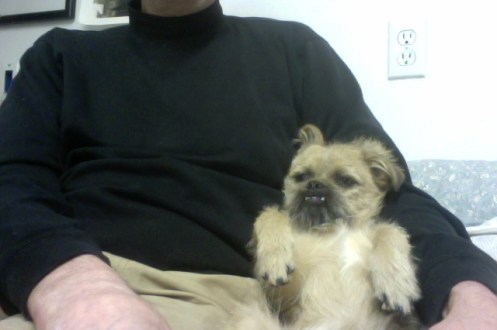
Gunther felt better!
I was wrong when I said Gunther died.
Remember how I told you that Gunther got swallowed by a Grizzly? Because Gunther could not fit into the bear’s duodenum, he sat in the stomach, thinking. He had discovered, like so many of you do, that talking and thinking cannot occur at the same time. So Gunther stopped talking, or whining, or call it whatever you want. Gunther quit vocalizing.
The grizzly, of course, was on display because people thought he might speak to the anxious crowd. The crowd expected a talking bear, but they were disappointed.
They got a bear with a bad stomach ache. Gunther was in there, scratching around inside the bear’s stomach. The grizzly felt terrible! He pointed his front paw, with its razor sharp claws, at his belly.
Seeing the distressed grizzly, the zoo keeper telephoned the veterinarian, a doctor who specialized in taking care of sick or injured animals. She told the veterinarian that the grizzly seemed to have a stomach ache. And it was getting worse.
The veterinarian put down the phone and she rushed to the zoo. “Appendicitis,” she said, reaching into her doctor bag for a vial of powerful medicine to put the bear to sleep.
Well, what do you think? Right! She found Gunther alive inside the bear, but slimy and frightened. She was a bit miffed that her diagnosis was incorrect. But just to be sure, she removed the bear’s appendix. Then she stitched up the grizzly and recommended several weeks of strict bed rest.
Gunther went home with Daniel and the rest of Gunther’s human family amid much rejoicing. Everyone wanted to pet Gunther after they cleaned off the slime that he picked up inside the bear. They gave Gunther treats.
You know what? Gunther stopped talking, except to speak to the mail carrier. And Gunther never pooped or peeped in the house, but always outdoors.
That is because Gunther is a GOOD DOG.
He knew in his heart that he was not larger than a grizzly.


 insearchofbud