 Homer was one of the many children of Agnes Limpy. I made this photo in 1997.
Homer made them large and small, but he always used leather for the stone pocket, and he always used red inner tube rubbers that he tied with string or thread. I don’t know how many of his slingshots I bought.
His slingshots were always in demand because of the packs of dogs in Lame Deer, a menace to everyone.
Tribal historian and scholar William Tallbull said that when he was animal control officer for the tribe he would catch dogs, put them in a box in the back of his pickup, then run a hose from his exhaust into the box so that by the time he reached the dump at the top of the hill the dogs had all been killed.
I was friends with the tribal sanitarian, a commissioned officer with the U.S. Public Health Service like me. His name was Matt and I don’t remember his last name, but he helped spay and neuter the stray dogs each spring. He said the dogs seldom had names or identities other than “brown dog” or “black dog.”
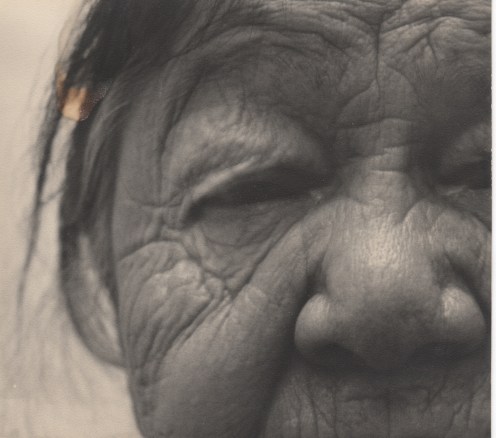 She gave me a beautiful Pendleton wool blanket. I made this photograph.
I met her son Lloyd August 15, 1988, my first day at the Lame Deer Clinic on the Northern Cheyenne reservation. My journalism mentor, Nathaniel Blumberg, had told me that he was confident that I would love working there, and he was right.
Lloyd and I had adventures after work and on weekends. Did I mention that Lloyd was in charge of the clinic supply department? I was a pharmacist at the clinic and I commuted from Billings for 17 years until I retired.
Anyway, we went fishing once, but caught nothing. We looked for a meteor crater over by Ashland. I don’t think we found one. We drove to a buffalo jump and then to Wild Hog Butte lookout tower, a metal tower, still standing, that had been manufactured by the Aermotor Machine Company, better known for its water pumping windmills. When Lloyd was a child his father worked for the forestry department as a fire lookout.
Lloyd is a Vietnam Conflict Veteran of the First Army Division and I could tell he was proud of his service, but had terrible memories of combat. I didn’t press him.
Lloyd was a lifetime member of the National Rifle Association. He gave me a rifle which I passed on to our son Todd.
Martha, a bunch of relatives, and I once held a vigil at the hospital after Lloyd wrecked his truck. Things looked bad. Martha handed me a tissue for my tears. A priest administered last rites. Then Lloyd got well. Almost well, that is. He still has poor use of his arm because he broke his neck.
Martha Wolfname died several years ago. At her funeral I was proud that her daughter, Lenora, displayed a photograph of her mother that I had made. I haven’t seen Lloyd since that day, but my friend Walter Blackwolf stays in touch.
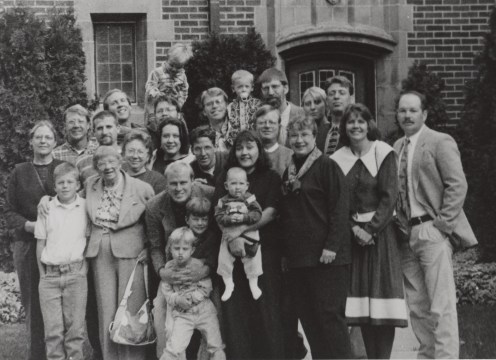 Back: Penny Struckman, Chuck Angel, Jon Angel, Oscar Angel, Chris Angel, Jacob Wild, Dan Struckman, Clara Struckman, Bob Struckman, Beth Rohrer, Joe Rohrer. Front, Joey Rohrer, Corinne Ackley, Jason Wild, Bonna Hall, Tom Angel, Hannah Wild, Finn Angel, Geoff Angel, Sam Rohrer, Todd Struckman, Bradley Angel, Kristi Angel, Mark Fryberger, and Carol Hotchkiss.
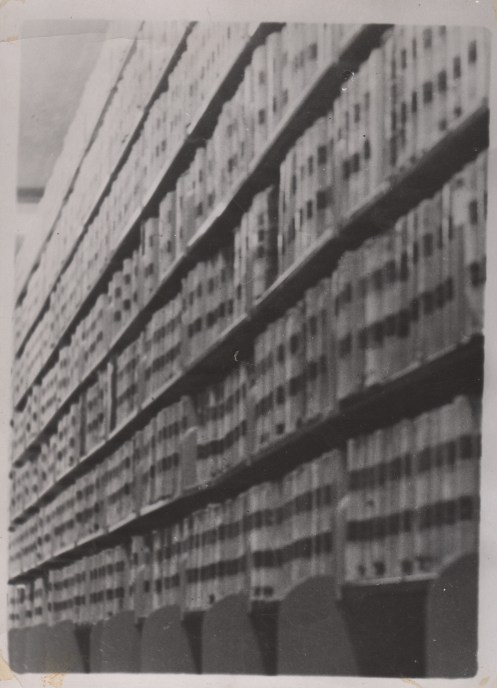 I was able to make a printable photograph at the library in 1960.
April 7, 2016
Seems like every time I raced through the men’s dormitories the telephones in the hall alcoves were different. And I did race. Right up until I moved with my mother and grandma from Missoula to Dillon in 1962. For me, Dillon was a hell of a comedown. Missoula was the land of plenty. Dillon, the land of want. Missoula had men’s dormitories to race through with telephones in the alcoves. I didn’t want to think about Dillon, only Missoula. Only Missoula. In 1960.
A phone without a dial.
I remember this one time. The telephones in the alcoves of Craig Hall all had no dials! They had dial-like disks, perhaps, but no little numbers and nothing to stick one’s fingers into to dial the phone. They were just bare naked phones. As I raced through the halls, just an adolescent boy who lived about six blocks away from the main campus of the University of Montana, I picked up one of the phones. An operator asked me what I wanted. I was afraid. I was surprised to speak to an operator! I quickly, quietly, put the phone back on its cradle. I thought that the phones in the men’s residence hall were not so much fun, after all.
The University of Montana library in 1960.
The fun was usually at the campus library. The library in 1960 was in the building later occupied by Scholars Press. I guess that’s no help, if you don’t know Scholars Press. The library was just west of the University Theater building. I don’t know if that’s much help now days, in telling what used to be one great building for a kid in the 6th grade to play in.
The library had two parts, front and back. The front part had three levels, the back part, four. An elevator ran smack dab between them. It stopped in the front at three floors, and in the back, four. Seven in all. Therefore, the elevator could be entered in front or in back. The elevator car had a gate, like the gate that holds a child in, fore and aft. The gate opened and shut automatically. On the other side of the gates was the door to the elevator as entered from each floor. Therefore, if one wanted to go from front one to back two, the gate automatically shut, the door on the other side shut, the elevator climbed a couple of feet, then the car stopped and the gate opened and the door opened. What a splendid show of doors and gates! I spent hours.
Any cowboy books?
I had this friend I wanted to impress. He asked me if the library had any cowboy books. Shit! Does a university library have any cowboy books? It certainly had fuck books! I knew where in the stacks I could find Playboy magazine. Of course, I answered, yes to his question about cowboy books. I knew where in the stacks one could find school textbooks for the School of Education. Some of the reading texts had a cowboy theme, and I had spent enough time wandering through the library that I could find them.
One time I went into the library and found a suitably uniform set of law books to photograph. I still have it, and I will share it here.
 Here, in the third grade, I am exploring the flammability of flatulent emanations.
I owe a lot to my third grade teacher, Mrs. Ruth Olson. No, she wasn’t my favorite teacher. No, she was the most destructive. I also didn’t like her. That says a lot, because in the third grade I still loved school and I loved just about every teacher at Washington School in Missoula. Mrs. Olson wasn’t just insane, she labeled me a genius. She also spanked me. Both actions were cruelly unjust.
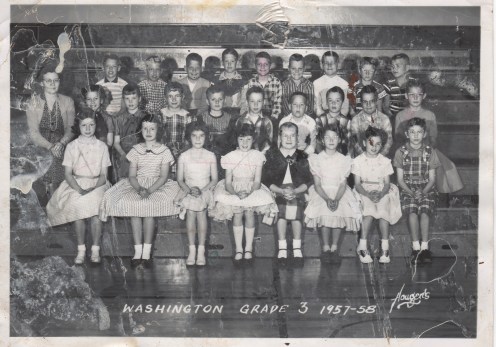 I had performed several experiments on this photograph of Mrs. Olson’s class.
In the first instance, Mrs. Olson enrolled me in a study for the School of Education at the university to try an accelerated elementary program to take the fourth through sixth grades in two years. This messed me up. I shit my pants and smelled bad.
In the second instance, she caught me copying the answers on an arithmetic quiz. I had been in a hurry so I could go home and eat lunch. I did eat lunch, but I went home sobbing and sore. She spanked me really hard.
But that’s not why I blame her because I nearly burned down the house.
Now, I’m thinking burning houses down isn’t that rare a thing for a kid to do. This story gets hashed and rehashed.
It always comes back to the same larger tale, that of my maternal uncle whom I never met. I never met him because he died about four years before I was born, yet evidence of his life has been popping up periodically even until now and I’m 67 years old now. The latest evidence appeared just two days ago.
I could blame the burning of my house on my uncle Carl Ralph Bonde, Jr. because I got the fire going thanks to some things that had once belonged to him. Sure.
Carl grew up in Kalispell.
My grandparents lived in Kalispell. That’s where uncle Carl grew up. That’s where I borrowed a great big black electric motor that had probably once powered a washing machine. Uncle Carl had used it with a pulley to power a bench grinder for sharpening tools. It had been in their long garage up on the hill where the Bonde family lived. It was one of those orchards with a big garden. They had maybe, oh, two dozen fruit trees. They had several acres they rented out to a woman named Marion who had a few horses. She kept her saddles and stuff in grandpa’s barn. You get the picture, I hope.
Anyway, the thing about my grandparent’s place was its size: five acres had plenty of room for old rusting stoves and old motors and a shop. Several shops, really. Grandpa drank beer down in the barn where Marion kept her saddles. Pete Rigg often visited grandpa there to have a nip of “County Fair Whiskey” or two off grandpa’s bottle and to smoke a cigar or two, or perhaps dip some snuff. Drink a beer. I knew all about that, even though nobody told me. I was pretty much everywhere when I visited or stayed with my grandparents.
I got the old motor off the workbench in the long garage with an adjustable wrench and lots of work. I was in the third grade! I lugged it out to my mom’s Oldsmobile and put it in the trunk without telling anybody. I knew, of course, that grandpa would discover that the motor was gone. Or not. He had emphysema really bad, so he didn’t make unnecessary trips into the long garage.
Grandpa accused me of kissing the girl.
He did go fishing, though, and he eventually did find the motor missing. He suspected me! He didn’t accuse me directly. At Christmas he accused me of kissing the girl across the road. A false accusation. He must have been thinking of one of my cousins, instead. Probably Mike. He was the cute one. I didn’t react. Then he accused me of taking the motor by starting, “You know, Danny, it’s a good idea to leave other people’s things alone.”
Of course I denied everything, tearfully, with dramatic force. He didn’t even know about the fire.
The fire might not have happened if it hadn’t been for Mrs. Olson, who told my mother that I was a genius. I may have been a genius before getting hit several times on the head, but I certainly wasn’t a genius when I nearly burned down our house.
Motors are mysterious to many, but I had confidence in my knowledge. I knew about electricity because I had gone to show and tell at school and told all the kids how I would wire the motor. My teacher didn’t contradict me, so I knew I was right.
Only I wasn’t. And one day, when the weather was cold and I stayed home because I wasn’t ready to give my report on “Norway’s natural resources,” I sought to give the motor a trial run. The motor had no wires because I had unscrewed the terminals when I took the motor from my grandpa’s workbench. How I loved motors!
I was good at science.
I was good at science. Even when I was four years old I played with my brother’s Erector Set motor. That’s when I learned that it didn’t matter which way I plugged it in, it still ran. Another thing: both prongs, or just either one, could give me a shock bad enough to make me cry every time. I tried again and again, touching the top prong, then the bottom, and every time I got the same painful result. Pure science. I came to the conclusion that the two slots in the plug in were about equal. In those days the slots were the same size and there was no third, grounding plug hole.
The lessons I learned from that and my other experiments gave me the solid confidence I needed to wire the big electric motor. On my day off from school. I got the day off by playing sick. My friend Mike across the alley and I sometimes played sick on the same day so we could do experiments with our bodies. Those experiments almost always involved burning things. But that’s a story for another time.
The day I stayed home I started by playing sick in bed. Once mother’s car was out of the driveway I leaped out of bed and lugged the motor to the middle of my floor. I remember the floor was varnished pine and I had a small hooked rug near my bed. My clothes were scattered all around and I worked away in my pajamas. I did most of my experiments in my pajamas.
I needed a wire.
I needed a wire to plug into my wall, to make the motor work, so I cut the end off an extension cord. My mother often complained that she couldn’t find an extension cord and I always urged her to buy another. School teachers didn’t make much money, so we usually just did without.
I used one of my brother’s razor blades to strip the rubber insulation from the wires. Then I twisted them and wrapped them around the only screw remaining on the motor, in the little recessed place where the wires went. I plugged the plug into the wall.
Nothing happened. The motor didn’t hum. I always felt happy when the motors hummed. Often they made a nice sweet smell, like lubricating oil warming. Only this time nothing happened. Took me a long time to figure out that the circuit breaker in the back room had tripped. Well, I pushed the breaker switch back with my finger, but it wouldn’t stay. I knew what to do. Sometimes we had mops or brooms in the back room so I held the switch with my finger and imagined holding it there with some kind of stick.
A popping noise from the front of the house.
At the front of the house I heard a popping noise, so I let go the circuit breaker switch and ran to my room. I saw flames!!
I read lots of Tom Swift Jr. books in those days. I could see in my mind’s eye a drawing illustrating the young genius in his room with the caption, “He saw flames!!”
The flames emanated from the extension cord joining the motor with the wall receptacle. The flames were easy to extinguish with a pair of my pants that was on the floor. ‘That part of the trouble was easy to cope with,’ I thought. The smoke was stinky, like burning plastic.
Science! I had to keep these findings private for years.
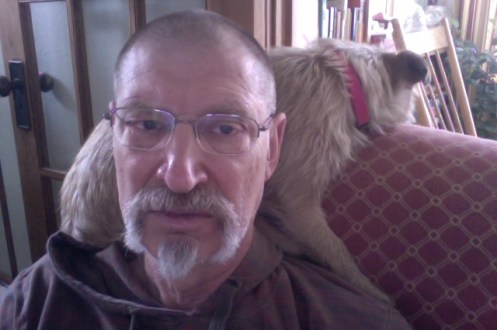
April 5, 2015
I’m in the garage with Gunther and Jackson.
Near the door, four all-season tires. Bought them from a guy named Wiley. Soon I’ll replace the studded snows.
An anvil is on my workbench. The bench is made from a door I got from Jace Laakso about 34 years ago. The anvil came from my brother-in-law John, made from a piece of railroad rail, welded.
Hanging from the wall is a professionally painted community day care sign with its phone number. Some targets from Cabellas are tacked up below.
Over there in the bike rack Todd made, three bikes. Also, two trikes. There’s an air compressor. Drywall screws, wire staples, a Bethany lefse grill I found behind the garage.
A bucket of Kirkland Laundry Detergent, but without the detergent. A swayback kitchen table with a Dewalt cordless drill case (plastic). A 5-gallon propane tank (full). Some four-conductor 12-guage wire. Time to go.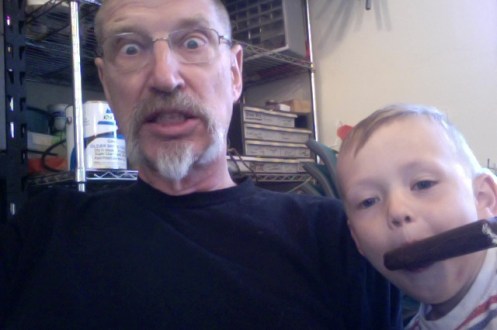
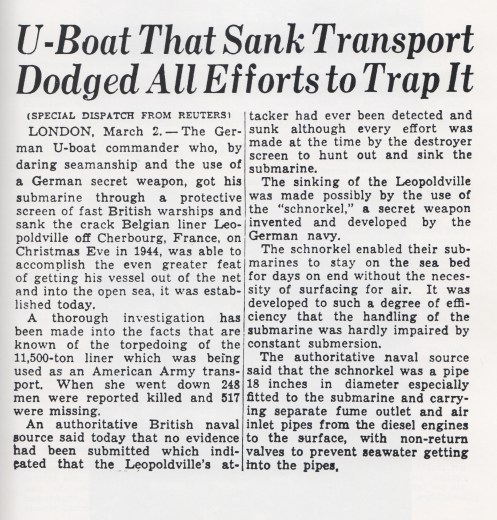
This clipping from March, 1945, describes the device designed by Helmut Walter.
According to Clay Blair, author of Hitler’s U-Boat War (Random House, 1998), submarine snorkels had not been first introduced by the Germans. The Dutch, in the 1930s, also outfitted submarines with “snorts,” as the British called ’em. However, nobody could seem to invent a snorkel that would work without hammering shut when a wave would wash over. Other times diesel exhaust would sicken the submariners.
The schnorkel features described in the Reuters article were the invention, according to Blair, of a notable German engineer. That engineer’s name was Helmut Walter. He was better known for inventing a damned fast submarine that used hydrogen peroxide for fuel. Walter’s fast sub could travel submerged at nearly 30 knots, about four times faster than any other subs.
Now comes the strange part of this story.
Yesterday I learned that the pharmacy technician who has been working within an arm’s length of me is Helmut Walter’s granddaughter. I had been idly chatting with Jean Loran who told me her roots were in Germany.
Jean’s mother was born in a bomb shelter in Kiel, the German port city, where U-486, the submarine the killed my uncle Carl Ralph Bonde, Jr., was built.
Turns out Helmut Walter and his family emigrated to Great Britain, and then to the USA after WW II.
I could hardly speak when I learned of her grandfather’s hand in building the U-Boat that sunk the SS Leopoldville.
“The war is over,” Jean said softly.
Back about six months ago, I got to my initial workshop session at Russ’s house earlier than most of the others so I helped myself to one of the cookies at the dining room table.
I had hoped we’d all be lounging around in overstuffed chairs. I had a mental image. Yes, our feet upon hassocks, admiring a variety of rugs and tapestries, and, of course, a crackling blaze in the fireplace. Maybe sipping wine, maybe smoking a little weed?
I had fancied the sage would read aloud a sentence someone had written. Then, as we neophytes strained our ears, the master would divulge his secrets of writing some in-your-face prose. I was so wrong. About nearly everything.
Feeling a bit put out by the lack of comforts listed in paragraph one, I took a bite of the cookie, an applesauce, I think, and it yielded in a chewy manner. I asked, half-believing I’d succeed, for a glass of milk. To my pleasure, Russell poured me a cold one, which I drank, as the others arrived.
All of that was, I don’t know, six months ago? Did I say that already? Just now I was recalling what I had gained, writing-wise.
We started with ten of us. That was session one. We had a slightly different group in session two.
One of us, I believe, dropped out to finish up a thriller she was selling to a publisher. I remember that she smiled at us when we criticized her work.
Two others in our group have solid plot ideas that they are using to turn out actual books. One more is working on a novel, but hers is in an early stage.
I’m reluctant to tell the premises of these stories. Someone might try to steal their ideas. However, the stories are all set in Montana.
The rest of us have memoirs or histories to finish writing, and our tales are almost incredible: one told of being the child of a whore. Another visited whores in Butte. One documents his veterinary work with bison. Another tells of owning a well-established cattle ranch, then selling it. You get the idea. Some of the others started in Wyoming, Nebraska, California, or Ireland, but ended up in Montana.
Only one has anything to do with the military.
So what did I get for my $300/session? Some humility. Not from the criticism, which I mostly disregarded. Hmm that’s not humility, is it? Say….
The humility came from knowing that three of the workshop writers had either sold books or were close to selling books to publishers, and they did it by working damned hard, some of it during the time of our workshop. Well, prior to the workshop, Russell traveled all over Montana, wrote a book, sold it, and it comes out this month. Vicki Williamson and Carina Cooper simply worked and worked on theirs, for months. Vicki’s is ready for the publisher.
At one point, Russell looked me in the eye and told me that I had two, maybe three books, worth of stories to tell. Trouble is he and the others always wanted more. More. This translates into more work, lots more work. “Work?” I asked querulously. Russ said nothing.
We spent all our workshop time sitting at the table. The advice was as you might guess. Write more. Use the active voice. Don’t make plurals using apostrophes, because you kill a puppy each time. Like that. Advice.
Russell’s advice was sound, especially with regard to creating “scenes” in fiction, and the architecture of the novels. Of course, his advice was often to write more.
No overstuffed chairs. No weed, no wine. Or any of the rest of it. Neither.
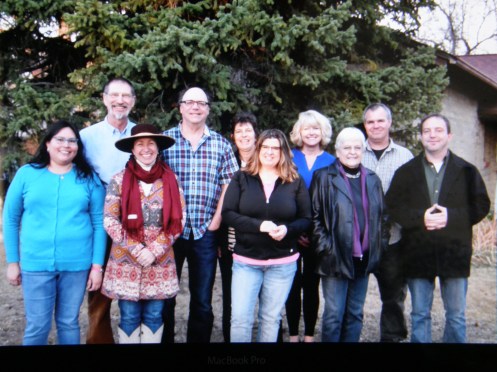
Our writing group, March 21, 2016. Rhonda Whiteman said I could use her photograph.

Sunday, April 3, 2016.
Drove to Beartooths yesterday to hike. Way too wet and snowy without special gear. Turned to Prior foothills out of Warren. Warm, dry. Damned amazing rocks. Gave Gunther water by pouring it into my cupped hand. Home. Root beer floats.

House with tires.
April 2, 2016
Gunther and I made the usual foray west. The sun was up and he didn’t act frightened this time. He pooped at the last house on our block, the one with all of the colorfully painted tires. The one with “Posted Keep Out” signs on the windows. And a cross dangling from the porch.
The people who live there act as if others are a threat to them. They have multiple signs warning intruders to keep out. They have security cameras at the entrance and on the side of the house. The inexpensive kind of camera, the kind you can plug into a computer. I’ve met the woman who lives there, and she seems friendly. I asked her if I could take a picture of the pretty tires. I think her husband was the perfectly friendly guy with all of the tattoos. Anyway, someone said I could snap a picture.
The younger looking, smaller guy, might be tattoo man’s brother, the one who roars around the block and up the alley on a four-wheeler. He would be the one with the foul language who cursed at the preschool-age girl when his colorful tires were still tacky from the colorful paint.
Anyway, I picked up G’s poop and off we went, looking to put the baggie in a dumpster in the alley.


 insearchofbud