From Vang, Valdres, to Nerstrand, Minnesota
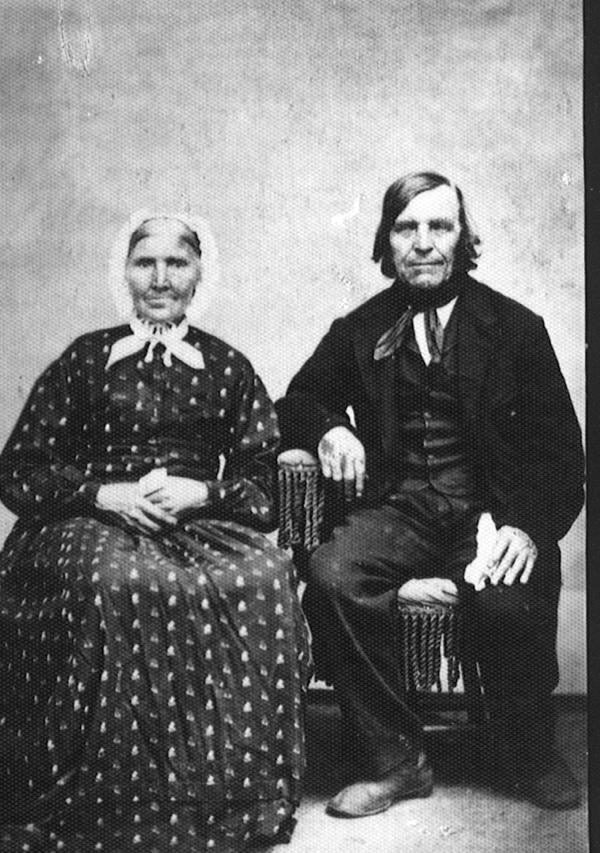
Berit Bunde 1801-1877 with Einar Halvorson Groven 1800-1875
Long, long ago, our ancestors had pretty much moved from Africa to a large area of unforested grassland of Asia to learn how to herd sheep and oxen. Things probably went well for many generations, once they got used to the weather.
Eventually, they got raided and beaten up by a variety of horsemen and other savage types, like Tartars, who stole their land, drove them off.
The sheepherders who survived rode their horses north of the Black Sea, and west into the mountains.
They eventually got into the area north of the Danube River, to the woods. No doubt they encountered people who were already there. Did they then steal their land and drive them away?
Did they raise oats, wheat, and livestock? This is a recurring theme in our family’s history.
I suspect they made friends with some Neanderthal types. Our son Bob said we have some DNA. Some Neanderthals might have been more than friends. Friends with benefits.
They eventually settled down, learned how to spin wool and flax and grind grain into flour. They ate bread, but otherwise they didn’t eat well, unless they killed a deer or a neighbor’s ox. People only lived to be thirty, give or take.
Early on, they had to avoid the Roman military. The Danube kept the Romans away for a long time. But not indefinitely. Only until the Romans invented the bridge.
In the middle ages, Germanic tribes ran away from Rome; from the mountainous areas of Eastern Europe north, to what is now Scandinavia: Denmark, Sweden, Norway.
In Vang, Norway, Berit Olsdatter Egge was born on June 24, 1801. Her parents were Ole Gulikson Egge and Ingri Osteinsdatter Kjos who descended from a long line of farmers in Vang.
There is the twelfth-century stave Hore church in Kvien, in the Vang parish, repository of records. It is still in use. We went in there once. I saw the name “Bonde” on the end of a pew.
The original Vang stave church was relocated to Poland, thanks to a wealthy guy who wanted it preserved.
Berit was my great, great grandmother. She married Thorstein Osteinson Bunde and they farmed the stony soil of Vang. The couple had four children: Ostein, in 1820; Ole, in 1822; Kari, in 1825, and Ingri, shortly thereafter.
In later years the name “Bunde” changed into “Bonde.” Sometimes it is spelled “Bondy.”
We visited Vang two or three years ago. The land had a lake surrounded by nearby mountains. This was late March. Easter, actually. We stayed at a bed and breakfast owned by Arne and Berit Nefstad.
I didn’t see any houses near the lake. In fact, Vang looked sparsely settled.
Bob and his wife Heather, and their daughter Olivia, along with Cyrus and Roland (Todd’s boys), and Penny and I drove there by rented car from Bergen, a port city on Norway’s west coast. Vang doesn’t even have a gas station, but it has a modern-looking school back in the woods.
Back to telling about G-G-Grandmother Berit.
Thorstein Bunde, considered gifted mentally and physically, was unsuccessful at farming. He had to sell the farm and leave his family behind. The farm was not large, but it was good, and he got four hundred specie dollars, a good price in those days. He got a log house for Berit to use for life, along with a small annuity for her and the children.
Berit Bonde’s log house is still there, although it is no longer in use, and still stands erect and has a good roof. Good condition for a place nearly 200 years old.
Because Berit Bunde’s husband Thorstein had “costly litigation” trouble such that he couldn’t stay with Berit and her children in Vang, he went to Lillehammer to find a new life. He died a few years later in his twenties or early thirties. I don’t know how word got back to Vang of Thorstein’s death, but I imagine horse-drawn trucks and sleds carried supplies and news throughout Norway.
A present-day informant (Arne Nefstad) said word back in Vang was that Thorstein was alcoholic and drank himself to death. Alcoholism seems to run in our family, as does mental illness.
Back to the story of Berit Bonde. The 1820s and 30s.
Remember? Berit had four children from her marriage to Thorstein. Her daughter Kari and her husband, Thomas Veblen, emigrated to the United States in 1847 via Quebec. Kari is said to have inspired Berit to do likewise.
The Veblens originally settled in Mount Vernon, Wisconsin, before relocating to Nerstrand, Minnesota.
Kari and Thomas’ son, Thorstein, studied at Carleton College in Northfield, and became a famous social theorist and economist. In Vang, Norway, we saw a roadside monument dedicated to Thorstein Veblen. A sign in English and Norwegian proclaimed him the world’s greatest economist. I remember wondering who in Vang would dispute it?
The farmland at Vang is limited by the lake and by rocky outcrops. Arne told us the land wouldn’t support the farmers’ increased numbers of children.
After five years of widowhood, Berit Bunde married a neighbor farmhand, Einar Halvorson Groven. He took Berit’s last name because they lived on the Bunde farm. Berit bore five more children there over the next 14 years. Einar Halvorson Groven, starting as a neighborhood laborer, had become a Bonde family patriarch.
Their name morphed from Bunde into Bonde.
Three of Berit’s children didn’t survive long. I know only the names of the two sons who did: Halver and Tosten. There was a third child who perished before the family arrived in America.
Like I said, Berit and Einar and three small children left their farm in Vang. They traveled 237 km (142 miles) to Oslo with a few belongings. One child died on the road. In 1849, they got on a ship to Germany, then sailed to Quebec, same as Kari and her husband had two years previously. They and their sons, Halver, age four, and Tosten, age six, survived the harsh traveling conditions.
Einar and Berit and the two boys traveled by boat on the great lakes from Quebec, settling in Port Washington, Wisconsin, on the southwest shore of Lake Michigan. They were farmers and they had very little formal education.
The Port Washington area was originally inhabited by the Menominee, Potawatomi and Sauk tribes. The US government forcibly removed these indigenous people in 1832. No. It was worse than it sounds.
According to a website hosted by Native Americans in Philanthropy, history through a Native American lens:
Black Hawk, a Sauk Chief, returned to his territory for corn planting season, only to find it overrun by American settlers. The settlers refused to move, noting that they had supposedly bought the land. The state militia came and drove the Sauk out of the territory. Surrounded by 11,000 state militia, the Sauk flew a white flag of surrender but were then massacred by the militia. Black Hawk was captured, and the Sauk were forced to cede the eastern portion of Iowa.
The first white settlers arrived at Port Washington in 1835.
Thus did the Bonde family, like the other immigrants, live on land freshly stolen from the Indians.
According to Wikipedia, the population of Port Washington was 2,500 in 1853.
Five years later the Bondes left Wisconsin for Winneshiek county, in the extreme northeastern part of Iowa.
Then, in 1855, Berit and Einar were granted a 160-acre farmstead by Congress in Wheeling Township, in Rice County, Minnesota. Einar built a log house of hardwood. It’s still there. I’ve slept in the house attached to it.
Native Americans called Minnesota home for centuries. Stone tools have been found that date back more than 10,000 years. The oldest known inhabitants of the area were the Mound Builders, most likely the ancestors of the Dakota and Iowa Native Americans.
Wahpekute, a tribe of Dakota, were the group that lived on the land that is now Rice County. Wahpekute meant the Leaf Shooters or “The Shooters Among the Leaves.” In the winter months, the Wahpekute lived in teepees made from American bison hides. During the summer they lived in elm bark lodges near the lakes and streams fishing, hunting, and raising crops.
Earl Bonde, Einar and Berit’s great grandson, eventually restored and added on to the log house. In 1985, Earl showed me how he made a concrete foundation for the log structure, located next to a soybean field near the edge of Nerstrand, Minnesota.
Einar probably raised wheat, oats, and hay to feed his cows and horses on his 160-acre farmstead. Berit kept house, took care of Tosten and Halver.
After the American Civil War started, Congress implemented the draft in 1862. Halver Bonde was 17 years old. After serving the Union in the Civil War, Halver married Margaret and farmed in Rice County for a short time.
Halver and his wife subsequently settled in Swift County, Minnesota, in the western central part of the state. They arrived in the wake of more brutal warfare between settlers and Natives.
According to Wikipedia, “Scandinavians and Germans were in a decided majority among the early settlers of Swift County. A number of them came with the honor and privileges of Civil War veterans.” Including Halver Bonde, probably.
The Bondes arrived to farm in Swift County a few years after the following occurred in 1861-62:
In exchange for having been pressured to cede great tracts of land in Minnesota, the government promised annuities to the Natives. The tribes reluctantly moved to a narrow reservation twenty miles wide. In 1861 Dakota and Santee Sioux tribes had a tough time because of a harsh winter and depleted game, and the promised government payments did not arrive. Shopkeepers were not willing to extend credit to the Indians, partly because of doubts of the solvency of the federal government because of the ongoing Civil War. The starving Santee Sioux wanted to drive out the white settlers. A battle ensued in which both sides suffered many casualties.
The army intervened. About 300 Indians were sentenced to death, but Abraham Lincoln pardoned all but 39. One was spared at a brief trial, and 38 were hanged at Mankato, Minnesota in 1862.
After that, history is silent about Halver and Margaret Bonde. I even asked Helen Lodmill, one of Oscar Bonde’s daughters and a reliable historian.
After years living in an old soldier’s home in San Francisco, Halver was eventually buried at Presidio, California, November 7th, 1931, 86 years old.
Halver was my grandpa’s uncle. Tosten was his father. Grandpa spoke fluent Norwegian. Grandma looked angry when he and his friend Nils chatted in Norwegian in her kitchen.


 insearchofbud