Saving our teenagers from themselves
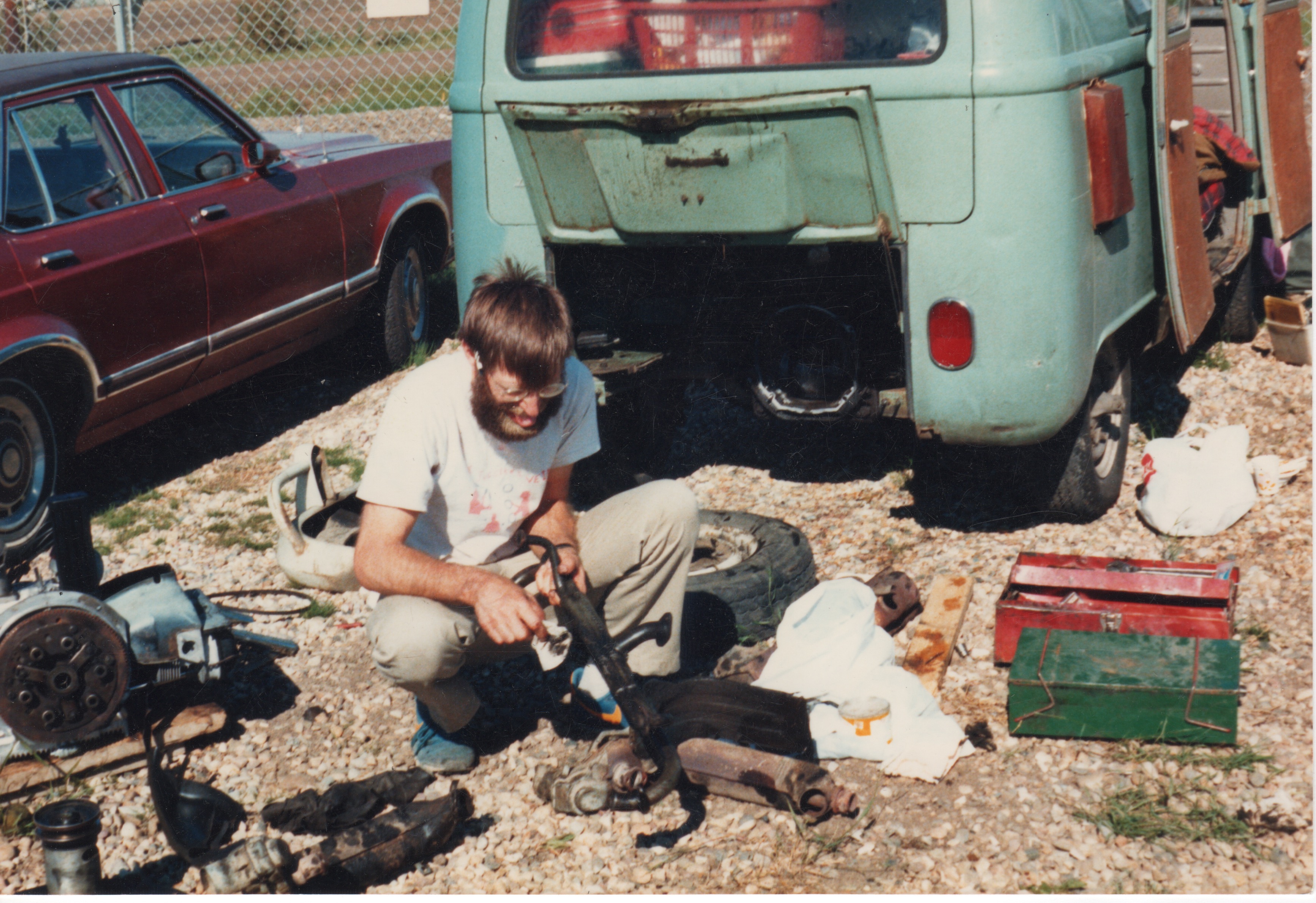
I worked on the van in the parking lot across from the Nisku Inn
Buddy’s high school years
His sisters dominated the Bonde household during the turbulent years leading up to World War II. Corinne was a singer, a diva; she had a singing part in a high school production of Gilbert and Sullivan’s H.M.S. Pinafore. Helen was a serious student and played the flute in the school orchestra. Carol was much quieter than either of her sisters, and all of them loved Buddy dearly.
I inherited Buddy’s high school annual for 1940. Nowhere was his name printed, but many of his friends signed it. Buddy was a Boy Scout; he liked to camp, hunt, and fish. He enjoyed chess and bridge. He was damned intelligent. In many ways, Bud’s high school years paralleled those of our three children as they negotiated the sorrows, hazards, and pleasures of their teenage years.
Chapter seven
Penny and I discovered the house while walking the Billings neighborhood. Our quest that fall day: walk to Clark Avenue and admire the castles, including the Moss Mansion.
We returned to Burlington Avenue, headed home toward the place we rented on the 400 block. In front of a green house on the 200 block shined a pickup’s tail lights. I walked to the door and notified a young man who thanked me, saying a faulty brake pedal spring made the lights go on. He trotted out to the truck while Penny and I walked two blocks home.
More than a year later, I got a job working the night shift at the hospital and a raise to $10.20 an hour. Penny and I looked to buy a house, but they were scarce in 1983. The only suitable house for sale was the one where we asked about the truck tail lights.
We thought we could afford a $500 a month payment, so we asked a real estate lady to offer the owner, John Frasco, a suitable amount. Of course, he turned us down, but ultimately accepted. We moved in during a blizzard, January 1, 1984.
To our sorrow, Burton the cat ran out the back door never again to be seen and admired. The temperature was at least twenty below. The next day, we drove up and down the streets and alleys, but no luck.
The house we bought—a 1925 bungalow—may have had some mixed karma. The family who lived there before us had suffered a tragedy: they lost their mom to a heart attack, apparently. They had a couple of kids, at least, past high school age.
Originally it had two official bedrooms, a vast unfinished attic, a full basement that had been mostly finished, but flooded years before. The washing machine and dryer were parked in the unfinished part of the basement. I sat on the washer. I looked up at the floor joists.
I loved the floor joists, the pipes, the wires. The concrete floor, the furnace. The furnace had been a coal burner, then an oil, then a natural gas. A squirrel cage fan forced air through the steel ducts. I loved what I saw.
The steep stairs to the attic led from a door in the back bedroom, making two left-hand turns. A bare bulb illuminated the huge wood-floored space. Marks from countless roller skates.
The house was painted a sort of brownish green throughout. It had filthy, greenish carpet.
I wanted to make the place mine. We ripped up the carpet and painted a bunch of boards chocolate brown for baseboards. I aimed to fix up the attic.
It took me a day to break a hole in the dining room wall, move the door from the bedroom, and cobble a straight stairway up. Nephew Chuck Angel helped me insulate and frame and sheetrock the attic. By then it was spring and our two sons moved upstairs.
It has since been floored and carpeted, windowed and re-windowed. A great place to freeze in the winter and swelter other times. Look how tough it made our kids. Todd is a man, now, sleeping in an old house in Duluth—upstairs without heat—with his wife and two sons of his own. Bob lives in Billings. Clara used to brave the Minnesota winters, but now lives with her family near San Diego.
The door that used to lead to the attic has been removed and the stairs replaced by a real carpenter. A couple months ago I took the door to the NOVA theater to install as part of the set for A Christmas Carol. The door was successfully opened and slammed shut (after suitable reinforcing) numerous times. Then the door appeared in the play No Exit. And Free Birdie. Now it has increased its repertoire to include Shakespeare’s Macbeth.
“Knock, knock! Who’s there?”
Most of the years our kids were in school remain a blur for me because I worked the overnight shift at the hospital pharmacy. I’d come home tired and sleep as much as I could until the kids got home after school. Penny was a Head Start teacher.
I begged the people in the pharmacy at Deaconess to let me work a share of days like everybody else, but they wouldn’t. I quit abruptly after five years.
I worked at the other hospital up the street, Saint Vincent’s, to cover the shifts of two women who took maternity leave. We had to be sneaky about dispensing birth control pills in a Catholic hospital. We kept the pills on an out-of-the-way shelf.
Once my term at Saint Vincent’s ended, Clinic Director Joan McCracken hired me at Planned Parenthood to dispense birth control pills, creams, jellies, devices, and antibiotics for sexually transmitted infections. I also conducted mother-son and father-son sexuality classes. The folks at Planned Parenthood were kind, professional, and competent.
I got good at explaining how to take birth control pills. After months of this, I had an epiphany. I realized I didn’t have to make the long spiel to those who already knew how to take them. My task was to determine who needed the spiel?
Here’s what I learned. If they could answer two questions correctly, I could be fairly sure their knowledge was sufficient. My questions: 1) (handing the pack of pills to the woman) What’s the first pill to take? And 2) When will you take it?
Depending upon their answers, I had a feel for how much time I needed to spend going over the instructions.
This style of pharmacist-patient interaction helped me throughout the next thirty years.
I was afraid only once during my thirty years as a pharmacist. A social worker at Planned Parenthood told me she would offer dietary counseling to anyone who wanted it. She suggested that I could make referrals.
“Great,” I said. That morning a large woman came in for a refill of her birth control pills. As I prepared them for her, I mentioned the new dietary counseling we offered.
Her expression looked a little like an approaching thunderstorm.
“Are you saying I’m FAT?” she demanded, placing her hands on my desk and leaning toward me. (Silence.)
I lied. “Oh no, no. Nothing like that…”
Another time, a teenage patient told me she knew my sons, and said the one was “wild.” I knew it was time to find a new job. I didn’t want to compromise anyone’s privacy.
Penny suggested I check with the Public Health Service for employment, and that’s how I became friends with Captain Bob Ashmore, the Billings Area Pharmacy Officer. He helped me in more ways than I can say.
I applied to be a commissioned officer with the US Public Health Service. I aimed to work in the IHS (Indian Health Service) at one of the nearby reservations. Best of all, my seven years of service in the Marines would count toward my eventual retirement.
Even better, I would soon outrank the Marine major who as much as asked me to hit him when I was a private. Funny how things change.
Joan McCracken said to me, “Don’t leave Planned Parenthood. Do you want a tribe? I’ll get you a tribe.” Her husband, Dr. Clayton McCracken, the clinic medical director, was a retired commissioned officer with IHS. Joan was funny! Clayton was always quiet, but kind and firm.
North to Alaska in a hippie van
My application for a commission in the USPHS took about a year. For a time I was between jobs. I worked as a relief pharmacist in Red Lodge, Hardin, Colstrip, and Roundup. Job security wasn’t great, but it was daytime work, and usually fun.
In June, 1987, the day after school let out for the summer, we packed up the family and headed to Alaska in our 1964 green VW van.
My unspoken aim was to protect our teenagers from themselves. The green VW van had an old engine that used a lot of oil. What the hell, I thought. We didn’t have much money, but I had two credit cards with credit limits of about a thousand dollars available on their accounts.
The van always had trouble with overheating. I fastened a cake pan to one side and a broiler pan on the other, near the back of the van, to serve as air scoops to force more air into the engine compartment vents. This gave it a distinctive, homemade look.
We bought the van in 1980 when Larry Felton helped us pull it out of a field up the Bitterroot Valley. It had hay growing up through its rusty floor and some bailing twine in the back. The ’64 took us on adventures in northern Idaho to work on a lookout tower with Andy, our llama. Our kids slept in the van with rain dripping on their heads at Priest Lake. In the cold, in late spring.
This is the ’64 VW we eventually drove to Alaska. Well, part way there. To a place twenty kilometers short of Edmonton, Alberta.
As we headed into Canada, we needed to add oil every hour or so. As I drove, I mentally calculated how many cases of oil I’d need to reach Alaska. I contemplated buying several dozen.
That night it rained and the wind blew. Then the engine emitted a kind of loud howl and we lost power. The “check oil” light shined bright yellow. I stopped beneath an overpass. A green sign in the headlights said Edmonton was twenty kilometers distant. I opened up the engine compartment that smelt of burnt oil. I checked the tension in the fan belt. There was none. It was loose. We decided to get some sleep. Todd took his sleeping bag to the borrow pit.
The next morning was sunny. Todd and I walked to the top of the overpass and spied a distant sign. Looked like it said, “Husky Inn.” As we walked closer, we saw we had misread the sign. We also found a license plate in the shape of a polar bear.
The Nisku, not “Husky,” Inn was a hotel. Todd and I walked into the lobby as some people were boarding an airport shuttle. Without a word, we filed aboard the shuttle with the others. At the airport, we rented a small car, then drove triumphantly to our disabled green van. Using a tow strap, we towed our van backward, up the on-ramp, toward the Nisku. We were glad to see a parking facility near the Nisku. I jumped out to talk to the owners of the lot. They were kind and generous.
We ended up staying several days in the parking lot across the highway from the Nisku Inn. The owners allowed us to use their phone and to repair our van on their lot. They even fastened some “get well” balloons to our dead engine.
We bought a new engine from a dealer in Edmonton, but the engine hemorrhaged oil when we tried to return the rental car.
Once we saw the heartbreaking mess of oil, we towed the VW, new engine and all, back to the parking lot. Still early in the day, I phoned the guy who sold the engine, who advised me to check a pair of rubber seals at the oil cooler. So I again struggled with the tools, removed the engine, then dismantled the tin. I removed the oil cooler, checked the rubber seals, put the whole works back together and got the engine back in and ready to go before dark that same day. The kids spent another day swimming in the hotel pool at the Nisku Inn.
I fired up the engine again, and as it idled, I made the compulsory check back under the rear. So far, so good. Until came a fat stream of oil pouring down. Again.
I jumped up front and switched off the ignition. This time, after perhaps fifteen seconds, I howled with rage and tears as I pounded my fists on the big round steering wheel. “Boo hoo! I quit!” I cried, looking at Penny, who looked at me like I was an imbecile, but said a comforting word.
The following morning, on the phone from the parking lot office, the dealer in Edmonton supposed I needed a different sort of rubber oil cooler seal, so I drove to town in the rental car and came back with some robust seals. And more oil. Once I had installed these, and mantled and installed the engine, we returned the rental and drove the van to the dealer to have the mechanics check my work.
The mechanic walked to the van, started the engine, pulled the throttle all the way open so it made a deafening roar. The tin around the cylinders blew outwards like an inflating balloon. “Looks good,” he said. “Don’t baby it, aye.”
The engine was stronger than ever as we sped north. A couple days later we arrived at Dawson Creek. At this point we were ready to start our long journey north to Alaska!
The Alaska Highway seemed endless. We took turns driving, and when tired, we slept in the back with various teenage children. Clara kept a tally of gophers and of dead gophers. “G” and “DG” in her notebook.
We often had to push our van to start the engine. Early one morning when I was driving, I had Todd push the van while I popped the clutch. He pushed us up the hill, then back down. Then I thought to turn on the ignition switch, which was a household light switch fastened to the dashboard with screws.
I wish you could have been there for the adventure of traveling north for almost a week, sleeping in the back of the van. Not just riding and sleeping, but changing a flat with a spare that was in a box bolted to the roof. In a box, along with a spare can of gas and most of the camping equipment.
Our van was loaded with extras: extra carburetor, extra generator/fan combo, extra distributor and coil. All of the things one might need, plus the tool chest and container of hand cleaner. Once we left Edmonton with our new rebuilt engine, we had a much better vehicle than the one we started out with.
We soon learned that the best places to pull off the Alaska Highway for roadside adventures were any of the bridges. That’s where we found Edith Creek, a paradise without anyone else’s tracks. You could drink the water, go swimming and come out bright red and blue, or make a fire and hunker. A great place to go for a break.
Things were good, except our son Bob suffered episodes of vomiting, which we treated with prescription suppositories. Only we ran out of them. Somewhere in Canada we stopped at a public clinic. The doctor told us the vomiting was a symptom of the severe kidney pain Bob suffered. This was news to me!
Bob had colicky pain in his kidney, and we could do nothing for it but treat the symptoms. Once we got back to Billings, many weeks later, he went in for surgery to correct a blocked ureter. Many years later, he needed the surgery to be revised. That’s when he helped me start my blog, In Search of Bud.
Once we crossed from Canada into Alaska, we drove all day to get to Anchorage, to my sister Carol’s house. We ended up staying several days, going salmon fishing at the Russian River on the Kenai Peninsula.
Everything in Alaska seemed to cost a $20 bill. We called the twenties “frogskins.” We all got three-day fishing permits for a frogskin apiece, bought some brightly colored flies for another frogskin, then proceeded to the river to a parking lot. Cost a frog to park. We arrived at 11 p.m. It never got dark, so we waded into the icy river. Turns out the dark shapes we saw were salmon. We weren’t allowed to snag them, so we cast our lure, reeled it in. If a fish came in sideways or tail first, we unhooked it. If it came back headfirst, we kept it. As the morning became brighter, I could see the river bottom was littered with brightly colored flies like the ones we bought.
A moose calf loped along the riverbank while we fished. I think we were all allowed to keep three fish apiece. They each weighed about ten pounds.
We froze all our salmon in Carol’s freezer, then wrapped them in newspaper and added dry ice. On our way back to the lower forty-eight states, we found some more dry ice for sale at White Horse. Cost another frogskin. My nephew Chuck and one or two of his brothers accompanied us back to Montana, via Glacier National Park. Chuck had a red VW van with a rusty gas tank that often choked his gas line filter. We swapped out his gas tank in Billings.
In August of 1988, I got commissioned as an officer with the US Public Health Service, along with orders to go to Lame Deer, Montana. The clinic was exactly 106 miles from my house. Commuting distance for the next seventeen years until I retired.


 insearchofbud