The Castle in White Sulphur Springs in 1936
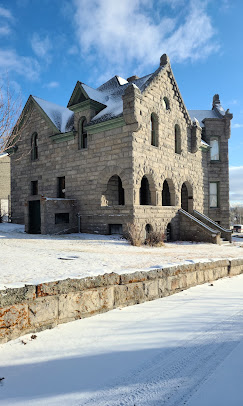
My parents, Robert and Helen, married in Kalispell in 1936, in Helen’s parents’ house. I found a newspaper clipping from the Kalispell Daily Interlake. Her two sisters and brother were in attendance. I forget who poured the coffee, but that used to be an important item in a wedding story.
Robert Powers Struckman, after years of pounding out tales and garnering rejection slips, had begun selling his short stories, most often to the editor of Household magazine. Importantly, he hit one over the fence! He sold a short story, “The Night of the Pig,” to Esquire magazine for $150 and he bought Helen a diamond wedding ring with the money. Our daughter Clara wears it these days.
At first the couple lived in Missoula, where Robert earned a teaching certificate at the university; then they moved to White Sulphur Springs, Montana, Meagher County. Each of them got jobs teaching. She taught elementary, he taught in high school.
The county was named for Thomas Francis Meagher, a Montana territorial governor who had been a general in the Irish Brigade, a Union army unit during the American Civil War. Before that, according to Wikipedia, he had been convicted of high treason in Britain, sentenced to be hanged, drawn and quartered. Luckily for him, his sentence was commuted to deportation to Australia.
Governor Meagher disappeared on the Missouri River near Fort Benton, Montana; some say he was murdered. Today, a statue of Meagher on a horse stands proudly in front of the Montana capitol. A few years ago, Penny, my cousin Blaine, and his wife Fran, and I visited a bed and breakfast in San Juan, Costa Rica. The owner was a historian who had studied extensively about Meagher, who was instrumental in opening up transportation in Costa Rica for giant fruit companies. I stole a paperback he had about German U-boats. I still have it.
Wait. I started out in 1936 or 1937 in White Sulphur Springs and ended up in Costa Rica. Back to White Sulphur Springs.The Struckman couple lived in a rooming house everyone in town called the Castle. They still call it the Castle, only now it is a museum. A few years ago, several of us, including our grandson Josiah, visited the Castle. On a table there, I found a copy of an old Frontier and Midland magazine, with another short story Robert wrote, “The Train.” H.G. Merriam published and edited Frontier and Midland. Mark Royden Winchell, who wrote a definitive biography of Leslie Fiedler, Too Good to be True, praised H.G. Merriam and his magazine. When Dr. Merriam died in March, 1980, Nathaniel Blumberg and I were among many who attended the funeral in the music recital hall at University of Montana.


 insearchofbud